


Every law firm leader knows that a single misstep in privacy practices can threaten not just client relationships but a firm’s entire reputation. With clients expecting absolute discretion for their most sensitive information, building trust starts with a transparent privacy policy that aligns with legal and ethical obligations. Strengthening your website’s privacy policy framework safeguards client data, supports your professional standing, and enhances your online visibility in a competitive legal market.
Table of Contents
- Core Concepts of Law Firm Privacy Policies
- Key Types of Information Collected Online
- Legal Regulations Governing Attorney Websites
- Mandatory Disclosures and Consent Mechanisms
- Risks of Non-Compliance and Ethical Pitfalls
Key Takeaways
| Point | Details |
|---|---|
| Importance of Privacy Policies | Law firm privacy policies are vital for client confidentiality and the firm’s professional integrity. Regular reviews are essential for compliance with evolving standards. |
| Data Collection and Security | Law firms must limit data collection and enhance security measures such as encryption and proper client consent protocols to manage sensitive information. |
| Compliance with Legal Regulations | Adhering to ethical advertising guidelines and confidentiality protections is crucial for building client trust and minimizing legal risks. |
| Risks of Non-Compliance | Failing to comply with privacy regulations can lead to disciplinary actions, liability exposure, and reputational damage, necessitating proactive risk management. |
Core Concepts of Law Firm Privacy Policies
Privacy policies for law firms represent far more than routine website documentation. They serve as critical legal instruments that protect both client confidentiality and the firm’s professional reputation. Comprehensive security policies are fundamental to maintaining trust and meeting ethical obligations in legal practice.
Law firms handle an extraordinary volume of sensitive client information, ranging from personally identifiable details to privileged legal communications. The American Bar Association (ABA) mandates that attorneys implement reasonable protection measures to prevent unauthorized data disclosure. This requirement encompasses multiple strategic approaches:
- Implementing robust encryption protocols
- Developing comprehensive staff training programs
- Creating secure communication channels
- Establishing clear data handling procedures
- Regularly updating cybersecurity infrastructure
The core privacy policy framework draws from globally recognized principles established by organizations like the OECD. These principles include critical concepts such as data collection limitation, purpose specification, and individual participation. Privacy protection principles guide law firms in responsible information management, ensuring that client data is collected, used, and stored with the utmost integrity and transparency.
Key Privacy Policy Considerations for Law Firms:
- Clearly define data collection methods
- Specify the precise purposes for data usage
- Outline client rights regarding their personal information
- Detail security mechanisms protecting sensitive data
- Provide transparent disclosure about data handling practices
Pro tip: Conduct an annual comprehensive review of your privacy policy to ensure alignment with evolving legal technology standards and regulatory requirements.
Key Types of Information Collected Online
Law firms collect a diverse range of sensitive client information during digital interactions, each category carrying unique privacy implications. Personally identifiable information represents the most critical data type that requires meticulous protection and strategic management.
The primary categories of information collected by law firms online typically encompass several critical data types:
- Personal Identification Data
- Full legal names
- Social security numbers
- Date of birth
- Contact information
- Professional Information
- Employment details
- Professional credentials
- Workplace contact information
- Financial Information
- Bank account details
- Income verification documents
- Tax identification numbers
Sensitive Legal and Confidential Information plays a particularly crucial role in law firm data collection. Cyber threat protection becomes paramount when handling these specialized data categories. This includes privileged communication records, intellectual property documentation, trade secrets, and detailed case-related materials that demand stringent confidentiality protocols.

Biometric and Digital Tracking Data represents an emerging collection category, involving:
Here’s a concise summary of how different types of information collected by law firms impact privacy risk and security needs:
| Data Type | Privacy Risk Level | Typical Security Measures |
|---|---|---|
| Personal Identification Data | High | Encryption, restricted access |
| Professional Information | Moderate | Authentication, secure storage |
| Financial Information | Very High | Multi-factor authentication |
| Legal and Confidential Records | Extremely High | Legal privilege, audit trails |
| Biometric/Digital Tracking | Moderate to High | Anonymization, consent logs |
- IP address tracking
- Device identification information
- Geolocation data
- Browser and interaction history
- Digital communication metadata
Technological advances have exponentially increased the complexity and volume of data collection, necessitating robust privacy frameworks.
Pro tip: Implement granular data classification systems to ensure each information type receives appropriate security and privacy protections.
Legal Regulations Governing Attorney Websites
Navigating the complex landscape of legal regulations for attorney websites requires a comprehensive understanding of professional conduct guidelines and ethical standards. Model Rules of Professional Conduct establish critical frameworks for how lawyers must manage their online presence and protect client information.
The primary legal regulations governing attorney websites encompass several key areas of compliance:
- Confidentiality Protections
- Safeguarding client information
- Preventing unauthorized disclosures
- Implementing secure communication protocols
- Ethical Advertising Guidelines
- Truthful representation of legal services
- Avoiding misleading statements
- Maintaining professional integrity
- Data Privacy Requirements
- Protecting personally identifiable information
- Securing digital communication channels
- Compliance with federal and state privacy laws
State bar associations play a crucial role in interpreting and enforcing these regulations. Legal ethics guidelines provide nuanced guidance on how attorneys must conduct themselves online, with specific attention to:
- Client confidentiality standards
- Accurate representation of legal capabilities
- Protection of sensitive information
- Maintaining professional boundaries
- Ensuring transparent communication
Attorneys must recognize that their websites are extensions of their professional practice, subject to the same rigorous ethical standards as in-person interactions.
Compliance Challenges emerge from the evolving digital landscape, where technological advances continually reshape communication methods and information security requirements. Law firms must remain vigilant in adapting their online practices to meet both ethical obligations and emerging regulatory standards.
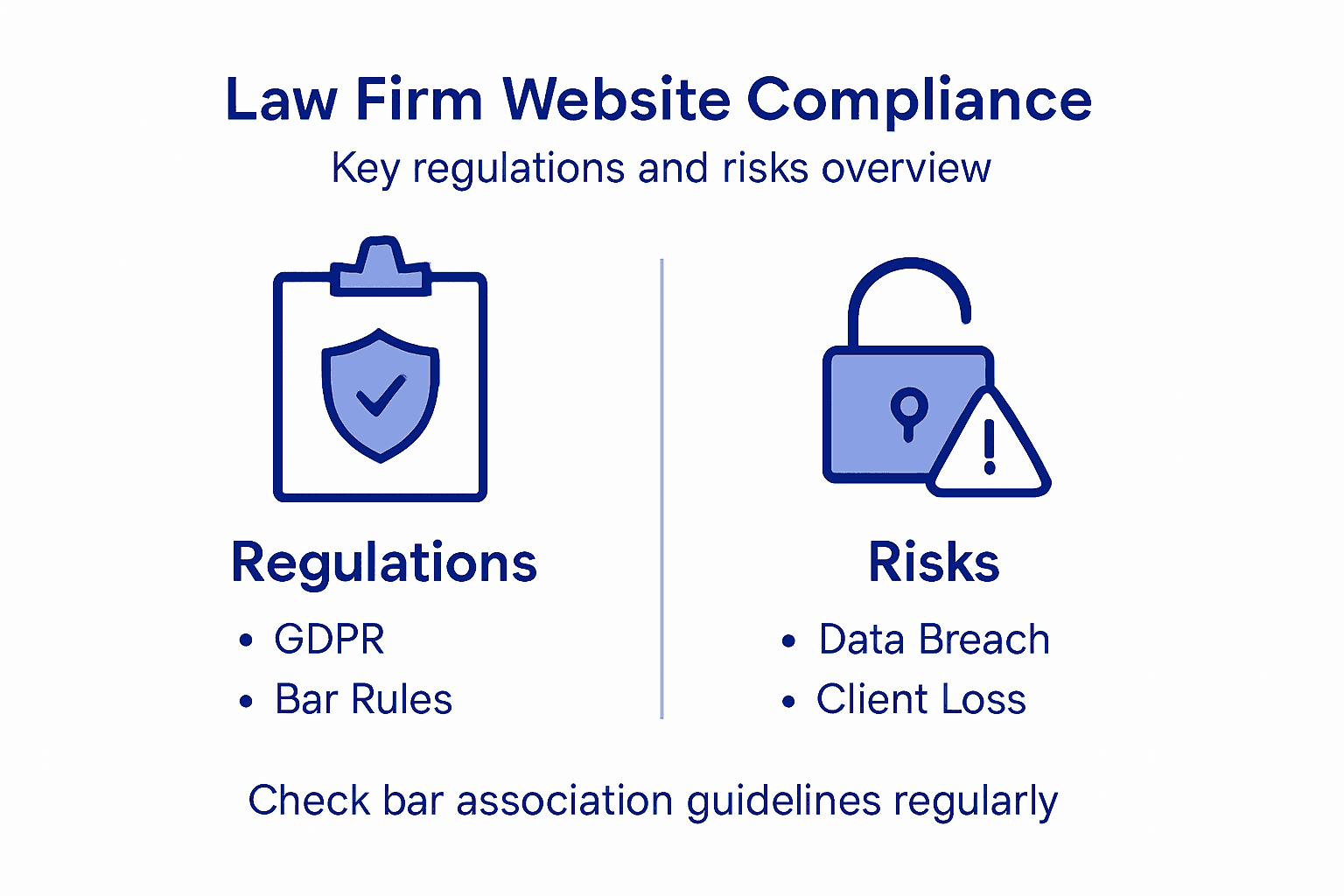
This table compares legal website compliance areas and highlights their effects on client trust and firm risk:
| Compliance Area | Effect on Client Trust | Impact on Firm Risk |
|---|---|---|
| Confidentiality | Strengthens reputation | Reduces liability exposure |
| Ethical Advertising | Builds credibility | Minimizes disciplinary action |
| Data Privacy | Enhances transparency | Prevents regulatory penalties |
Pro tip: Conduct quarterly reviews of your website’s compliance with current bar association guidelines to ensure ongoing adherence to professional standards.
Mandatory Disclosures and Consent Mechanisms
Law firm websites must implement robust consent management platforms that transparently communicate data collection practices and obtain explicit user permissions. These mechanisms are critical for maintaining legal and ethical standards in digital client interactions.
The key components of effective consent mechanisms include:
- Transparent Data Collection Notifications
- Clear explanation of collected information
- Purpose of data collection
- Specific uses of client data
- Explicit Consent Requirements
- Granular consent options
- Ability to withdraw consent
- Separate consent for different data uses
- User Control Features
- Option to modify data preferences
- Access to stored personal information
- Complete data deletion requests
Regulatory Compliance Frameworks demand comprehensive disclosure strategies. Informed written consent represents a critical legal standard, requiring law firms to:
- Clearly communicate potential risks
- Provide detailed information about data usage
- Obtain explicit, documented agreement
- Maintain comprehensive consent records
- Enable easy consent modification
Electronic consent mechanisms must be as legally robust and transparent as traditional written agreements.
Consent Documentation involves creating clear, accessible records that demonstrate compliance with professional ethics rules and privacy regulations. Law firms must develop systematic approaches to capturing, storing, and managing user consent data with the highest level of precision and accountability.
Pro tip: Develop a standardized consent documentation template that can be easily updated to reflect changing regulatory requirements and technological advances.
Risks of Non-Compliance and Ethical Pitfalls
Law firms face substantial legal and professional consequences when navigating the complex landscape of privacy regulations and ethical standards. Emerging ethical issues can quickly escalate into significant liability risks that threaten a firm’s reputation and operational integrity.
The primary ethical risks and potential consequences include:
- Professional Disciplinary Actions
- Suspension of legal practice license
- Mandatory ethics retraining
- Public reprimand
- Financial penalties
- Legal Liability Exposure
- Malpractice lawsuits
- Client compensation claims
- Potential criminal investigations
- Reputational Damage
- Loss of client trust
- Negative media coverage
- Reduced referral networks
- Difficulty attracting new clients
Compliance Vulnerabilities represent critical areas of potential ethical breaches. Legal ethics guidelines highlight several key risk areas that demand proactive management:
- Unauthorized practice of law
- Inadequate client confidentiality protocols
- Conflicts of interest disclosure failures
- Insufficient cybersecurity measures
- Improper communication of legal services
Ethical compliance is not a one-time achievement but an ongoing commitment to professional standards and client protection.
Mitigation Strategies require law firms to develop comprehensive risk management frameworks that continuously monitor and address potential ethical vulnerabilities. This involves regular training, robust internal policies, and a culture of transparency and accountability.
Pro tip: Implement an annual comprehensive ethics audit to identify and address potential compliance gaps before they become serious legal or professional risks.
Enhance Your Law Firm’s Privacy Compliance and Online Visibility
Navigating complex privacy policies and strict legal regulations for law firm websites can feel overwhelming. This article highlights critical challenges like safeguarding client confidentiality, managing consent mechanisms, and staying ethically compliant—all vital to building trust and protecting your firm’s reputation. Ensuring your website meets these privacy and ethical standards is essential but not enough if your firm remains hidden from potential clients online.
At LawSEO.com, we specialize in helping law firms like yours not only stay compliant with these evolving privacy demands but also dominate search results. Our expert-driven SEO strategies focus on ethical marketing, website optimization, and AI-driven content visibility tailored exclusively for legal professionals. By integrating strong privacy standards with powerful online marketing, you protect your clients and grow your practice simultaneously. Learn how our comprehensive SEO services and founder-led approach can position your firm for sustained success.
Don’t risk losing clients due to poor online presence or compliance gaps. Visit LawSEO.com now to start building a privacy-conscious website that attracts and converts quality leads while staying fully compliant with ethical and legal requirements.
Frequently Asked Questions
What are the core principles of a law firm’s privacy policy?
A law firm’s privacy policy should include principles such as data collection limitation, purpose specification, and individual participation to ensure responsible information management and client data protection.
Why is it important for law firms to implement strong cybersecurity measures?
Law firms handle sensitive client information, making robust cybersecurity measures essential to prevent unauthorized access and maintain client trust and compliance with ethical obligations.
What types of sensitive information do law firms typically collect online?
Law firms usually collect personal identification data, financial information, professional credentials, and sensitive legal communications, all of which necessitate stringent privacy protections to secure client confidentiality.
What are the potential consequences of failing to comply with legal regulations related to privacy?
Non-compliance with privacy regulations can result in professional disciplinary actions, legal liability exposure through malpractice lawsuits, and significant reputational damage that can harm client trust and the firm’s operations.
Recommended
- Website Security for Legal SEO – Why Law Firms Must Prioritize It
- HTTPS for Law Firms: Boost Security and Trust
- How to Design a Lawyer Website for Legal SEO Success
- Website Accessibility for Law Firms: Legal Risks and SEO Impact
- Terms of Use – Los Angeles Employment Lawyers | California United Law Group, P.C.