

Every law firm website holds a story that numbers alone cannot tell. For a mid-sized American law firm, simply tracking visits falls short of revealing which practice areas engage prospective clients and whether those visitors actually reach out. Understanding website analytics means uncovering proven insights about where your best leads come from, how your content performs, and what truly drives client growth. This guide will help you harness web analytics to make smarter marketing decisions and measure results that matter to your firm.
Table of Contents
- Defining Website Analytics for Law Firms
- Key Metrics for Legal Website Performance
- Analytics Tools and Implementation Strategies
- Data Privacy and Compliance for Attorneys
- Avoiding Common Law Firm Analytics Mistakes
Key Takeaways
| Point | Details |
|---|---|
| Importance of Analytics | Analytics helps law firms understand visitor behavior, conversion rates, and effective marketing channels, ultimately guiding decisions that improve client acquisition. |
| Focus on Key Metrics | Track metrics that directly impact client growth, such as conversion rates and lead quality, rather than vanity metrics like pageviews. |
| Implementing Proper Tools | Choosing the right analytics platform is crucial; consider firm size, practice areas, and integration capabilities to optimize data utilization. |
| Data Privacy Compliance | Law firms must adhere to legal and ethical standards when collecting and analyzing data to protect client confidentiality and avoid penalties. |
Defining Website Analytics for Law Firms
Website analytics isn’t just about counting visitors. It’s about understanding who lands on your site, what they do once they’re there, and whether they eventually become clients.
For law firms, website analytics means measuring and analyzing web data to reveal visitor behavior, traffic sources, and conversion patterns. This data tells you which marketing channels work, which practice areas attract the most interest, and where potential clients drop off.
What Analytics Reveals About Your Firm’s Online Presence
Analytics answers the questions that matter to your practice:
- Which practice areas or geographic markets drive the most traffic?
- Are visitors finding you through organic search, paid ads, or referral sites?
- How long do prospects spend on your pages before contacting you?
- Which practice area pages convert visitors into leads most effectively?
- What’s your actual cost per lead from each marketing channel?
Without this data, you’re essentially marketing blind. You might be spending thousands on strategies that don’t convert while overlooking your most effective channels.
Analytics reveals the hard truth about your marketing efforts. You’ll discover what actually works instead of relying on assumptions.
Why Law Firms Need Analytics Differently Than Other Businesses
A typical e-commerce business cares about cart abandonment rates and average order value. Your firm cares about something different: lead quality and conversion to paid engagements.
A prospect visiting your family law page might convert into a consultation next week. Another might spend 30 minutes researching on your employment law page, then call a competitor six months later. Analytics helps you track these patterns specific to your practice.
You also need to understand how prospects discover you in an increasingly complex digital environment. They might find you through essential SEO metrics that matter most to legal practices, then return weeks later through a direct search.
The Core Components of Law Firm Website Analytics
When you set up analytics for your firm’s website, you’re tracking several key components:
- Traffic sources – Where visitors come from (organic search, paid ads, direct, referrals)
- User behavior – Pages visited, time on site, scroll depth, button clicks
- Conversions – Contact form submissions, phone calls, consultation requests
- Traffic by practice area – Which legal services attract the most interest
- Geographic data – Where clients are located and which areas drive qualified leads
- Device data – Mobile versus desktop behavior patterns
Each metric tells a different part of your firm’s story. Together, they reveal exactly how prospects interact with your online presence.
Pro tip: Start by setting up conversion tracking for contact forms, phone calls, and live chat interactions before analyzing traffic sources. You’ll quickly see which channels bring qualified prospects rather than just volume.

Key Metrics for Legal Website Performance
Not all website metrics matter equally for law firms. While pageviews might look impressive in a report, they mean nothing if those visitors never contact you.
You need to track metrics that directly connect to client acquisition. The right key performance indicators (KPIs) reveal whether your website is actually working as a lead-generation tool or just consuming your marketing budget.
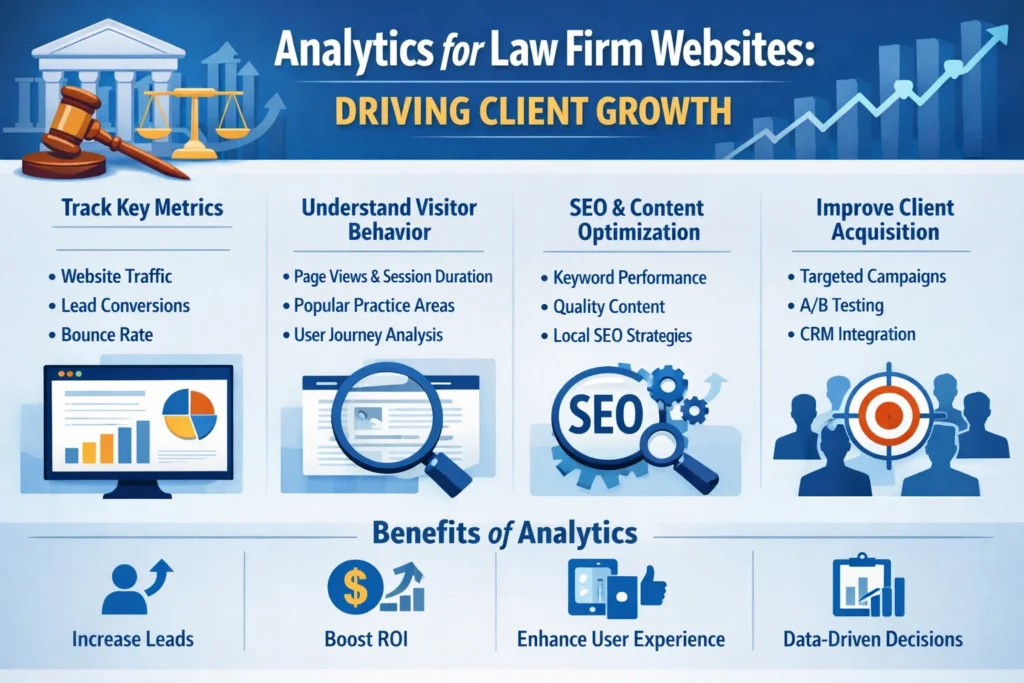
The Essential Metrics That Drive Client Growth
Focus on these core metrics first:
- Pageviews and traffic volume – Overall visitor count, but only meaningful with conversion data
- Average time on page – Indicates whether content engages prospects or they bounce immediately
- Bounce rate – Percentage of visitors who leave without taking action
- Conversion rate – Percentage of visitors who submit a form, call, or request a consultation
- Traffic sources – Which channels (organic search, ads, referrals) bring your best leads
These key performance indicators help law firms understand visitor behavior and how effectively pages convert prospects into clients.
Performance Metrics That Impact User Experience
How fast your website loads directly affects whether prospects stay or leave. Speed matters more than you think.
Metrics like Time to First Byte and First Contentful Paint measure how quickly visitors see your content. A slow site kills conversions.
When a prospect lands on your DUI defense page and waits three seconds for it to load, they’re already considering calling another firm. Mobile users are even less patient.
Your website speed directly impacts your conversion rate. A one-second delay can cost you qualified leads.
Which Metrics Matter Most for Your Practice
Prioritize metrics based on your business model:
For high-volume practices (family law, personal injury) – Track conversion rate obsessively. One percentage point improvement means dozens more clients annually.
For consultation-based practices (corporate law, M&A) – Monitor lead quality metrics alongside volume. Track which practice area pages generate the most qualified inquiries.
For service-specific firms – Segment metrics by practice area. Your employment law page might convert at 8% while immigration converts at 3%.
Understanding conversion rate optimization for attorneys helps you identify which pages and strategies actually generate revenue-producing clients.
The Dashboard You Actually Need
Stop looking at vanity metrics. Create a simple dashboard tracking:
- Monthly conversion rate (total leads divided by total visitors)
- Cost per lead (marketing spend divided by leads generated)
- Lead quality score (what percentage actually become paying clients)
- Traffic by practice area (which services attract the most interest)
- Mobile versus desktop conversion rates
- Average time on key landing pages
These five metrics tell your firm’s complete story. Everything else is noise.
Pro tip: Set up conversion tracking for phone calls, contact forms, and live chat submissions separately so you can identify which channels your best clients use to reach you.
Analytics Tools and Implementation Strategies
Having the right metrics means nothing without the right tools to collect and analyze them. Your firm needs a system that tracks visitor behavior, converts data into insights, and actually integrates into your workflow.
Picking the wrong tool wastes time and money. Picking the right one accelerates growth by turning data into decisions.
Choosing the Right Analytics Platform for Your Firm
Start with these considerations:
- Firm size and budget – Solo practices need simpler, cheaper tools than 50-person firms
- Practice areas you serve – Different legal specialties attract different visitor behaviors
- Integration with existing systems – The tool must connect to your CRM, website, and practice management software
- Lead tracking capabilities – Can it track phone calls, forms, and chat submissions separately?
- Reporting ease – If your team can’t understand the reports, they won’t use them
Google Analytics is free and powerful but requires technical setup. Specialized legal analytics platforms cost more but handle law-firm-specific tracking automatically.
Here’s a quick comparison of analytics tools suited for law firms:
| Tool Type | Setup Complexity | Best For | Notable Features |
|---|---|---|---|
| Free Generic (e.g., Google Analytics) | Moderate technical skill needed | Solo or small practices | Cost-effective, flexible reporting |
| Legal-Specific Platforms | Easy, purpose-built | Medium/large firms | Tracks legal leads, integrates with CRM |
| Custom Dashboard Solutions | High technical expertise | Firms needing custom insights | Highly configurable, advanced segmentation |
This table helps clarify which tool matches different firm sizes and needs.
Implementation That Actually Sticks
Rolling out analytics fails when firms don’t plan properly. Successful implementation follows a structured approach.
Legal analytics tools for law firms require careful selection and training to fit your practice size, practice areas, and operational needs. You’ll need to designate ownership, train staff, and establish regular review cycles.
Start small. Track conversion rate and traffic sources for 30 days before adding complexity. Let your team get comfortable with the data before expanding.
Implementation fails when firms expect instant answers. Start simple, build gradually, and let your team adapt to data-driven thinking.
Building an Analytics-Driven Culture
Technology is only half the battle. The other half is getting your team to actually use the data.
Schedule weekly or monthly review meetings where you examine metrics together. Show how changes impact lead volume and lead quality. When your team sees that optimizing a form reduced bounce rate by 12%, they become believers.
Integration strategies for analytics tools must align with firm workflows and ethical standards while maintaining client confidentiality. Your data collection practices must comply with privacy regulations and bar association rules.
Essential Setup Checklist
Before launching any analytics program, complete these steps:
- Install tracking code properly on all website pages
- Set up conversion goals for each lead type (phone, form, chat)
- Create custom dashboards your team will actually look at
- Establish baseline metrics so you know what “normal” looks like
- Document your tracking setup so you don’t lose institutional knowledge
- Train at least two team members so you’re not dependent on one person
- Schedule monthly review meetings to examine trends and adjust strategy
Skip any of these and your analytics program dies quietly on the shelf.
Pro tip: Start with conversion rate tracking alone for your first month, then gradually add traffic source analysis, practice area segmentation, and mobile performance metrics as your team becomes comfortable with data.
Data Privacy and Compliance for Attorneys
Tracking website analytics creates a responsibility you cannot ignore: protecting client data. Every visitor to your website generates information. Some of that data is sensitive. Your firm must handle it correctly or face serious legal consequences.
Compliance isn’t optional. It’s a professional obligation and a legal mandate.
Federal Privacy Laws That Affect Law Firms
Multiple regulations govern how you collect and store client information online.
HIPAA and the Federal Trade Commission Act regulate client data collection and storage, establishing strict requirements for how law firms handle sensitive information. Violating these laws exposes your firm to substantial fines and reputational damage.
If your practice handles health law cases or works with health information, HIPAA compliance becomes critical. The FTC Act applies to all firms and requires reasonable safeguards against unauthorized access.
State privacy laws add another layer. California’s privacy law, for example, gives residents rights to know what data you collect and how you use it.
The ABA Model Rule 1.6 Obligation
Beyond federal law, professional ethics require strict confidentiality practices.
ABA Model Rule 1.6 mandates confidentiality of all client information unless informed consent is given or disclosure is required by law. Your analytics system must prevent unauthorized access to client data while still allowing you to improve your website.
This creates a tension: you want to analyze visitor behavior, but visitors might include current clients or opposing counsel. Your tracking systems must respect this reality.
Your ethical obligations extend to digital data. Breach a client’s confidentiality through your website, and you face bar discipline plus potential liability.
Essential Privacy Protections for Your Analytics
Implement these safeguards immediately:
- Anonymize visitor data where possible; don’t track names or case details
- Encrypt data transmission using HTTPS on your entire website
- Limit access to analytics dashboards; not every staff member needs to see raw data
- Establish data retention policies specifying how long you keep analytics data
- Secure your analytics account with strong passwords and two-factor authentication
- Document your data practices so you can prove compliance if audited
- Review vendor agreements if using third-party analytics platforms
Your analytics provider must meet privacy standards. Google Analytics and similar tools have privacy addendums available; use them.
For a clear reference, here’s a summary of essential privacy and compliance safeguards:
| Protection Strategy | Legal Requirement | Practical Benefit |
|---|---|---|
| Anonymize visitor data | Meets privacy laws | Prevents client identification |
| Use HTTPS encryption | FTC Act and HIPAA | Secures all website transmissions |
| Limit dashboard access | ABA Rule 1.6 | Reduces internal risk |
| Data retention policy | State regulation | Controls storage duration |
| Strong authentication | Federal & state law | Prevents unauthorized access |
This summary table supports quick review of critical privacy measures for law firm analytics.
What You Cannot Track
Some information is off-limits entirely.
Never use analytics to track which specific clients visit your site or what pages they view. Don’t record form submissions containing case details or client information. Don’t use tracking cookies on pages containing sensitive legal content without explicit consent.
When in doubt, ask: “If this data leaked, would a client be harmed?” If yes, don’t track it.
Your Privacy Policy Must Match Reality
Your website’s privacy policy must accurately describe your analytics practices. Saying you “don’t track personal information” while running detailed visitor tracking is both unethical and illegal.
Keep your privacy policy up to date and aligned with your actual practices to build trust and ensure compliance.
Pro tip: Have your state bar’s ethics hotline review your analytics setup and privacy policy before launching new tracking. One conversation prevents expensive mistakes later.
Avoiding Common Law Firm Analytics Mistakes
Most law firms that fail with analytics don’t fail because they lack data. They fail because they collect data without knowing what to do with it.
You can track every metric imaginable and still make decisions in the dark. That’s the real problem.
Mistake #1: Collecting Data Without Connecting It to Decisions
The biggest analytics failure is creating dashboards nobody uses.
You set up conversion tracking, traffic sources, and practice area performance metrics. Then nothing changes. No one examines the data. No decisions get made based on what you learned.
Decision-driven analytics requires linking insights to business decisions rather than simply collecting information. Your analytics should answer specific questions your firm needs answered, not just generate reports.
Before implementing any analytics tool, ask: “What decision will we make based on this data?” If you can’t answer that question, skip tracking it.
Mistake #2: Relying on AI-Generated Analytics Without Verification
Generative AI tools are powerful but dangerous when used blindly.
AI systems sometimes fabricate data or misinterpret patterns, creating false conclusions that look credible. Verifying AI-generated data rigorously prevents hallucinations and fabricated insights that could lead your firm down the wrong path.
Never accept an AI recommendation about your analytics without human verification. Cross-check the data. Ask how it was calculated. Demand proof before acting on it.
Your analytics tools should assist your judgment, not replace it.
Trash data produces trash decisions. Verify everything before changing your marketing strategy based on analytics insights.
Mistake #3: Ignoring Practice Area Performance Differences
Not all practice areas convert equally.
Your family law pages might convert at 12% while criminal defense converts at 3%. If you look only at overall conversion rate, you miss this critical insight.
Segment your analytics by practice area. Track which legal services attract quality leads. When you examine critical SEO mistakes law firms make, you’ll notice that underperforming practice areas often suffer from poor content or targeting, not lack of traffic.
Mistake #4: Setting Goals Without Baselines
You need to know where you’re starting before you can measure improvement.
Establish baseline metrics for your first 30 days:
- Overall conversion rate
- Cost per lead by channel
- Average time on key landing pages
- Mobile versus desktop performance
- Traffic by practice area
- Lead quality (what percentage becomes paying clients)
After 30 days, anything that changes becomes meaningful data. Before that, you’re just guessing.
Mistake #5: Treating All Traffic Equally
One visitor from organic search might be worth ten times more than a random click from a display ad.
Track lead quality separately from lead volume. A 2% conversion rate from organic search beats a 5% rate from low-quality referral traffic. Focus on which channels bring prospects who actually hire you.
Mistake #6: Changing Everything at Once
When conversion rate drops, some firms panic and overhaul their entire website.
Change one element at a time. Optimize your contact form, measure results for two weeks, then try something else. This approach shows you what actually works instead of guessing.
Pro tip: Pick three specific questions your analytics must answer, then build your tracking system to answer only those questions. Simplicity beats complexity every single time.
Unlock Your Law Firm’s Growth with Data-Driven SEO Strategies
Struggling to turn your website traffic into real clients is a common challenge for law firms today. The article highlights how crucial it is to focus on conversion tracking, lead quality, and practice area performance rather than vanity metrics. At LawSEO.com, we understand these pain points intimately because we specialize exclusively in legal SEO and marketing. We know how to leverage your website analytics to drive qualified leads, improve conversion rates, and boost your firm’s online visibility within search results and emerging AI-driven platforms.
Don’t waste another dollar guessing what works. With founder Todd R. Stager’s expertise and our comprehensive services covering local SEO, content production, link building, and paid advertising, we create tailored strategies that align your analytics insights with powerful marketing actions. Experience the difference a dedicated legal marketing partner makes by visiting LawSEO.com. Discover how our AI optimization and exclusive law firm focus can transform your analytics data into a steady stream of new clients. Take control of your online presence today and turn insights into growth.
Frequently Asked Questions
What are the key metrics law firms should track in their website analytics?
To optimize client growth, law firms should focus on metrics such as conversion rate, traffic sources, average time on page, bounce rate, and lead quality. These metrics help determine the effectiveness of your website as a lead-generation tool.
Why is understanding traffic sources important for a law firm?
Traffic sources reveal how visitors find your site, whether through organic search, paid ads, or referrals. This information helps identify which marketing channels are most effective in attracting qualified leads and optimizing marketing spend.
How can law firms ensure compliance with privacy laws while using analytics?
Law firms must anonymize visitor data, use HTTPS encryption, limit access to analytics dashboards, and document data practices. Adhering to regulations such as HIPAA and the FTC Act is essential to protect client information and maintain ethical standards.
What common mistakes do law firms make with website analytics?
Common mistakes include collecting data without linking it to decisions, relying on AI-generated analytics without verification, ignoring practice area performance differences, and changing multiple elements at once during optimization efforts. Each of these can lead to misunderstandings and ineffective strategies.