


TL;DR:
- Law firms must prioritize client reviews as essential SEO assets that enhance local search visibility and build trust. Consistent, recent reviews with thematic content improve Google prominence signals and AI-generated summaries, giving firms a competitive edge. Implementing a systematic review collection and response strategy is critical for sustained local search success and reputation management.
Online reviews are not just for restaurants and retail stores. Law firms that treat client reviews as a passive reputational concern are leaving a significant local search advantage unused. Google uses reviews as a “prominence” trust signal and as source content to generate AI-powered sentiment summaries visible directly in Maps and the Local Pack. Understanding this changes how you should think about every client review your firm receives, and every one it never asks for.
Key Takeaways
| Point | Details |
|---|---|
| Reviews drive visibility | Client reviews directly impact whether your law firm shows up in local search results and how it is perceived by potential clients. |
| Recency and velocity matter | Consistently acquiring up-to-date reviews is more important than having a large number of outdated ones for local SEO. |
| Strategy beats chance | A proactive review strategy—timely requests, professional replies, and relevant mention of services—yields sustainable SEO results. |
| Watch for pitfalls | Ignoring review management risks lost visibility, poor summaries, and potential compliance issues. |
| Start now, gain long-term | Treat reviews as a key part of your law firm’s SEO and client growth—not just an afterthought. |
Why reviews matter for local SEO in legal marketing
With the basics in mind, let’s break down exactly how reviews shape your firm’s local search performance.
Most law firm marketing discussions focus on website content, backlinks, and technical SEO. Reviews tend to get grouped under “reputation management” rather than treated as a core SEO input. That framing is outdated and costly. Reviews serve a dual purpose that directly benefits your firm’s search visibility and client conversion rate at the same time.
Trust for clients, signals for Google. When a potential client searches “personal injury attorney in Dallas,” Google’s algorithm weighs multiple factors to decide which firms appear in the Local Pack, the prominent map-based listings above organic results. Review signals, including the total number of reviews, your average star rating, and the language used in individual reviews, factor heavily into that calculation. Simultaneously, those same reviews are the first thing a prospect reads when evaluating whether to call your firm.
According to why law firm reviews matter, clients actively research attorneys online before making contact, and positive, detailed reviews serve as powerful social proof that influences the decision to reach out. Your firm’s law firm local SEO checklist should treat reviews as a standing operational priority, not a one-time setup task.
Key ways reviews influence local SEO for law firms:
- Review quantity: More verified reviews generally improve your firm’s prominence score in Google’s algorithm.
- Star rating average: A consistently high average rating improves click-through rates from search results.
- Review content: Google’s AI reads the text of reviews to identify recurring themes, practice areas, and sentiment.
- Recency: Fresh reviews carry more weight than older ones, which means a firm that collected strong reviews two years ago and then stopped soliciting them is gradually losing ground.
- Owner responses: Timely, professional responses to reviews signal active engagement and can reinforce the keywords and themes present in the review itself.
“Google uses reviews as a key signal for local prominence and for summary generation, which appears in Maps and local listings directly.”
The connection between review activity and local SEO growth for law firms is measurable. Firms that prioritize review generation consistently outperform competitors in Local Pack placement.
The mechanics: How Google weighs law firm reviews

Now that we know why reviews are so influential, it’s crucial to see how their mechanics work behind the scenes for law firm SEO.
Google does not simply count stars and move on. The system behind how your reviews are calculated and displayed is more nuanced than most firms realize. Understanding these mechanics allows you to build a smarter review strategy rather than just hoping clients leave feedback.
Review scores and star rating calculations. Google calculates your firm’s aggregate star rating based on all reviews submitted across your Business Profile. However, review scores can take up to two weeks to update after new reviews are posted. This matters because if you run a client outreach campaign and receive ten new reviews in one week, you won’t see the rating change immediately. Plan your marketing and reporting timelines accordingly.
Review summaries and AI-generated themes. One of the most important developments in local search is Google’s use of AI to generate review summaries. These short, thematic summaries appear directly in Google Maps and the Local Pack, giving searchers an instant digest of what clients say about your firm. Google updates review summaries weekly based on reviews from the past year. Only recent, thematically consistent reviews contribute to these summaries. If your firm has dozens of strong reviews from three years ago but few from the past twelve months, your summary will reflect that gap.
Review velocity versus sudden spikes. Consistent review velocity means your firm receives a steady stream of new reviews over time. A sudden spike, such as fifteen reviews in one week after months of silence, can trigger Google’s spam filters and may result in some reviews being suppressed or flagged for review. Consistent velocity signals organic, credible feedback rather than coordinated activity.
| Review factor | Low performance | Strong performance |
|---|---|---|
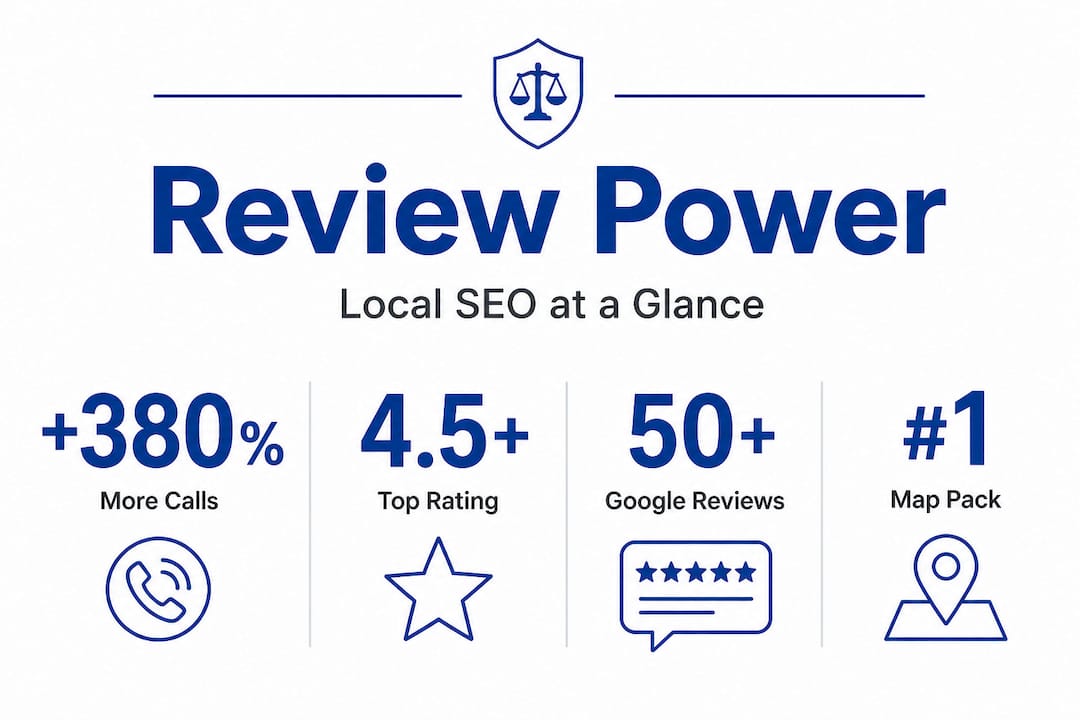
| Total review count | Under 10 reviews | 50 or more verified reviews |
| Average star rating | Below 4.0 | 4.5 or higher |
| Review recency | Most reviews older than 12 months | Regular reviews within past 90 days |
| Review velocity | Sporadic, irregular | Consistent monthly intake |
| Theme consistency | Vague or mixed topics | Clear practice area and location mentions |
| Owner responses | Absent or delayed | Timely, professional, keyword-aware |
Understanding the benefits of local SEO for law firms makes clear why getting these mechanics right is worth the investment. Local Pack placement is often the highest-value real estate in legal search results. And building strong local citation strategies alongside your review program reinforces your firm’s local authority further.
Pro Tip: Don’t try to catch up for lost time by asking all former clients to post reviews simultaneously. Spread your outreach over several weeks to maintain a natural, credible intake pattern that doesn’t trigger Google’s spam detection algorithms.
Building a review strategy for your law practice
Understanding the rules is useful, but practical action wins. Here’s how to implement a review strategy that drives results.
A review strategy is not a one-time campaign. It is an ongoing operational process embedded in your client lifecycle. The most effective law firm review programs are systematic, ethical, and consistent. Here is how to build one.
Step-by-step review acquisition process:
- Identify the right moment to ask. The best time to request a review is shortly after a matter is resolved and the client has expressed satisfaction. A closing email or follow-up call within one to two weeks of resolution is ideal timing.
- Make the ask simple and direct. Provide clients with a direct link to your Google Business Profile review form. Reduce friction wherever possible. The easier you make it, the more clients follow through.
- Use email and text outreach. A short, personalized email referencing the case outcome and including a direct review link performs well. Text messages have even higher open rates for this purpose.
- Comply with bar association guidelines. Most state bar rules prohibit incentivizing reviews or making misleading claims about client outcomes. Review your jurisdiction’s rules before launching any outreach program. Never offer discounts, gifts, or other benefits in exchange for reviews.
- Follow up once, respectfully. A single follow-up reminder after seven to ten days is acceptable and often results in additional responses. Do not send multiple follow-ups, as this can feel coercive and damage client relationships.
- Respond to every review promptly. Responses should be professional, acknowledge the client’s feedback, and avoid disclosing any confidential details. For positive reviews, a brief thank-you that naturally references your practice area is appropriate. For negative reviews, respond calmly and invite the client to contact your office to resolve the matter.
Consistent review velocity, professional responses, and natural mention of practice areas are hallmarks of an effective strategy and are signals Google actively looks for when evaluating local prominence.
Checklist for review content optimization:
- Encourage clients to describe the specific legal matter in their own words (without prompting them on exact wording).
- Location and practice area mentions that arise naturally in a client’s own language are highly valuable for theme density.
- Avoid coaching clients to include specific keywords. This risks sounding unnatural and may violate bar rules.
- Reviews that describe the client’s experience in detail, including the outcome and what made working with your firm positive, provide the richest content for Google’s AI summaries.
Pro Tip: Include a brief note in your closing client communication that says something like, “If you’re comfortable sharing your experience online, it genuinely helps other families in similar situations find our firm.” This phrasing is client-centered, not self-serving, and tends to produce more authentic, detailed reviews.
Understanding how to improve your firm’s Google Local SEO benefits depends heavily on consistent execution of these foundational steps. If your team needs guidance on improving response time to reviews, faster engagement correlates with stronger client conversion rates as well.
Pitfalls and nuances: Risk management in review-based SEO
A robust review strategy means staying clear of common mistakes and navigating subtle complexities in Google’s evolving review landscape.
Even well-intentioned law firms can run into trouble with their review programs. The risks range from missed SEO opportunities to ethical violations and Google penalties.
Why your firm may not have a review summary. Not every law firm gets an AI-generated review summary in Google search results. Review summaries may be absent if themes are weak or there aren’t enough recent reviews. If your reviews lack consistent themes or were mostly collected more than twelve months ago, Google may not generate a summary at all. Older reviews have less impact on this feature. The practical implication is that you need a regular pipeline of fresh reviews, not a one-time push.
“Review summaries reflect the most recent and thematically consistent client feedback. A firm with fifty older reviews and no recent ones will often be outperformed in local results by a competitor with twenty current, thematic reviews.”
| Scenario | SEO impact | Risk level |
|---|---|---|
| No reviews or very few reviews | Very low local prominence | High risk of being outranked |
| Reviews older than 12 months only | Reduced summary quality | Moderate risk of visibility decay |
| Sudden influx of reviews (spike) | Possible spam filter trigger | Moderate to high risk |
| Fake or incentivized reviews | Google removal and possible suspension | Very high risk |
| Negative reviews with no response | Damaged trust signals | Moderate to high risk |
| Consistent monthly review intake | Strong local prominence | Low risk, high reward |
Fake and incentivized reviews. This is an area where ethical obligations and SEO best practices align perfectly. Paying for reviews, creating fake Google accounts to post reviews, or offering any form of compensation for feedback violates both Google’s terms of service and, in most jurisdictions, state bar rules. The consequences include review removal, Business Profile suspension, and potential disciplinary action from your bar association. No short-term ranking boost is worth that exposure.
Review decay. If your firm stops actively soliciting reviews, your review summary quality will decline over time. Google’s weekly summary updates mean that a firm coasting on last year’s reviews will gradually lose visibility as the one-year window shifts. This is review decay. It is slow and silent, which makes it especially dangerous because firms often don’t notice until they’ve already lost significant Local Pack placement.
Monitoring your review performance. Use your Google Business Profile dashboard to track review volume, average rating trends, and flagged reviews on a monthly basis. Integrate this with your broader law firm SEO strategies to identify whether review activity correlates with changes in Local Pack rankings or website traffic from local searches. If you notice a drop in review volume, address it immediately rather than waiting to see if it corrects itself.
Connecting your review program to a strong law firm lead management advice framework ensures that the leads generated by your improved local visibility are being captured and converted effectively.
The uncomfortable truth: What most law firms miss about reviews and local SEO
With pitfalls in mind, here’s a candid perspective every law firm should hear.
Most firms approach reviews the same way they approach their office’s parking situation: something that exists, occasionally causes a problem, and doesn’t need active attention. That mindset is the single biggest missed opportunity in law firm local SEO today.
Reviews have become content assets and trust infrastructure, not just testimonials. Google reads them the same way it reads your website pages, your blog posts, and your service descriptions. When a client writes, “Todd helped us navigate a complicated estate dispute in Chicago and was always available to answer our questions,” that sentence does real SEO work. It associates your firm’s name with a practice area, a location, and a positive outcome. Google’s AI indexes that and uses it in ways that a generic five-star rating never could.
Firms that dominate local search in competitive markets are almost always the firms that have made review cultivation a standard operational step. It is not an accident. It is a system. They ask every satisfied client. They respond to every review within 24 hours. They track their review velocity and adjust outreach timing accordingly. They treat the review section of their Google Business Profile as an active marketing channel, not a passive scoreboard.
What makes this frustrating is how achievable it is. Unlike link-building campaigns or technical SEO audits, a review strategy requires almost no budget. It requires discipline, consistency, and a genuine commitment to client communication. The legal SEO fundamentals have not changed in this regard. Firms that master the basics, and reviews are absolutely a basic, give themselves an enduring advantage that is genuinely hard for competitors to overcome quickly.
If your firm has been treating reviews as something that takes care of itself, this is the moment to change that. The firms outranking you in Google Maps are almost certainly more intentional about review cultivation than you are. That gap is closeable, but only if you act on it.
Upgrade your law firm’s local SEO with expert support
If you’re ready to put this advice into practice and accelerate your firm’s local growth, here’s where to start.
Building a review-driven local SEO program is a meaningful step forward, but it is only one component of a complete strategy. At LawSEO.com, we work exclusively with law firms to build the full picture: local SEO, content production, review strategy, link building, and AI-optimized content that positions your firm in both traditional search and emerging generative AI platforms. Our founder, Todd R. Stager, brings over 29 years of SEO experience to every client campaign. Explore our advanced SEO strategies for lawyers to see how a tailored program can transform your firm’s local visibility. You can also compare leading platforms through our guide to top law firm SEO platforms to understand your options.
Frequently asked questions
How quickly do Google review scores update for law firms?
Review scores can take up to two weeks to update after new reviews post, so don’t expect immediate changes to your firm’s rating after a review campaign.
Do older reviews still help law firm SEO?
Older reviews have less impact because Google prioritizes recent reviews from the past year for both local rankings and AI-generated review summaries.
How many reviews does a law firm need to show a review summary in Google search?
There is no official minimum number, but review summaries may be absent if themes are weak or recent review volume is insufficient, so consistent and thematically relevant feedback is essential.
Can law firms remove negative Google reviews?
Law firms can flag reviews that violate Google’s policies for removal consideration, but legitimate negative reviews from real clients generally cannot be deleted and must be managed through professional responses.
Should client reviews mention practice areas or location for SEO?
Yes, when it happens naturally in a client’s own words. Consistent review themes that reference practice areas and locations improve the quality and relevance of Google’s AI-generated summaries for your firm.