


TL;DR:
- Bounce rate can be misleading; high bounce doesn’t always indicate poor performance or content.
- Combining bounce rate with engagement metrics provides a true picture of website effectiveness.
- Focus on tailored user experience improvements and meaningful client actions rather than just lowering bounce rate.
Bounce rate is one of the most watched and most misunderstood metrics in legal marketing. When a visitor lands on your law firm’s website and leaves without clicking to another page, analytics platforms record that as a bounce. Many legal marketing managers treat every bounce as a failure, a lost client, a wasted ad dollar. That thinking is costing firms real insight. The truth is more nuanced: some bounces represent a visitor who got exactly what they needed and took action. Understanding when bounce rate is a red flag versus a non-issue is the first step toward smarter engagement strategy.
Key Takeaways
| Point | Details |
|---|---|
| Bounce rate nuance | Not all high bounce rates are negative—single-page conversions can be wins for law firms. |
| Analyze beyond bounces | Look at engagement metrics like time on page and goal completions to reveal true client interest. |
| Targeted improvements | Address the most common causes of bounce with UX, calls to action, and mobile design upgrades. |
| Strategic focus | Prioritize tracking real outcomes such as contact form fills and phone calls, not just bounce reduction. |
What bounce rate means for law firms
Bounce rate measures the percentage of sessions in which a user visits only one page on your website before leaving. In Google Analytics 4 (GA4), the metric has evolved into an “engagement rate,” but the underlying concept remains central to how marketers evaluate site performance. For law firms, tracking this metric starts with placing analytics code on every page and reviewing session data regularly through analyzing law firm analytics.
There are several common misconceptions about bounce rate in the legal sector:
- A high bounce rate always means bad content. Not true. A visitor who reads your entire personal injury FAQ page and then calls your office is technically a bounce but also a conversion.
- Bounce rate is consistent across all page types. Blog posts naturally attract higher bounce rates than practice area pages. Comparing them directly distorts your analysis.
- A bounce means the visitor was unimpressed. Many bounces occur because the visitor found exactly what they were looking for on the first page.
“A single-page visit that ends in a form fill or call is a success, not a failure, even though analytics record it as a bounce.”
This is especially important for law firm contact pages and attorney profile pages. A prospective client may land on your contact page through a Google search, verify your phone number, and call immediately. That session registers as a bounce. But you may have just won a new client.
When bounce rate can be misleading, the context of the page matters most. A landing page designed for a single action, like booking a free consultation, should be evaluated on conversion rate rather than bounce rate. Similarly, a practice area page that answers a visitor’s specific legal question completely may generate a high bounce rate but still serve its purpose effectively.
Engagement metrics like time on page, scroll depth, and goal completions give you a far more accurate picture of how visitors interact with your content. A page with a 70% bounce rate but an average session duration of four minutes and a high consultation request rate is performing exceptionally well. Raw bounce rate alone does not tell you that.
Beyond the numbers: Pairing bounce rate with engagement metrics
Once you grasp that bounce rate alone isn’t the whole story, the next step is learning how to combine it with other data for a fuller picture. Raw bounce rate can mislead when reviewed in isolation. Pairing it with engagement metrics like time on page, conversions, and goal completions gives you the true client engagement picture your firm needs to make informed decisions.
Here is how the two categories of data compare:
| Metric | What it measures | What it tells you |
|---|---|---|
| Bounce rate | Single-page sessions | Surface-level exit behavior |
| Time on page | Average minutes per visit | Depth of content engagement |
| Goal completions | Form fills, calls, bookings | Actual conversion success |
| Scroll depth | How far users read | Content relevance and quality |
| Conversion rate | Actions per total sessions | Real business outcomes |
Consider a realistic scenario: your criminal defense practice area page shows a 65% bounce rate. At first glance, that looks concerning. But when you layer in the data, you find that the average time on page is 3.5 minutes, scroll depth reaches 80%, and consultation booking rate sits at 12%. That page is a high performer by any reasonable measure. The bounce rate number alone would have sent you chasing the wrong problem.
Good website conversion strategies always start with segmented data review. Aggregate bounce rate across your entire site hides the story. Different page types serve different purposes, and each should be evaluated accordingly. Service pages, blog posts, attorney bios, and contact pages all have different expected behavior patterns.
Balancing user experience and SEO is also critical here. A page optimized only for search rankings but not for visitor clarity will see distorted engagement data across the board.
Pro Tip: Segment your bounce rate by practice area page in your analytics platform. A divorce law page and a corporate litigation page attract different audiences with different intent levels, and their bounce rates should be analyzed separately, not lumped together in a site-wide average.
Why visitors leave: Diagnosing high bounce rates on legal websites
With the right metrics in mind, you can focus your diagnostic efforts on the real barriers driving visitors away. Industry data suggests that average bounce rates for legal websites typically fall between 45% and 65%, though pages with poor legal marketing metrics alignment can push well above 70%.
Here are the top reasons visitors leave law firm websites before engaging:
- Slow page load speed. Research consistently shows that most users abandon a page if it takes more than three seconds to load. Legal websites with unoptimized images and heavy scripts suffer disproportionately.
- Poor mobile experience. More than half of legal searches now happen on mobile devices. A desktop-focused design that does not adapt to smaller screens immediately frustrates visitors.
- Unclear calls-to-action (CTAs). Visitors should never have to guess what to do next. Vague language like “learn more” instead of “schedule your free consultation today” creates friction.
- Irrelevant or generic content. A visitor searching for a DUI attorney in Phoenix who lands on a page with generic legal information about traffic laws will leave immediately.
- Cluttered or confusing design. Too many navigation options, pop-ups, or visual noise overwhelms users and pushes them toward the back button.
- Mismatched search intent. If your paid ad promises a free case evaluation but the landing page leads to a general firm overview, the disconnect causes instant departure.
Focusing on improving legal website UX is often the highest-return activity for reducing harmful bounces. The fixes above are not cosmetic; they are structural improvements that directly influence whether a prospective client stays or leaves.
Your analytics platform can show you which pages have the highest exit rates. Start there. Those pages are your priority list for redesign and content improvement. Detailed attention to optimizing lawyer landing pages for specific practice areas can drive significant measurable reductions in bounce rate within weeks.
Pro Tip: Set up exit page reports in your analytics platform. Filter by pages with both high bounce rate and low average session duration. Those two signals together identify pages with genuine engagement problems, not just single-action successes.
Proven strategies to reduce negative bounce rate and increase engagement
Now that you know what drives clients away, let’s focus on the proven strategies to keep them engaged and ready to connect. Not all improvements require the same investment. Some changes deliver results quickly; others build cumulative gains over time.
| Strategy | Type | Expected impact |
|---|---|---|
| Improve page load speed | Quick win | Immediate bounce reduction |
| Add prominent contact forms | Quick win | Higher conversion rate |
| Rewrite vague CTAs | Quick win | Improved click-through behavior |
| Mobile optimization | Quick win | Broader audience retention |
| Content depth and relevance | Long-term | Sustained engagement growth |
| Internal linking structure | Long-term | Lower aggregate bounce rate |
| Video content integration | Long-term | Increased time on page |
| Trust signals and reviews | Long-term | Higher consultation booking rate |
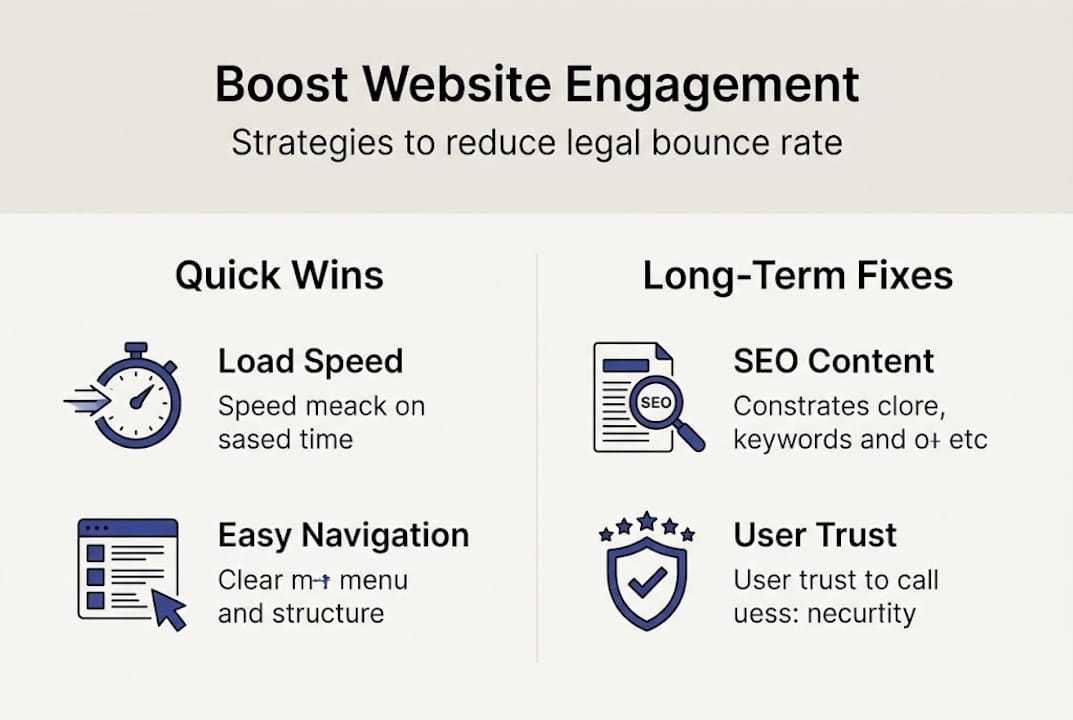
The single-page goal completion principle reinforces why your quick wins should center on making it as easy as possible for visitors to act without needing to navigate elsewhere. Putting your phone number and a consultation form above the fold on every practice area page removes the single biggest barrier to conversion.
Beyond the table above, here are the best practices that consistently improve engagement on legal websites:
- Place CTAs above the fold so visitors see the action option immediately upon arrival.
- Use attorney photos and real case results to build credibility and encourage visitors to read further.
- Write practice area content that directly addresses the visitor’s specific legal situation, not generic firm descriptions.
- Implement internal links that guide readers from blog posts and FAQs to relevant practice area pages, extending sessions organically.
- Test page headlines regularly. The first line of copy on any page is the most influential factor in whether a visitor stays to read more.
Applying rigorous on-page SEO for lawyers principles ensures your content is both search-optimized and visitor-friendly, two goals that reinforce rather than conflict with each other when done correctly.
Perspective: Why obsessing over bounce rate can hold law firms back
After years of working exclusively with law firms on digital strategy, we have seen a recurring pattern: legal marketing teams that chase a lower bounce rate as a primary goal often end up making decisions that hurt real business outcomes. They shorten content to reduce exits, remove information to force multi-page navigation, and redesign pages based on a metric that may have nothing wrong with it.
The uncomfortable truth is that some of your highest-bounce pages are your top converters. A well-crafted attorney bio page or a targeted practice area landing page may show a 70% bounce rate and still generate 40% of your consultation requests.
The firms winning in legal marketing right now are tracking calls booked, consultations attended, and cases signed. They use bounce rate as one signal among many, reviewed through law firm analytics best practices rather than treated as a standalone verdict. Shifting your team’s focus from vanity metrics to meaningful client actions is what separates firms that grow from firms that optimize endlessly without results.
Take the next step with expert law firm SEO and digital strategies
Reducing harmful bounce rates and improving client engagement requires strategy that goes well beyond surface-level fixes. At LawSEO.com, we work exclusively with law firms to build law firm SEO services and digital marketing programs that are grounded in real analytics, not guesswork. Our advanced SEO strategy for lawyers covers everything from technical site performance to content that genuinely connects with prospective clients at every stage of their search. If you are ready to turn website traffic into booked consultations, our team can build a tailored plan for your practice. Explore our full range of digital marketing for lawyers to see where the opportunity is greatest for your firm.
Frequently asked questions
What is a good bounce rate for a law firm website?
A good bounce rate for law firms typically falls between 40% and 60%, but the real benchmark depends on page purpose and visitor intent. A single-page conversion like a phone call or form fill means the page succeeded regardless of bounce rate.
Does a high bounce rate always mean something is wrong?
No. A high bounce rate is fine when visitors complete a single-page action like calling your office or submitting a contact form. Single-page goal completion counts as a win, even if analytics records it as a bounce.
How can I use bounce rate data to improve my legal website?
Combine bounce rate with engagement metrics like time on page, goal completions, and conversion rate. Focusing on pages with both high bounce rate and low session duration will direct your improvement efforts where they matter most.
What are some quick strategies to reduce bounce rate for law firms?
Improve page load speed, write specific and action-oriented CTAs, and ensure your site is fully mobile-responsive. Adding a prominent contact form above the fold on practice area pages is one of the fastest ways to improve engagement and reduce exits.