


California attorneys must comply with Rules of Professional Conduct 7.1–7.5 (and legacy Rule 1-400), Business and Professions Code Article 9.5 (sections 6157–6159.2), and Senate Bill 37, which expands private civil remedies and vendor liability for non-compliant advertising. Every communication must be truthful and non-misleading, carry the name and address of a responsible lawyer or firm, and retain copies for at least two years. Targeted solicitations require an “Advertisement” label. Three actions to take this week:
- Update your website footer and Google Business Profile to include a bona fide office city, county, or State Bar address of record.
- Audit all paid search and display ads for false or misleading claims, guarantees, and missing responsible-party disclosures.
- Label every targeted email, direct mail piece, and social DM as “Advertisement” on the outside of the envelope or in the subject line.
Key Takeaways
California attorney advertising compliance requires immediate action on disclosures, retention, and vendor oversight, with SB 37 making civil liability a real risk for every active campaign.
| Point | Details |
|---|---|
| Controlling authorities | Rules 7.1–7.5, legacy Rule 1-400, and BPC §6157–6159.2 govern all California attorney advertising. |
| Top three immediate actions | Update website footer disclosures, audit paid ad copy for misleading claims, and label all targeted messages “Advertisement.” |
| Retention period | Retain copies of all communications, targeting parameters, and landing page snapshots for a minimum of two years per Rule 1-400. |
| SB 37 vendor liability | Firms are liable for non-compliant vendor content; add written-approval and indemnification clauses to all agency contracts now. |
| Lawseo compliance review | Lawseo delivers audit reports, ad copy redlines, and vendor clause templates to reduce SB 37 exposure for California law firms. |
What California attorney advertising rules actually govern
California lawyer marketing regulations draw from three overlapping sources, and understanding which one applies to a given communication is the first step toward compliance.
| Rule / Statute | What It Governs | Primary Coverage |
|---|---|---|
| Rule 7.1 | Prohibits false or misleading communications about a lawyer’s services | All communications: website, social, print, email |
| Rule 7.2 | Permits advertising through any written, recorded, or electronic means; requires responsible-party ID | Paid ads, website content, video, podcasts |
| Rule 7.3 | Defines solicitation; requires “Advertisement” label on targeted messages | Direct mail, targeted email, in-person outreach |
| Rule 7.1–7.5 | Governs claims of specialization or certification | Bios, practice-area pages, LinkedIn profiles |
| Rule 7.5 | Firm names and trade names | Letterhead, domain names, signage |
| Legacy Rule 1-400 | Defines “communication,” lists presumption categories, requires two-year retention | All prior-era advertising still under review |
| BPC §6157–6159.2 | Statutory advertising prohibitions, disclosure mandates, civil remedies | Electronic media, TV, radio, print, digital |
Rule 7.2 covers “any written, recorded, or electronic means,” so the scope is broad. A Google Ads headline, a YouTube pre-roll, a LinkedIn post, and a firm newsletter all qualify as communications subject to Rule 7.1’s truthfulness standard.
What counts as an “advertisement” versus a non-regulated communication
An advertisement is any communication that expressly or implicitly invites contact or describes the lawyer’s availability for employment. A press release about a court ruling, a law review article, or a purely educational social post that does not reference the firm’s services generally falls outside the definition. The line blurs quickly on professional websites. BPC §6157.2 treats any electronic communication that promotes legal services as advertising, which means a practice-area page describing case results is regulated content, not editorial content.
State Bar explanatory materials for the Rule 7.x series confirm that professional website content inviting contact or describing case results is advertising. Attorney biographies that imply availability for new matters carry the same classification.
What attorney ads in California cannot say or do
The prohibitions under Rule 7.1 and BPC §6157.2 are specific. Vague aspirational language often crosses the line without the firm realizing it.
Absolute prohibitions:
- False or misleading statements about the lawyer’s services, credentials, fees, or case outcomes. This includes technically true statements that create a false impression through omission or context.
- Guarantees or warranties of results. “We guarantee a favorable outcome” violates Rule 7.1 outright. The permissible alternative: “Past results do not guarantee future outcomes.”
- Dramatizations without disclosure. A video reenactment of a courtroom scene must be labeled as a dramatization. Omitting that label is a presumptive violation under legacy Rule 1-400.
- Impersonation of a judge, juror, or opposing counsel in any advertisement, regardless of context.
- Misleading fee statements. Advertising “free consultation” when the firm charges for follow-up calls within the same engagement is deceptive. “No fee unless you win” is permissible only when the firm genuinely charges no fee on a loss, including costs.
- Testimonials without disclaimers. Under Rule 1-400’s presumption categories, an unqualified client testimonial that implies typical results is presumptively problematic. The fix: add “Results may vary. This testimonial does not guarantee a similar outcome.”
- Comparative claims without factual basis. Calling your firm “the best DUI defense attorneys in Los Angeles” requires verifiable substantiation. Unsubstantiated superlatives are misleading under Rule 7.1.
Fee-splitting and referral limits under Rule 7.2 prohibit paying a non-lawyer for a referral. Referral fees to other lawyers are permissible only under the conditions Rule 1.5.1 specifies, and any arrangement must be disclosed to the client.
Pro Tip: Before publishing any ad copy, run a simple substitution test: replace every superlative (“best,” “top,” “most experienced”) with a factual claim you can document. If you cannot document it, cut it.
What disclosures and labels the law requires
Required disclosures fall into two categories: identification disclosures (who is responsible for this ad) and content-specific disclosures (what the results or testimonials actually mean).
-
Responsible-party identification. Every communication must include the name and address of at least one lawyer or law firm responsible for its content. This is a hard requirement under Rule 7.2© and BPC §6157.2. “Address” means a bona fide office location by city, town, or county, or the firm’s State Bar address of record.
-
“Advertisement” label on targeted solicitations. Any written or electronic communication directed to a specific person known to need legal services must be labeled “Advertisement” on the outside of the envelope or at the top of the message. Rule 7.3 is explicit on this point.
-
Testimonial and result disclaimers. BPC §6158.3 requires that any portrayal of a result in an electronic advertisement include a disclosure that the result does not guarantee a similar outcome. Place this disclosure conspicuously, not buried in a footer in 6-point type.
-
Language service disclaimers. When advertising to multilingual audiences, California’s language access considerations apply. If the ad is in Spanish, the required disclosures must also be in Spanish. Running an English-only disclaimer on a Spanish-language ad does not satisfy the conspicuousness standard.
-
Joint advertising disclosures. When two or more firms co-advertise, each firm’s name and responsible-party address must appear in the communication.
Correct vs. incorrect disclosure placement:
- Website footer (correct): “Law Offices of Jane Smith | 123 Main Street, Los Angeles, CA 90001 | State Bar No. 123456. Attorney advertising.”
- Website footer (incorrect): A copyright line with no lawyer name, no address, and no State Bar reference.
- PPC ad (correct): Ad headline names the firm; the landing page carries full name, address, and disclaimer above the fold.
- PPC ad (incorrect): Generic headline with no firm identification; landing page buries disclosures below a contact form.
- Social video (correct): On-screen text at the start and end of the video: “Advertisement | [Firm Name] | [City, State].”
- Influencer post (correct): Caption opens with “#Ad | [Firm Name], [City]” and links to a disclosure landing page with full statutory language.
- Short-form ads: When character limits make full disclosure impractical, BPC §6157.2 accepts a clear, prominent link to a landing page containing the complete disclosures.
For ethical SEO practices on attorney websites, the same disclosure standards apply to every page that invites contact or describes services, not just the homepage.
How solicitation rules differ from mass-media advertising
The distinction between a solicitation and a general advertisement determines whether the “Advertisement” label is required and whether additional prohibitions apply.
Mass-media communications are directed to the general public through channels like billboards, television, internet banner ads, website copy, and search engine results. Rule 7.3 explicitly states that a communication is not a solicitation when it reaches the general public through these channels or is automatically generated in response to a user’s search query.
Solicitations are targeted communications directed to a specific person known or reasonably believed to need legal services. In-person contact, live telephone calls, and real-time electronic messaging are the clearest examples. A direct email to someone whose name appeared in a police report, or a targeted Facebook ad served to users who recently searched for “car accident lawyer,” crosses into solicitation territory.
Examples by category:
Mass media (not solicitations):
- Firm website and practice-area pages
- Google search ads triggered by keyword queries
- Billboard and transit advertising
- Television and radio spots
- LinkedIn company page posts
Solicitations (require “Advertisement” label and additional rules):
- Direct mail to a named accident victim within 30 days of the incident
- Targeted email to a person identified as a party in a pending lawsuit
- Direct message to a social media user who posted about a legal problem
- Outreach to a represented party (generally prohibited outright under Rule 4.2)
When does a blog become advertising?
State Bar Formal Opinion No. 2016-196 draws a clear line: a blog integrated into a professional website is a regulated communication when it expresses the lawyer’s availability for employment or describes practice successes. A stand-alone blog that discusses legal topics without referencing the firm’s services or inviting contact is generally not a communication subject to advertising rules. Most law firm blogs live on the firm’s domain, include a “Contact Us” button, and reference case outcomes. That combination almost always qualifies as advertising.
For guidance on structuring legal content marketing to stay within these boundaries, the distinction between educational content and promotional content is the operative test.
Retention and documentation obligations for ads
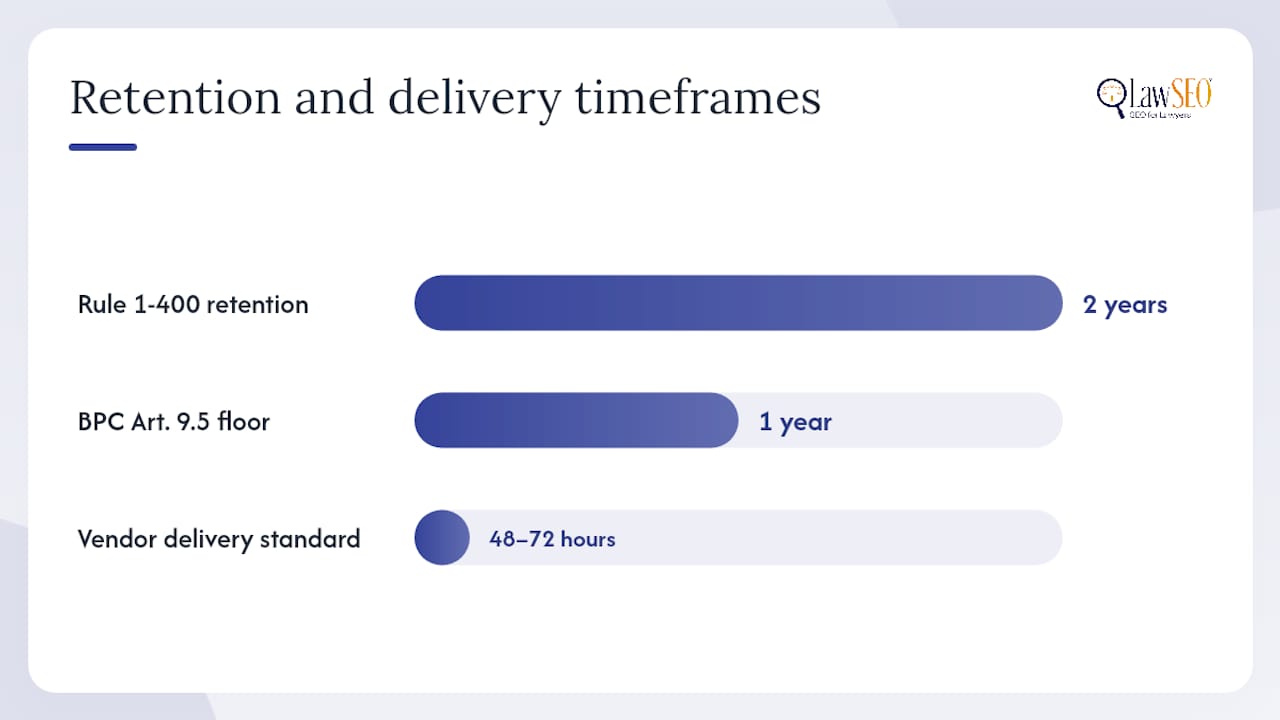
Legacy Rule 1-400 requires attorneys to retain a true and correct copy or recording of any communication made by written or electronic media for two years from the date of dissemination. BPC Article 9.5 sets a one-year retention floor for certain electronic advertising, but Rule 1-400’s two-year standard is the controlling obligation for most communications.
“Copy or recording” means more than saving the final creative. A complete retention file includes:
- Ad creative: Final approved versions of every ad, landing page, email, and social post.
- Targeting parameters: Screenshots or exports of audience targeting settings (geographic, demographic, keyword, interest-based) from Google Ads, Meta Ads Manager, or any other platform.
- Landing page snapshots: Timestamped screenshots of the landing page as it appeared when the ad ran, including all disclosures.
- Influencer agreements: Signed contracts specifying disclosure requirements, approval rights, and the firm’s right to demand copies of posted content.
- Intake transcripts: Recordings or notes from intake calls generated by advertising campaigns, where applicable.
- Metadata: Publication dates, run dates, and platform-specific identifiers (campaign ID, ad set ID).
Vendor contracts must include a clause requiring the agency or platform to deliver copies of all posted materials within a defined period (48–72 hours is a practical standard) and to preserve records for the full two-year window. Under SB 37-era enforcement thinking, firms are accountable for vendor content, so the contract is your first line of defense.
Store records in a searchable, access-controlled system. A shared Google Drive folder with no version control is not adequate. Use a document management system that logs access, preserves version history, and allows rapid production to the State Bar on request.
Enforcement, penalties, and what SB 37 changes
State Bar review procedure
Under BPC §6158.4, the State Bar may review an advertisement upon receiving a complaint. The procedure gives the advertiser an opportunity to withdraw or modify the communication within a specified period. Failure to comply can result in formal discipline, including public reproval, suspension, or disbarment for repeated or egregious violations.
Consumers misled by attorney advertising have a direct civil remedy under BPC §6157.2, which establishes statutory damages and other remedies for false, misleading, or deceptive advertisements. BPC Article 9.5 (§6158, §6158.3, §6158.4) adds presumptions about deceptive electronic media and a withdrawal-and-review process with specific timelines.
| Enforcement Mechanism | Governing Authority | Practical Consequence |
|---|---|---|
| State Bar complaint and review | BPC §6158.4 | Mandatory withdrawal or modification; formal discipline if ignored |
| Consumer civil action | BPC §6157.2© | Statutory damages; injunctive relief; attorney’s fees |
| Private action under SB 37 | SB 37 (current session) | Expanded standing; vendor co-liability; civil penalties |
| Formal discipline (State Bar) | Rules of Professional Conduct | Reproval, suspension, disbarment |
What SB 37 changes in practice
SB 37 expands the scope of attorney advertising regulation and creates private causes of action for aggrieved consumers. The practical shift is significant: before SB 37, enforcement was primarily administrative. Now, a consumer who was misled by a deceptive attorney ad can bring a civil suit directly, without waiting for the State Bar to act.
Practitioner analysis of SB 37 concludes that firms relying on third-party agencies are now exposed to strict liability for non-compliant vendor content. If your SEO agency or PPC vendor publishes a misleading ad on your behalf, the firm bears the legal risk. That shifts vendor oversight from a best practice to a compliance obligation.
Immediate risk-reduction steps:
- Withdraw any ad that contains a guarantee, an unqualified testimonial, or a missing responsible-party disclosure.
- Preserve evidence of the withdrawal: screenshots with timestamps, platform confirmation emails, and internal approval records.
- Audit every active vendor relationship and add SB 37-compliant indemnification and approval clauses to contracts.
- Keep versioned snapshots of all live ad creative in a searchable evidence store so you can demonstrate remediation quickly.
Step-by-step compliance checklist and firm audit template
Run this audit across every active channel before the end of the month. Assign each section to a named team member and document the outcome.
Website content and bios
- [ ] Every practice-area page includes the firm name, bona fide office city/county, and State Bar address of record in the footer.
- [ ] Attorney bios do not claim specialization or certification unless the State Bar or an ABA-accredited organization has formally certified the attorney in that area.
- [ ] Case result descriptions include a conspicuous disclaimer that past results do not guarantee future outcomes.
- [ ] The “Contact Us” page and intake forms do not make implied promises about outcomes.
- [ ] Blog posts integrated into the site that reference case results or invite contact carry the firm’s name, address, and a result disclaimer.
Paid search and display advertising
- [ ] Every ad creative names the responsible firm or attorney.
- [ ] Landing pages carry full disclosures above the fold: firm name, address, result disclaimer, and “Attorney Advertising” label.
- [ ] No ad copy contains a guarantee, warranty, or unqualified superlative.
- [ ] Targeting parameters are exported and saved with the ad creative file.
- [ ] Ads targeting users based on legal-need signals (e.g., “car accident,” “DUI arrest”) are reviewed for solicitation classification.
Social media and influencer content
- [ ] Firm-published posts that describe services or invite contact include the firm name and city.
- [ ] Influencer or sponsored posts open with “#Ad | [Firm Name], [City]” and link to a full disclosure page.
- [ ] Influencer contracts include approval rights, disclosure requirements, and a clause requiring the influencer to deliver copies of all posted content within 48 hours.
- [ ] Social video ads include on-screen text identifying the firm and labeling the content as an advertisement.
Direct mail and email outreach
- [ ] All targeted mail and email pieces are labeled “Advertisement” on the outside of the envelope or in the email subject line.
- [ ] No outreach targets represented parties.
- [ ] Mailing lists are documented with the source and date of acquisition.
Testimonials and dramatizations
- [ ] Every client testimonial includes: “Results may vary. This testimonial does not guarantee a similar outcome.”
- [ ] Video dramatizations are labeled “Dramatization” on screen.
- [ ] Testimonials are from real clients; no composite or illustrative testimonials appear anywhere.
Multilingual advertising
- [ ] Ads published in a language other than English carry all required disclosures in the same language as the ad.
- [ ] Translated disclosures are reviewed by a qualified translator, not auto-translated.
Referral arrangements and fee disclosures
- [ ] No referral fees are paid to non-lawyers.
- [ ] Lawyer-to-lawyer referral arrangements comply with Rule 1.5.1 and are disclosed to the client.
- [ ] “No fee unless you win” claims are accurate: the firm charges no fee and no costs on a loss.
Pro Tip: Add a standard vendor clause to every marketing agency contract: “Vendor shall deliver copies of all published creative, targeting parameters, and platform reports to [Firm Name] within 48 hours of publication and shall preserve all records for a minimum of two years. Vendor shall indemnify [Firm Name] for any State Bar or civil enforcement action arising from content published without written approval from [Firm Name].”
Internal governance: Assign one attorney as the advertising compliance officer. Run a monthly ad inventory (a spreadsheet listing every live ad, its channel, its run date, and its disclosure status). Conduct a quarterly vendor audit. Require marketing team members to complete annual training on permissible claims, with a signed acknowledgment on file.
For a practical framework on designing a lawyer website that meets these disclosure standards from the ground up, footer structure and page-level disclosure placement are the highest-priority elements to address first.
The compliance areas that matter most right now
Three areas generate the most enforcement exposure for California firms right now, and none of them require a complete marketing overhaul to fix.
Website disclosures are the most common gap. Firms spend significant resources on SEO and paid traffic, then send visitors to pages that lack a bona fide office address or a result disclaimer. The fix takes an afternoon: update the footer template site-wide and add a one-line disclaimer to every case result page.
Paid ad audits are urgent because SB 37 creates private civil liability, not just State Bar discipline. A single misleading Google Ad headline can now trigger a consumer lawsuit. Pull every active campaign, review the copy against Rule 7.1’s truthfulness standard, and confirm that every landing page carries the required disclosures.
Vendor contracts are the most underestimated risk. Most firms have no clause requiring their SEO or PPC agency to seek written approval before publishing. Under SB 37, that gap means the firm is liable for whatever the vendor publishes. A one-page addendum to existing contracts closes that exposure faster than any other single action.
For firms with limited resources, start with the website footer. It is the one disclosure that touches every page, every visitor, and every potential complainant simultaneously.
How Lawseo helps California firms stay compliant and competitive
California’s attorney advertising rules create a real tension: the more aggressively a firm markets, the greater the compliance exposure. Lawseo resolves that tension by building compliance into the marketing process from the start, not as an afterthought.
Lawseo’s law firm SEO services include a full advertising compliance review covering website disclosures, landing page structure, paid ad copy, and vendor contract language. Every campaign Lawseo manages includes a pre-publication approval workflow, versioned creative archives, and targeting-parameter exports stored for the full two-year retention window. When a client receives a State Bar inquiry, the evidence file is already organized and ready to produce.
The deliverables are concrete: an audit report identifying every non-compliant element, recommended redlines for ad copy, and a vendor clause template drafted to SB 37 standards. To schedule a compliance review and ad audit for your firm, contact Lawseo directly at Lawseo.
Primary sources and further reading
The documents below are the controlling authorities for California attorney advertising compliance. Keep these links in your firm’s compliance binder and save a timestamped snapshot of each for your audit trail.
| Source | What It Covers |
|---|---|
| Rules 7.1–7.5, Rules of Professional Conduct | Core advertising and solicitation rules: truthfulness, permitted advertising, solicitation definitions, specialization claims, firm names |
| Rule 1-400, State Bar of California | Legacy definitions, presumption categories of problematic communications, two-year retention requirement |
| BPC §6157.2, Article 9.5 | Statutory advertising prohibitions, conspicuous disclosure requirements, consumer civil remedies |
| BPC Article 9.5 full text | Electronic media presumptions, result-disclosure rules (§6158.3), State Bar review procedure (§6158.4) |
| Formal Opinion No. 2016-196 | When a blog or integrated website content becomes a regulated attorney communication |
| SB 37 bill text and history | Expanded private civil actions, vendor liability, and operative changes to attorney advertising regulation |
This article provides general information about California attorney advertising rules and does not constitute legal advice. Confirm current rules with the State Bar of California or a qualified ethics counsel before making compliance decisions.
This article is general information, not a substitute for advice from a qualified lawyer. Consult a qualified legal professional about your own circumstances before acting on anything here.
Sources
- Rule 7.1–7.3 (Chapter 7) — Rules of Professional Conduct (California)
- California Code, Business and Professions Code §6157.2 (Article 9.5 Legal Advertising)
- Rule 1-400 Advertising and Solicitation | The State Bar of California
- SB 37 — California Legislature bill text and history
- Formal Opinion No. 2016-196 — Blogging and attorney communications (State Bar Standing Committee)