


Run a Google Local Services Ads pilot if your practice handles volume matters like personal injury, family law, DUI, or immigration. LSAs place your firm above both paid search results and organic listings, and you pay only when a prospective client actually calls or messages you. Verify eligibility, budget for active lead management, and track cost per signed case before scaling spend.
TL;DR:
- Cost per lead for legal LSAs typically ranges from $50 to $250, with higher costs for personal injury and criminal defense due to higher case value.
- Tracking cost per signed client is essential, as high lead costs can be offset by higher close rates, especially in competitive practice areas.
- Verification delays often stem from mismatched business names, licenses, or insurance documents, making alignment before applying critical for faster approval.
- Responding promptly to calls and reviews, managing the profile actively, and maintaining accurate service areas significantly improve ranking and lead quality.
- Running LSAs alongside local SEO and testing both channels for at least six weeks provides the clearest picture of cost-effectiveness and client acquisition.
What Are Google Local Services Ads for Lawyers?
Local Services Ads work on a pay-per-lead model, not the pay-per-click structure most attorneys already know from Google Ads. Instead of paying every time someone clicks your listing, you’re charged only when a prospective client calls or messages your firm directly through the ad. LSAs appear above traditional PPC ads and organic results, occupying the most valuable real estate on the results page.
Your listing shows a business name, a tracking phone number, your service area, star ratings, and hours. Attorneys who pass Google’s screening also display a Google Verified badge (formerly known as Google Screened), which signals to searchers that Google has confirmed your license and background before you ever appear in results.
The dashboard behind the ads is where the real work happens. You manage incoming leads, adjust weekly budgets, pause the campaign when your intake team is overloaded, and request credits for leads that never should have counted. That last feature matters more than most firms realize, and it’s worth building a workflow around it from day one.
What Does Google Require to Verify Lawyers for LSAs?
Google’s screening process for U.S. legal advertisers is more rigorous than for most home-service categories, and for good reason. Expect background checks and license verification tied to the specific attorney or attorneys who will handle incoming leads, not just the firm as a business entity.
Here’s what Google typically asks for:
- State bar license number and standing, matched to the exact legal name on your business registration.
- Business registration documents confirming your firm operates legitimately in the service area you select.
- Proof of malpractice insurance where the practice area calls for it.
- A background check on the responsible attorney and any staff who might field calls.
- A professional headshot and basic profile information tied to a real, findable person, not a logo or stock photo.
The most common delay isn’t the background check itself. It’s a mismatch between your legal business name, your bar registration, and your insurance documents. Lining those up before you apply is the single most effective way to avoid getting stuck in verification limbo. Realistically, budget two to five weeks from application to approval, and treat any Google request for additional documentation as urgent rather than routine paperwork.
How Much Do Legal Leads Cost Through LSAs?
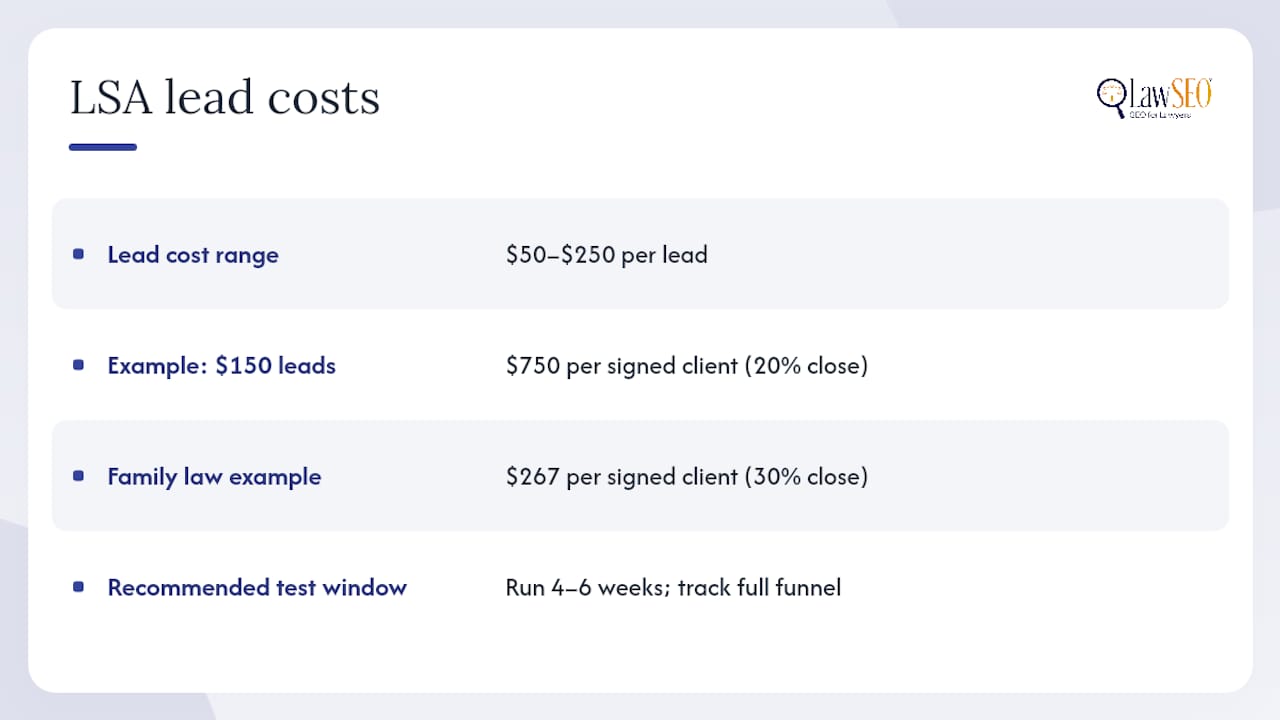
Cost per lead for legal LSAs varies more than almost any other advertised category on Google, and practice area drives most of that swing. Aggregated agency data puts legal leads in the $50 to $250 range per lead, with personal injury and criminal defense frequently landing at the high end because those cases carry higher lifetime value and more competition for the same searchers.
The number that actually matters isn’t cost per lead. It’s cost per signed client.
Here’s the math a lot of firms skip: if you’re paying $150 per lead and closing one out of every five leads into a signed retainer, your real acquisition cost is $750 per client, not $150. A family law firm with a 30% close rate on $80 leads is paying roughly $267 per signed client, a very different number than the sticker price suggests.
Start with a modest weekly budget, something you can afford to run for four to six weeks without touching, and track every lead from first contact through signed engagement. You need that full window before the ranking algorithm and your intake process settle into a realistic pattern.
How Do You Set Up Google Local Services Ads for a Law Firm?
Getting an LSA campaign live involves more than clicking “start.” Follow this order to avoid the rework that comes from skipping steps:
- Confirm eligibility first. Check that your practice area and state are supported before investing time in the application.
- Align your legal documentation. Match your business name across your state bar registration, business license, and insurance certificates.
- Build the profile. List your specific practice areas, define your service area by ZIP code or radius, set accurate business hours, and upload a professional headshot.
- Submit to verification. Google runs background checks on the responsible attorney and reviews your submitted business documents.
- Set your operational rules. Configure weekly budget caps, decide who receives lead notifications, and build a same-day intake script before your first lead arrives.
- Launch with a pause plan. Know in advance how you’ll pause the campaign if intake capacity gets overwhelmed, rather than scrambling in the moment.
Skipping step two is the mistake that costs firms the most time. A single-letter discrepancy between your bar filing and your business registration can add weeks to approval.
What Improves LSA Ranking and Lead Quality for Attorneys?
Google ranks LSA listings using a mix of proximity, reviews, responsiveness, and profile completeness, and the factors that move you up fastest aren’t always the ones firms assume matter most. Budget increases help, but responsiveness and review volume tend to move your position faster than throwing more money at the campaign.
Pro Tip: Answer every LSA call live during business hours if you possibly can. Google’s algorithm weighs response speed heavily, and a missed call that goes to voicemail can quietly cost you ranking position over time, not just that one lead.
The levers that actually move the needle:
- Request reviews consistently from satisfied clients, not just occasionally after a big win.
- Respond publicly to every review, positive or negative, since responsiveness signals extend to how you handle feedback.
- Staff phones during your listed hours and return missed calls the same business day.
- Write intake scripts that qualify callers quickly without sounding like an interrogation.
- Keep service categories and service area radius accurate rather than casting too wide a net and attracting leads outside your real coverage zone.
- Use a real, current headshot and a firm bio that matches your actual practice focus.
None of this happens in isolation. Your Google Business Profile and your organic local rankings feed the same reputation signals that LSAs draw on, and firms that neglect one while investing in the other usually see weaker results than the spend justifies. A profile with strong local search visibility tends to convert LSA leads at a higher rate simply because prospective clients cross-check you before calling.
How Do You Dispute Junk Leads and Track ROI?
Because you’re paying per lead, every spam call or wrong-number message that slips through is money wasted unless you catch it. Google allows advertisers to dispute leads that are spam, solicitations, or otherwise outside your practice area, and successful disputes mean you don’t pay for them. Most firms never build a disciplined process around this, which leaves real money on the table.
A workable system looks like this:
- Log every lead the moment it arrives, tagging it as booked, retained, unqualified, or spam in your CRM.
- Dispute junk leads within Google’s specified window rather than batching them for later, since delayed disputes are harder to win.
- Review your dispute rate monthly. A high rate might mean your service area or category settings need tightening.
- Calculate cost per signed client monthly, not just cost per lead, and use that number to decide whether to increase or pull back budget.
Firms that actively dispute non-qualified leads lower their net cost per lead meaningfully over time, simply by refusing to pay for calls that were never real prospects to begin with.
Should You Run LSAs, Search Ads, or Both?
The right answer depends heavily on practice area. Volume-oriented categories like family law, DUI defense, and personal injury tend to perform well on LSAs because searchers in those situations want a fast, verified answer and often call the first credible listing they see. Higher-value, more considered matters like complex litigation or business law sometimes convert better through Search Ads, where the searcher has already done more research and shows stronger intent.
The most reliable way to know for your firm: run both channels simultaneously for six to twelve weeks, then compare cost per booked client and close rate side by side. Reports suggest Search Ads sometimes win on cost per signed client even when LSAs win on raw cost per lead, because Search Ads captures searchers further along in their decision. Once you have real numbers from your own market, reallocate budget toward whichever channel is actually producing signed clients at the lower cost, and revisit that split quarterly as competition shifts.
Why LawSEO’s Legal Marketing Experience Matters Here
Todd R. Stager has spent over 29 years in SEO, working exclusively with law firms on the campaigns described throughout this guide. Lawseo handles the pieces that trip up most attorneys attempting this alone: profile setup, verification document alignment, ongoing campaign management, CRM lead tagging, and monthly ROI reporting that separates real signed clients from noise in the lead data.
What Actually Happens When You Run an LSA Pilot
Most firms overestimate how fast LSAs will produce booked clients and underestimate how much intake discipline the channel demands. A short pilot, four to six weeks with disciplined lead tagging, tells you more than any industry benchmark. Track signed retainers, not raw lead counts. Keep conflict checks and intake ethics as rigorous for LSA callers as for any referral. And never treat paid leads as a replacement for organic visibility. The firms getting the best long-term numbers run LSAs alongside local SEO, not instead of it.
— TODD
Get Help Launching and Managing Your LSA Campaign
Setting up Local Services Ads correctly the first time saves weeks of verification delays and wasted spend on unqualified leads. Some providers run a structured audit, pilot, and managed-service process for law firms: first an audit of your current profile and eligibility gaps, then a short pilot with weekly lead tracking, then ongoing campaign management once the numbers justify scaling. That process includes CRM integration so every lead gets tagged from first call to signed retainer, letting you see real cost per client instead of guessing from cost per lead alone.
If your firm handles volume practice areas and hasn’t tested LSAs yet, or has tried them without a clear measurement system, start with a legal SEO strategy session to see where your profile and verification status currently stand.
Where to Verify LSA Policies and Requirements
- Local Services Ads overview: profile fields, badges, and how ads display.
- U.S. screening requirements: background checks and license verification.
- Clio’s guide for lawyers: practice-specific LSA context.
Sources
- Google Local Services Ads for Lawyers: Maximize Your ROI | Clio
- Business screening and verification requirements – United States – Local Services Help
- Local Services Ads overview – Local Services Help
- Local Services Ads cost per lead by industry (aggregated agency data)