


TL;DR:
- A law firm website should function as a client acquisition system focused on building trust and making contact easy. Proper preparation involves defining goals, finalizing branding, and setting up essential technology before development begins. Once launched, ongoing content updates, analytics review, and form optimization are necessary for sustained growth and improved conversions.
A law firm website is a client acquisition system, not a digital brochure. Knowing how to launch a law firm site correctly means building a conversion-focused platform that communicates expertise, builds trust, and makes contact effortless. Well-designed law firm websites optimized for mobile and speed achieve conversion rates between 5–10%, compared to the 2–3% industry average. That gap represents real clients. This guide walks you through every stage of starting a law firm website, from pre-launch prerequisites to post-launch growth, using current best practices for legal web design and SEO.
What you need before launching your law firm website

Every successful law firm website launch starts with preparation, not design. Attorneys who skip this stage end up rebuilding their sites within 18 months.
Define your business and marketing goals first. Decide which practice areas you want to promote, what volume of leads you need monthly, and which geographic markets you serve. These decisions shape every content and design choice that follows.
Branding elements must be ready before development begins. You need a finalized firm name, logo, color palette, and a clear tone of voice. A personal injury firm in Houston projects a different personality than an estate planning boutique in Connecticut. Both need consistency across every page.
Essential content requirements include:
- Attorney bios with professional photos and relevant credentials
- Dedicated practice area pages for each service you offer
- Client testimonials and, where permitted, case results
- A clear contact page with phone number, address, and office hours
- An “About the Firm” page that explains your history and values
Technology and tools must be in place before you build. This includes a registered domain name, reliable hosting, a content management system (CMS) such as WordPress, analytics tracking via Google Analytics 4, and a CRM to capture and manage leads.
| Prerequisite | Purpose | Example |
|---|---|---|
| Business goals | Focus content and design decisions | “Generate 20 personal injury leads per month” |
| Branding assets | Create visual and tonal consistency | Logo, color palette, firm tagline |
| Core content | Give visitors reasons to contact you | Attorney bios, practice area pages |
| Domain and hosting | Make the site accessible and fast | .com domain, managed WordPress hosting |
| Analytics and CRM | Track performance and manage leads | Google Analytics 4, CRM integration |
Pro Tip: Register your domain as your firm name, not a keyword phrase. “SmithLawGroup.com” builds brand recognition. “BestPersonalInjuryLawyer.com” looks dated and can hurt credibility.
How should you structure your law firm website for client engagement?
Site architecture determines whether visitors find what they need or leave. Professional law firm websites function as client acquisition systems where every page has a defined role in moving a visitor toward contact.
Homepage: the routing page
Your homepage is not where you close the deal. Its job is to confirm you serve the visitor’s legal need and direct them to the right practice area page. The headline should address the visitor’s problem and promise a solution, not just display your firm name. Include your location, a phone number visible above the fold, and clear navigation links to your core practice areas.
Practice area pages: the conversion engines
Practice area pages designed with specific client needs convert 2–3 times better than generic homepages. Each page should address one legal issue, explain the process in plain language, include relevant case results or outcomes, answer common client questions, and close with a targeted call to action. A personal injury page and a family law page need entirely different tones, structures, and contact strategies.
Attorney bio and contact pages
Attorney profile pages build trust by connecting visitors to real people with relevant experience. Include a professional photo, bar admissions, years of practice, and a brief personal statement. The contact page needs a short intake form, a click-to-call phone button, an embedded map, and your operating hours. Multiple contact methods, including click-to-call buttons optimized for mobile, increase engagement from high-intent visitors who are ready to act.
Pro Tip: Place trust signals, including bar membership badges, peer review awards, and real client testimonials, on every page, not just the homepage. Visitors land on practice area pages directly from search results and need to see credibility signals immediately.
Steps to launch your law firm site from development to go-live
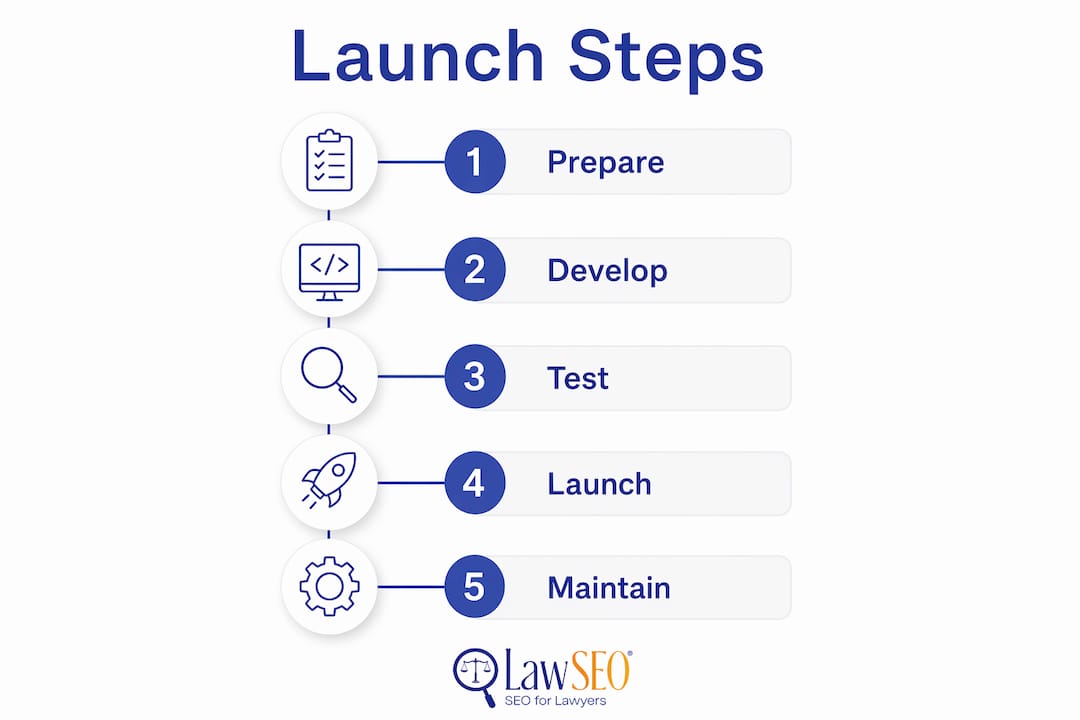
Building a law firm website follows a defined sequence. Skipping steps creates technical debt that costs more to fix after launch than before.
- Choose your CMS and development approach. WordPress with a legal-specific theme is the most common choice for small to midsize firms. Custom development takes longer and costs more but offers greater flexibility. Budget 8–12 weeks for a properly built site.
- Develop content with SEO built in. Write practice area pages around specific search queries your clients use. “Chicago truck accident lawyer” outperforms “personal injury attorney” for local intent. Use plain language, structured headings, and answer common questions directly on the page.
- Apply UX principles during design. Fast page loading under 3 seconds on mobile connections drives higher conversion. Use a mobile optimization checklist to verify responsiveness, font sizes, button tap targets, and image compression before launch.
- Set up lead capture on every page. Short intake forms, click-to-call buttons, and calendar booking integrations capture leads at different stages of the decision process. Reducing intake form fields from 4 to 3 increases conversion rates by nearly 50%. For complex practice areas like personal injury or estate planning, multi-step intake forms convert 86% higher than long single-step forms when they show progress indicators.
- Test before you launch. Check every form submission, phone link, and page load on both desktop and mobile. Confirm Google Analytics 4 is recording sessions. Test your CRM integration to verify leads are captured correctly.
- Execute launch day tasks. Point your domain to the live server, submit your sitemap to Google Search Console, and announce the launch via email and social media. A balanced call-to-action strategy matched to visitor decision stage, informational CTAs at the top of the funnel and consultation booking at the bottom, maximizes conversions from day one.
| Launch phase | Key task | Success metric |
|---|---|---|
| Pre-development | Goals, branding, content ready | All assets approved before build starts |
| Development | CMS setup, SEO content, UX design | Pages load under 3 seconds on mobile |
| Pre-launch testing | Forms, tracking, CRM integration | Zero broken links or failed submissions |
| Launch day | Domain pointing, sitemap submission | Site indexed in Google Search Console |
Pro Tip: Do not launch without Google Analytics 4 and Google Search Console both verified and recording data. You cannot improve what you cannot measure, and the first 30 days of data are irreplaceable.
How do you maintain and grow your law firm website after launch?
A law firm website is not a one-time project. It requires ongoing attention to sustain and grow client acquisition. A well-designed website supports SEO performance only when it is actively maintained and updated.
Monitor analytics weekly. Track which practice area pages generate the most contact form submissions and phone calls. Identify pages with high traffic but low conversion and investigate why visitors are leaving without acting.
Iterate based on user behavior data. Heatmap tools show where visitors click and scroll. Session recordings reveal where users get confused or drop off. Use this data to rewrite unclear sections, reposition calls to action, and simplify navigation.
Publish targeted content consistently. Publishing relevant legal content regularly builds topical authority and organic traffic that sustains client acquisition over time. A blog post answering “What should I do after a car accident in Dallas?” can attract qualified leads for years after publication.
Automate your follow-up process. Booking tools integrated with your CRM eliminate delays and manual follow-ups. A lead who submits a form at 10 PM should receive an automated confirmation immediately and a personal call the next morning.
Pro Tip: Target specific high-intent local search queries in your content strategy. “Estate planning attorney in Phoenix” is more valuable than “estate planning tips” because the searcher has clear purchase intent. This approach builds a self-sustaining lead generation system that reduces dependence on paid advertising.
Key Takeaways
A law firm website succeeds when it functions as a client acquisition system, built on clear goals, targeted content, fast mobile performance, and consistent post-launch optimization.
| Point | Details |
|---|---|
| Prepare before you build | Define goals, finalize branding, and gather all content before development starts. |
| Design for conversion | Practice area pages convert 2–3x better than homepages when built around specific client needs. |
| Speed and mobile matter | Pages loading under 3 seconds on mobile directly improve lead conversion rates. |
| Simplify your forms | Reducing form fields from 4 to 3 can increase conversions by nearly 50%. |
| Maintain and publish | Regular content and CRM automation sustain client acquisition long after launch day. |
What I have learned from launching law firm sites
After nearly three decades working exclusively in legal digital marketing, one pattern stands out: attorneys consistently over-invest in visual design and under-invest in content structure. A site that looks polished but buries the phone number below the fold will always underperform a simpler site that puts contact options front and center.
The homepage mistake I see most often is treating it as a summary of everything the firm does. Visitors do not want a firm overview. They want confirmation that you handle their specific legal problem, in their city, and that you are reachable. The homepage should open the door and route visitors to the right practice area page. That page closes the deal.
Contact forms deserve more attention than most attorneys give them. I have seen firms lose leads because their intake form asked for case details, budget range, and preferred contact time before even asking for a name. Simplicity wins. Ask for the minimum information needed to start a conversation, then gather details during the consultation.
The firms that grow consistently are the ones that treat their website as a living system. They publish new content, test their forms, and review their analytics. They also invest in improving website UX as search behavior evolves. A site built in 2024 and never touched in 2026 is already losing ground to competitors who are actively optimizing.
Trust signals are non-negotiable. Real client testimonials, bar association memberships, and peer recognition awards belong on every major page, not just a dedicated “Reviews” tab. Visitors who land directly on a practice area page from a Google search need to see credibility signals immediately, or they will leave.
— TODD
How Lawseo supports your law firm website from launch to growth
Lawseo works exclusively with attorneys and law firms, which means every recommendation is built around the specific demands of legal marketing. The firm’s founder, Todd R. Stager, brings over 29 years of SEO experience to every client campaign, personally reviewing strategy and execution. Lawseo offers law firm SEO services that cover web design, local SEO, content production, and CRM integration, giving you a complete system rather than disconnected tactics. If you are building a new site or redesigning an existing one, Lawseo’s digital marketing for lawyers programs are built to generate measurable client inquiries from day one.
FAQ
What is the most important page on a law firm website?
Practice area pages are the highest-converting pages on a law firm website. They convert 2–3 times better than homepages when built around specific client needs and focused content.
How many fields should a law firm intake form have?
Three fields is the proven standard. Reducing intake form fields from 4 to 3 increases conversion rates by nearly 50%, with name, phone, and email as the core required fields.
How long does it take to launch a law firm website?
A properly built law firm website typically takes 8–12 weeks from kickoff to launch, accounting for content development, design, testing, and CRM integration.
Does a law firm website need a blog?
Publishing relevant legal content regularly builds topical authority and organic traffic that continues attracting clients for years beyond the initial publication date.
What conversion rate should a law firm website achieve?
Well-designed law firm websites optimized for mobile and speed achieve conversion rates between 5–10%. The industry average sits at 2–3%, so there is significant room to outperform competitors with proper design and content strategy.