


TL;DR:
- Effective law firm keywords focus on local, transactional phrases with measurable search volume and manageable competition. Prioritizing city-specific and long-tail terms boosts conversions and ranks faster than broad, national keywords. Regular keyword review and mapping ensure targeted, results-driven SEO strategies.
Keyword selection for law firms is the process of identifying the exact search phrases potential clients type into Google when they need legal help. Done correctly, it connects your practice to people who are ready to hire, not just browse. Knowing how to select keywords for law firms means balancing search volume, competition, geographic relevance, and searcher intent. Tools like Google Keyword Planner and Google Search Console give you the raw data. The real skill is knowing which signals matter most for a legal practice competing in a specific city and practice area.
How to select keywords for law firms: core criteria
The right keyword for a law firm meets four tests: it has measurable search volume, it signals clear intent, it is geographically relevant, and it is realistically winnable given your current domain authority.

Search volume is the starting point. Keywords with 100–500 monthly searches in your jurisdiction hit the sweet spot. They attract enough traffic to matter but face far less competition than broad national terms. Chasing “personal injury lawyer” nationally is a losing bet for most firms. Targeting “personal injury lawyer Houston” is a fight you can win.
Search intent separates browsers from buyers. Transactional keywords deliver the highest conversion rates for legal practices. Phrases like “hire personal injury lawyer” or “employment attorney consultation” signal that the searcher is ready to act. Informational queries like “what does a personal injury lawyer do” attract readers, not clients.
Keyword difficulty determines whether ranking is realistic. A difficulty score of 30–50 offers a balance of achievability and traffic volume for firms entering SEO. Scores above 70 require major investment in links and authority before you see results.
Cost Per Click (CPC) is a reliable proxy for commercial value. When advertisers pay over $200 per click for “car accident attorney near me”, that signals the organic version of that keyword is equally valuable. High CPC means high client lifetime value. Prioritize those terms.
- Target 100–500 monthly searches in your jurisdiction
- Favor transactional intent over informational intent
- Stay within difficulty scores of 30–50 when building authority
- Use CPC as a commercial value signal
- Always add geographic modifiers to reduce competition
Pro Tip: Never target a competitor’s branded name as a keyword. It violates ethical advertising standards in most state bar rules and wastes budget on traffic you cannot convert.
Which keyword categories should law firms prioritize?
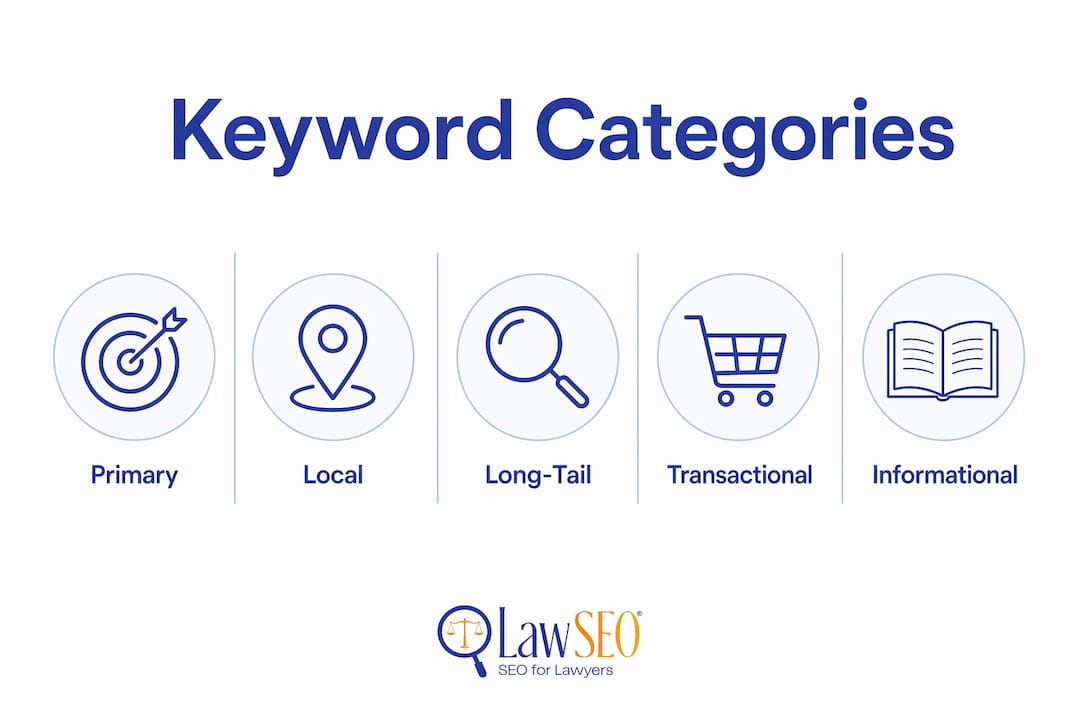
Effective keyword strategies for law firms combine three distinct categories: primary practice area keywords, city-level local keywords, and long-tail keywords. Each category plays a different role in your overall SEO strategy.
Primary practice area keywords
These are the broad terms that define what you do. Examples include “divorce attorney,” “criminal defense lawyer,” and “estate planning attorney.” They carry moderate to high search volume and moderate competition. They belong on your homepage and main service pages. Alone, they are hard to rank for nationally. Paired with a city name, they become far more achievable.
City-level local keywords
Practice area keywords combined with local modifiers yield the highest client conversion potential. “Family law attorney Austin” and “truck accident lawyer Dallas” are the types of phrases that bring in clients who are physically near your office and ready to book a consultation. Geographic context reduces competition and increases relevance. “Near me” keywords can carry up to 49% more search volume than their generic equivalents, making them a priority for any firm with a local client base.
Long-tail keywords
Long-tail phrases run 4–7 words and carry lower volume but dramatically higher intent. They are also easier to rank for. A phrase like “how to file for divorce without a lawyer” attracts a very specific searcher at a defined stage of their decision. These terms work best in blog posts, FAQ pages, and practice area sub-pages. Some long-tail phrases with strong commercial signals, such as “no fee unless you win car accident lawyer,” convert at rates that rival transactional head terms.
| Category | Example | Best page type | Conversion potential |
|---|---|---|---|
| Primary practice area | “divorce attorney” | Homepage, service page | Moderate |
| City-level local | “divorce attorney Chicago” | Service page, location page | High |
| Long-tail local | “uncontested divorce lawyer near me” | Blog, FAQ, sub-page | Very high |
Pro Tip: Build one dedicated page per keyword category. A single page targeting “divorce attorney,” “divorce attorney Chicago,” and “uncontested divorce lawyer near me” simultaneously will underperform on all three.
How to conduct keyword research step by step
A repeatable research process produces better results than one-off keyword lists. Follow these steps to build a keyword portfolio that grows with your firm.
-
Start with seed keywords. List every practice area your firm handles. Add your city and surrounding suburbs. These combinations are your starting seeds: “DUI lawyer Denver,” “workers comp attorney Denver,” “immigration lawyer Aurora CO.”
-
Run seeds through keyword tools. Google Keyword Planner shows volume and competition tiers at no cost. Google Search Console reveals what queries already bring traffic to your site. Ahrefs and SEMrush provide difficulty scores, CPC data, and SERP analysis for each term.
-
Run a competitor gap analysis. Competitor gap analysis identifies 30–50 valuable keywords where other firms rank but yours does not. Focus on terms with difficulty under 50, clear commercial intent, and direct relevance to your practice areas. These are your fastest wins.
-
Evaluate each keyword against four metrics. Record monthly search volume, keyword difficulty, CPC, and search intent type. Discard terms with difficulty above 70 unless your domain authority is already strong.
-
Map keywords to specific pages. Every keyword needs a home. Your homepage owns your top primary keyword. Each service page owns one practice area plus city modifier. Blog posts own long-tail informational terms. This keyword mapping process prevents two pages from competing against each other.
-
Start with 5–10 primary terms. A focused keyword set of 5–10 primary terms is the right starting point. Expand to 20–30 terms as your domain authority grows. Spreading too thin early dilutes your results.
-
Build content clusters around primary keywords. A pillar page on “personal injury law” supported by blog posts on “how long does a personal injury case take” and “personal injury settlement timeline” reinforces the primary keyword through topical authority. This is how you earn rankings on competitive terms over time.
| Step | Tool | Output |
|---|---|---|
| Seed keyword generation | Practice area list + city names | Raw keyword ideas |
| Volume and difficulty check | Google Keyword Planner, Ahrefs | Filtered keyword list |
| Competitor gap analysis | SEMrush, Ahrefs | 30–50 gap keywords |
| Keyword mapping | Spreadsheet | Page-to-keyword assignments |
| Content cluster planning | Internal linking map | Supporting blog topics |
For a deeper walkthrough of the research process, Lawseo’s guide on legal keyword research covers each step with legal-specific examples.
What keyword mistakes do law firms most often make?
Most law firm keyword strategies fail not from lack of effort but from predictable, fixable errors.
- Targeting overly broad terms. “Lawyer” and “attorney” have enormous competition and zero geographic relevance. They attract national traffic that never converts to local clients.
- Ignoring local modifiers. Skipping city names and “near me” variants means competing nationally when your clients are local. Local intent drives the highest conversion rates in legal search.
- Keyword cannibalization. Dedicating one primary keyword per page is the standard. When two pages target the same keyword, Google splits authority between them and ranks neither well.
- Misreading search intent. Publishing a blog post targeting “hire a DUI lawyer tonight” wastes a high-intent transactional keyword on a format that does not convert. Match the page type to the intent.
- Ignoring CPC signals. A keyword with zero advertiser interest usually means low commercial value. CPC data tells you which terms drive revenue, not just traffic.
- Stuffing keywords into content. Maintaining a keyword density of approximately 1.5–2% with natural semantic variations produces better results than forcing exact-match phrases into every sentence. Overuse triggers Google quality filters and damages readability.
- Skipping performance tracking. Keyword rankings shift. Google Search Console and rank tracking tools show which terms are climbing and which are stalling. Review your keyword portfolio at least monthly and adjust content accordingly.
Pro Tip: Set a calendar reminder to audit your keyword rankings every 30 days. A term that ranked on page two six months ago may now be ready to push to page one with a single content update.
Key takeaways
Selecting the right keywords for a law firm requires matching transactional intent, local relevance, and realistic difficulty to each page on your site.
| Point | Details |
|---|---|
| Prioritize transactional intent | Keywords like “hire personal injury lawyer” convert far better than informational queries. |
| Use local modifiers on every term | City names and “near me” phrases reduce competition and increase conversion rates. |
| Target difficulty scores of 30–50 | This range offers achievable rankings without requiring massive domain authority. |
| Map one keyword per page | Assigning multiple competing keywords to one page splits authority and weakens rankings. |
| Start small, then expand | Begin with 5–10 primary terms and grow to 20–30 as your domain authority increases. |
What I’ve learned after 29 years of legal SEO
Most law firms I work with arrive with the same problem. They have a list of keywords that looks impressive on paper but produces almost no qualified leads. The terms are too broad, too competitive, and completely disconnected from how real clients search in their city.
The single biggest shift I see when firms start winning is the move from ego keywords to intent keywords. “Best lawyer in New York” is an ego keyword. “Wrongful termination attorney Brooklyn free consultation” is an intent keyword. The second phrase has a fraction of the volume and delivers ten times the clients.
Local and long-tail focus is not a compromise. It is the actual strategy. The firms that try to rank nationally for broad terms spend years and significant budget with little to show for it. The firms that own their city and practice area with specific, intent-driven phrases start seeing qualified calls within months.
Keyword research is also not a one-time event. Search behavior changes. New competitors enter your market. Google updates its algorithm. The firms that treat keyword selection as an ongoing process, reviewing and adjusting their portfolio regularly, consistently outperform those who set it and forget it.
The data-driven approach I apply at Lawseo, using CPC signals, difficulty scores, and competitor gap analysis together, removes the guesswork. Every keyword on a client’s target list has a measurable reason to be there. That discipline is what separates a keyword strategy that produces leads from one that just looks thorough. You can read more about how this connects to a full law firm SEO strategy in Lawseo’s published guides.
— TODD
Lawseo’s approach to law firm keyword strategy
Lawseo works exclusively with attorneys and law firms, which means every keyword recommendation comes from deep familiarity with legal search behavior, bar advertising rules, and local competition patterns. Todd R. Stager and the Lawseo team apply the same data-driven criteria covered in this article, including CPC analysis, competitor gap research, and intent-based mapping, to every client campaign. The firm’s proven SEO strategies for law firms are built around the keyword frameworks that consistently produce qualified client leads. If you want a keyword strategy built specifically for your practice area and city, Lawseo’s law firm SEO services are a direct next step.
FAQ
What is the best keyword volume range for law firms?
Keywords with 100–500 monthly searches in your jurisdiction offer the best balance of traffic potential and achievable competition. Broad national terms with tens of thousands of monthly searches are rarely winnable for local firms.
How do I choose between informational and transactional keywords?
Transactional keywords, such as “hire a personal injury lawyer,” convert at higher rates and belong on service pages. Informational keywords belong in blog posts and FAQ content where they build authority over time.
What is keyword cannibalization and why does it matter?
Keyword cannibalization occurs when two pages on your site target the same primary keyword. Google splits authority between both pages and ranks neither effectively. Assign one primary keyword per page to avoid this.
How many keywords should a law firm target at first?
Start with a focused set of 5–10 primary keywords. Expand to 20–30 terms as your domain authority grows and your initial pages begin ranking. Spreading too thin early produces weak results across the board.
How do “near me” keywords perform for law firms?
“Near me” keywords carry up to 49% more search volume than generic equivalents and attract searchers with immediate, local intent. They are among the highest-converting keyword types for any law firm with a local client base.