


Finding your law firm buried beneath national giants in search results feels frustrating and costly. American clients searching online are not just browsing—they use detailed, location-based phrases to find attorneys for their exact legal needs. Focusing on long-tail keywords for law firms puts your services in front of ready clients by matching the specific words they actually search for, helping you stand out where it matters most.
Table of Contents
- What Are Long-Tail Keywords For Law Firms
- Types Of Long-Tail Keywords In Legal Marketing
- How Long-Tail Keywords Improve Local Search
- Integrating Long-Tail Keywords With Ai Optimization
- Common Mistakes Law Firms Make With Keyword Strategy
Key Takeaways
| Point | Details |
|---|---|
| Focus on Long-Tail Keywords | Law firms should prioritize specific, long-tail keywords to attract qualified leads actively seeking their services. |
| Utilize AI for Keyword Optimization | Leverage AI tools to identify and create targeted long-tail keywords and content, enhancing both efficiency and effectiveness. |
| Understand Keyword Intent | Align keyword strategies with the intent of searchers to effectively address potential clients at different stages of their legal journey. |
| Regularly Audit Keywords | Continuously review and update keyword strategies to capture evolving trends and ensure relevancy in search results. |
What Are Long-Tail Keywords for Law Firms
Long-tail keywords are specific, targeted search phrases that typically contain three or more words. Unlike broad terms such as “personal injury lawyer” or “divorce attorney,” long-tail keywords get much more granular. Think along the lines of “car accident injury lawyer near me” or “how to handle wrongful termination in California.” These extended queries reflect exactly what potential clients are looking for when they search online, making them extraordinarily valuable for law firms trying to connect with clients ready to take action.
The power of specific keyword phrases lies in their specificity and lower competition. When someone types a three or four word query into Google, they’re usually further along in their decision-making process than someone searching a single word. A prospect searching “DUI lawyer with free consultation in Phoenix” is actively hunting for your services right now. They know they need help. They know their location. They know what matters to them. That level of intent converts at dramatically higher rates than generic searches. Your competition for these specific phrases is also significantly lower because most law firms are chasing the same broad, high-volume keywords that everyone else targets.
Long-tail keywords also help you capture searches driven by niche legal services and specific client needs. Perhaps you specialize in ERISA disability claims or commercial lease disputes. The long-tail keywords related to your specific practice area will have lower search volume, but they attract clients seeking exactly what you offer. A business owner searching “small business contract review attorney in Colorado” is far more likely to hire you than someone generically looking for “attorney.” These hyper-specific phrases allow you to dominate search results for your actual service offerings rather than competing with massive national firms for impossible-to-win broad keywords. The math is simple: lower competition plus higher intent equals more qualified leads and more cases.
Here’s what makes this approach work for law firms specifically. You’re not just getting more traffic. You’re getting better traffic. Your practice areas and geographic focus define which long-tail keywords matter for your firm. A family law practice in Atlanta targets different long-tail phrases than an intellectual property firm in Seattle. The specificity means you’ll rank higher, faster, and attract clients who are genuinely seeking your services. This is where real client acquisition happens, not in the race to rank for impossible broad keywords.
Pro tip: Start identifying long-tail keywords by examining the actual language your current clients use when describing their legal problems. Client intake forms, phone consultations, and email inquiries contain gold. Mine that language and build your keyword strategy around how real people describe their situations, then create content addressing those exact problems.
Types of Long-Tail Keywords in Legal Marketing
Not all long-tail keywords work the same way in your law firm’s SEO strategy. Understanding the distinct types helps you build a keyword strategy that actually converts prospects into clients. Long-tail keywords fall into three primary categories based on what the searcher is trying to accomplish: informational, navigational, and transactional. Each type serves a different purpose in your content and targeting approach, and each appears at different stages of a potential client’s journey.
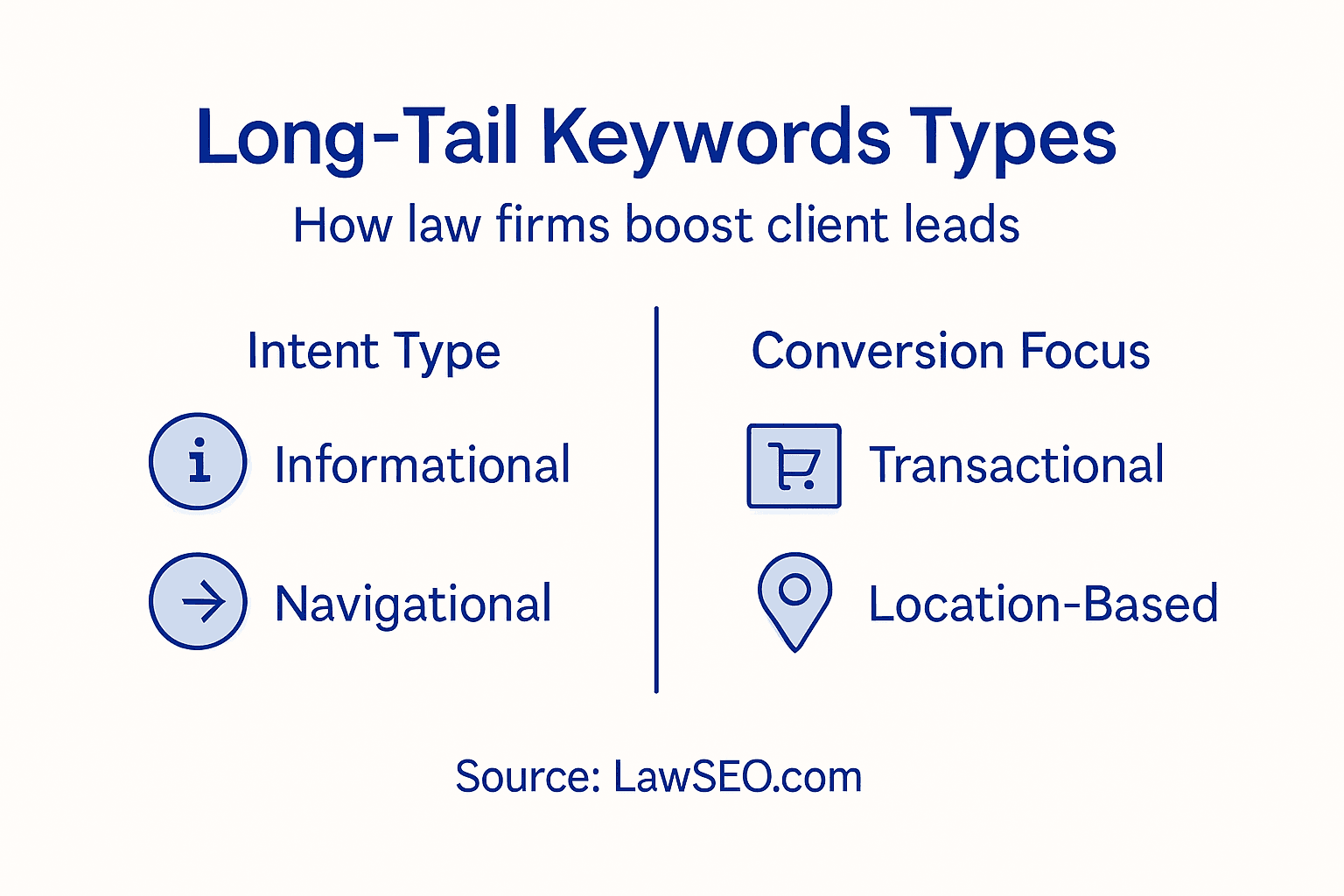
Informational keywords capture people who are researching their legal situation but haven’t yet decided to hire an attorney. These are the “how do I” and “what should I” questions. Someone might search “what are the grounds for divorce in Florida” or “how long does a workers compensation claim take.” These question-based keywords represent early-stage prospects still figuring out their options. Your law firm should create content addressing these questions directly. A comprehensive blog post answering “what happens during a deposition” positions your firm as knowledgeable and trustworthy. When prospects later decide they need legal help, they remember the firm that answered their questions.
Navigational keywords target people actively searching for a specific firm or service provider by name. This includes searches like “Smith and Associates law firm” or “employment lawyers in Denver.” While these searches have lower volume, they carry high intent. Someone typing your firm’s name into Google is already thinking about you. Navigational long-tail keywords also include searches for specific service categories combined with location, which help prospects discover local firms. These keywords are easier to rank for because you’re not competing against massive national legal directories. Your business name, your location, and your practice areas combined in a search phrase represent prime real estate for attracting ready-to-hire clients.
Transactional keywords indicate immediate buying intent. These are the golden conversions. Searches like “best personal injury attorney near me” or “affordable bankruptcy lawyer in Chicago” show someone is ready to contact an attorney right now. Service-specific keywords that highlight your particular expertise fall into this category. A corporate law firm should target “business formation attorney” or “contract review for startups.” These highly qualified long-tail phrases attract prospects with genuine need and budget to hire legal services. They may have lower search volume than broad terms, but the conversion rate makes them invaluable.
Location matters for all three types. Location-based long-tail keywords incorporate geographic information to capture clients searching within specific areas. “Divorce attorney in Austin Texas” performs differently than “divorce attorney” because it signals local intent. Law firms operating in multiple cities should develop location-specific long-tail strategies for each market. Someone searching your city plus your practice area plus a specific problem is extremely likely to become a client if you rank for that phrase.
Here’s how these types work together in a real strategy. Your informational content ranks for questions and builds authority. Your navigational optimization ensures people find you when searching for firms like yours. Your transactional content converts ready-to-hire prospects into actual cases. Most law firms focus heavily on transactional keywords and ignore the other two, missing entire groups of prospects earlier in their decision journey. Building content across all three types creates a complete funnel.
Here’s a comparison of long-tail keyword types and their impact on client acquisition:
| Keyword Type | Searcher Intent | Example Query | Conversion Potential |
|---|---|---|---|
| Informational | Researching legal options | “what are the grounds for divorce in Texas” | Low to medium, early stage |
| Navigational | Finding a provider or firm | “Smith Law Firm Seattle office” | Medium, firm-specific intent |
| Transactional | Ready to hire | “best DUI lawyer in Denver now” | High, immediate intent |
| Location-Specific | Seeking local expertise | “employment lawyer near 60614” | High, matches geography |
Pro tip: Create a simple spreadsheet categorizing your top 50 keywords by type (informational, navigational, transactional), then audit your existing content to see which categories you’re missing. Fill those gaps first, as you likely have untapped opportunities in the keyword types your competitors are ignoring.
How Long-Tail Keywords Improve Local Search
Local search is where law firms actually win new clients, and long-tail keywords are the secret weapon that makes local search work. When a prospect searches “family law attorney in Charlotte North Carolina” or “personal injury lawyer near 28202,” they’re expressing exactly what they want in a way that Google can match to your firm’s service area and expertise. Unlike broad keywords that pit you against national firms with massive marketing budgets, location-specific long-tail keywords let small and mid-sized practices rank first in their actual markets. The combination of geographic specificity plus service specificity plus intent creates search queries that convert at dramatically higher rates than anything else.

Long-tail keywords reduce competition dramatically in local search because they’re so specific. A firm competing for “attorney” or even “personal injury attorney” faces thousands of competitors bidding for the same broad term. But “personal injury attorney handling car accidents in Portland Oregon” has exponentially less competition. Fewer firms bother optimizing for these hyper-specific phrases because they have lower individual search volume. Here’s the math that changes everything for your firm: three hundred people searching “personal injury attorney in Portland” might convert at 2 percent, giving you six potential clients. But three thousand people searching “personal injury attorney handling car accidents in Portland Oregon” across all variations throughout the month, converting at 8 percent because of the extreme specificity, gives you two hundred and forty qualified leads. Targeting local long-tail keywords means you attract traffic with clear geographic intent and strong buying signals, which naturally performs better in local search algorithms.
Your local search visibility improves directly through how these keywords work with Google’s algorithm. Google evaluates your website content, your Google My Business profile, your local citations, and your backlinks in the context of location relevance. When your content emphasizes long-tail keywords that combine your city name, neighborhood names, or zip codes with your practice areas, Google recognizes you as locally relevant. A blog post titled “How to File for Divorce in Colorado Springs” ranks differently in Colorado Springs searches than a generic post called “How to File for Divorce.” The location-specific long-tail version signals to Google that your firm has local expertise and should appear in that specific market. This applies across your entire site. Service pages, blog content, meta descriptions, and headers should incorporate these local long-tail variations.
Geographic locations combined with legal services create the foundation for local search domination. Your Google My Business listing becomes infinitely more powerful when your website content and internal linking strategy target the long-tail keywords that match your service area. Someone searching for a lawyer in your market goes through Google’s local algorithm, which looks for relevance, distance, and prominence. Your website relevance increases when it targets the specific long-tail keywords for that market. Think strategically about your geography. If you serve five counties, each county deserves its own keyword strategy. Client searches happen at the neighborhood level sometimes. A firm in Los Angeles should have pages and content addressing “employment lawyer in Santa Monica” not just “employment lawyer in Los Angeles.”
The conversion advantage of location-specific long-tail keywords compounds over time as you build authority and content around them. A prospect searching your city plus your practice area plus their specific problem is essentially qualified before they click. They know they need a lawyer. They know your location works for them. They know you handle their issue type. That level of match creates a consulting phone call, not a general inquiry. Your local SEO efforts multiply in effectiveness when you combine long-tail keyword optimization with a strong Google My Business presence, consistent local citations, and locally focused content.
Pro tip: Create separate pages or content clusters for each geographic area you serve, each centered around local long-tail keywords specific to that market, then link these pages together internally so Google understands your service area coverage and local relevance.
Integrating Long-Tail Keywords With AI Optimization
Artificial intelligence has fundamentally changed how law firms can identify and leverage long-tail keywords. Where keyword research once meant manually brainstorming variations and checking search volumes one at a time, AI now automates the discovery process while uncovering patterns humans would miss entirely. The real power emerges when you combine AI-driven keyword identification with AI-optimized content creation. Your firm can now research long-tail keywords, understand their search intent, and generate precisely targeted content at a scale that was impossible five years ago. This integration transforms long-tail keywords from a nice-to-have tactic into a core competitive advantage.
AI excels at identifying long-tail keywords that align with actual user intent, which is the foundation of everything. Modern AI systems analyze millions of search queries, forum discussions, social media conversations, and FAQs to understand exactly how people phrase their legal questions. Someone might search “what happens if I get injured at work and it wasn’t reported immediately” rather than the generic “workers compensation injury claim.” Traditional keyword tools would miss this variation entirely. AI finds these phrases because they appear repeatedly across the web, representing genuine search behavior. More importantly, AI-driven optimization techniques detect knowledge gaps in your existing content by identifying questions your website doesn’t answer. This gap analysis reveals which long-tail keywords you should target next, eliminating guesswork from your content strategy. Your firm can now focus resources on the specific long-tail keywords that actual prospects are searching for right now.
Content creation becomes exponentially more efficient when AI handles the heavy lifting. You identify a long-tail keyword like “can I file bankruptcy if I’m self employed with irregular income,” and AI generates a comprehensive, SEO-optimized first draft in minutes. But here’s the critical part: you’re not letting AI publish raw output. You’re using AI to accelerate your research and drafting process, then applying your firm’s legal expertise and personality to ensure accuracy and authenticity. Large language models excel at generating content tailored to niche audiences when given proper direction. You feed the AI your target long-tail keywords, your practice area expertise, and your brand voice guidelines. The AI produces multiple content variations addressing that specific keyword. You select the strongest version, refine it with your legal knowledge, and publish content that ranks for that precise long-tail phrase while maintaining your firm’s credibility and authority.
The integration also improves how AI systems themselves find your firm. Generative AI tools like ChatGPT and Claude increasingly serve as a new search front door for client acquisition. When someone asks ChatGPT “which law firm should I hire for a wrongful termination case in Austin,” the AI generates answers based on information it’s been trained on. Law firms optimizing their content for long-tail keywords and using AI-friendly formatting like clear headers, structured data, and direct answers to common questions perform better in these AI-driven results. Your long-tail keyword strategy feeds directly into AI optimization. The more specific your content addressing niche legal questions, the more likely AI systems recommend your firm when users ask those exact questions. This creates a flywheel where long-tail keyword optimization improves both traditional Google search visibility and emerging AI search visibility simultaneously.
Implementing this integration requires specific actions. Start by using AI tools to audit your existing content against long-tail keywords in your practice areas. Identify gaps where you’re missing obvious keyword opportunities. Use AI to generate topic clusters around each long-tail keyword, then create supporting content pieces. Monitor how specific long-tail keywords perform in both traditional search and AI search results. Track which long-tail content converts prospects into actual clients, then double down on those keywords and expand related variations. The firms winning today are those treating long-tail keyword optimization and AI integration as interconnected strategies rather than separate initiatives.
Pro tip: Use AI tools to identify long-tail keyword variations and gaps, write initial drafts, but always have an attorney review and refine the content before publishing to ensure legal accuracy and maintain your firm’s distinctive voice and expertise.
Common Mistakes Law Firms Make With Keyword Strategy
Most law firms chase keywords that sound important rather than keywords that actually convert prospects into clients. This fundamental mistake cascades through everything else your firm does online. You spend money on content creation, pay for ads, build pages around keywords that generate traffic but not cases. The prospect visits your site, realizes it doesn’t match what they searched for, and leaves. That visitor cost you money and gave you nothing in return. The problem starts with choosing keywords that are too broad, too generic, or misaligned with how real people search for legal help. When you target “personal injury attorney” instead of “bicycle accident injury attorney in Denver,” you’re competing against enormous national firms while attracting prospects who may not even be in your market.
Another widespread mistake is neglecting long-tail keywords while overinvesting in broad keywords. This happens because broad keywords sound more impressive. “DUI attorney” has higher search volume than “DUI attorney first offense under 21.” Your firm sees those big numbers and assumes broad keywords are the prize. But here’s the reality: broad keywords convert at dramatically lower rates, cost more to rank for, and often attract the wrong prospects entirely. Someone searching just “DUI attorney” might be researching for a friend, gathering information for a paper, or completely unqualified. Someone searching “DUI attorney first offense under 21 in Colorado” is likely a young person or parent who got arrested and needs your help right now. That specificity creates urgency and buying intent. By obsessing over broad keywords, firms ignore the long-tail phrases where actual clients live.
Law firms also make the mistake of using keywords that lack specificity to their actual services. A family law firm might optimize for “family lawyer” when they should target “custody modification attorney” or “high net worth divorce specialist.” A bankruptcy firm optimizes for “bankruptcy” when they should focus on “Chapter 7 bankruptcy for self employed” or “medical debt bankruptcy relief.” The generic terms seem bigger, but they fail to communicate what you actually do. Your ideal client doesn’t search for generic categories. They search for specific solutions to their specific problems. When your keywords don’t match that specificity, prospects who need exactly what you offer never find you because your content ranks for the wrong phrases.
Another critical error is setting keywords and forgetting them. Search behavior changes. Legal trends shift. New competitors enter your market. Your keywords from two years ago may not match today’s search patterns. Law firms that fail to regularly audit and update keywords gradually lose visibility as search trends move around them. Someone might search “social media defamation attorney” this year but “online harassment lawyer” next year as terminology evolves. If your firm doesn’t update keywords and content to match these shifts, competitors who do will capture that traffic. Effective keyword strategy requires quarterly or semi annual reviews. Track which keywords actually drive cases. Identify keyword gaps in your content. Remove low performing keywords. Add emerging keywords your prospects are searching for now.
One more mistake that compounds everything else is ignoring the relationship between keywords and user intent. Aligning keyword research with actual user intent means understanding that someone searching “how to file for divorce” needs different content than someone searching “divorce lawyer near me.” The first person is researching. The second person is ready to hire. Your keyword strategy should address both, but your conversion focus should be on intent based keywords that capture ready to hire prospects. Many firms create content around informational keywords but fail to create the conversion focused content around transactional keywords. You educate prospects through informational content, then lose them because you don’t have pages targeting transactional keywords when they’re ready to hire.
Below is a summary of mistakes law firms make with keyword strategy and how to fix them:
| Mistake | Why It Fails | Solution |
|---|---|---|
| Targeting broad keywords | High competition, low results | Focus on niche, specific phrases |
| Ignoring keyword updates | Misses new trends, loses rank | Review and update quarterly |
| Lacking user intent focus | Mismatched prospects, low ROI | Align keywords with search stage |
| Overlooking local relevance | Generic audience, less leads | Add location to key search terms |
Pro tip: Audit your top 50 currently ranking keywords by conversion intent (research, navigation, or buying), identify which categories you’re missing or underweight, then build a six month content calendar addressing the keyword gaps your competitors likely haven’t filled.
Unlock More Qualified Leads with Long-Tail Keyword Expertise
Law firms face a critical challenge when targeting the wrong keywords that attract traffic but fail to convert into clients. This article highlights the power of long-tail keywords to reach highly specific, ready-to-hire prospects by aligning search intent with localized and transactional phrases. If you struggle with competing against broad, generic terms or miss the opportunity to capture niche legal searches, then a focused approach to long-tail keywords is essential. You need a partner who understands your industry nuances and knows how to integrate AI optimization into your local SEO strategy.
At LawSEO.com, we specialize exclusively in legal SEO to help you harness the full potential of long-tail keywords. With founder Todd R. Stager’s 29 years of proven experience leading every campaign, our comprehensive services include targeted content production, local SEO strategies tailored to your practice area, and AI-optimized content that captures emerging client search patterns across traditional and AI-driven platforms. Do not let your competitors dominate the searches that matter most to your firm. Act now to transform your SEO strategy and start attracting more qualified clients who are searching for exactly what you offer. Visit LawSEO.com today and discover how our exclusive legal marketing solutions can elevate your firm’s online presence.
Frequently Asked Questions
What are long-tail keywords and why are they important for law firms?
Long-tail keywords are specific search phrases containing three or more words that target niche queries. They are important for law firms because they attract highly motivated clients who are closer to making a hiring decision, resulting in higher conversion rates.
How can I identify effective long-tail keywords for my law firm?
You can identify effective long-tail keywords by analyzing the language your current clients use when describing their legal issues. Consider customer inquiries, intake forms, and common questions during consultations.
What types of long-tail keywords should law firms focus on?
Law firms should focus on three types of long-tail keywords: informational (research-based queries), navigational (searches for specific firms), and transactional (queries indicating intent to hire). Each serves a different purpose in attracting and converting clients.
How do long-tail keywords improve local search visibility for law firms?
Long-tail keywords improve local search visibility by combining geographic information with specific service offerings. This specificity reduces competition and helps law firms rank higher in local searches, making it easier to attract clients from their target areas.