

TL;DR:
- Content silos organize related pages to improve search engine rankings and user navigation.
- Building topic clusters with pillar and cluster pages enhances SEO, leads, and trust signals.
- Proper silo strategy yields significant ROI, faster rankings, and better client conversion rates.
Many attorneys assume that publishing more web pages automatically attracts more clients. The reality is more nuanced. Without a deliberate structure, even a large website can become a scattered collection of pages that search engines struggle to interpret and potential clients struggle to navigate. Content silos solve this problem by organizing your website into clearly defined topic groups that signal expertise to Google and guide visitors toward conversion. Law firms using clustering and silo strategies can see up to 526% ROI over three years, with break-even arriving in as little as 14 months. This guide explains what content silos are, why they matter for attorneys, and how to build them effectively.
Key Takeaways
| Point | Details |
|---|---|
| Content silos boost SEO | Organizing law firm website content into silos significantly improves search rankings and lead generation. |
| Silos deliver strong ROI | Law firms investing in topic clusters and silos often see a 526% return over three years. |
| Structure beats volume | Well-organized silos outperform random content additions by channeling authority to priority pages. |
| Actionable framework | Implementing a strategic silo is possible for small firms with a clear step-by-step approach. |
What are content silos and why do they matter for attorneys?
A content silo is a method of organizing related web pages into structured topic groups so that search engines and users can navigate your site’s subject matter logically. Think of it as a library filing system: every page on divorce law links to and from other divorce-related pages, creating a self-reinforcing cluster of topical authority. This approach is sometimes called a topic cluster model, where a central pillar page covers a broad practice area and cluster pages address specific subtopics within it.
For attorneys, structuring legal websites this way is not optional if you want to compete in dense markets. Without silos, your pages compete against each other for the same keywords, a problem known as content cannibalization. Google gets confused about which page to rank, and ranking signals get diluted across multiple underperforming URLs rather than concentrated on one authoritative page.
The specific SEO benefits attorneys gain from silos include:
- Higher keyword rankings because topical authority signals are concentrated and clear
- More qualified leads because visitors arrive via targeted, intent-driven queries
- Lower bounce rates because related internal links keep users engaged on the site
- Stronger E-E-A-T signals (Experience, Expertise, Authoritativeness, Trustworthiness), which Google uses to evaluate legal content
- Better crawl efficiency because search engine bots follow a logical path through your content
The data on ROI is compelling. Silo and clustering strategies yield a 14-month break-even and 526% compounding returns over three years for law firms. That outpaces random content production by a wide margin.
“Disorganized content is invisible content. A law firm that publishes without structure is essentially building a city with no street signs.”
Well-organized legal tech content organization also makes your firm’s website more usable, which reduces friction for potential clients trying to understand your practice areas. Better usability correlates directly with higher contact form completions and phone calls. Combined with strong internal linking strategies, silos create a multiplier effect that scattered content simply cannot replicate.
Core elements of a content silo for law firms
Every effective content silo for a law firm shares the same foundational architecture. Understanding each component helps you plan before you write a single word.
Pillar pages are the cornerstone. These are long-form, authoritative guides covering a broad practice area, such as “Family Law in Texas” or “Personal Injury Claims Overview.” A pillar page does not try to rank for every keyword. It establishes topical authority and links out to cluster content.

Cluster pages are focused subtopic articles that link back to the pillar and to each other where relevant. For a family law silo, cluster pages might cover alimony calculations, child custody arrangements, property division rules, and divorce filing procedures. Each cluster page targets a specific, longer-tail keyword phrase.
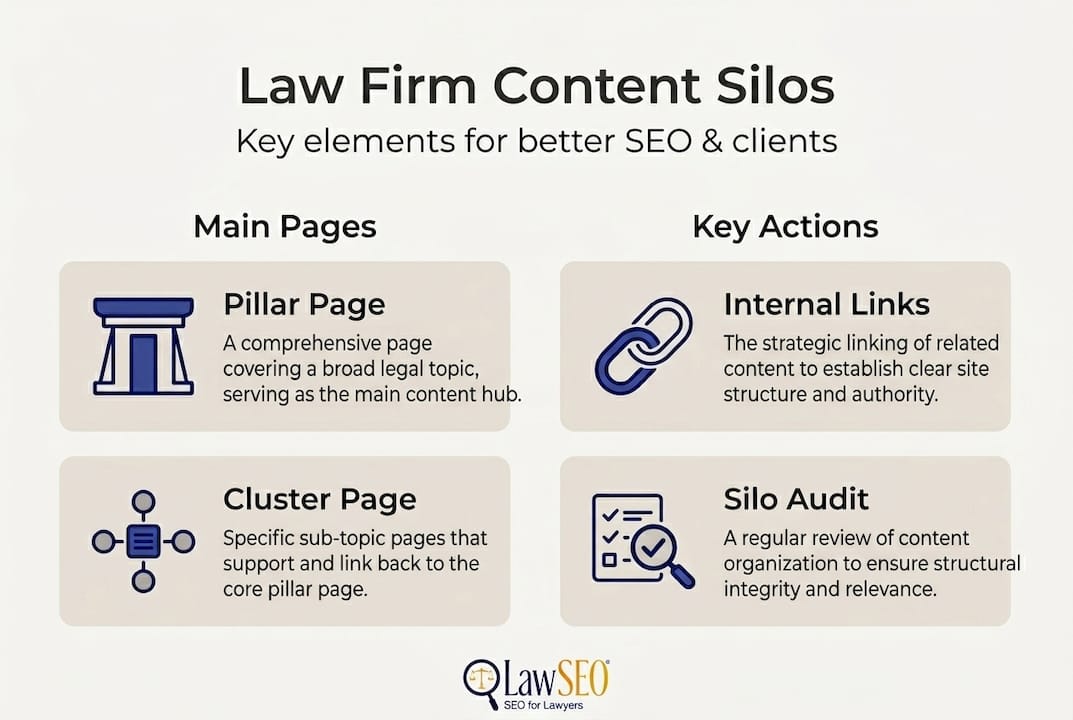
Internal linking is the connective tissue. Clusters and supporting articles fuel compounding SEO gains because the links between pillar and cluster pages transfer authority bidirectionally. Follow internal linking best practices by using descriptive anchor text and linking contextually within the body copy, not just in navigation menus.
Example silo structure for a family law practice:
| Page type | Example title | Target keyword |
|---|---|---|
| Pillar page | Family law overview | Family law attorney [city] |
| Cluster page | How alimony is calculated | Alimony laws [state] |
| Cluster page | Child custody rights explained | Child custody attorney [city] |
| Cluster page | Dividing marital assets in divorce | Property division divorce |
| Cluster page | How to file for divorce | Divorce filing process [state] |
To build your first silo, follow these steps:
- Choose one core practice area that generates the most revenue or has the most competitive opportunity.
- Write or identify your pillar page for that practice area.
- Map out five to ten cluster topics that address common client questions within that practice area.
- Assign a primary keyword to each cluster page and verify there is no overlap.
- Build internal links from each cluster page to the pillar, and from the pillar out to each cluster.
- Add technical SEO for lawyers elements including schema markup, optimized meta tags, and clean URL structures.
Pro Tip: Keyword grouping before writing is non-negotiable. Two pages targeting nearly identical queries will cannibalize each other’s rankings. Use a keyword research tool to confirm each cluster page targets a distinct search intent before publishing.
How content silos drive SEO performance and client conversions
Understanding the structure is essential, but the business case for silos becomes clearest when you compare performance outcomes directly.
Siloed vs. scattered website structures:
| Factor | Scattered structure | Siloed structure |
|---|---|---|
| Keyword rankings | Diluted across many pages | Concentrated on authority pages |
| Organic traffic quality | Mixed intent visitors | High-intent, practice-area-specific |
| Lead conversion rate | Low, mismatched queries | Higher, aligned with client needs |
| Content cannibalization | Common | Eliminated by design |
| Time to page-one rankings | Unpredictable | Faster with compounding gains |
When silos are built correctly, law firms experience measurable improvements across several performance indicators:
- Organic traffic volume increases because more cluster pages rank for long-tail queries
- Lead quality improves because visitors arrive with specific legal questions your content directly answers
- Average case value tends to rise because clients who find you through targeted content already understand your specialty
- Page authority accumulates faster because internal links concentrate signals rather than spreading them thin
Topic clusters help avoid content cannibalization and maximize return on investment by keeping each page focused on a distinct keyword and user intent. When visitors move from a cluster page to your pillar page and then to a contact form, you have created a conversion pathway that a scattered site simply cannot replicate.
The SEO impact of structuring sites also extends to how you optimize URL structure for each practice area. Clean, descriptive URLs reinforce silo architecture and make it easier for Google to understand page relationships. The ROI on strategic SEO investment compounds over time because every new cluster page you add strengthens the pillar rather than starting from zero authority.
Pro Tip: Conduct a silo audit every six months. Remove or consolidate pages with overlapping topics, update outdated content, and verify that all internal links still point to the correct destination URLs.
Building your first legal content silo: a practical step-by-step guide
With the theory clear, here is how to move from planning to a live, performing silo for your law firm.
- Select your practice area. Choose the one that generates the most revenue, faces the most online competition, or where you most want to grow. Personal injury, criminal defense, and family law are common starting points.
- Audit existing content. List every page on your site related to that practice area. Identify which pages overlap in topic and which gaps exist.
- Build your pillar page. If you do not have one, write a 2,000 to 3,000-word guide covering the practice area broadly. Include internal links to all planned cluster pages, even if those pages do not yet exist.
- Map and write cluster pages. Assign a unique keyword to each cluster topic. Write focused, 800 to 1,500-word pages that address one specific client question per page.
- Optimize URLs. Structure them to reflect the silo hierarchy, for example: yourfirm.com/family-law/child-custody. Review best website architecture tips for formatting guidance.
- Add internal links. Every cluster page links back to the pillar. The pillar links out to all cluster pages. Cross-link between closely related cluster pages where it adds reader value.
- Apply ethical SEO practices. Follow ethical SEO for attorneys guidelines to ensure your content meets bar association standards for attorney advertising.
Common pitfalls to avoid:
- Over-broad silos. A silo titled “Law” is too wide. “Personal Injury in Chicago” is appropriately scoped.
- Misaligned topics. A page about “car accident statistics” belongs in a personal injury silo, not a criminal defense silo. Misplacements confuse search engines.
- Skipping measurement. Track rankings, organic sessions, and contact form submissions per silo monthly.
Topic silos and cluster strategy are proven to deliver rapid SEO ROI in competitive legal markets, making them one of the highest-leverage investments a law firm can make in its digital presence.
Why most attorney websites fail to leverage silos—and how to stand out
After working with law firms across practice areas and markets, one pattern emerges consistently: most attorneys either copy a competitor’s site structure or purchase a generic template. Neither approach reflects a real silo strategy. Both approaches result in pages that rank for nothing specific and convert visitors at low rates.
The attorneys who outperform their markets treat strategic site structuring as an ongoing discipline, not a one-time website project. They map client intent first, build clusters around real questions clients ask, and refine those clusters based on actual performance data. That discipline is what separates firms that dominate local search from those that simply exist in it.
Silos are not purely a technical fix. They are a reflection of your firm’s expertise and organization. When Google sees a tightly structured cluster of pages on a specific topic, it interprets your site as a genuine authority. When a prospective client navigates that cluster, they experience a firm that clearly understands their problem. Both outcomes build trust. Trust drives calls. Calls become clients. That cycle does not start with more content. It starts with better-organized content.
Unlock better client growth with proven legal SEO solutions
At LawSEO.com, we build custom content silo strategies exclusively for attorneys and law firms. Every campaign is reviewed by Todd R. Stager, an SEO veteran with nearly three decades of legal market experience. We do not use generic templates. We research your practice areas, map your competitive landscape, and design silo architectures built to rank and convert. Explore our legal SEO advantages to see how a structured content strategy can transform your firm’s online visibility and deliver qualified leads month after month. If you are ready to stop guessing and start growing, connect with our team today for a strategy consultation.
Frequently asked questions
What is a content silo in legal SEO?
A content silo is a method of organizing web pages into related topic groups, helping law firms target specific client queries and boost search rankings. Content silos and topic clusters group related topics to maximize SEO value across your entire site.
How do content silos help attorneys get more clients?
Silos improve your site’s SEO authority, making it easier for potential clients to find your services in search results. Content silos increase visibility and lead quality for legal websites by aligning each page with a specific client need.
How long does it take to see results from content silos?
Most attorney websites see clear ROI from silos within 12 to 18 months, with compounding benefits building in later years. ROI benchmarks suggest break-even in roughly 14 months with substantial compounding gains thereafter.
Can small law firms benefit from content silos?
Yes, even small firms can drive local leads and outperform larger competitors with a focused silo strategy targeting specific practice areas and geographic markets. Silo strategies boost SEO for firms of any size, not just large practices with extensive budgets.