


Most law firms see their first measurable SEO signals, indexed pages, crawl fixes, a cleaned-up Google Business Profile, within four to six weeks. Meaningful local visibility usually shows up between months two and five, and consistent, attributable lead flow typically takes four to twelve months depending on your market’s competition and how much you invest. Start with a technical audit and a Google Business Profile check, then build a 30-day prioritized fix list before you judge anything else.
TL;DR:
- Technical fixes, such as fixing canonicalization errors and improving site speed, produce detectable results within days to weeks, providing the earliest signals of progress.
- Most law firms see meaningful local visibility and initial rankings between two and five months, but consistent lead flow often takes four to twelve months depending on competition and investment.
- Authority-building through backlinks and press placements typically begins around months three to nine, with significant ranking improvements and lead generation occurring after six months.
- Ongoing maintenance, like monitoring and refreshing content, is essential past six months to sustain rankings, while major updates are best scheduled annually or after large algorithm changes.
- Firms that prioritize technical health first, including site audits and Google Business Profile optimization, generally outperform those focusing prematurely on content or links without foundation fixes.
The Law Firm SEO Timeline, Month by Month
Every law firm asks the same question in the first client call: when will this actually work? The honest answer depends on competition, budget, and site health, but the sequence of milestones is remarkably consistent across markets, from solo practitioners in mid-sized cities to full-service firms competing in major metros.
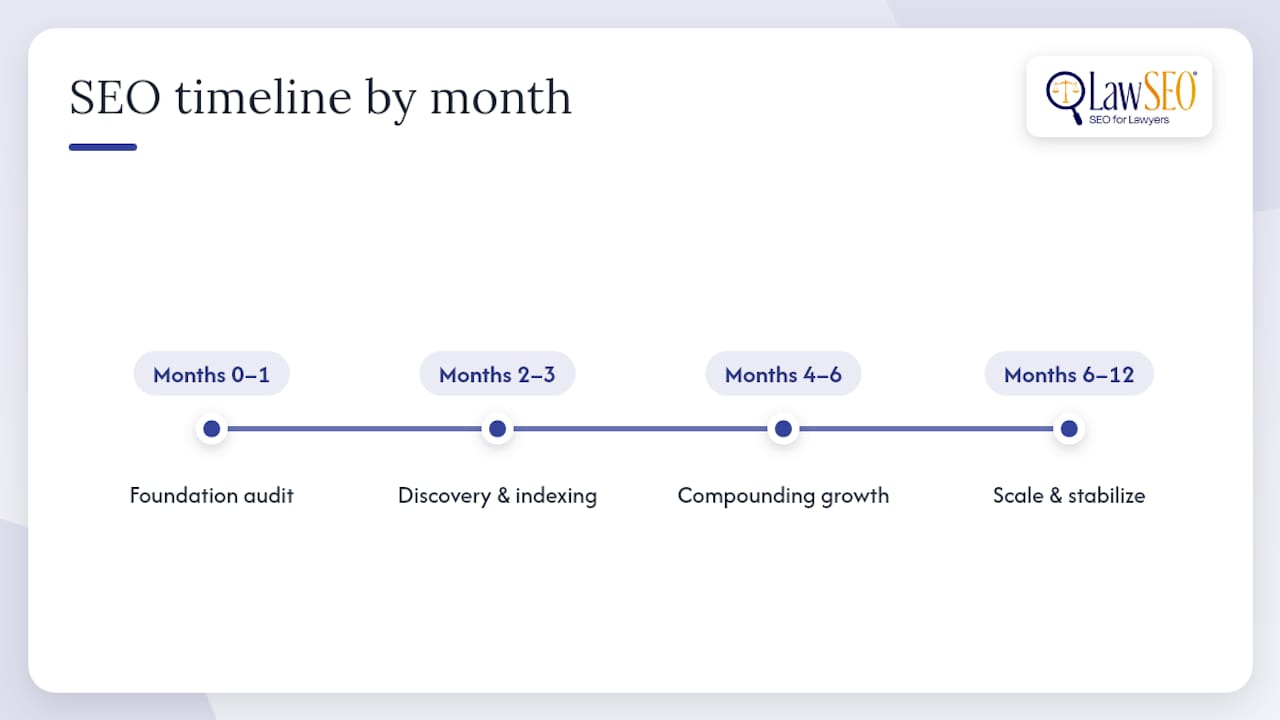
1. Month 0 to 1: Foundation and diagnosis. This phase is entirely about finding what’s broken before fixing anything else. A proper audit checks indexability, mobile rendering, page speed, and duplicate content, while a parallel track claims and verifies your Google Business Profile, corrects inconsistent name/address/phone (NAP) data across directories, and installs conversion tracking. Google’s own guidance confirms that complete and accurate business information directly affects whether you show up in local results, which is why this step happens before any content work. Title tag corrections also belong here: Google’s Search Central team has noted that title elements are used roughly 87 percent of the time to generate the titles shown in search results, so fixing weak or duplicate titles on your practice-area pages is one of the fastest, cheapest wins available.
2. Months 2 to 3: Discovery and early movement. Pages start getting indexed and appearing, often quietly, for long-tail queries like “car accident lawyer near [neighborhood]” rather than head terms like “personal injury lawyer.” Impressions in Google Search Console begin climbing before clicks do. This is normal, not a warning sign. Google’s index coverage data is the clearest early proof point that your content is being discovered and crawled, and a steady upward trend here is the first legitimate signal that the technical foundation is working. Expect the first flickers of map-pack movement for less competitive service and city combinations.
3. Months 4 to 6: Compounding begins. This is usually when firms start getting their first organic-sourced phone calls or contact form submissions that didn’t come from paid ads or referrals. Map-pack presence becomes more consistent for your priority keyword combinations, not just occasional appearances. Authority signals, backlinks, press mentions, review volume, start compounding rather than acting in isolation, because Google treats prominence as a function of both links and reviews, and neither builds meaningful weight in isolation during the first three months.
4. Months 6 to 12 and beyond: Scale and stabilization. Head-term rankings, the competitive keywords without a city or neighborhood attached, start moving meaningfully in this window, assuming the earlier phases were executed well. Lead flow becomes more stable and forecastable rather than sporadic. A documented case study tracked one firm’s organic traffic climbing from roughly 100 to over 7,900 monthly visitors across 14 months, with the biggest gains concentrated in months six through eleven once authority signals matured. That pacing, slow build, then acceleration, is the norm, not the exception.
Pro Tip: Track your Search Console impressions weekly starting in month one, not month four. A rising impression count with flat clicks is often the earliest honest signal that your content is being discovered, even before rankings move.
By month twelve, firms that stayed consistent typically have enough data to plan geographic expansion or add new practice-area pages with real confidence, instead of guessing.
What Actually Controls How Fast Your SEO Timeline Moves
Two firms in different cities can run identical campaigns and get wildly different results. The gap almost always comes down to five variables, and knowing which ones you control changes how you should spend your first budget dollar.
- Market competition and keyword difficulty set your baseline. Ranking for “divorce attorney” in a saturated metro takes longer than ranking for a niche practice area in a mid-sized city, regardless of how well the campaign is run.
- Technical health determines how fast everything else can work. Indexability, page speed, and mobile rendering are foundational, and fixing them tends to produce the fastest early wins because you’re removing barriers rather than building new signals from scratch.
- Authority signals, quality backlinks, press mentions, and citations, move on a mid-term clock, typically three to nine months, because earning genuine editorial links takes longer than fixing a broken sitemap.
- Local signals, reviews, Business Profile completeness, and citation consistency, directly influence map-pack timing, since Google explicitly weighs prominence built from links and review activity.
- Resource allocation, your budget, your team’s content capacity, and how fast your agency executes, is the multiplier that either compresses or stretches every other factor on this list.
Pro Tip: If you can only fix one thing this month, fix technical health first. Authority and content investments built on a slow or unindexed site are money spent twice.
The order matters more than most firms realize. A firm with a fast, clean site and thin content will often outperform a firm with excellent content sitting on a technically broken foundation for the first several months of a campaign.
What Milestones Should You Actually See at 30, 90, 180, and 365 Days?
Vague optimism isn’t a KPI. What separates a healthy SEO program from a stalled one is whether specific, checkable numbers move in the right direction at each checkpoint.
Early on, the KPIs that matter are boring but essential: pages indexed, crawl errors resolved, your Google Business Profile claimed and verified, and impressions appearing for the long-tail terms you targeted first. As the campaign matures, the metrics shift toward clicks, map-pack appearances, and, eventually, contact form submissions and phone calls.
| Timeframe | What to check | Realistic signal of progress |
|---|---|---|
| 30 days | Indexed pages, crawl errors, GBP status | Audit complete, critical errors fixed, profile verified |
| 90 days | Search Console impressions, long-tail rankings | Impressions rising for targeted terms, early map-pack flickers |
| 180 days | Map-pack consistency, organic clicks, first leads | Steady map-pack appearances, first organic-attributed inquiries |
| 365 days | Head-term rankings, lead volume, conversion rate | Stabilized lead flow, measurable ROI on spend |
A few practical notes on reading this table honestly:
- Rising impressions with flat clicks is progress, not failure, since it means your pages are being discovered before they’re being chosen.
- Attribution matters: use UTM-tagged contact forms and call tracking so leads from organic search aren’t accidentally credited to paid ads or referrals.
- One slow week or month is noise. A three-month trend in the wrong direction is a signal worth investigating.
How to Speed Up Your Law Firm’s SEO Results
You cannot rush authority building, but you can absolutely control how fast the controllable parts move. Prioritize in this order.
- Fix technical debt first. Canonicalization errors, robots.txt misconfigurations, broken sitemaps, and slow load times block everything downstream, and they’re usually the cheapest problems to solve.
- Optimize your Google Business Profile completely. Fill in every category and service, post updates regularly, and actively generate reviews, since complete profiles perform measurably better in local results.
- Build convert-intent content. Practice-area pages with FAQ schema and clear calls to action convert better than generic blog posts, and they should be built before you chase long-tail blog traffic.
- Earn authority deliberately. Editorial outreach, legal press placements, and reclaiming unlinked brand mentions build the backlink profile that drives mid-term ranking gains.
- Balance your budget across all three levers, technical, content, and outreach, rather than dumping everything into one. A firm that spends its entire budget on link building while ignoring a broken sitemap is optimizing the wrong variable.
Pro Tip: Ask any agency proposing “guaranteed rankings” to explain their qualifying language. The ABA’s advertising guidance warns against claims that create unjustified expectations, and the same discipline should apply to what your SEO vendor promises you.
Why Founder-Led Oversight Changes the Timeline
Timeline reliability depends heavily on who’s making the prioritization calls. Todd R. Stager, who founded Lawseo after more than 29 years in SEO, personally reviews strategy across client campaigns rather than delegating triage to junior staff. That matters because the single biggest timeline killer isn’t lack of effort, it’s misordered effort: spending months on link outreach while a canonicalization error keeps half your site out of the index.
The documented case study referenced earlier, traffic scaling from roughly 100 to 7,900-plus monthly visitors over 14 months, followed a specific sequence: foundation work in months one and two, link earning in months three through five, authority gains in months six through eight, and controlled expansion from month nine onward. That pacing wasn’t accidental.
Ask any vendor for time-stamped proof before you trust their timeline claims: before-and-after map-pack screenshots, Search Console indexed-page graphs, backlink acquisition reports, and UTM-tagged conversion data. If they can’t produce it, they’re asking you to trust a story instead of evidence.
Request these specific artifacts before signing anything:
- Pre- and post-campaign analytics snapshots with dates attached
- Google Business Profile position screenshots over time
- Backlink acquisition reports showing domain quality, not just link count
- Conversion-tracking data tied to specific organic landing pages
How Long Does Link Building and Guest Posting Actually Take?
Off-page SEO runs on the slowest clock in the entire campaign, and that’s by design. Earning a link from a respected legal publication or local news outlet takes real editorial relationships, not a form submission.
Realistically, expect the first outreach-earned links to land somewhere between month two and month four, once initial pitches and relationship-building have had time to convert. Guest posting on legitimate legal or industry publications follows a similar clock: pitching, editorial review, and publication scheduling routinely add four to eight weeks per placement, even when the content itself is ready immediately.
The mistake most firms make is expecting off-page results on the same timeline as technical fixes. A broken sitemap gets fixed in a day. A quality backlink from a state bar association newsletter or a regional business journal might take ten weeks from first contact to publication. Volume compounds this: firms doing consistent monthly outreach, rather than a single burst, tend to see their backlink profile, and the ranking benefit that follows, mature around months six through nine.
Guest posting also carries a secondary benefit that’s easy to overlook: referral traffic and brand mentions that show up even before Google fully credits the link. Treat off-page work as a background process running in parallel with technical and content workstreams, not a phase you complete and move past.
Ongoing Maintenance vs. Major SEO Overhauls
Once a law firm’s SEO program stabilizes, usually somewhere past month six, the work shifts from building to maintaining. Confusing these two modes is one of the more common reasons firms either overspend on unnecessary rebuilds or underspend and watch rankings slowly erode.
Ongoing maintenance is monthly and light: monitoring Search Console for crawl errors, refreshing underperforming content, responding to new reviews, checking for citation drift, and watching competitor movement. This work rarely produces dramatic month-over-month changes, but skipping it for even a quarter tends to show up as a slow ranking decline three to four months later.
Major updates are different in scope and cadence. A full technical re-audit, a site migration, a redesign, or a significant content restructuring should happen roughly once a year, or immediately after a Google core algorithm update meaningfully disrupts rankings. These projects take weeks to plan and execute properly, and they should never be run on the same casual cadence as monthly maintenance tasks.
The firms that struggle most tend to treat every month like a major overhaul is needed, burning budget on redundant audits, or treat every year like routine maintenance is sufficient, letting technical debt accumulate until a migration becomes urgent and expensive instead of planned and controlled.
How Fast Do Technical SEO Fixes Actually Move the Needle?
Technical fixes are the fastest-moving lever in the entire timeline, which is exactly why they belong in month one. Fixing a broken robots.txt file or a canonicalization error can allow Google to properly crawl and index pages within days of the fix going live, not months.
The catch is that the fix and its visible impact are two different clocks. You might correct a duplicate content issue on a Tuesday, but it can take two to six weeks for Google to recrawl, reprocess, and reflect that change in rankings and impressions, depending on how frequently your site gets crawled. Google’s own index coverage reporting is the tool to watch here: a rising trend in indexed pages confirms discovery is happening, even before rankings visibly shift.
Site speed improvements follow a similar pattern. Compress images, fix render-blocking scripts, and improve server response time, and you’ll often see Core Web Vitals scores improve within the tool almost immediately, but the ranking impact tied to those improvements can lag by several weeks as Google re-evaluates the page in context.
The practical takeaway: technical fixes are cheap, fast to implement, and produce the earliest observable signals of any SEO workstream, which is exactly why skipping them to chase content or links first is one of the most common timeline mistakes law firms make.
Why Content Refresh Cycles Matter More Than New Pages
Publishing new blog posts feels productive, but refreshing existing practice-area pages often moves rankings faster, particularly for law firms with a modest existing content library. A page that’s ranked on page two for eighteen months usually isn’t failing because it needs a sibling. It’s failing because it’s stale, thin, or answering a slightly outdated version of the reader’s question.
A disciplined refresh cycle, revisiting core practice-area pages every four to six months to update statistics, add FAQ schema, tighten calls to action, and reflect any changes in relevant law, tends to produce ranking movement faster than net-new content creation for firms past their first six months. That’s because refreshed pages already carry some existing authority and indexing history; new pages start from zero.
This doesn’t mean stop publishing new content. It means sequence it correctly: audit and refresh your highest-traffic existing pages first, then use new content to fill genuine topic gaps, like an underserved practice area or a location you haven’t targeted yet, rather than duplicating what already exists in a slightly different format.
The firms that treat their site as a living document, revisited and improved on a schedule, consistently outperform firms that treat content production as a one-time build followed by years of neglect.
What This Timeline Data Actually Tells Us
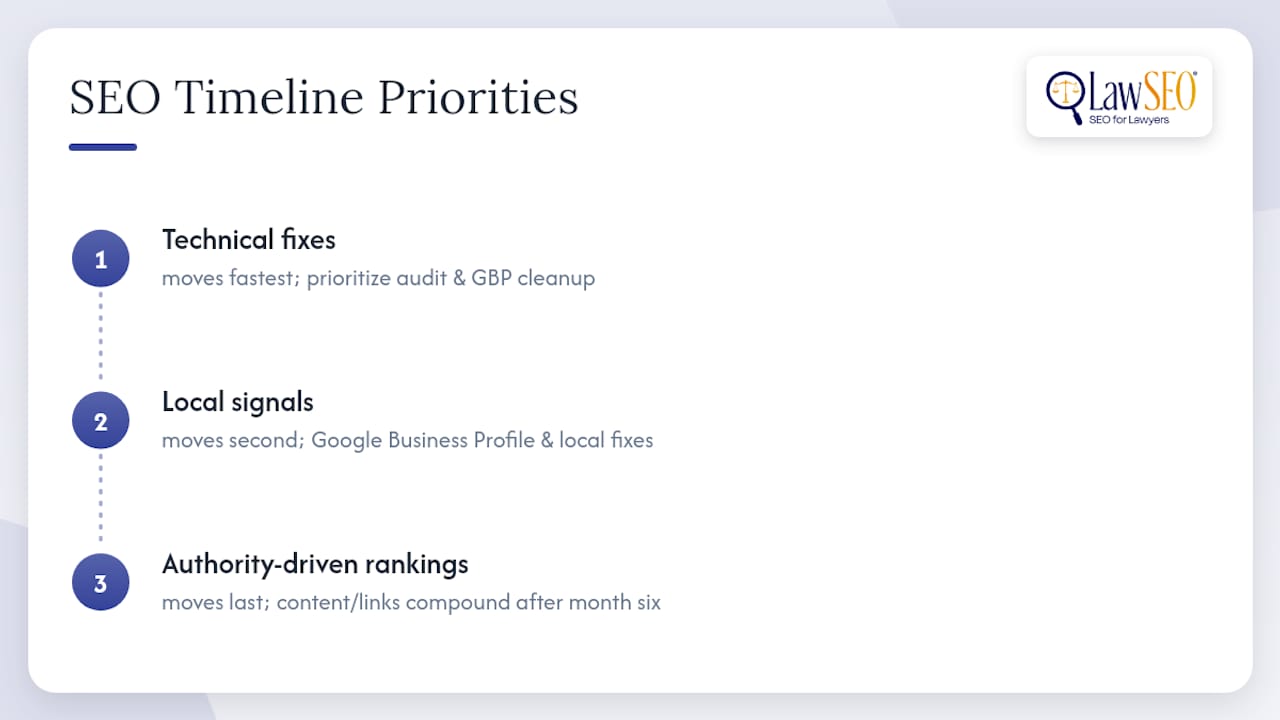
Most SEO timeline advice online is either falsely precise (“rank in 90 days”) or uselessly vague (“it depends”). The research supports a third position: the sequence is predictable even when the exact speed isn’t. Technical fixes move fastest, local signals move second, and authority-driven rankings move last, in that order, almost every time.
The conventional advice that content volume alone drives faster results doesn’t hold up well against the evidence. A firm publishing four blog posts a month on a technically broken site is wasting most of that output. The compounding pattern in the case study data, slow months one and two, acceleration starting month six, only works when the foundation was fixed first.
If you take one thing from this timeline, prioritize the technical audit and Google Business Profile cleanup before anything else. It’s the cheapest, fastest-moving lever you have, and every other investment, content, links, paid ads, performs better once it’s done. Firms that skip this step and go straight to content or outreach are almost always the ones asking six months later why nothing has moved.
— TODD
Get a Realistic SEO Timeline Built for Your Firm
Our firm specializes in working exclusively with attorneys and involves experienced leadership personally reviewing every strategy decision to ensure expert oversight rather than delegating to less experienced staff. We also offer exclusivity agreements to prevent conflicts with local competitors.
A first engagement typically starts with a full technical and local audit, a prioritized 30-day fix list, Google Business Profile cleanup, and a content roadmap built around your actual practice areas and market, the exact sequence this article just walked through. From there, services scale into local SEO, AI search optimization, content production, and authority link building depending on what your competitive analysis shows you actually need first.
If you want a realistic, firm-specific version of this timeline instead of a generic one, start with a services evaluation and get a prioritized plan built around your market’s actual competition.
Sources
The milestones and pacing in this article draw on Google’s own local ranking guidance, established legal advertising ethics rules, and a documented traffic growth case study, not industry guesswork.
- Tips to improve your local ranking on Google – Google Business Profile Help
- From 100 to 7,900+ Monthly Visitors: Scaling High-Intent Organic Traffic (case study)
FAQ
How Long Does SEO Usually Take for a Law Firm?
Most firms see initial technical and indexing signals within four to six weeks, measurable local visibility within two to five months, and consistent lead flow within four to twelve months. The exact pace depends on your market’s competition, your site’s starting condition, and how much you invest, so a step-by-step local SEO approach built around your specific market matters more than any generic average.
What Is the 80/20 Rule for Law Firm SEO?
Technical fixes and Google Business Profile optimization typically drive most of your early visible SEO results. For law firms specifically, fixing indexability and claiming a complete, accurate profile typically outperforms early investment in blog volume or minor content tweaks.
Is SEO Still Worth It for Law Firms in 2026?
Yes. Search remains one of the primary ways prospective clients find and vet attorneys, and Google’s ranking factors, relevance, distance, and prominence built from reviews and quality links, haven’t fundamentally changed even as AI search tools grow. Firms that skip SEO typically rely more heavily on paid ads or referrals, which cost more per lead over time.
How Do I Know if My Law Firm’s SEO Program Is on Track?
Check indexed pages and crawl errors in the first 30 days, rising impressions for long-tail terms by 90 days, consistent map-pack appearances by 180 days, and stabilized organic-attributed leads by 365 days. If those benchmarks aren’t moving in that rough order, the priority sequence, not just the effort level, likely needs review.
What Proof Should I Ask an SEO Vendor for Before Trusting Their Timeline?
Request time-stamped Search Console indexed-page graphs, before-and-after Google Business Profile position screenshots, backlink acquisition reports, and UTM-tagged conversion data tied to organic landing pages. Any vendor unwilling or unable to produce this is asking you to trust claims rather than evidence, which the ABA’s advertising guidance specifically cautions against for results claims in legal marketing.