


A basic template site runs $1,000 to $3,000, managed legal platforms charge $150 to $500 a month, freelancers typically bill $3,000 to $10,000 for a custom build, and full-service agencies charge $8,000 to $20,000 or more. Solo practitioners usually do best with a managed platform or freelancer; small firms should budget for a mid-tier agency package; growth-focused and multi-office firms need custom builds with dedicated SEO investment. Ongoing hosting, maintenance, and content costs often exceed the original build price within three years.
TL;DR:
- Custom website builds can cost between $8,000 and $20,000 or more, with ongoing costs for hosting, SEO, and maintenance often surpassing initial expenses within three years.
- SEO integration during the design phase reduces long-term costs and improves search rankings, while retrofitting SEO later is significantly more expensive and disruptive.
- Smaller firms with minimal needs can budget around $6,000 to $15,000 for the first build, plus monthly SEO retainers of $750 to $2,500, while large firms may spend over $25,000 on complex, multi-location sites.
- A website’s true cost includes ongoing subscription, content, security, and SEO expenses, which can add up to several times the initial build price over five years.
- The most effective websites are those with measurable inquiry results, not the ones with the highest price tag, making tracking inquiries, conversions, and response times essential for ROI.
What Does a Lawyer Website Cost by Approach?
The dollar figure on a proposal only tells part of the story. What matters more is what that number buys, and what it fails to include. Here’s how the four common paths break down.
DIY and template builders run the cheapest on paper. Platforms like Wix and Squarespace bundle hosting and design templates into a single subscription, typically $20 to $50 a month, plus a domain fee. That looks like a $1,000 to $3,000 first-year cost. It rarely is. Attorneys who choose this route usually end up doing the writing, the photo sourcing, and the troubleshooting themselves, and that time carries a real opportunity cost against billable hours. A template site also tends to arrive with generic structure that was never built with legal search intent in mind, which means SEO work later costs more than if it had been planned from the start.
Managed legal platforms sit in the middle. Vendors built specifically for law firms often charge $150 to $500 monthly for a subscription that includes hosting, a legal-specific template, and basic support. Total year-one cost lands around $1,800 to $6,000, with no large upfront design invoice. The tradeoff is customization ceiling. Firms with unusual practice structures, multi-office needs, or ambitions beyond a standard template often outgrow these plans within two or three years.
Freelancers offer the widest range and the widest variance in quality. A solo web designer might quote $3,000 for a five-page brochure site or $10,000 for something closer to custom development with a content management system. According to Clio’s budgeting guide, attorney websites overall span from low-cost template subscriptions to $20,000-plus custom builds, and freelancers occupy the middle of that spectrum. The upside is flexibility and a direct relationship with the person doing the work. The downside is inconsistent scope. Some freelancers include revisions, hosting setup, and basic SEO; many do not, and firms discover the gaps only after signing.
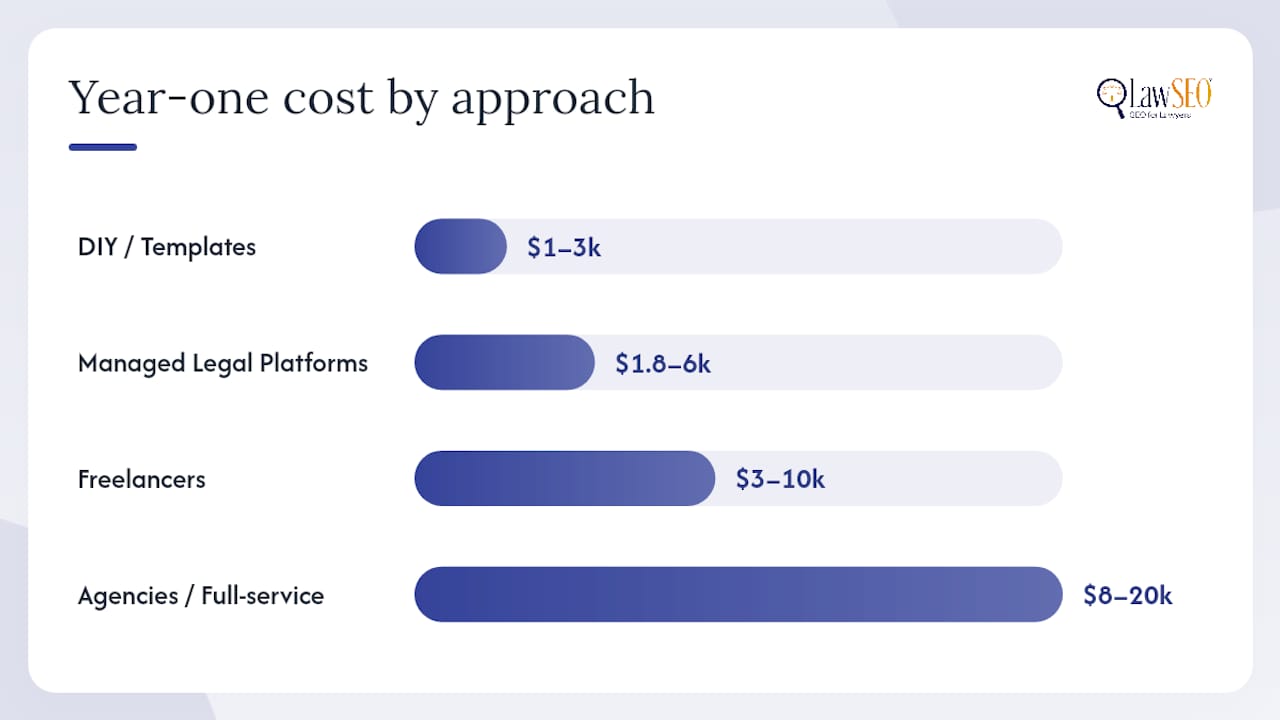
Agencies and full-service firms command the highest fees, generally $8,000 to $20,000 for a complete build, with complex sites (multiple practice areas, client portals, multi-language support) pushing past that range. Industry benchmarking across agency pricing consistently places mid-tier custom sites and full-service packages in the several-thousand to tens-of-thousands range, depending on scope. What that premium buys, when it’s spent well, is a design system built for conversion, technical SEO baked into the site architecture, and ongoing support that doesn’t fall on the attorney’s desk.
Across all four paths, the sticker price hides the same recurring gaps:
- Hosting and domain renewal are rarely included past year one on custom builds
- SEO is treated as an add-on rather than part of the build, which raises total cost
- Content writing (attorney bios, practice area pages, blog posts) is frequently billed separately
- Ongoing maintenance and security patching get quoted as a surprise after launch
The American Bar Association recommends budgeting for both the build and the ongoing expenses together, precisely because maintenance, updates, and security work materially change the real cost of ownership over time.
What Actually Drives the Price of a Lawyer Website?
Two firms can request “a new website” and receive quotes that differ by $15,000. The gap almost never comes from one vendor overcharging. It comes from scope decisions that aren’t obvious until you compare line items directly.
- Design and branding work. A template with swapped colors and a new logo costs far less than a custom design system built around your firm’s identity, photography, and visual hierarchy. Custom design work alone can account for 30% to 40% of an agency quote.
- Feature complexity. Each added function raises the price. Intake forms are inexpensive. A secure client portal, online payment processing, appointment booking, or embedded video consultation tools each add development time, testing, and often a recurring license fee.
- Page count and content volume. Every practice area page, attorney bio, and location page needs writing, editing, and formatting. A ten-page site and a sixty-page site are not the same project, even on identical templates.
- Technical architecture. Your CMS choice affects both build cost and future maintenance. Wordpress documents that self-hosted WordPress requires separate hosting and maintenance budgets, unlike bundled platform subscriptions. Custom integrations (case management software, CRM syncing, live chat) add development hours on top of the base build.
- Regulatory and security requirements. Firms handling sensitive client data may need SSL certification, ADA-compliant design, and specific disclaimer language reviewed by counsel. None of that is expensive in isolation, but it adds hours that a generic small-business quote won’t include.
- SEO timing. This is the single most expensive mistake in the entire budgeting process. Integrating SEO during the design phase costs meaningfully less than retrofitting it afterward, because site architecture, schema markup, and page structure all need to be built with search intent in mind from day one. Adding SEO after launch often means rebuilding navigation, restructuring URLs, and rewriting content that was never designed to rank.
If you want a plain-English rule for evaluating any quote: ask what happens to the price if you remove the client portal, cut the page count in half, and skip custom integrations. If the number barely moves, you’re likely paying for design labor rather than functionality, and that’s worth questioning directly with the vendor.
What’s a Realistic Website Budget by Firm Size?
Budget planning gets easier once you stop asking “what does a lawyer website cost” as a single number and start asking what your specific firm size actually needs.
Solo practitioner. A credible minimum budget sits at $2,500 to $6,000 for a professional, mobile-friendly site with five to eight pages, basic on-page SEO, and a contact or intake form. Below that range, expect either a heavily templated look or gaps in mobile performance and search visibility. A managed platform subscription or a mid-range freelancer both fit this budget comfortably.
Small firm (2 to 5 attorneys). Expect $6,000 to $15,000 for the initial build, plus an SEO retainer running $750 to $2,500 monthly depending on market competitiveness. This tier typically covers individual attorney bio pages, multiple practice area pages, a blog structure for ongoing content, and basic schema markup for local search.
Growth-focused mid-size firm. Firms actively expanding practice areas or markets should plan $12,000 to $25,000 for the build itself, with SEO investment scaling to $2,000 to $5,000 monthly. This tier justifies custom features: video content, detailed case result pages, and conversion-focused intake flows. Expect three to six months before SEO investment shows measurable ranking movement.
Multi-office or enterprise firm. Complexity multiplies fast here. Multiple office locations each need localized landing pages, consistent branding across markets, and often multilingual support. Budgets commonly reach $25,000 to $60,000-plus for the build, with SEO and content retainers scaling per location.
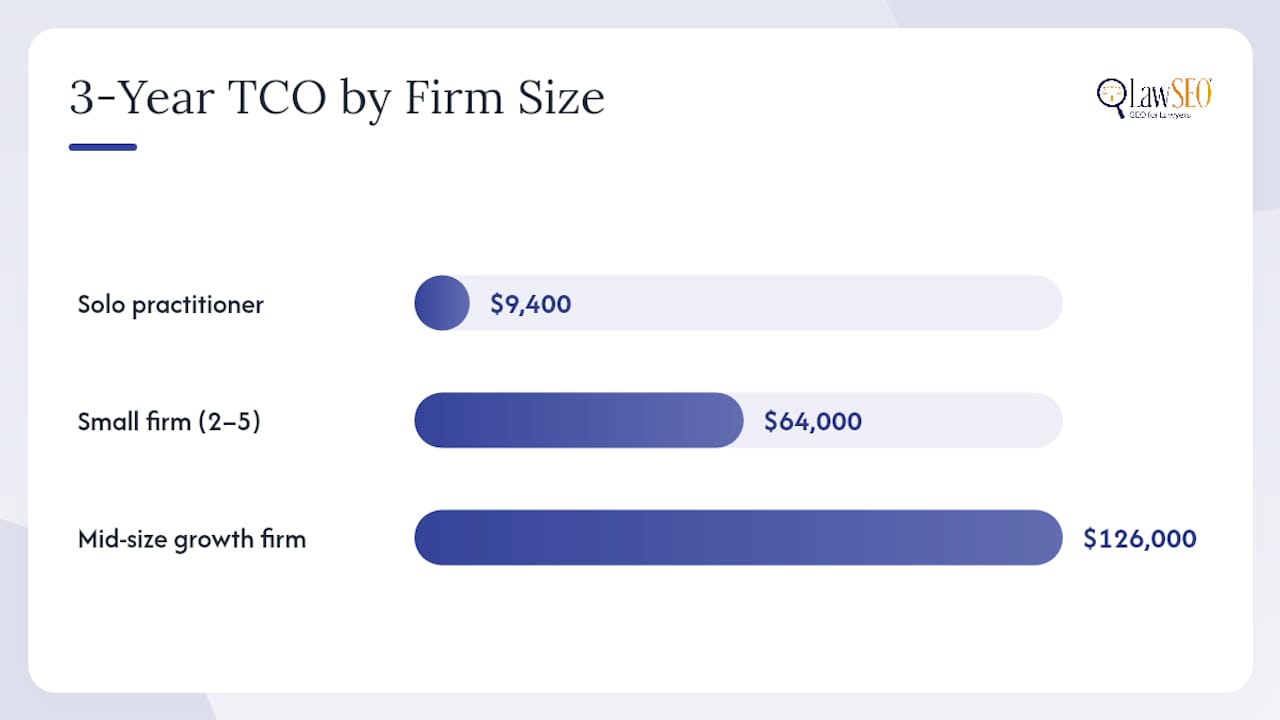
Here’s what those numbers look like as total cost of ownership:
- Solo, year one: $4,000 build plus $150/month hosting and maintenance equals roughly $5,800 total
- Solo, three-year total: roughly $9,400, assuming no major redesign
- Small firm, year one: $10,000 build plus $1,500/month SEO retainer equals roughly $28,000 total
- Small firm, three-year total: roughly $64,000, factoring modest retainer increases
- Mid-size, year one: $18,000 build plus $3,000/month SEO retainer equals roughly $54,000 total
- Mid-size, three-year total: roughly $126,000, reflecting compounding SEO investment and content expansion
The American Bar Association advises evaluating these numbers over a 3 to 5 year window rather than comparing upfront invoices alone, since a cheaper build with a weak SEO strategy frequently costs more in lost client inquiries than it saves in cash.
How Much Should You Budget for Ongoing Website Costs?
The build price is the smallest number in your long-term budget. Hosting, maintenance, content, and SEO retainers accumulate every month, and over three to five years they typically dwarf the original invoice.
Hosting ranges from $10 to $50 monthly on shared or managed hosting to $100 to $300 monthly for higher-traffic firms needing dedicated resources. Bundled platform subscriptions fold this into the monthly fee; self-hosted WordPress sites pay for it as a separate line item.
Maintenance and security can be purchased two ways: hourly, at $75 to $200 per hour for updates and fixes as needed, or through a managed flat-rate plan, typically $100 to $400 monthly, covering software updates, backups, and security monitoring. Flat-rate plans tend to produce more frequent updates, since there’s no per-task invoice discouraging small fixes, and that update frequency correlates with better site freshness and stronger conversion performance over time.
Content and SEO retainers run the widest range, from $750 monthly for a solo practitioner in a low-competition market to $5,000-plus for a mid-size firm competing in a dense metro area. Ad-hoc content purchases (a one-off blog post, a single page rewrite) usually cost more per piece than a retainer arrangement, because retainers build efficiency and consistency into the relationship.
To forecast a 3 to 5 year total, add the build cost to (monthly hosting plus monthly maintenance plus monthly SEO retainer) multiplied by 36 to 60 months. That single number, not the initial quote, is what belongs in an ROI conversation with firm partners.
How to Choose the Right Website Approach and Vendor
Once you know your rough budget tier, the next step is vetting vendors against a consistent checklist so quotes are actually comparable.
- Ask who owns the website files, the CMS login, and the content once the project ends.
- Confirm the update turnaround time for content changes and whether it’s included in a retainer or billed hourly.
- Require a written list of SEO deliverables: schema markup, page speed targets, and keyword-mapped content strategy.
- Ask what analytics and conversion tracking are set up at launch, not added later.
- Get the pricing model in writing: flat project fee, hourly, per-page, or subscription, and confirm what triggers additional charges.
- Ask for a sample contract showing exactly what happens if you want to leave the platform or vendor later.
- Request examples of attorney website projects similar to your practice area and firm size.
- Confirm whether the quote includes content writing or whether that’s a separate line item.
- Ask how mobile performance and page speed are tested before launch.
- Clarify what happens to your SEO rankings and content if you switch vendors down the road.
Four red flags to watch for: a quote with no mention of SEO deliverables at all, a vendor who can’t explain your ownership rights in plain language, a subscription plan that locks your content behind a proprietary system with no export option, and a proposal priced entirely on page count with no mention of technical architecture.
Pro Tip: Ask every vendor the same ten questions in the same order and score the answers side by side. Quotes that look wildly different on price often converge once you account for what each one actually includes.
What Do Legal Marketing Experts Recommend Spending On?
Firms consistently overspend on visual polish and underspend on the infrastructure that actually generates inquiries. A redesigned homepage with better photography feels like progress. It rarely moves the needle the way a properly structured conversion path does.
The highest-return dollars typically go toward integrating SEO at the build stage rather than afterward, adding case result pages and short video introductions that build trust before the first call, and setting up call tracking so partners can see which pages actually produce leads. A $15,000 build with SEO baked in from day one routinely outperforms a $25,000 build that treats search visibility as an afterthought.
The firms that get the most from their website budget aren’t the ones spending the most. They’re the ones who can point to a specific page, a specific keyword, or a specific conversion path and say, “that’s where our last five inquiries came from.”
Recommended ongoing budget bands: $100 to $400 monthly for managed maintenance, and $750 to $5,000 monthly for SEO depending on market competitiveness.
Why “Bigger Budget” Doesn’t Mean “Better Results”
The myth that a higher price tag guarantees more clients is one of the most expensive assumptions in legal marketing. A $30,000 site with no conversion tracking tells you nothing about whether it’s working. A $6,000 site with clear intake forms and call tracking tells you exactly what’s converting and what isn’t.
The real budget test isn’t the invoice total. It’s whether you can measure inquiry volume, response time, and conversion rate against the dollars spent. Firms chasing a cosmetic redesign every three years would often get more return from fixing a slow intake form or adding client-facing case results to their existing site.
— TODD
A Managed, SEO-First Alternative to the Agency Guessing Game
Most of the paths above force a tradeoff: cheap and generic, or expensive and slow to prove its worth. Some firms offer a founder-led strategy review tailored specifically around legal search behavior rather than adapted from generic small-business templates. This approach integrates SEO, schema, and conversion structure into the site from the first wireframe, rather than adding them after launch.
Some vendors also offer exclusivity agreements, meaning local competitors do not have access to the same strategic playbook. If your current site was built as a brochure and never turned into a client-generating asset, the fix usually isn’t a full redesign. It’s rebuilding the parts that touch search visibility and conversion. Start with a review of your current site’s SEO structure and get a clear picture of what a properly built site should be doing for your firm.
Where to Verify These Numbers
For deeper detail on budgeting frameworks, consult the American Bar Association’s guidance on attorney website costs, Clio’s pricing breakdown, and platform documentation from WordPress and technical guides like site architecture SEO fundamentals.
Sources
- Attorney Website Costs: Budgeting and Maximizing ROI — American Bar Association
- How Much Are Attorney Websites? A Guide to Budgeting and Value — Clio
- Wordpress
- Wix
- Squarespace
FAQ
Is $1,000 a Good Price for a Lawyer Website?
For a bare-bones template site with a handful of pages, $1,000 covers the basics but rarely includes SEO, custom content, or ongoing maintenance. Treat it as a starting point, not a complete solution.
Is $1,500 a Good Price for a Lawyer Website?
At $1,500, expect a slightly more polished template build, but this range still typically excludes meaningful SEO work, custom design, and content writing, all of which affect whether the site actually generates inquiries.
How Much Does a Law Firm Website Cost in 2026?
Costs range from $1,000 to $3,000 for DIY template builds, $150 to $500 monthly for managed platforms, $3,000 to $10,000 for freelancer projects, and $8,000 to $20,000-plus for full agency builds, with ongoing SEO and maintenance adding to total cost every year.
Should I Prioritize Design or SEO When Budgeting?
Neither in isolation. A site that looks polished but doesn’t rank won’t generate inquiries, and a site that ranks but doesn’t convert visitors wastes that traffic. Budget for both integrated from the start rather than treating either as an afterthought.