

Every law firm knows the frustration of chasing leads that never convert. For managing partners at small to mid-sized American law firms, the real challenge is finding a structured way to attract the right prospects and maintain meaningful engagement. Focusing on targeted prospect profiles transforms your client acquisition strategy from guesswork into science, helping your firm prioritize leads with the highest potential for conversion and long-term growth.
Table of Contents
- Step 1: Define Your Ideal Prospect Profiles
- Step 2: Organize Leads With Effective Segmentation
- Step 3: Implement Targeted Communication Strategies
- Step 4: Automate Follow-Up Sequences For Efficiency
- Step 5: Measure Campaign Results And Refine Tactics
Quick Summary
| Main Takeaway | Explanation |
|---|---|
| 1. Define Ideal Prospect Profiles | Create specific client personas to enhance lead generation and client acquisition strategies. |
| 2. Implement Effective Lead Segmentation | Categorize leads to tailor marketing efforts, improving conversion rates through targeted approaches. |
| 3. Use Targeted Communication Strategies | Develop personalized messaging that resonates with different client segments for better engagement. |
| 4. Automate Follow-Up Processes | Use automation to streamline communication, ensuring timely interactions while reducing manual tasks. |
| 5. Measure Campaign Performance | Regularly analyze marketing data to refine strategies, maximizing resource efficiency and client engagement. |
Step 1: Define your ideal prospect profiles
Defining your law firm’s ideal prospect profiles is about creating a strategic blueprint for targeted client acquisition. By developing precise, data-driven client personas, you’ll transform your lead generation from a scattered approach to a laser-focused strategy.
To craft these targeted prospect profiles, start by analyzing your firm’s existing client landscape. Here’s a systematic approach to developing comprehensive prospect profiles:
- Examine your current high-value clients
- Review geographic and demographic trends
- Analyze industry-specific legal needs
- Identify potential revenue opportunities
- Map out client decision-making processes
When developing these profiles, consider key characteristics such as:
- Company size and annual revenue
- Specific legal challenges they typically face
- Geographic location and market segment
- Growth potential and long-term relationship prospects
- Alignment with your firm’s practice areas
Client profiling isn’t about casting the widest net—it’s about attracting the right fish.
By narrowing your prospect research with precision, you’ll create a targeted approach that significantly improves client conversion rates. Each profile should feel like a detailed roadmap, guiding your marketing and business development efforts.

Pro tip: Update your prospect profiles quarterly to ensure they remain aligned with evolving market dynamics and your firm’s strategic goals.
Step 2: Organize leads with effective segmentation
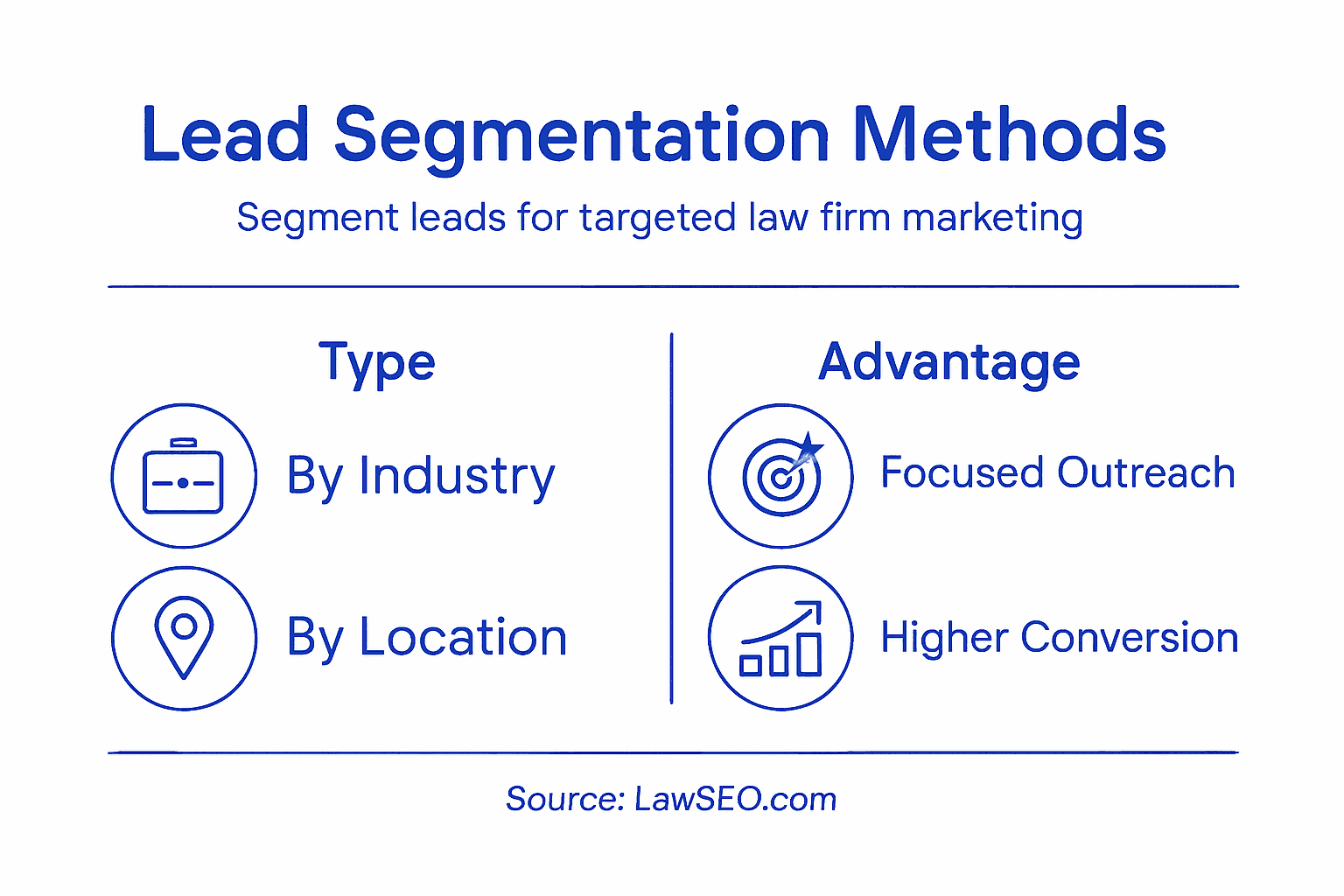
Lead segmentation is your strategic roadmap for transforming generic contacts into potential high-value clients. By categorizing your leads with precision, you’ll create targeted approaches that dramatically improve conversion rates and client engagement.
To develop powerful market segmentation strategies, consider breaking down your leads into multiple strategic categories:
- Geographic location and jurisdiction
- Company size and annual revenue
- Specific legal challenge complexity
- Previous interaction history
- Industry or sector specialization
When implementing your segmentation approach, utilize detailed classification techniques that allow for nuanced categorization. Market segmentation trees provide an excellent framework for organizing leads with precision, enabling more personalized communication strategies.
- Start with broad categorical divisions
- Refine segments using behavioral data
- Create tailored communication protocols
- Continuously update segmentation models
- Monitor engagement metrics
Effective segmentation transforms random leads into strategic opportunities.
By developing sophisticated lead segments, your law firm can create laser-focused marketing approaches that speak directly to each prospect’s unique needs and challenges. This targeted strategy increases the likelihood of converting leads into long-term clients.
Pro tip: Invest in a robust customer relationship management (CRM) system that allows dynamic lead segmentation and real-time tracking of prospect interactions.
Here’s how various segmentation approaches impact lead management effectiveness:
| Segmentation Method | Main Advantage | Best Use Case |
|---|---|---|
| Geographic segmentation | Focuses on regional compliance | Multi-location law practices |
| Industry segmentation | Tailors services to sector needs | Specialized legal expertise |
| Behavior-based segmentation | Prioritizes engaged prospects | Optimizing follow-up efforts |
| Revenue segmentation | Targets high-growth opportunities | Maximizing firm profitability |
Step 3: Implement targeted communication strategies
Targeted communication transforms your law firm’s marketing from generic broadcasting to precision-targeted engagement. By crafting messages that speak directly to specific client segments, you’ll create more meaningful connections that dramatically improve client acquisition and retention.
To develop strategic communication approaches, focus on these key implementation techniques:
- Personalize messaging for each lead segment
- Select appropriate communication channels
- Develop clear, concise content
- Match tone to client persona
- Track message performance
When executing your communication strategy, prioritize multi-channel communication techniques that ensure your message reaches prospects through their preferred platforms. Successful communication strategies require a nuanced approach that balances frequency, relevance, and compliance.
- Define communication objectives
- Map content to specific audience segments
- Choose optimal communication channels
- Create tailored messaging templates
- Establish performance tracking metrics
Precision in communication beats volume every single time.
By implementing a sophisticated, data-driven communication approach, your law firm can build trust, demonstrate expertise, and create meaningful connections with potential clients. Each interaction becomes an opportunity to showcase your understanding of their unique legal challenges.
Pro tip: Develop a communication matrix that matches message type, audience segment, and preferred channel to maximize engagement effectiveness.
Step 4: Automate follow-up sequences for efficiency
Automating follow-up sequences transforms your law firm’s client engagement from manual tracking to strategic, seamless communication. By implementing intelligent automation, you’ll dramatically reduce administrative overhead while maintaining personalized, timely interactions with potential clients.
To develop AI-driven follow-up strategies, consider these key automation techniques:
- Create multi-stage communication workflows
- Design personalized email sequences
- Set up triggered response mechanisms
- Implement intelligent scheduling
- Track engagement metrics automatically
When building your automation framework, prioritize strategic communication technology that ensures each prospect receives relevant, timely information. Automated communication systems enable law firms to maintain consistent client relationships with minimal manual intervention.
- Select appropriate automation platform
- Map communication touchpoints
- Design segmented follow-up sequences
- Configure trigger-based communications
- Establish performance monitoring
Automation amplifies human connection, it doesn’t replace it.
By integrating sophisticated follow-up automation, your law firm can deliver remarkable client experiences that feel personal and responsive, even at scale. Each automated interaction becomes an opportunity to demonstrate professionalism and attentiveness.
Pro tip: Test and refine your automation sequences quarterly to maintain optimal engagement and responsiveness.
This table highlights how automation enhances follow-up processes:
| Automation Feature | Efficiency Benefit | Recommended Tool Type |
|---|---|---|
| Triggered emails | Reduces manual outreach | CRM with automation |
| Scheduling assistant | Streamlines meeting booking | AI scheduler application |
| Automated reminders | Prevents missed follow-ups | Email automation platform |
| Engagement tracking | Monitors prospect responses | Analytics dashboard |
Step 5: Measure campaign results and refine tactics
Measuring campaign performance transforms raw data into actionable insights that can dramatically improve your law firm’s marketing effectiveness. By systematically analyzing your results, you’ll develop a continuous improvement strategy that maximizes client acquisition and engagement.
To implement strategic campaign monitoring, focus on these critical measurement techniques:
- Track key performance indicators (KPIs)
- Compare output versus outcome metrics
- Analyze conversion rates
- Evaluate client acquisition costs
- Identify high-performing marketing channels
When assessing your campaign performance, prioritize comprehensive analytical frameworks that provide nuanced insights beyond surface-level numbers. Understanding the difference between activities and actual results enables more precise marketing strategy refinement.
- Define clear measurement objectives
- Select relevant performance metrics
- Collect data systematically
- Conduct comparative analysis
- Develop improvement recommendations
Not everything that can be counted counts, and not everything that counts can be counted.
By developing a rigorous, data-driven approach to campaign measurement, your law firm can continuously optimize marketing strategies, reduce wasted resources, and improve client engagement rates. Each analysis becomes an opportunity to learn and adapt your approach.
Pro tip: Create a quarterly performance dashboard that visualizes key metrics, making complex data immediately understandable for decision-makers.
Elevate Your Law Firm’s Lead Nurturing with Expert SEO Strategies
The article highlights the critical challenges law firms face in defining ideal prospects, segmenting leads, and automating follow-ups to boost client conversions. You understand that precise lead nurturing involves personalized communication and continuous refinement to turn interest into lasting relationships. However, without strong online visibility and strategic marketing tailored for legal professionals, even the best lead nurturing efforts can fall short.
At LawSEO.com, we specialize in addressing these exact pain points. Our founder-led team offers exclusive SEO and digital marketing services dedicated solely to law firms. We help you attract your ideal clients by improving your Google rankings and optimizing content for emerging AI-driven platforms. Combining powerful local SEO, content creation, and AI optimization with targeted marketing strategies unlocks your firm’s full potential to engage and convert leads more effectively.
Ready to transform your lead nurturing into a client acquisition powerhouse Yes Explore our proven solutions at LawSEO.com and discover how our comprehensive approach, including personalized SEO strategies and automation support, can help your law firm dominate online presence today.
Frequently Asked Questions
How can I define my law firm’s ideal prospect profiles?
Defining your ideal prospect profiles involves analyzing your existing client base, considering factors like company size, legal needs, and geographic location. Start by reviewing your high-value clients and identifying trends that can help you craft accurate client personas.
What are the best strategies for organizing leads in my law firm?
To organize leads effectively, implement segmentation by categorizing them based on criteria like industry, geographic location, and legal challenges. Establish a detailed classification system that allows you to personalize communication and improve engagement with each lead group.
How do I implement targeted communication strategies for potential clients?
Start by personalizing your messaging for different lead segments, choosing the most effective communication channels for each group. Develop clear and concise content that addresses specific legal challenges and aligns with the preferences of your target audience.
What are the benefits of automating follow-up sequences in law firm marketing?
Automating follow-up sequences allows for timely and personalized communication with prospects, reducing manual effort. Create multi-stage workflows and trigger-based responses to engage leads consistently, improving conversion rates by up to 30%.
How can I measure the effectiveness of my lead nurturing campaigns?
Measure the effectiveness of your campaigns by tracking key performance indicators (KPIs) like conversion rates and client acquisition costs. Analyze the data systematically to identify high-performing strategies and adjust your tactics accordingly for optimal results.
How often should I update my prospect profiles for accuracy?
Aim to update your prospect profiles quarterly to ensure they align with current market dynamics and your firm’s goals. Regular updates will help maintain accuracy and improve your lead generation strategy over time.