


TL;DR:
- Legal SEO relies on ethical link building that complies with ABA rules and local bar regulations. High-authority backlinks from directories, legal publications, and local sources strengthen search rankings and build trust. Reclaim unlinked mentions and ensure your website is fully optimized before pursuing external links.
Link acquisition best practices are the ethical, targeted strategies law firms use to earn high-quality backlinks that strengthen search rankings and build client trust. In legal SEO, the industry term is “link building,” and it carries specific compliance obligations that general marketers never face. Attorneys operate under ABA Model Rules 7.1 and 7.2, which restrict misleading claims and paid recommendations. Those rules shape every outreach decision you make. The firms that treat ethical compliance as a framework rather than a burden consistently outrank competitors who cut corners. This guide covers what works, what to avoid, and how to build a durable backlink profile that survives algorithm updates.
What are the ethical standards in legal link acquisition?
Paid links disguised as endorsements violate both ABA ethical rules and Google’s link spam policies simultaneously. That dual exposure is unique to legal marketing and makes compliance non-negotiable.
ABA Model Rule 7.1 prohibits false or misleading statements about legal services. Any link placed in exchange for a claim you cannot substantiate crosses that line. ABA Model Rule 7.2 restricts paying for recommendations, which directly covers paid link placements dressed up as editorial content. Paid links violate both ABA rules and Google’s guidelines, meaning a single bad link can trigger both a bar complaint and a search penalty.
State bar rules add another layer. California, New York, and Florida each have specific advertising rules that extend ABA guidance. California’s Rules of Professional Conduct Rule 7.1 mirrors the ABA prohibition but adds requirements around attorney-client relationship disclosures. Florida requires specific disclaimers on attorney websites. Before launching any outreach campaign, confirm your state’s bar rules apply to digital content.
- Never pay a blogger or publication for a link labeled as editorial content
- Avoid reciprocal link schemes where links are traded purely for SEO value
- Do not use a third-party network to place links across unrelated sites
- Disclose sponsored content clearly if you fund any publication placement
Pro Tip: Treat ABA compliance as a competitive filter. Most of your competitors are cutting corners. Staying clean means your link profile survives every Google update they don’t.
Which high-authority sources matter most for law firm SEO?
Unique referring domains carry more weight than raw link volume. One link from a state bar directory outperforms 50 links from generic article directories. That ratio matters when you plan where to invest outreach time.

The strongest sources for law firm backlinks fall into clear tiers:
| Source Type | Why It Works |
|---|---|
| State bar directories | High trust, legal-specific, editorially controlled |
| .edu and .gov domains | Domain authority signals credibility to Google |
| Local news publications | Builds regional relevance and local pack rankings |
| Legal publications and journals | Contextual authority within the legal niche |
| Chamber of commerce pages | Local trust signal with geographic relevance |
| Avvo, Justia, and bar membership pages | Consistent NAP data enhances local pack rankings |
Local links from community sites reinforce regional relevance and trustworthiness in Google’s local ranking algorithms. A personal injury attorney in Dallas benefits more from a Dallas Morning News mention than from a national legal blog with no geographic tie.
Link diversity also matters structurally. A profile built entirely from legal directories looks manufactured. Mix editorial links, local news citations, community organization pages, and practice-specific resource pages. That variety signals natural authority accumulation over time.
- Prioritize sources with editorial oversight over open-submission directories
- Target .edu sites through law school clinics, alumni pages, or legal aid partnerships
- Pursue local nonprofit and community organization pages for geographic signals
- Avoid link farms, low-quality article directories, and irrelevant niche sites
For a broader view of effective backlink tactics that apply across industries, the principles of editorial quality and source relevance hold constant.
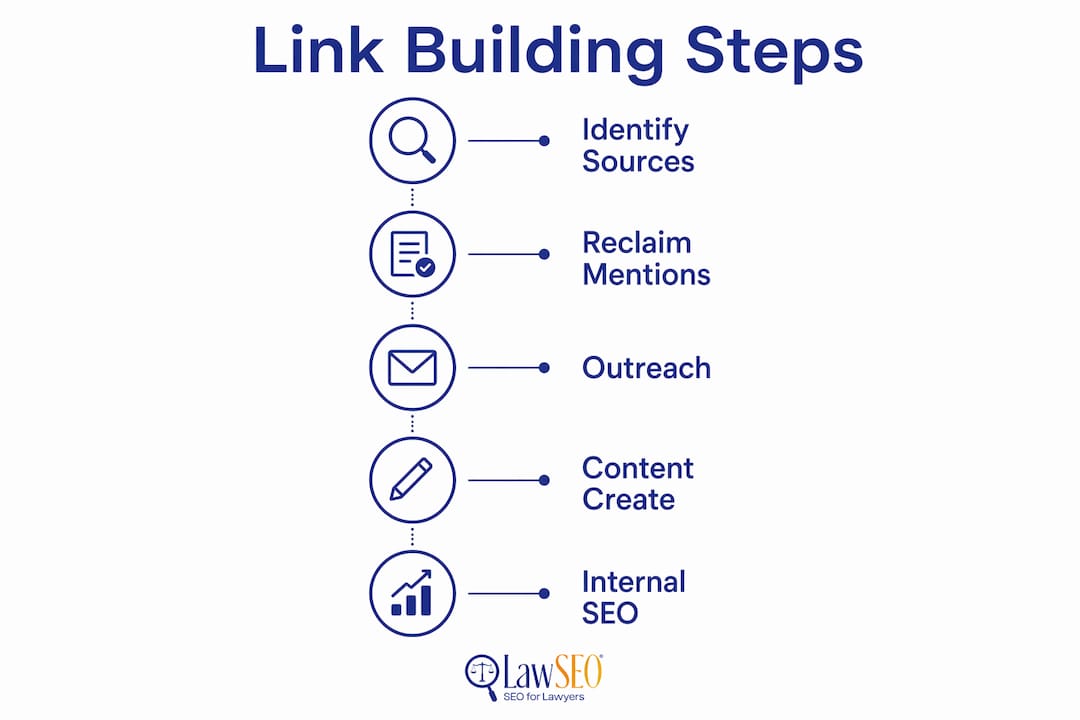
How to effectively reclaim and build new links through outreach
Link reclamation is the fastest path to new backlinks because the editorial decision has already been made. Someone mentioned your firm without linking to it. Converting that mention costs nothing except a polite email.
- Set up Google Alerts for your firm name, your attorneys’ names, and your primary practice areas. Every alert is a potential link reclamation opportunity.
- Use Ahrefs Webmaster Tools to audit your existing backlink profile. Identify lost links, broken inbound links, and unlinked brand mentions across the web.
- Draft a specific outreach email. Reference the exact page where your firm was mentioned, explain the value a link adds to their readers, and keep the message under 150 words. Generic templates get ignored.
- Target broken links on reputable legal sites. Auditing broken links on law school resource pages, legal aid sites, and bar association pages gives you a reason to reach out with a concrete offer.
- Build relationships before you need links. Comment on local reporters’ articles, attend bar association events, and contribute to community organizations. Relationships convert to links faster than cold outreach.
- Guest post on relevant legal publications. High-quality legal guest posts on relevant sites generate lasting, authoritative backlinks when the content is original and attorney-verified.
Unlinked brand mentions convert into backlinks through targeted outreach at zero cost. That makes reclamation the highest-ROI activity in any link building program.
Pro Tip: When pitching guest posts, propose a specific angle tied to a recent court ruling or local legal development. Editors accept pitches that solve a content gap, not pitches that promote a firm.
What content and internal SEO groundwork supports link acquisition?
Foundation SEO should precede external link campaigns for maximum effectiveness. Incoming links need well-optimized destination pages to convert into rankings. A link pointing to a thin, unstructured practice area page delivers a fraction of the value it would on a detailed, authoritative page.
Your Google Business Profile is the first asset to optimize before pursuing external links. A complete, verified profile with accurate NAP data, photos, and practice area descriptions gives local links a strong destination to reinforce. Inconsistent NAP across directories undermines the trust signals those links are meant to build.
- Write detailed, attorney-verified content on every practice area page
- Create local landing pages with original data specific to your city or region
- Use natural, varied anchor text in internal links to avoid over-optimization
- Build internal links from high-traffic blog posts to your core practice area pages
- Maintain consistent name, address, and phone number across every citation and directory
Internal linking strategy deserves more attention than most firms give it. When a legal blog post earns a backlink from a news site, that authority flows into your site. Internal links then distribute that authority to your money pages, such as your personal injury or family law practice pages. Without internal links, authority pools in the blog post and never reaches the pages that generate client inquiries.
Website optimization at the page level also determines how long earned links sustain ranking improvements. Pages that load slowly, lack schema markup, or carry thin content lose ranking gains faster than pages built on a solid technical foundation.
What common link acquisition pitfalls should law firms avoid?
The most damaging mistakes in legal link building share one trait: they prioritize short-term gains over durable authority. Google’s algorithms and bar disciplinary boards both catch up eventually.
- Purchasing links: Paid placements violate Google’s link spam policies and ABA Rule 7.2. The risk is not theoretical. Google’s manual actions have removed law firm sites from search results for paid link schemes.
- Exact-match anchor text overuse: Exact-match anchors kept above 5% of your link profile trigger algorithmic penalties. “Personal injury attorney Dallas” repeated across dozens of links looks manipulative because it is.
- Bulk directory submissions: Submitting to hundreds of low-quality directories in a short period creates an unnatural link velocity pattern. Google’s systems flag it.
- Ignoring toxic backlinks: Spam sites, link farms, and irrelevant foreign domains pointing to your site drag down your profile. Audit quarterly and disavow links that cannot be removed through outreach.
- Over-reliance on directories: Directories alone do not build authority. They establish baseline citations. Editorial links from news sites, legal publications, and community organizations do the heavy lifting.
Pro Tip: Run a disavow file audit every six months. One toxic link cluster from a previous vendor’s work can suppress rankings you earned through months of clean outreach.
Key Takeaways
Ethical, earned link acquisition from high-authority legal and local sources is the most durable path to improved search rankings for law firms.
| Point | Details |
|---|---|
| Ethics govern every link decision | ABA Rules 7.1 and 7.2 prohibit paid links and misleading placements; violations risk both bar complaints and Google penalties. |
| Source quality beats volume | One link from a state bar directory or .edu domain outweighs dozens of generic directory links. |
| Reclamation is the fastest win | Unlinked brand mentions convert to backlinks at zero cost through targeted, specific outreach emails. |
| Foundation SEO comes first | Optimize practice area pages and Google Business Profile before launching any external link campaign. |
| Anchor text diversity protects rankings | Keep exact-match commercial anchors below 5% of your total link profile to avoid algorithmic penalties. |
Why ethical link building is actually your competitive edge
After nearly three decades working in SEO, the pattern I see most often in legal markets is this: firms that treat compliance as a constraint fall behind, and firms that treat it as a filter pull ahead. The legal niche is one of the few where your ethical obligations and your SEO interests genuinely align.
Most of your competitors are buying links, stuffing directories, or outsourcing outreach to vendors who have no idea what ABA Rule 7.2 says. That creates a gap. When Google’s next link spam update rolls out, those firms take the hit. Your clean, editorially earned profile holds its ground.
The sequencing matters more than most attorneys realize. Starting with internal optimization, then local authority, then digital PR maximizes long-term SEO return. Firms that skip to aggressive outreach before their pages are ready waste every link they earn. The authority arrives, finds a weak page, and dissipates.
My strongest recommendation is to build relationships in your local legal community before you need anything from them. Sponsor a local bar association event. Contribute a column to a regional legal journal. Those relationships produce links that no outreach template can replicate. They also produce referrals, which is the real prize.
The lawyer link building workflow that works in 2026 is not complicated. It is consistent, ethical, and patient. The firms willing to do it right are the ones still ranking when everyone else is recovering from a penalty.
— TODD
How Lawseo supports ethical link acquisition for law firms
Lawseo works exclusively with attorneys and law firms, which means every link strategy we build accounts for ABA compliance, state bar rules, and Google’s link policies from the start. Todd R. Stager personally reviews every client campaign, applying over 29 years of SEO experience to the specific competitive dynamics of legal markets. The firm’s approach sequences foundational SEO work before any external outreach, so every earned link lands on a page built to hold rankings. If you want to see how proven legal SEO strategies translate into measurable client growth, Lawseo’s services are built for exactly that outcome.
FAQ
What are link acquisition best practices for law firms?
Link acquisition best practices for law firms are ethical, targeted methods for earning backlinks from high-authority sources such as state bar directories, legal publications, and local news sites. These methods comply with ABA Model Rules 7.1 and 7.2 and avoid paid or manipulative link schemes.
How do I find unlinked mentions of my law firm?
Set up Google Alerts for your firm name and attorney names to identify unlinked brand mentions. Then send a short, specific outreach email to the publisher requesting a link to the relevant page on your site.
What types of backlinks help law firm SEO the most?
Links from state bar directories, .edu and .gov domains, local news publications, and editorially controlled legal directories carry the most weight. Unique referring domains matter more than total link count.
How much exact-match anchor text is too much?
Exact-match commercial anchor text should stay below 5% of your total link profile. Exceeding that threshold creates an unnatural pattern that Google’s algorithms flag as manipulative.
Should I build links before optimizing my website?
No. Foundation SEO, including optimized practice area pages and a complete Google Business Profile, should come before any external link campaign. Incoming links need strong destination pages to convert into lasting ranking improvements.