


Clients searching for legal help now turn to their smartphones before anything else. For law firms in the United States, this shift means that relying on traditional desktop strategies alone is no longer enough to stay competitive. Mobile SEO ensures your firm’s website delivers a fast, intuitive, and responsive experience to connect with more potential clients right when they are searching for legal guidance on any device.
Table of Contents
- Defining Mobile SEO for Legal Websites
- Critical Mobile Ranking Signals for Law Firms
- Responsive Design and User Experience Essentials
- Local SEO and AI Optimization for Attorneys
- Compliance, Trust, and Ethical Considerations
- Avoiding Common Mistakes and Pitfalls
Key Takeaways
| Point | Details |
|---|---|
| Importance of Mobile SEO | Law firms must prioritize mobile SEO to enhance online visibility as over 60% of legal searches come from mobile devices. |
| Key Mobile Ranking Signals | Focus on optimizing site speed, mobile responsiveness, and structured data to improve search rankings. |
| User Experience Design | Implement responsive design and user-friendly navigation to ensure potential clients can easily access legal information. |
| Ethical Considerations | Maintain ethical standards and client trust by ensuring accurate, transparent digital communication and secure data handling. |
Defining Mobile SEO for Legal Websites
Mobile SEO represents a critical digital strategy for law firms seeking to optimize their online presence specifically for smartphone and tablet users. Unlike traditional desktop search optimization, mobile SEO focuses on delivering a seamless, fast, and responsive experience that meets the unique browsing behaviors of potential legal clients searching on mobile devices.
At its core, mobile SEO involves adapting website design and content for mobile platforms, ensuring that legal websites load quickly, display correctly across different screen sizes, and provide intuitive navigation. This approach recognizes that over 60% of legal searches now originate from mobile devices, making responsive design and mobile-friendly content essential for attracting and retaining potential clients.
Key components of effective mobile SEO for legal websites include technical optimization such as responsive web design, accelerated page loading speeds, mobile-friendly typography, and touch-friendly interface elements. Search engines like Google prioritize websites that deliver exceptional mobile user experiences, using metrics like page load time, mobile usability, and content accessibility as ranking signals. Law firms must therefore invest in creating websites that not only look professional but also function seamlessly across smartphones, tablets, and other mobile devices.
Pro tip: Conduct a mobile responsiveness test using Google’s free tools to identify and quickly resolve any mobile optimization issues on your law firm’s website.
Critical Mobile Ranking Signals for Law Firms
Mobile search rankings for legal websites depend on a complex array of technical and user experience signals that search engines use to evaluate online performance. Understanding these critical mobile ranking factors allows law firms to strategically optimize their digital presence and improve visibility in competitive search results.
Key ranking signals start with technical performance metrics that directly impact user experience. These include site speed, mobile responsiveness, secure HTTPS connections, and intuitive navigation. Google’s mobile algorithm prioritizes websites that load quickly, display correctly on various device screen sizes, and provide seamless interaction for potential clients searching for legal services on smartphones and tablets.
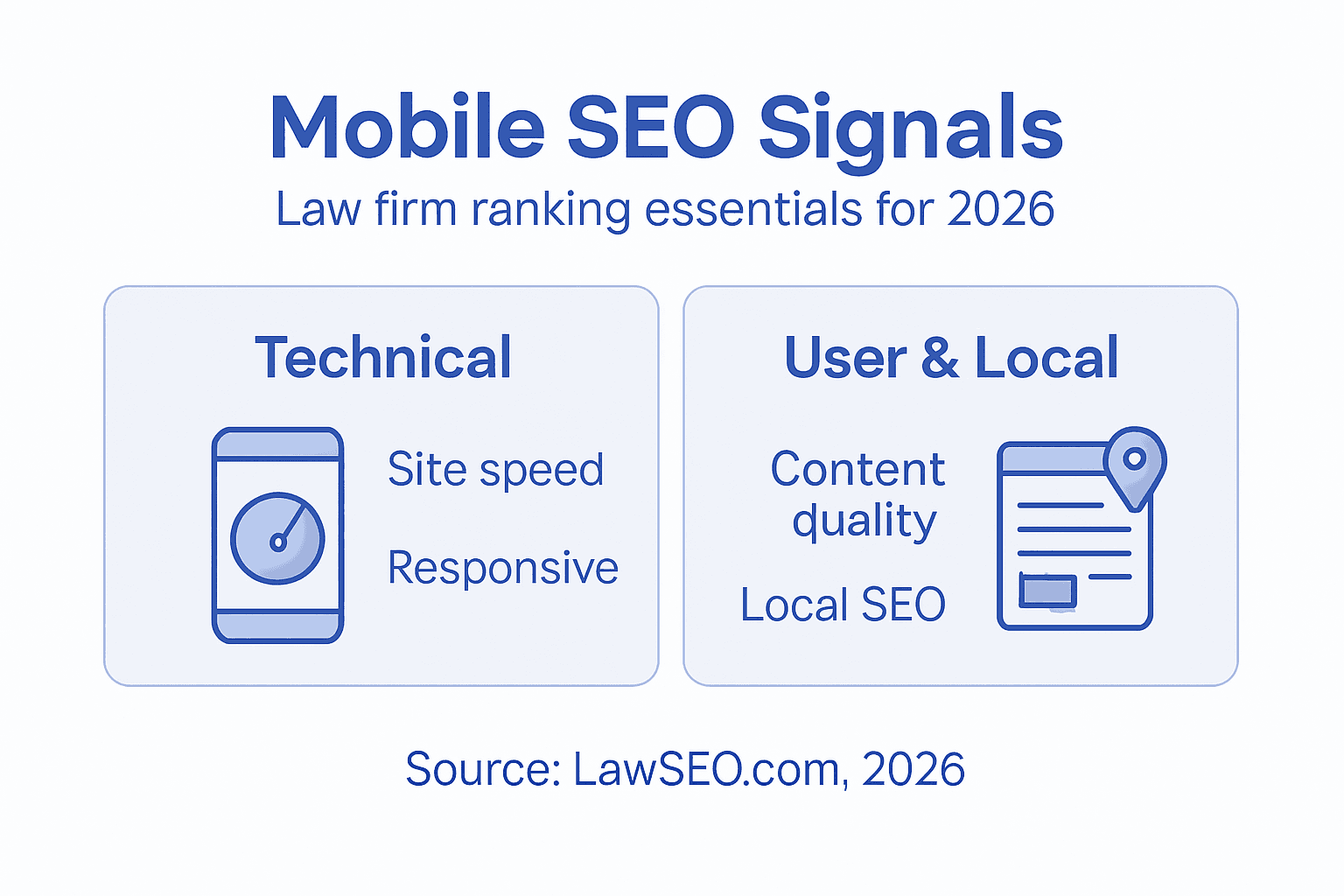
Beyond technical optimization, content quality and engagement metrics play a crucial role in mobile search rankings. Law firms must develop mobile-friendly content that addresses specific client needs, incorporates targeted local keywords, and utilizes structured data markup to help search engines understand and index their services more effectively. Emerging technologies like AI are also influencing mobile SEO strategies, with sophisticated algorithms evaluating factors such as content relevance, user interaction time, and mobile-specific engagement patterns.
Additionally, local SEO signals remain paramount for law firms targeting geographic markets. Mobile search results increasingly emphasize proximity, relevance, and prominence of local businesses, meaning law firms must optimize their Google Business Profile, maintain consistent contact information across digital platforms, and generate positive client reviews to improve mobile search rankings.
Pro tip: Regularly use Google’s Mobile-Friendly Test tool to identify and immediately resolve any mobile optimization issues that could negatively impact your law firm’s search rankings.
Here is a comparison of key mobile SEO ranking signals for legal websites and why they matter:
| Ranking Signal | What It Means | Business Impact |
|---|---|---|
| Site Speed | How fast pages load on mobile devices | Reduces bounce rates, improves visibility |
| Mobile Responsiveness | Adapting layout to screen size | Ensures usability, increases engagement |
| HTTPS Security | Encrypted site connections | Builds trust, safeguards confidentiality |
| Local Relevance | Optimization for geo-targeted queries | Attracts local clients, boosts rankings |
| Structured Data Markup | Code that helps search engines index | Enhances search appearance, drives clicks |
Responsive Design and User Experience Essentials
Responsive web design has become the cornerstone of modern digital strategy for law firms seeking to provide exceptional mobile user experiences. The fundamental goal is creating websites that seamlessly adapt to different device screen sizes, ensuring potential clients can access critical legal information regardless of whether they are using smartphones, tablets, or desktop computers.

Responsive web design principles transform how legal websites function across digital platforms. This approach utilizes flexible grid layouts, scalable images, and intelligent media queries that automatically adjust content presentation. For law firms, this means developing websites that not only look professional but also provide intuitive navigation, readable text, and easily clickable contact elements on screens of all sizes.
User experience goes beyond visual adaptation, focusing on creating meaningful interactions that address potential clients’ specific needs. Law firms must consider navigation simplicity, content hierarchy, and interaction design that accommodates mobile users’ unique browsing behaviors. This involves designing clear call-to-action buttons, minimizing form complexity, and ensuring critical information like practice areas, contact details, and consultation scheduling are immediately accessible.
Technical considerations play a crucial role in responsive design implementation. Law firms should prioritize fast loading times, optimize image sizes, minimize unnecessary scripts, and utilize browser caching to create smooth mobile experiences. Advanced techniques like lazy loading and responsive image optimization can significantly improve performance, directly influencing both user satisfaction and search engine rankings.
Pro tip: Conduct monthly mobile usability tests using real devices to identify and immediately address any user experience friction points in your law firm’s website design.
Local SEO and AI Optimization for Attorneys
Local SEO represents a critical digital strategy for attorneys seeking to attract clients within specific geographic markets. As mobile search continues to dominate legal service discovery, law firms must develop sophisticated approaches that combine local targeting with advanced technological capabilities.
Artificial intelligence is transforming how attorneys approach local search optimization strategies. AI-powered tools now enable law firms to analyze hyper-local search trends, generate location-specific content, and personalize client engagement with unprecedented precision. These technologies help attorneys understand nuanced search intent, predict potential client needs, and create targeted content that ranks higher in mobile search results.
Effective local SEO for attorneys involves multiple strategic components beyond traditional keyword optimization. Law firms must maintain consistent business information across digital platforms, generate positive client reviews, and develop location-specific landing pages that address community-specific legal challenges. AI can assist in identifying emerging local search trends, suggesting content improvements, and automating metadata optimization to enhance local search visibility.
Technological integration requires law firms to leverage AI not just as a search optimization tool, but as a comprehensive client engagement strategy. Advanced AI algorithms can help attorneys understand local search patterns, predict client behavior, and create personalized content experiences that significantly improve mobile search rankings and client acquisition rates.
Pro tip: Implement AI-driven local SEO tools that provide real-time analytics and content optimization recommendations for your law firm’s digital marketing strategy.
Compliance, Trust, and Ethical Considerations
Navigating the complex landscape of digital legal marketing demands an unwavering commitment to ethical standards, professional conduct, and client trust. Legal websites must carefully balance technological innovation with stringent ethical guidelines that protect client confidentiality, maintain professional integrity, and ensure transparent communication.
Ethical compliance principles provide a critical framework for law firms developing mobile digital strategies. These principles require consistent leadership, clear procedural standards, and proactive measures that prioritize client privacy and professional responsibility. Every aspect of a law firm’s digital presence must reflect the same level of ethical consideration applied in traditional legal practice, from content creation to client interaction mechanisms.
Trust represents the foundational element of legal service delivery, especially in digital environments where personal interaction is limited. Law firms must demonstrate credibility through transparent website design, clear communication of services, accurate representation of legal expertise, and robust privacy protections. This involves implementing secure data handling protocols, providing clear disclaimers about the nature of online legal information, and ensuring that mobile platforms maintain the same level of professional discretion expected in face-to-face consultations.
Technological advancements like artificial intelligence and mobile optimization create new ethical considerations for legal professionals. Law firms must develop comprehensive guidelines that address potential conflicts between innovative marketing strategies and professional ethical standards. This includes establishing clear boundaries for AI-generated content, maintaining human oversight in client communications, and ensuring that technological tools enhance rather than replace professional legal judgment.
Pro tip: Conduct quarterly ethical audits of your law firm’s digital marketing strategies to ensure ongoing compliance with professional conduct standards and client protection guidelines.
Avoiding Common Mistakes and Pitfalls
Mobile SEO for legal websites requires a strategic approach that anticipates and mitigates potential digital marketing errors. Law firms must recognize that mobile search optimization is a nuanced field where seemingly minor mistakes can significantly impact online visibility and client acquisition.
Common mobile SEO mistakes frequently derail legal marketing efforts. These include neglecting local search optimization, creating websites with slow loading times, providing unclear navigation, and failing to implement performance tracking mechanisms. Law firms often underestimate the importance of mobile-specific design elements that create seamless user experiences across different device types and screen sizes.
Technological pitfalls present significant challenges, particularly with the rise of artificial intelligence tools. Law firms must exercise extreme caution when leveraging AI-generated content, ensuring that all digital materials maintain professional accuracy and ethical standards. Unvetted AI content can produce hallucinated or inaccurate information that damages professional credibility and undermines search engine trust. Successful mobile SEO strategies require human oversight, rigorous content verification, and a commitment to delivering genuine, authoritative legal information.
Performance tracking represents another critical area where law firms frequently stumble. Simply publishing content is insufficient. Attorneys must implement robust analytics systems that provide granular insights into mobile user behavior, search performance, and content engagement. This involves using advanced tracking tools to monitor bounce rates, time on site, conversion metrics, and mobile-specific interaction patterns that reveal how potential clients interact with legal websites.
Below is a summary of common mobile SEO mistakes law firms should avoid and their potential consequences:
| Mistake | Typical Cause | Possible Outcome |
|---|---|---|
| Ignoring local search signals | Missing Google Business optimization | Fewer local client inquiries |
| Slow mobile load times | Large images or unoptimized scripts | Higher bounce rates, lost visitors |
| Overly complex navigation | Poor UX design for mobile | Frustrated users, fewer conversions |
| Lack of performance tracking | No analytics or monitoring setup | Missed optimization opportunities |
| Unvetted AI content | Publishing without human review | Inaccurate info, reputation damage |
Pro tip: Conduct monthly comprehensive mobile SEO audits using multiple professional tools to identify and rapidly address performance gaps in your law firm’s digital strategy.
Take Your Law Firm’s Mobile SEO to the Next Level with Expert Support
Navigating the complexities of mobile SEO for legal websites can feel overwhelming. The article highlights key challenges such as optimizing site speed, ensuring mobile responsiveness, and leveraging AI for local SEO — all while maintaining ethical compliance. Your law firm deserves a tailored strategy that not only addresses these pain points but also drives more qualified clients through mobile search channels.
At LawSEO.com, we specialize exclusively in legal SEO, combining deep industry knowledge with cutting-edge AI optimization techniques. Our founder-led team understands the importance of fast loading times, secure mobile experiences, and local search dominance. We work closely with your firm to create responsive, ethically compliant websites that perform at the highest level on both traditional and AI-driven platforms. Don’t let common mobile SEO mistakes hold your firm back. Discover how our comprehensive approach to local SEO and mobile optimization can transform your online presence today.
Ready to outpace competitors and attract more mobile clients? Visit LawSEO.com now to schedule your personalized mobile SEO strategy consultation and start winning search results in 2026.
Frequently Asked Questions
What is Mobile SEO for legal websites?
Mobile SEO for legal websites is the strategy of optimizing a law firm’s online presence for mobile device users. It focuses on creating a fast, responsive, and user-friendly experience specifically tailored to how potential clients browse on smartphones and tablets.
Why is responsive design important for legal websites?
Responsive design is crucial because it ensures that a legal website adapts seamlessly to different screen sizes. This improves usability and engagement, ultimately helping law firms retain potential clients who are searching for legal services on mobile devices.
How can local SEO impacts mobile search rankings for law firms?
Local SEO enhances mobile search rankings by optimizing a law firm’s online presence for geographic relevance. This includes maintaining accurate Google Business Profile information, generating positive client reviews, and creating location-specific content to attract local clients searching for legal services.
What common mistakes should law firms avoid in mobile SEO?
Law firms should avoid mistakes such as ignoring local search signals, having slow loading times, overly complex navigation, lacking performance tracking systems, and using unvetted AI-generated content. These errors can lead to higher bounce rates, lost inquiries, and damage to professional credibility.