


Multi-touch attribution is the practice of crediting every marketing touchpoint, not just the last click, for a signed case. Law firm marketers should stop relying on last-click reports and start today: turn on call tracking, standardize UTM tagging across every campaign, and push source data into your CRM. That closed loop is what finally connects ad spend to retained clients and real ROI.
TL;DR:
- Only about 18% of law firms currently use multi-touch attribution to effectively track which channels actually drive signed cases.
- Building a complete attribution system requires five interconnected layers, with the biggest data gaps occurring during handoffs between engagement, conversion, and intake.
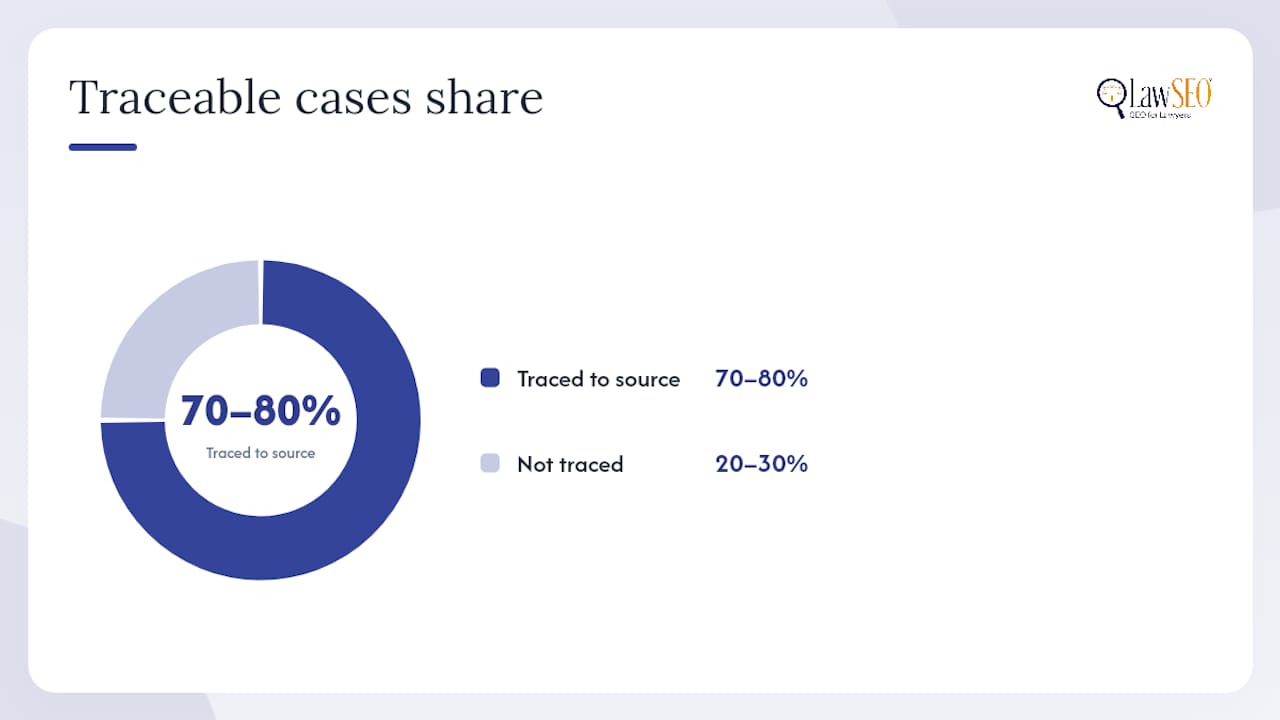
- Most firms can reliably trace 70 to 80% of signed clients back to specific marketing sources once they fix tracking gaps in their intake processes and call attribution.
- Adopting attribution models such as U-shaped or linear, and comparing their results over 60 to 90 days, helps identify which channels truly influence client signings.
- A tracking setup should be trusted after three to six months of consistent data collection before making significant budget decisions based on attribution insights.
What Multi Touch Attribution Lawyers Actually Need Solves
Most law firm marketing reports are lying to you, and not maliciously. They’re built on last-click attribution, a model that hands 100% of the credit for a new client to whatever channel happened to close the deal, ignoring the blog post, the review, and the two Google searches that got the prospect there in the first place.
That single flaw compounds badly in legal marketing because of three structural realities. Platforms like Google Ads and Meta default to their own attribution windows and take last-click credit for themselves, which means two platforms can both claim the same client and both look profitable in isolation. Phone calls make it worse: a personal injury or family law prospect who calls after seeing three ads and a referral leaves zero trail in a web-only analytics setup unless call tracking is in place.
Cross-device behavior and “dark social” (a prospect researching on their phone, then calling from a desk line, or getting your firm’s name from a private group text) erase the digital paper trail entirely. Add recall bias at intake, where a stressed new client says “I found you on Google” when they actually clicked a Facebook ad three weeks earlier, and you get data that’s confidently wrong rather than honestly incomplete.
This is why so few firms have solved it. Industry data shows only about 18% of law firms use multi-touch attribution to understand which campaigns actually drive signed cases. The problems that cause this show up in a few predictable places:
- Last-click reporting overcredits paid search and branded terms while starving the content and referral channels that started the journey.
- Phone-first intake means a huge share of conversions never touch a trackable web form.
- Cross-device research (mobile discovery, desktop conversion) breaks cookie-based tracking without a unifying identifier.
- Dark social and word-of-mouth referrals leave no digital breadcrumb at all.
- Intake staff asking “How did you hear about us?” get vague, unreliable answers instead of specific channel data.
The Five Layers of a Complete Attribution System
A working attribution setup for a law firm is not one tool. It’s five connected layers, and most firms that fail at attribution have only built one or two of them. A complete system runs from source tracking through revenue attribution, and skipping a layer is what causes the data gaps everyone blames on “bad tracking.”
- Source tracking captures where a visitor or caller originated: which ad, which organic keyword, which referral partner. This runs on UTM parameters and unique tracking phone numbers.
- Engagement tracking records what the prospect did after arriving: pages viewed, time on site, chatbot interactions, calls listened to or transcribed.
- Conversion tracking logs the moment intent becomes action: a form submission, a call connected, a chat that ends with a scheduled consultation.
- Intake attribution is where legal marketing diverges sharply from ecommerce. This layer captures what happens during the actual intake call or consultation, including case type, retention likelihood, and referral context.
- Revenue attribution ties the signed retainer, and ultimately the fee collected, back through every layer to the original source.
Data loss almost always happens at the same two seams: between engagement and conversion (when a call isn’t tracked with a unique number) and between conversion and intake (when the intake team doesn’t record or forward source information to the CRM). Fix those two seams and most of your attribution “mystery” disappears.
Pro Tip: *Audit your CRM’s lead source field once a quarter.
Which Attribution Model Should Law Firms Actually Use?
Once the tracking layers exist, you need a model to decide how much credit each touchpoint gets. The common options each tell a different story about the same client journey.
- First-touch credits whatever brought the prospect in initially, useful for measuring top-of-funnel awareness but blind to what actually closed the deal.
- Last-touch credits the final interaction before conversion, the default in most analytics platforms and the most misleading for firms with long consideration periods.
- Linear splits credit evenly across every touchpoint, simple to explain to a managing partner but mathematically naive since not every touch matters equally.
- Time-decay weights recent touches more heavily, a reasonable fit for shorter sales cycles but often undervalues the content or review that built initial trust.
- U-shaped (position-based) gives the heaviest weight to the first and last touch, with the middle touches splitting what’s left.
- W-shaped adds a third weighted point, typically the moment a lead becomes a marketing-qualified or sales-qualified lead, useful for firms with a distinct intake screening step.
Many law-firm attribution guides recommend U-shaped as the practical default because it recognizes two truths about legal client acquisition: the channel that first earned trust and the channel that closed the consultation both deserve real credit, and everything in between (a retargeting ad, a second blog visit) matters less than either bookend.
Don’t just adopt a model on faith. Run first-touch and last-touch reports side by side for 60 to 90 days. Big divergence between the two tells you which channels are doing early-funnel work versus closing work, and that comparison alone often reshapes a budget more than any single attribution model does.
Setting Up Multi-Touch Attribution Without an Enterprise Budget
You don’t need a marketing data warehouse to get this working. Most firms can build a reliable system in layers, starting cheap and adding sophistication only where it earns its cost.
- Fix your intake questions first. Replace “How did you hear about us?” with something specific like “What made you decide to reach out today?” Better phrasing improves recall accuracy far more than any software purchase will.
- Standardize UTM naming across every campaign, every platform, every ad group, using one consistent naming convention so a spreadsheet pivot table can actually group the data later.
- Tag every trackable link, including email newsletters, sponsored content, and directory listings, not just paid ads.
- Assign unique tracking phone numbers to each major campaign or channel. Call tracking with number pools and recording is the single highest-leverage technical investment for firms where phone calls dominate intake.
- Add hidden form fields that auto-populate source, medium, and campaign data from the URL, so that data lands in the CRM without a human retyping it.
- Move to event-based analytics so scroll depth, video plays, and chat starts count as engagement signals, not just pageviews.
- Map source fields directly into your CRM or case-management platform, alongside flags for retained versus not retained and the final fee collected.
- Reconcile monthly. Pull a sample of signed cases and manually trace their source data back to the original campaign to catch silent tracking failures before they skew a quarter’s reporting.
- Layer in advanced tools only once the basics hold. Session stitching across devices, a customer data platform for unified profiles, and BI tool queries for weighted multi-touch credit are worth the investment once your foundational data is trustworthy, not before.
Pro Tip: Don’t buy a session-stitching tool to fix a problem that’s actually a broken intake script. Sequence matters: fix the cheap, human-process steps before spending on the expensive, technical ones.
Measuring Success: KPIs That Actually Tie to Revenue
Attribution data is only useful if it changes a budget decision. The metrics that matter for a law firm look different from typical marketing dashboards because the real unit of success is a signed retainer, not a click.
- Retained cases by source, the count of signed clients traceable to each channel, is the baseline number everything else builds on.
- Average case value by practice area turns a raw case count into a revenue estimate, since a signed mass tort case and a signed traffic ticket case are not equal wins.
- Marketing-influenced revenue captures total fees from cases where marketing touched any point in the journey, even if it wasn’t the final touch.
- Cost per retained client (CPRC), total spend divided by signed cases (not leads), is the number that should drive budget shifts, since cost-per-lead alone hides which leads actually convert.
Choosing the right lookback window matters more in legal marketing than almost any other industry. A slip-and-fall inquiry might convert in days; a complex commercial litigation referral might take months of nurturing before a consultation gets booked. Reviewing conversion tracking across search, ads, and referral touchpoints helps establish what window actually fits your practice mix rather than defaulting to a platform’s 30-day setting.
Once you have a few months of clean data, run a simple query in your CRM or BI tool: pull signed cases, apply weighted credit under both U-shaped and linear models, and compare the resulting channel rankings. If the rankings barely move between models, your data is stable enough to trust. If they swing wildly, you likely have a tracking gap, not a model problem. For firms increasing spend on a new channel, a holdout test (pausing that channel in one market or practice area for 60 days) is the cleanest way to confirm the attribution numbers reflect real incremental cases rather than cases that would have arrived anyway.
The Attribution Mistakes That Quietly Wreck Your Data
A few recurring failures corrupt otherwise well-built attribution systems, and all of them are fixable without a platform overhaul.
- Untracked phone calls are the most common gap. If a campaign doesn’t have its own unique number, every call gets lumped into “direct” or “organic,” hiding real performance.
- Offline and referral channels (attorney referral networks, community sponsorships, print ads) get ignored because they don’t generate a clickable link. A simple promo code or a dedicated intake question fixes this.
- Cross-device journeys overcount when two platforms both claim last-touch credit for the same prospect. Monthly CRM reconciliation against platform-reported conversions catches this quickly.
- Incomplete intake data from vague questions or rushed staff undermines every layer above it, no matter how good your tracking tech is.
Prioritize fixes by cost against impact: fixing an intake script costs nothing and pays off immediately, while a full CDP integration costs real budget and should wait until the cheap fixes are already in place.
Pro Tip: If your CRM shows a spike in “direct traffic” or “unknown source” right after a new campaign launch, that’s usually a tracking implementation bug, not a sudden change in client behavior.
How Lawseo Builds Closed-Loop Attribution for Law Firms
Todd R. Stager, who has spent close to three decades in SEO and personally reviews strategy on every Lawseo account, treats attribution as inseparable from SEO reporting rather than a side project. A campaign that can’t prove it produced signed cases isn’t a campaign worth defending in a budget review.
Lawseo’s approach centers on call tracking, CRM integration, and analytics reporting layered with AI-assisted analysis to surface which channels are actually producing retained clients, not just leads. Because Lawseo works under exclusivity agreements within each market, measurement stays honest: there’s no incentive to inflate one channel’s numbers when the firm isn’t also serving a competing practice down the street.
When Does Attribution Data Actually Become Reliable?
Most firms want a clean attribution dashboard in week one. That’s unrealistic, and chasing it wastes money. In practice, three to six months of consistent tracking is what it takes before the data settles enough to trust for budget decisions, since legal buying cycles are longer than a typical ecommerce funnel.
Before increasing spend on any channel, watch for stability across two or three reporting periods, not one good month. If a channel’s signed-case numbers hold steady across a quarter, that’s a real signal. If they spike once, it’s probably noise. Spend enough on measurement to trust the numbers, but not so much that instrumentation eats the budget meant for the campaigns it’s supposed to measure.
— TODD
Get a Measurement Audit From Lawseo
Most SEO agencies hand you a rankings report and call it a day. Lawseo builds the tracking infrastructure, call tracking, CRM field mapping, and revenue attribution, so you can see which campaigns actually produce signed retainers, not just traffic. That’s the gap most firms never close on their own, and it’s the difference between guessing at next quarter’s budget and knowing it.
If your firm is running paid search, content, or local SEO without a closed loop back to your CRM, that’s the first thing worth fixing before spending another dollar on new campaigns. Lawseo’s legal SEO services fold attribution setup directly into ongoing campaign management, so tracking improvements and content strategy move together instead of living in separate reports. Request a measurement audit through Lawseo and get a clear picture of where your marketing dollars are actually landing.
Sources
- What Marketing Attribution Should Look Like for Law Firms — JD Supra
- Attribution in legal marketing: why it’s hard to track (but still important) — Legal Marketing Blog
- Marketing outlook / vendor eBook (Call tracking features) — MediaValet / CallRail ebook