


TL;DR:
- Many attorneys see exhaustion as proof of commitment, but it actually harms judgment, client outcomes, and career longevity. Regular, structured naps supported by neuroscience improve cognitive function, reduce errors, and foster a healthier legal culture, ultimately benefiting firms and individuals. Building consistent rest routines is essential for sustainable, high-quality legal work and long-term professional success.
Most attorneys treat exhaustion as proof of dedication. That belief is costing them — in judgment, in client outcomes, and in career longevity. Nap consistency for attorneys is not a wellness trend. It is a cognitive performance strategy backed by neuroscience and clinical research. If you routinely push through 10-hour days on six hours of sleep, your analytical capacity is already compromised in ways you are unlikely to notice. This guide explains why rest matters specifically for legal professionals, what blocks attorneys from adopting it, and how to build a sustainable nap routine that fits a demanding practice.
Key takeaways
| Point | Details |
|---|---|
| Sleep deprivation impairs judgment | Restricting sleep to 6 hours nightly for two weeks produces impairment equal to 24 hours without sleep. |
| Cultural stigma is the biggest barrier | Legal culture frames exhaustion as status, making nap consistency feel professionally risky. |
| CBT-I is clinically effective | Cognitive behavioral therapy for insomnia reduces sleep onset time by 19 minutes and raises sleep efficiency by 10 points. |
| Power naps protect prefrontal function | Short structured naps support the prefrontal cortex, the brain region attorneys rely on most for reasoning and decisions. |
| Firms benefit from supporting rest | Law firms that embed wellness into their culture see improved retention, reduced ethical risk, and stronger reputation. |
Nap consistency for attorneys and why it matters cognitively
Legal work is one of the most cognitively demanding professions that exists. Drafting complex arguments, spotting factual inconsistencies, negotiating under pressure, and making rapid decisions under incomplete information all depend on prefrontal cortex function. That region of the brain is precisely what chronic sleep deprivation degrades first.
The research is unambiguous. Sleep restricted to 6 hours per night for 14 consecutive days produces cognitive impairment equivalent to 24 hours of total sleep deprivation. The critical problem is that most attorneys operating in this state do not perceive how impaired they actually are. They feel alert, functional, and capable. That subjective sense of competence masks real performance decline.
Consider what this means for legal practice specifically:
- Analytical capacity falls. Complex legal reasoning requires holding multiple variables in working memory simultaneously. Fatigue reduces that capacity significantly.
- Error rates increase. Cognitive performance declines beyond 49 to 55 work hours per week, with longer hours producing measurably higher error rates in professional tasks.
- Ethical risk rises. Fatigued attorneys miss details, misread client instructions, and make procedural errors that create liability and disciplinary exposure.
- Decision quality degrades quietly. Fatigue-driven decisions often feel confident and justified. That is what makes sleep deprivation uniquely dangerous for attorneys.
The prefrontal cortex requires genuine disengagement to return to baseline function. Continued overwork depletes it progressively, and no amount of caffeine substitutes for actual recovery. Strategic rest, including structured napping, directly supports recovery in that specific brain region.
For attorneys who already struggle with sleep, Cognitive Behavioral Therapy for Insomnia offers a clinically validated path forward. CBT-I produces moderate-to-large improvements in sleep quality, reducing time to fall asleep by 19 minutes and increasing sleep efficiency by 10 percentage points, with benefits that hold stable for up to 24 months. This is not a short-term fix. It is a structural intervention that attorneys can use to establish reliable sleep and nap routines.
Attorney sleep data at a glance
| Metric | General Population | Attorneys |
|---|---|---|
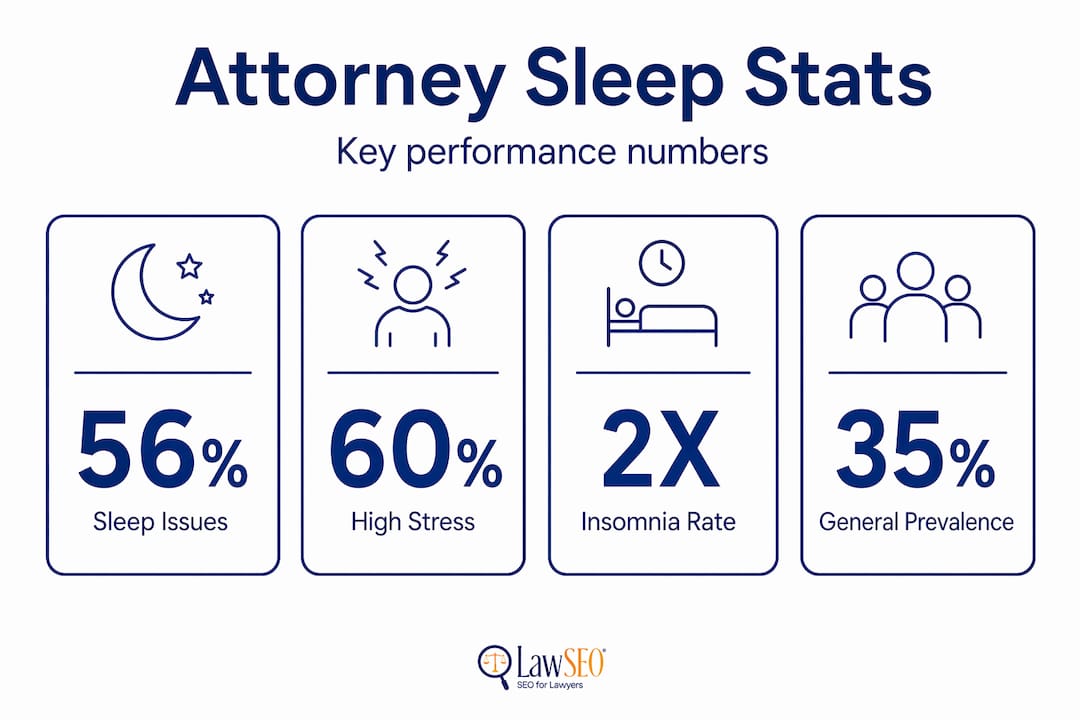
| Sleep issues prevalence | ~35% | 56% |
| Anxiety prevalence | ~18% | 71% |
| Poor mental well-being | ~25% | Nearly 60% |
| Sleep efficiency after CBT-I | Baseline | +10 percentage points |
These numbers confirm that attorneys face sleep challenges at roughly twice the rate of the broader population. Generic sleep advice rarely works for this group, for reasons that the next section addresses directly.
Why attorneys struggle to build nap habits
The barriers to nap consistency for attorneys go beyond scheduling. They are cultural, psychological, and sometimes structural.
Stress is a status symbol in legal culture. Nearly 60% of legal professionals report poor mental well-being, yet many treat stress as evidence of seriousness and professional commitment. When exhaustion signals status, rest signals weakness. This is not a minor mindset issue. It is a deeply embedded professional identity problem that makes napping feel like an admission of inadequacy.
Nocturnal cognitive arousal is specific to attorneys. High-achieving lawyers frequently experience a pattern where their minds race at bedtime, running through cases, anticipating conflicts, and rehearsing arguments. Attorneys experience hypervigilance and perfectionism that cause nocturnal cognitive arousal, making generic sleep advice largely ineffective for this population. Sleep hygiene tips designed for average adults do not account for the cognitive load attorneys carry home.
Attorneys underestimate their own fatigue. After 17 to 19 hours of continuous wakefulness, impairment reaches the equivalent of a blood alcohol concentration of 0.05%. Most attorneys in this state would tell you they feel fine and are performing well. This subjective underestimation of fatigue is one of the more dangerous patterns in the profession.
Other barriers include:
- Firm cultures that implicitly reward visibility and hours over output quality
- No designated space or time for rest during the workday
- Perfectionism that makes it psychologically difficult to step away from work mid-afternoon
- Reliance on caffeine to mask fatigue rather than address it
“Legal culture’s glorification of overwork creates an environment where firms must actively prescribe rest and recovery as a professional norm, not leave it to individual willpower.” Stress Addiction in Lawyers
Pro Tip: If you feel sharp and alert on six hours of sleep, that perception is likely the most dangerous part of your situation. Attorneys are particularly susceptible to subjective sleep stability, where the feeling of competence persists even as objective performance declines.
Practical strategies to build nap consistency
Building reliable nap habits requires structure, not willpower. Willpower is a depleting resource, which makes it exactly the wrong tool for any attorney managing a full caseload.
-
Schedule the nap before the fatigue hits. A 20-minute nap taken between 1:00 and 3:00 PM, placed in your calendar as a fixed appointment, is far more likely to happen than one you plan to take “if there is time.” Treat it exactly like a client meeting.
-
Use CBT-I principles to anchor your schedule. Scheduled sleep and stimulus control are core CBT-I techniques. Apply them to napping by keeping nap windows consistent, keeping naps under 30 minutes, and choosing a quiet, dark environment every time. Consistency trains your nervous system to transition quickly.
-
Limit naps to 10 to 20 minutes for maximum benefit. Naps exceeding 30 minutes risk entering slow-wave sleep, which causes grogginess upon waking. A 10 to 20-minute power nap restores alertness and supports working memory without the post-nap fog.
-
Address caffeine timing deliberately. Caffeine masks fatigue but increases stress hormones, which degrades actual performance over time. Cut off caffeine by 1:00 PM at the latest. This supports better afternoon napping and prevents the cortisol spike that disrupts evening sleep quality.
-
Incorporate micro-rest techniques on high-volume days. When a nap is genuinely impossible, five minutes of eyes-closed stillness, a ten-minute walk outdoors, or a brief mindfulness practice provides partial cognitive recovery. Strategic cognitive recovery through scheduled breaks, mindfulness, and movement supports prefrontal cortex health even on the busiest court days.
-
Negotiate firm culture directly. If you share office space or work in a firm environment, find out whether there is a wellness room, a quiet conference room during lunch, or a space you can use. Some attorneys use their car. The location matters far less than the regularity. If you work remotely, resources for working effectively from home include practical frameworks for building structured rest into a home-based legal practice.
-
Seek specialized support when needed. Specialized insomnia therapy designed for high-achieving attorneys addresses the unique cognitive arousal patterns of legal professionals without requiring career sacrifices. If self-directed strategies are not enough, this is the appropriate next step.
Pro Tip: Set a “nap alarm” ten minutes before your nap window and a second alarm 20 minutes later. This removes decision fatigue from the equation and builds the conditioned response faster.
Nap consistency versus the long-hours model
Legal culture has long operated on the assumption that more hours produce better outcomes. Research has dismantled that assumption systematically.
| Factor | Long-hours model | Consistent nap model |
|---|---|---|
| Weekly hours | 60 to 80+ | 45 to 55 with recovery built in |
| Error rate | Increases beyond 55 hours | Lower with structured rest |
| Prefrontal cortex function | Progressively depleted | Maintained through recovery cycles |
| Perceived performance | High (subjectively) | Accurately self-assessed |
| Sustainable career span | Shortened by burnout | Extended through deliberate recovery |
| Ethical risk | Elevated by fatigue | Reduced by cognitive clarity |
Deliberate rest and structured breaks enhance the quality of legal work, not by reducing hours but by ensuring the hours worked are high-function hours. Legal expertise requires managing cognitive load, not maximizing time on task. An attorney doing focused, well-rested work for seven hours produces better outcomes than the same attorney grinding through twelve hours on a depleted brain.
Recovery is not the opposite of performance. Recovery is fundamental to sustaining it. The attorneys who understand this are the ones who build long, productive careers rather than burning out in their 40s with compromised health and ethical records under review.
My perspective on nap consistency and legal culture
I have spent nearly three decades working closely with attorneys on how they present themselves professionally online and how their firms build credibility. What consistently surprises me is how many brilliant lawyers treat sleep and rest as problems to be managed rather than tools to be used.
I have watched attorneys defend brutal schedules with the same conviction they bring to a courtroom argument, insisting the schedule is necessary, that rest is for weekends, that fatigue has never affected their work. The research says otherwise. In my experience, the attorneys who perform at the highest level over the longest careers are not the ones who work the most hours. They are the ones who are deliberate about recovery in exactly the same way they are deliberate about case strategy.
Nap consistency became, for me, a non-negotiable cognitive tool when I recognized that my best thinking did not happen when I was grinding longest. It happened when I was sharp, rested, and focused for shorter stretches. That realization did not make me less productive. It made me significantly more effective. I believe the same shift is available to every attorney willing to challenge the legal profession’s mythology around overwork.
The norms in legal culture are not fixed. Firms that embed mental health and wellness into their professional culture report better retention, fewer ethical incidents, and stronger reputations. That is not a coincidence. Protecting attorney cognitive health is protecting the firm.
— TODD
How Lawseo supports law firms that invest in attorney performance
At Lawseo, we work exclusively with attorneys and law firms, which means we understand the pressures that define legal culture from the inside. We have seen how firm reputation is shaped not only by legal outcomes but by the professional environment a firm cultivates. Firms that prioritize attorney wellness, including sustainable workloads and nap-friendly policies, attract stronger talent and communicate trustworthiness to clients.
Our law firm SEO services are built to help practices grow their client base while also positioning their firms as places where exceptional attorneys want to build careers. If your firm is serious about standing out in a competitive market, how you treat your team is part of your brand. Explore how law firm branding connects wellness culture to client trust, and reach out to Lawseo to discuss how we support firms that are building for the long term.
FAQ
What is the optimal nap duration for attorneys?
The optimal nap duration for attorneys is 10 to 20 minutes. This length restores alertness and supports working memory without causing the post-nap grogginess associated with longer, deeper sleep cycles.
How does nap consistency improve attorney productivity?
Regular napping supports prefrontal cortex function, which governs reasoning, decision-making, and attention. Attorneys with structured nap habits maintain higher cognitive performance throughout the workday compared to those relying on caffeine to push through fatigue.
Why is sleep quality particularly poor among attorneys?
Attorneys experience nocturnal cognitive arousal driven by hypervigilance and perfectionism, with 56% reporting sleep issues and 71% reporting anxiety. These rates are significantly higher than the general population and require targeted interventions rather than generic sleep hygiene advice.
Can CBT-I help attorneys build better sleep and nap routines?
Yes. CBT-I is highly effective for attorneys struggling with insomnia, producing a 19-minute reduction in sleep onset time and a 10-point increase in sleep efficiency, with benefits lasting up to 24 months. Its structured scheduling techniques apply directly to nap routine building.
How do I justify napping to my firm or partners?
Frame napping as cognitive maintenance, not personal indulgence. Research shows that structured recovery prevents error rates from climbing and extends high-quality performance across longer careers. The risk of fatigue-related errors far outweighs the cost of 20 minutes of scheduled rest.