


Performance Max works for law firms that already have clean conversion tracking, a steady base of intake volume, and a practice area where a fast, high-intent lead is worth pursuing regardless of channel. It fails for firms that turn it on without call tracking, without exclusions, and without a human checking lead quality weekly. Test it in a contained pilot before you trust it with real budget.
TL;DR:
- Performance Max works best for law firms with established, clean conversion tracking, high client intake volume, and practice areas where quick leads are valuable.
- It heavily relies on first-party data and audience signals, requiring comprehensive creative assets, exclusions, and accurate conversion definitions for optimal results.
- Firms should pilot PMax within a contained budget and actively monitor lead quality through manual review during the first month to prevent wasted spend.
- Migrating from Local Service Ads to PMax demands exporting historical data beforehand, as reporting does not transfer automatically, and visibility remains limited post-migration.
- Success depends on pre-launch infrastructure, including detailed call tracking, CRM integration, and audience signals, with larger firms more suited to direct management than DIY approaches.
What Performance Max Lawyers Need to Understand About the Platform
Performance Max, or PMax, is Google’s automated campaign type that runs a single campaign across Search, Display, YouTube, Gmail, Maps, and Discover instead of managing each channel separately. Unlike a standard Search campaign, where you write keywords and bid on specific terms like “car accident lawyer near me,” PMax runs on asset groups: bundles of headlines, images, video, and logos that Google’s machine learning assembles into ads on the fly. There is no keyword list to review. Google decides which combination of assets to show, to whom, and on which channel, based entirely on your stated conversion goal.
That shift matters more for law firms than for most other advertisers. A personal injury firm and a family law practice have wildly different definitions of a “good lead,” yet PMax treats every conversion action the same way unless you tell it otherwise. The system optimizes toward whatever you mark as a conversion, whether that’s a phone call, a form fill, or a scheduled consultation. If your conversion tracking is sloppy, PMax will cheerfully spend your budget chasing the wrong outcome with total confidence.
PMax leans heavily on first-party data and audience signals rather than keyword intent signals. You feed it customer lists, website visitor data, and demographic or interest-based audience segments as a starting point. Google treats these as hints, not hard rules, then expands targeting based on what its models predict will convert. That’s a meaningful departure from the keyword-driven world most legal marketers grew up managing.
A few mechanics worth knowing before you commit budget:
- Asset groups replace ad groups, and each asset group can target a different practice area or geographic market.
- Bidding is fully automated toward Maximize Conversions or Maximize Conversion Value. There is no manual bid adjustment.
- Placement-level reporting is limited compared to standard Search or Display campaigns, so you often can’t see exactly which channel produced a given lead.
- Search terms reports are far thinner than in a manual Search campaign, which makes negative keyword management harder.
The tradeoff is real: you gain reach and automation efficiency, and you lose granular visibility into which lever actually moved the needle.
Where Performance Max Fits Best for Law Firms
PMax rewards practice areas with volume and immediacy. Personal injury, DUI defense, and other high-intake practice areas where a prospective client searches, clicks, and calls within minutes tend to perform best, because the automation has enough conversion events to learn from quickly. A boutique estate planning firm generating four leads a month gives Google’s models almost nothing to optimize against, and the campaign will likely underperform or stall in a permanent “learning” state.
Campaign goals matter as much as practice area. PMax is built for volume and reach, not precision targeting of a narrow niche. If your goal is to blanket a metro area with visibility across Search, YouTube, and Display simultaneously, and you’re comfortable trading some control for scale, PMax is a reasonable fit. If your goal is to protect brand terms or dominate one specific high-value keyword cluster, a standard Search campaign still does that job better.
Account maturity is the piece firms underestimate most. PMax needs a baseline of historical conversion data to bid intelligently. Google’s own guidance and practitioner experience both point to the same conclusion: campaigns launched cold, with no prior conversion history and no audience signal data, spend the first several weeks essentially guessing. Practitioners who work with sensitive verticals like law advise building in strong audience signals and first-party data before launch, precisely because the automation performs worse without that foundation.
Signs your firm is a reasonable candidate:
- You already have a reasonable baseline of tracked conversions per month across existing campaigns.
- Your practice area generates leads quickly after the initial click, rather than through a long research cycle.
- You have call tracking and CRM data clean enough to feed as first-party audience signals.
- You can tolerate a testing period without panicking over early cost-per-lead swings.
Firms missing two or more of those conditions should treat PMax as a future project, not a current priority.
Common Failure Modes and Red Flags to Watch
PMax failures rarely look dramatic at first. They usually show up as a slow leak of budget toward leads that never convert to signed clients, hidden behind a dashboard that still shows healthy conversion volume. Here’s what to watch for:
- Conversion volume looks strong, but intake staff report a spike in spam calls, wrong numbers, or unqualified inquiries. This is the clearest sign that PMax is optimizing toward a conversion action that doesn’t actually predict case value. If your conversion goal is “any phone call over 30 seconds,” you’ll get exactly that, and plenty of it will be junk.
- Cost-per-lead swings wildly week to week with no clear cause. Because bidding is automated and placement data is limited, a sudden spike often traces back to the system testing a new channel or audience segment aggressively. One practitioner account on Reddit described a new law-firm PMax campaign performing well initially, then dropping off sharply with no visible setup change. Watching performance daily in the first two to four weeks catches this before it drains a month’s budget.
- Thin or repetitive creative assets. PMax needs enough headline, image, and video variety to test combinations. A single asset group with three headlines and one stock photo gives the algorithm almost nothing to work with, and quality suffers accordingly.
- Missing exclusions. No negative audience lists, no site or topic exclusions, and no geographic refinement beyond a broad metro radius. This is the single most common technical gap and the easiest to fix.
- Wrong conversion definitions. Counting a click-to-call button impression as a conversion, rather than an actual connected call of meaningful duration, trains the entire campaign to chase the wrong signal.
Because PMax centralizes bidding, targeting, and placement decisions under one automated system, a single bad conversion definition doesn’t just hurt one ad group. It skews the whole campaign’s learning.
Setting Up Performance Max the Right Way for a Law Firm
Getting PMax right for a legal practice comes down to instrumentation before automation. Google’s models are only as good as the conversion data you feed them, so the setup work you do before launch matters more than any bid adjustment you’ll make afterward.
Start with conversion definitions and tracking infrastructure. Call tracking needs to distinguish a real, connected call from a missed call or a ring that hung up in ten seconds. Form submissions need spam filtering built in before they count as conversions. If your firm has a CRM, map signed retainers back to the original ad click through offline conversion import, so Google eventually learns to value a signed case, not just a phone call. Our conversion tracking guide for legal websites walks through the specific tagging and integration steps most firms skip.
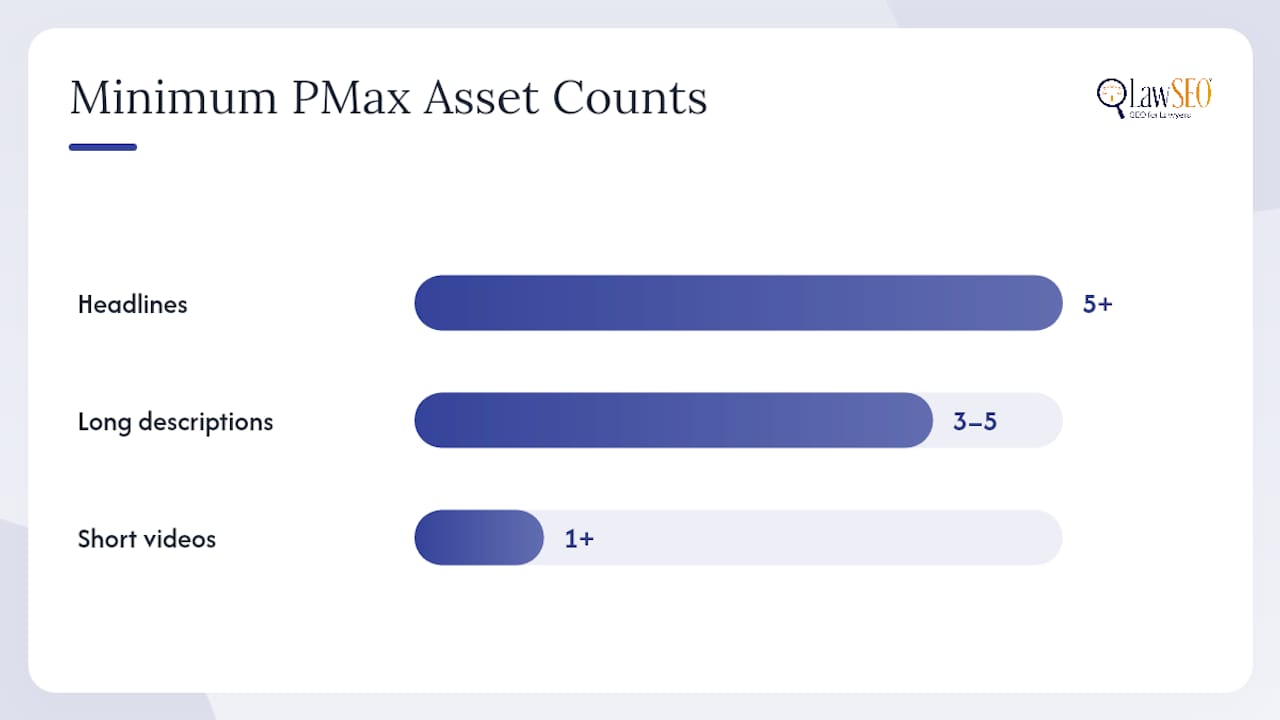
Next comes the asset matrix. Because PMax serves across YouTube, Display, Gmail, and Search simultaneously, asset variety directly affects reach and performance. A reasonable minimum for a law firm asset group looks like this:
- Five or more headline variations, written for different search intents (urgency, credibility, local trust).
- Three to five long-form descriptions that include compliant language about no-fee consultations or contingency arrangements where applicable.
- A mix of professional photography, not just stock imagery, showing attorneys and office settings.
- At least one short video, even a simple 15 to 30 second clip introducing the firm, since video-native placements on YouTube, otherwise, go unfilled.
- Clear calls to action: “Call Now,” “Free Consultation,” or “Get Your Case Reviewed,” matched to the practice area’s tone.
Audience signals come next. Upload existing client lists (properly excluded from ad delivery, obviously), website visitor remarketing lists, and any CRM segments that identify high-value case types. Add exclusions aggressively: competitor domains, content categories irrelevant to your practice, and any geographic areas outside your licensed service region.
Budget phasing protects you from the platform’s learning curve. Launch with a contained pilot budget for three to four weeks rather than your full monthly spend. Keep a small holdout budget in a standard Search campaign running in parallel so you have a performance baseline to compare against. Set KPI gates in advance, such as a target cost-per-lead ceiling, and agree with your team ahead of time what triggers a pause versus a scale-up decision.
Pro Tip: Build a simple weekly review habit where someone actually listens to a sample of calls PMax generated. Dashboards show conversion counts, not conversation quality, and that gap is where wasted budget hides.
The LSA to Performance Max Migration Law Firms Need to Handle Now
Google is folding Local Services Ads into specialized Performance Max campaigns built around pay-per-lead goals, and the change carries real urgency for firms still running LSAs. This isn’t a cosmetic rebrand. The underlying mechanics shift in ways that affect budgeting and reporting.
Pay-per-lead campaigns inside PMax serve only on Search and Maps, and they pull directly from your Google Business Profile rather than using manual keyword targeting. Onboarding is simpler than a standard PMax setup, since Google reuses your existing LSA profile data, but the tradeoff is a narrower feature set: certain standard PMax asset types and targeting controls aren’t available in the pay-per-lead version. Agencies used to full PMax flexibility will find this migrated version more constrained by design.
The most urgent task has nothing to do with campaign strategy: export your historical LSA reporting now. Aggregate cost-per-lead trends, lead volume history, and year-over-year comparisons won’t carry over automatically once migration completes, and the old dashboard becomes inaccessible for that data afterward.
Before migration, firms should:
- Export monthly cost-per-lead, lead volume, and dispute-rate reports going back at least 12 months.
- Screenshot or download campaign-level performance summaries, since ad-level and weekly spend reports won’t migrate with the account.
- Document your current LSA lead-dispute history for comparison against post-migration lead quality.
- Confirm your Google Business Profile listing is fully accurate, since pay-per-lead PMax leans on it directly.
Treat this as a data-preservation deadline, not a routine software update.
Proving PMax Actually Produces Signed Cases, Not Just Leads
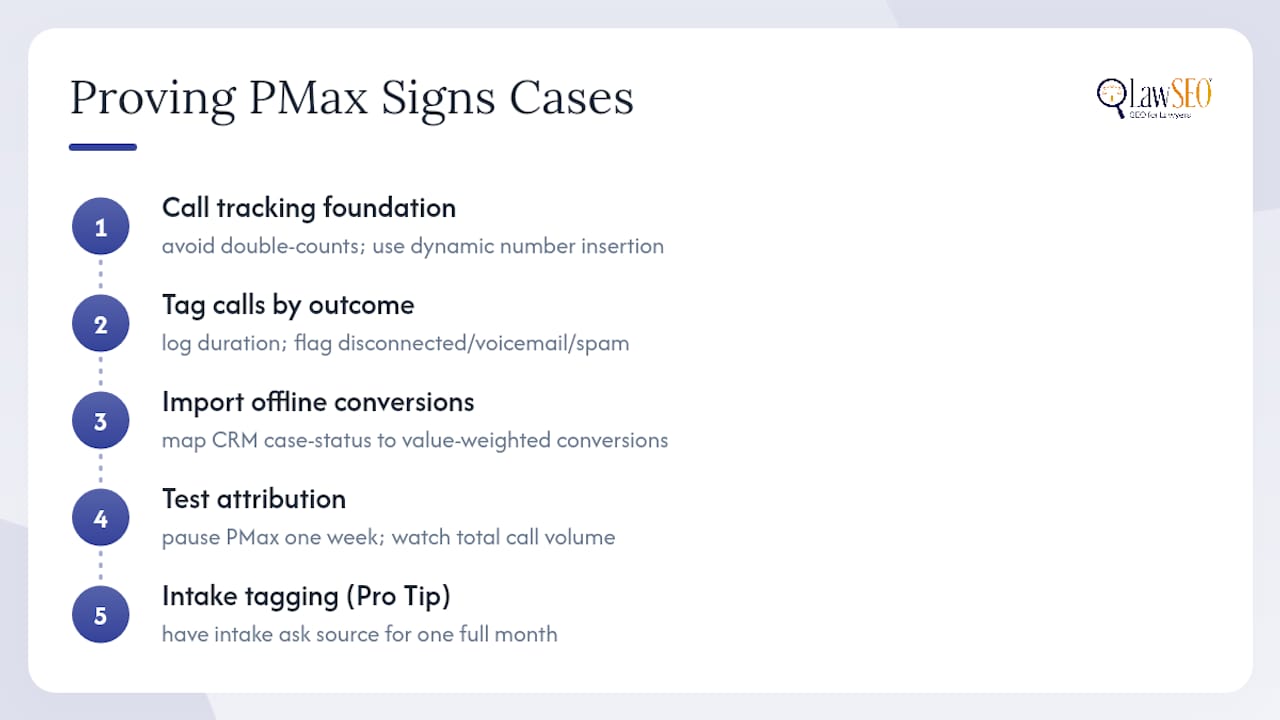
A lead is not a client, and PMax reporting will never make that distinction for you. Proving real ROI means connecting ad spend to signed retainers, which takes deliberate instrumentation most firms don’t have out of the box.
Call tracking is the foundation, but it needs to avoid double-counting. If a prospective client calls, hangs up, and calls back through a different number or channel, you want that logged as one lead, not two. Dynamic number insertion tied to session data, paired with duration and outcome tagging, solves most of this. Route every call through a system that flags disconnected numbers, voicemail, and spam separately from genuine inquiries.
Offline conversion import closes the loop between ad click and signed case. Map your CRM’s case-status fields, so a lead marked “signed retainer” or “consultation completed” feeds back into Google Ads as a value-weighted conversion. This lets PMax’s bidding algorithm eventually learn that a car accident case worth pursuing is more valuable than a one-off consultation that never converts. Our guide on lead nurturing for law firms covers the intake-side process that makes this data usable in the first place.
Attribution inside PMax carries real caveats. Because placement-level reporting is limited, you often can’t isolate exactly which channel, Search, YouTube, or Display, drove a specific signed case. A quick experiment worth running: pause PMax for one week in a stable market and watch whether total call volume from all sources drops meaningfully. If it doesn’t, PMax may have been cannibalizing leads you’d have gotten organically or through Search anyway.
Pro Tip: Ask your intake team to tag “how did you hear about us” responses for one full month. It’s a blunt instrument compared to digital attribution, but it catches PMax leads that never got tagged correctly in the ad platform.
How a Law-Firm Marketing Specialist Applies PMax in Practice
Pilots that succeed tend to share a pattern: a defined test period, a hard budget ceiling, and someone checking lead quality by hand rather than trusting the dashboard alone. Firms that skip that human review step are the ones who discover three months later that half their “conversions” were spam calls.
The firms that get real value from PMax are the ones willing to treat the first month as an audit, not a launch. If you can’t say what a “good lead” costs you in a standard Search campaign, PMax has nothing solid to optimize against. Automation amplifies whatever data you give it, good or bad.
LawSEO is built exclusively around legal marketing, which shapes how PMax gets evaluated for a client. Founder Todd R. Stager, who has worked in SEO for close to three decades, personally reviews campaign strategy rather than handing it off to a templated playbook. For firms without an in-house marketing director who can audit call quality weekly, a managed engagement is generally the safer path. DIY PMax works fine for firms with the staff time to monitor it; it works poorly for firms that turn it on and check back in a month.
Should Your Firm Run, Test, or Avoid Performance Max?
Run it if you have 30 or more monthly conversions, clean call tracking, and a high-intake practice area like personal injury or criminal defense. Immediate steps: audit your current conversion definitions, add negative audience exclusions, and launch with a phased budget.
Test it if your data is thinner but your practice area still generates quick-turn leads. Immediate steps: run a three to four week pilot against a Search holdout, and set a firm cost-per-lead ceiling before launch.
Avoid it if you’re migrating from LSA without a data backup plan, or your practice area (complex estate planning, high-value M&A) doesn’t fit high-volume automation. Immediate steps: export historical LSA reports first, then reconsider PMax once tracking is solid.
— TODD
How We Manage Performance Max Campaigns for Law Firm Clients
Every PMax engagement here starts with a conversion tracking audit, because automation built on bad data produces bad results faster than manual campaigns do. Todd R. Stager reviews the strategy behind each client account personally rather than leaving campaign structure to a generic template, which matters in a vertical where one wrong conversion definition can waste weeks of budget.
PMax rarely stands alone in a firm’s marketing mix. It typically runs alongside organic visibility work and Google Business Profile optimization, since paid and organic signals reinforce each other rather than compete for the same click. A pilot engagement usually includes an audit, a phased budget plan, and instrumentation work before any campaign goes live, with optimization continuing on a defined schedule afterward.
What Comes Next for Firms Considering Performance Max
If the sections above told you your firm fits the “run” or “test” category, the next move is getting your tracking foundation right before you spend a dollar on PMax. That’s where most law firm campaigns actually succeed or fail, long before Google’s algorithm ever gets involved.
LawSEO builds PMax pilots specifically around legal intake, starting with a conversion instrumentation audit that maps your calls, forms, and CRM data before any ad spend goes live. That sequencing matters: agencies that launch campaigns before fixing tracking end up optimizing toward junk conversions for weeks before anyone notices. Our approach reviews your current account structure, sets up call tracking and offline conversion import, builds the asset matrix for your practice area, and manages the pilot with weekly lead-quality checks rather than a dashboard glance once a month.
If you’re evaluating whether PMax makes sense for your firm right now, or you need help preserving LSA data before migration forces the issue, start with our legal SEO strategy guide to see how paid and organic channels fit together, then request a full SEO audit for your firm to get a clear read on where your current tracking and campaign setup stand before you commit real budget to Performance Max.
Sources
Performance Max overview, LSA to PMax migration guide, and our Google Ads mistakes guide for setup pitfalls.
- About Performance Max campaigns – Google Ads Help
- PMax for Law Firms: When to Use and When to Avoid — Bo Royal (LinkedIn)