


Many American law firms struggle to stand out online when potential clients search for experienced attorneys in their region. A well-executed SEO audit can reveal where your website may fall short and uncover hidden opportunities to strengthen your digital presence. By focusing on comprehensive SEO audit strategy and modern AI search readiness, your firm can establish stronger visibility and attract more high-value clients in a competitive legal market.
Table of Contents
- Step 1: Plan Your SEO Audit Strategy
- Step 2: Assess Your Law Firm Website Health
- Step 3: Analyze Your Content For Legal Topics
- Step 4: Evaluate Local And AI Search Presence
- Step 5: Verify Improvements And Track Results
Quick Overview
| Essential Insight | Clarification |
|---|---|
| 1. Systematically Plan Your SEO Audit | Develop a thorough roadmap to pinpoint website performance gaps and optimization opportunities. Focus on strategy and methodical execution. |
| 2. Conduct Regular Website Health Assessments | Schedule quarterly evaluations to identify barriers affecting performance and enhance accessibility for potential clients. |
| 3. Analyze Content for Comprehensive Coverage | Review your legal website’s content to ensure it addresses relevant topics, client needs, and demonstrates your firm’s expertise. |
| 4. Optimize for Local and AI Search | Enhance your digital presence by blending local search practices with AI-driven technologies to improve visibility and engagement. |
| 5. Track SEO Improvements Consistently | Use analytical tools to monitor benchmarks and changes in key performance indicators to ensure effective ongoing SEO optimization. |
Step 1: Plan your SEO audit strategy
Planning a comprehensive SEO audit for your law firm requires strategic thinking and methodical execution. Your goal is to create a detailed roadmap that identifies current website performance gaps and opportunities for improving online visibility. Comprehensive SEO audit strategies typically involve analyzing multiple critical components.
To develop an effective SEO audit plan, focus on these essential elements:
- Technical infrastructure assessment
- Content quality evaluation
- Keyword research and alignment
- Competitive landscape analysis
- Performance metrics tracking
Your initial strategy should prioritize a systematic approach that examines each aspect of your law firm’s online presence. Start by gathering baseline data about your current website performance, including page load speeds, mobile responsiveness, indexing status, and existing search rankings.
Here’s a summary of SEO audit elements and their impact on a law firm’s online presence:
| Audit Element | Area of Impact | Business Value Benefit |
|---|---|---|
| Technical Infrastructure | Site performance and crawlability | Better indexing and stability |
| Content Quality | Audience engagement | Attracts and retains clients |
| Keyword Alignment | Search rankings | Increases targeted organic traffic |
| Competitive Analysis | Market positioning | Identifies key differentiation |
| Performance Metrics | Growth tracking | Informs future marketing strategy |
A well-planned SEO audit provides the diagnostic insights needed to transform your law firm’s digital marketing effectiveness.
The most successful SEO audits integrate both quantitative metrics and qualitative analysis. This means looking beyond raw numbers to understand how your content resonates with potential clients and search engine algorithms.
Pro tip: Develop a standardized audit checklist to ensure consistent and comprehensive evaluation across all website elements.
Step 2: Assess your law firm website health
Assessing your law firm’s website health is a critical diagnostic process that reveals potential performance barriers and optimization opportunities. Website accessibility standards provide a comprehensive framework for evaluating your digital presence.
To conduct a thorough website health assessment, focus on these key evaluation areas:
- Technical performance metrics
- User experience indicators
- Mobile responsiveness checks
- Security protocol verification
- Content accessibility review
Your assessment should systematically examine each aspect of your website’s functionality and user interaction. Pay close attention to critical elements such as page load speeds, navigation clarity, and overall user engagement potential. Look for potential barriers that might prevent potential clients from accessing your legal services effectively.
A comprehensive website health check identifies hidden obstacles that could be preventing your law firm from attracting and converting potential clients online.
Legal websites must meet stringent accessibility requirements to ensure all potential clients can easily interact with your digital platform. This means evaluating your site’s compatibility with screen readers, color contrast ratios, and keyboard navigation capabilities.

Pro tip: Schedule quarterly comprehensive website health assessments to stay ahead of potential technical and accessibility issues.
Step 3: Analyze your content for legal topics
Analyzing your law firm’s content requires a strategic approach to ensure comprehensive coverage of relevant legal topics and practice areas. Legal topic categorization provides a crucial framework for systematic content evaluation.
To conduct a thorough content analysis, focus on these critical components:
- Practice area comprehensiveness
- Topic depth and expertise
- Client-focused language
- Keyword alignment
- Topical authority indicators
Your content analysis should map existing website materials against a comprehensive legal taxonomy, identifying gaps in your current topic coverage. Examine each piece of content through the lens of potential client needs, ensuring that your materials address specific legal challenges, practice areas, and frequently asked questions.
Effective content analysis transforms your website from a simple online brochure into a strategic client acquisition platform.
Legal content must demonstrate both breadth and depth, showcasing your firm’s expertise across multiple practice areas while providing nuanced insights that distinguish your services. This means going beyond surface-level descriptions to offer meaningful, actionable legal information that demonstrates your firm’s unique value proposition.
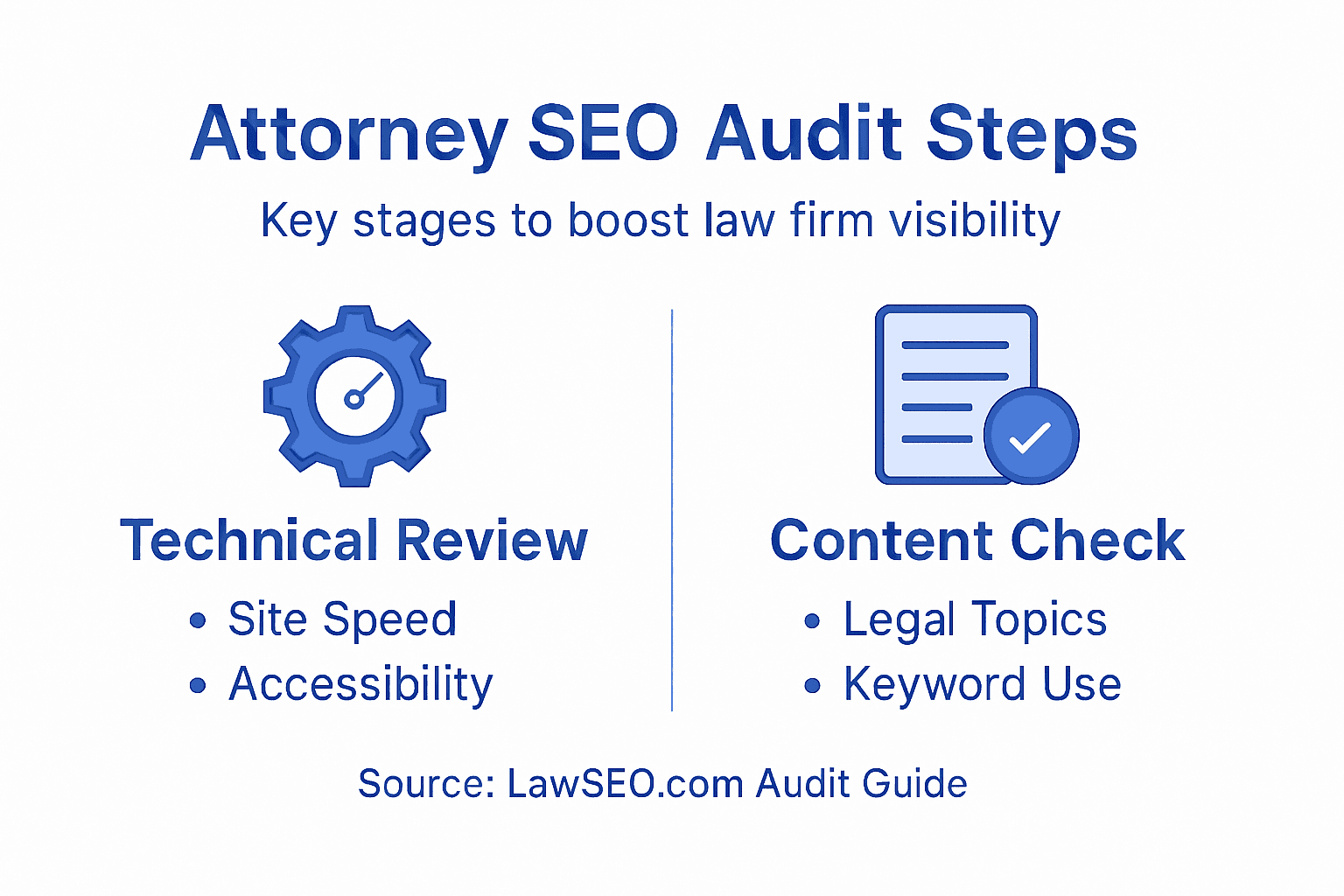
Pro tip: Create a content matrix that tracks your existing topics, identifying potential gaps and opportunities for targeted content development.
Step 4: Evaluate local and AI search presence
Evaluating your law firm’s digital presence requires a sophisticated approach that blends traditional local search optimization with emerging AI-driven search technologies. AI impact on law firm visibility reveals critical strategies for modern legal marketing.
To comprehensively assess your search presence, focus on these key evaluation areas:
- Google Business Profile optimization
- Local search ranking performance
- AI chatbot and generative search compatibility
- Geotargeted content effectiveness
- Voice search readiness
Your evaluation should go beyond traditional metrics by understanding how AI technologies interpret and present your law firm’s information. This means analyzing not just keyword rankings, but how artificial intelligence platforms might extract and display your firm’s expertise across different search environments.
Modern law firms must adapt their online presence to both human searchers and intelligent search algorithms.
Successful search presence requires a multifaceted approach that considers local geographic signals, practice area expertise, and technical optimization that makes your content AI-friendly. This involves structured data markup, clear semantic content, and authoritative information presentation that AI systems can easily comprehend and recommend.
The following table highlights key differences between traditional SEO and AI-driven search for law firms:
| Approach | Optimization Focus | Unique Consideration |
|---|---|---|
| Traditional SEO | Keywords and backlinks | Google ranking factors |
| AI-Driven Search | Semantic and structured data | AI platform content comprehension |
| Local SEO | Business listings | Geo-targeted search appearance |
| Voice Search | Conversational queries | Natural language optimization |
Pro tip: Conduct monthly AI search simulations to understand how your content performs in generative search environments.
Step 5: Verify improvements and track results
Verifying the outcomes of your SEO audit demands a systematic approach that goes beyond surface-level metrics. Website audit tracking techniques provide critical insights into measuring your law firm’s digital performance comprehensively.
To effectively track and validate your SEO improvements, concentrate on these key performance indicators:
- Organic search ranking progression
- Website traffic volume and quality
- Conversion rate improvements
- User engagement metrics
- Local search visibility changes
Your verification process should involve detailed comparative analysis between pre-audit and post-audit performance. This means establishing baseline measurements before implementing changes and then methodically documenting subsequent shifts in your digital presence.
Consistent monitoring transforms SEO from a one-time project into a strategic, ongoing optimization process.
Successful results tracking requires using multiple analytical tools that provide comprehensive insights. Google Search Console, Google Analytics, and specialized legal marketing platforms can help you understand not just raw numbers, but the meaningful implications of your SEO efforts.
Pro tip: Create a monthly SEO performance dashboard that visualizes key metrics to quickly identify trends and opportunities.
Unlock Your Law Firm’s Full Online Potential with Expert SEO Audits
If you’re facing challenges like slow website performance, scattered legal content, or difficulty appearing in local and AI-driven search results you’re not alone. The article highlights the critical need to plan a thorough SEO audit that covers your site’s technical health, content relevance, and presence across modern search platforms. These pain points can keep your law firm hidden from potential clients just when you need visibility the most.
At LawSEO.com we specialize exclusively in helping law firms overcome these obstacles by crafting customized SEO audit strategies and solutions designed specifically for attorneys. Our founder-led approach means every plan benefits from decades of legal SEO expertise combined with cutting-edge AI optimization to boost your rankings on Google and emerging AI search tools. From comprehensive website health checks to strategic content analysis and local SEO dominance you gain everything needed to transform your site into a powerful client magnet.
Ready to take control of your law firm’s online growth today Start with a professional SEO audit tailored to legal marketing realities. Visit LawSEO.com to discover how our exclusive services can pinpoint your exact challenges and deliver clear improvement paths. Don’t let competitors outrank you in this shifting digital landscape get started now and watch your online visibility soar.
Frequently Asked Questions
What is an SEO audit for attorneys?
An SEO audit for attorneys is a systematic evaluation of a law firm’s website performance, including technical infrastructure, content quality, and keyword alignment. Conduct an audit to identify gaps and opportunities that can enhance your online visibility.
How can I plan an effective SEO audit for my law firm?
To plan an effective SEO audit, focus on key areas such as technical performance, user experience, and local search presence. Start by gathering baseline data on your website and develop a standardized checklist to ensure a comprehensive assessment.
What metrics should I track during my SEO audit?
Key metrics to track during your SEO audit include organic search rankings, website traffic, conversion rates, and user engagement. Regularly monitoring these metrics allows you to evaluate improvements and adjust strategies based on performance shifts, typically within 30–60 days.
How can I improve my website’s content for better SEO?
To improve your website’s content, analyze the depth and relevance of your existing legal topics. Focus on creating content that addresses specific client needs and incorporates targeted keywords while enhancing your firm’s unique value.
What role does local search presence play in my SEO audit?
Local search presence is crucial for law firms, as it helps attract clients in your geographic area. Optimize your Google Business Profile and ensure that your content is relevant to local searches to enhance your visibility and engagement.
How do I verify the results of my SEO audit?
To verify the results of your SEO audit, conduct a comparative analysis between your website’s performance before and after implementing changes. Create a monthly dashboard to track key performance indicators, enabling you to identify trends and areas for further optimization.