

To rank in ChatGPT, make your page crawlable, answer-first, and schema-marked, then earn third-party mentions that pull it into the citation pool. The fastest blocker is technical: allow GPTBot, serve server-rendered HTML, and stay under the 4MB page limit. Once that gate is open, three levers decide the rest: content-answer fit, structured data, and outside authority signals.
TL;DR:
- Ensuring your site is crawlable by permitting GPTBot and serving server-rendered HTML under 4MB is essential for ChatGPT to access your content.
- Optimizing short, answer-focused sections with clear headings and schema helps ChatGPT extract and quote your content more reliably.
- Building third-party mentions, industry roundups, and community engagement signals increases your chances of being included in ChatGPT’s retrieval set.
- Prioritizing high-ranking and highly relevant pages in Google improves their likelihood of being cited by ChatGPT in related queries.
- Regularly verifying crawler activity through server logs and schema validation ensures your content remains accessible for ChatGPT’s retrieval process.
How ChatGPT Retrieves and Chooses Sources
ChatGPT does not read the whole internet before answering a question. It runs a retrieval pipeline: fetch candidates, skim or open pages, synthesize an answer, then cite whichever sources it actually used. Which step matters most to you depends on the mode ChatGPT is running.
In instant mode, the model leans on a cached index built from page titles and roughly the first 200 characters of visible text. It rarely opens the full page. In thinking mode, ChatGPT pulls from scraped Google results and can open live pages to read them in full, which is why ChatGPT’s retrieval stack behaves so differently depending on which tier a user is on. Paid, deeper-reasoning sessions favor scraped search results; free instant answers favor OpenAI’s own cached index.
That distinction changes your priorities. Getting retrieved is the first hurdle, not the finish line. A page can appear in the candidate set and still never get cited because the snippet failed to answer the question clearly enough, or because a competing source said the same thing more concisely.
For most legal marketing teams, this means:
- Optimize narrow, high-intent pages first, not broad hub pages that try to cover everything.
- Treat your H1 and opening sentence as prime real estate for instant mode, since that is often all the model sees.
- Build out deeper, well-structured pages for thinking mode, where full-page reads reward genuine depth over surface keyword matching.
Prioritize the queries your firm already wins in Google. If a page ranks well organically for “personal injury statute of limitations in [state],” it is a strong candidate for ChatGPT citation too, because query relevance and content-answer fit tend to move together.
Technical Checklist: Making Sure ChatGPT Can Actually Read Your Page
No amount of good writing matters if OpenAI’s crawlers cannot reach your content. This is the gate everything else passes through, and it trips up more law firm sites than any content problem does.
Work through this in order:
- Allow the right bots. Update robots.txt to permit GPTBot and OAI-SearchBot explicitly. Many sites unintentionally block all bots except Googlebot, which quietly excludes them from ChatGPT entirely.
- Server-side render your key content. If your practice area pages, attorney bios, or FAQ content load via client-side JavaScript, OpenAI’s crawlers likely never see them. ChatGPT’s crawlers do not execute JavaScript the way a browser does, so anything injected after page load is invisible to them.
- Stay under 4MB per page. Pages above that size are rejected outright, not truncated and partially read. Heavy embedded scripts, bloated CSS, or unoptimized inline data can push a page over the limit without anyone noticing.
- Improve server response time. Slow time-to-first-byte increases the odds a crawler times out before it finishes reading.
- Use semantic headings and visible text. Wrap answers in actual
<h2>and<h3>tags, not styled<div>elements, and add Article or Organization schema where it fits your page type.
Pro Tip: Check your server logs for the “ChatGPT-User” and “GPTBot” user agents. If they never show up, the crawler is being blocked upstream, likely at the CDN or firewall level, before it ever reaches robots.txt.
Verification tools matter here. Run pages through an SSR inspector to confirm what a non-JavaScript crawler actually sees, and cross-check that view against what a human visitor sees in a browser. If the two versions of the page disagree, ChatGPT is working from the wrong one. Firms that skip this audit often assume their content problem is a writing problem when it is really an access problem. For a deeper technical walkthrough, Lawseo’s guide on step-by-step AI-driven search optimization covers the crawl-verification process in more detail, alongside modern tools like an AI receptionist for law firms that enhance client intake workflows.
What Makes Content Liftable Enough for ChatGPT to Quote
ChatGPT can only cite what it can cleanly extract, and extraction rewards short, self-contained answers over sprawling paragraphs. The single highest-leverage habit is opening every section with a 40 to 60 word answer that could stand alone if quoted out of context.
Heading-to-query match is the second piece. If a searcher typed “how long do I have to file a car accident claim,” your heading should read close to that, not a clever variation. Practitioner testing on ChatGPT SEO shows this alignment correlates directly with citation frequency, because the model is essentially pattern-matching the user’s question against your heading text before it even reads the answer beneath it.
A large-scale study of AI citation behavior found that Content-Answer Fit accounts for roughly 55% of the ranking decision for AI citations, with on-page structure, domain authority, and query relevance splitting most of the remainder. That is a strikingly different weighting than traditional Google ranking factors, where backlink profiles historically carried more influence.
Structural habits that support this:
- Keep paragraphs to three or four sentences; long blocks resist extraction.
- Use tables for anything comparative (fee structures, timelines, eligibility criteria).
- Map your existing Q&A content to FAQPage schema so questions and answers are explicitly paired.
- Build narrow pages around single topics rather than one page trying to answer ten different questions.
Before publishing, run a quick revision pass: does the heading match a real query, does the first 200 characters of the section actually answer it, and is your schema complete and valid. FAQPage schema alone shows a measured lift of roughly 40% in ChatGPT source selection, which makes it one of the cheapest structural upgrades available to any content team.
Which Off-Page Signals Help ChatGPT Trust Your Content?
Domain authority still matters, but it works differently here than it does in Google’s algorithm. ChatGPT leans on it mostly to decide which candidates are worth including in its retrieval set in the first place, not to rank them once they are already competing.
Brand mentions and listicle inclusion carry outsized weight in that retrieval decision. If ten legal directories and roundup articles already name your firm as a top personal injury practice in your city, that repeated mention builds a pattern the model recognizes as consensus, even without a direct link. Community platforms punch above their apparent authority too. Threads on Reddit and Quora frequently surface in ChatGPT’s source set for consumer-facing legal questions, because the model treats crowd-sourced discussion as a signal of real-world relevance.
Practical outreach that moves this needle:
- Pursue inclusion in industry listicles and “best of” roundups relevant to your practice area and city.
- Participate genuinely in legal subreddits and Q&A communities rather than posting promotional links.
- Pursue measured PR placements that generate natural brand mentions across multiple domains.
- Align your published definitions and explanations with how recognized legal authorities phrase the same concepts, since consensus language gets picked up more readily than idiosyncratic phrasing.
None of this replaces the content-answer fit work. It amplifies it. A well-structured page that nobody else mentions anywhere online has a harder time entering the candidate set to begin with.
How Do You Know If ChatGPT Is Citing Your Site?
Measurement here is less mature than Google Analytics, but you are not flying blind. Start with your own server logs.
- Search logs for GPTBot and ChatGPT-User agents. Their presence confirms crawling; their absence confirms a technical block worth fixing immediately.
- Watch Bing Webmaster Tools reports and brand search volume. Because ChatGPT’s thinking mode draws on scraped Google and Bing data, movement in traditional search visibility often precedes movement in AI citations.
- Set concrete KPIs. Track pages retrieved, citation appearances in manual test queries, referral traffic tagged from AI sources, and recrawl frequency over time.
- Test on a fixed cadence. Run the same five to ten target queries through ChatGPT monthly and log which sources get cited. Recrawl frequency tracks user demand rather than a fixed schedule, so a page that never gets queried may sit stale in the cache for months regardless of how well you optimized it.
If citations still are not appearing after your technical and content fixes, the likely culprit is thin authority signals rather than a page-level problem. That is when outreach and consensus-building deserve more budget than another content rewrite.
Your First 90 Days: A Priority Action Plan
Sequence matters more than effort here. Skipping the technical gate to focus on content polish wastes the polish.
- 0 to 72 hours: Update robots.txt to allow GPTBot and OAI-SearchBot. Run an SSR check on your top ten pages. Fix any content that only loads via client-side JavaScript.
- 1 to 2 weeks: Rewrite section openings into 40 to 60 word answer-first paragraphs. Add FAQPage schema to existing Q&A content. Audit headings against real user query phrasing.
- 1 to 3 months: Pursue listicle inclusion and community mentions to build the consensus signals that pull your pages into ChatGPT’s candidate set. Secure a handful of quality backlinks tied to genuinely useful content, not link-swap filler.
- Ongoing: Monitor server logs monthly for crawler activity, and re-run your citation test queries to track movement.
Pro Tip: Do not declare defeat after two weeks. Thinking mode recrawls follow demand signals, not a calendar, so a page can sit unclicked for a month before ChatGPT bothers reopening it.
Lawseo’s guide to AI optimization for law firms walks through how these phases typically play out for legal practices specifically, including which practice-area pages tend to see movement first. Firms that want the technical audit handled by someone who has already done it hundreds of times over often find that the 0 to 72 hour phase is where an outside set of eyes catches the most costly blockers, like a CDN silently rejecting GPTBot before robots.txt ever gets consulted.
Who’s Behind This Strategy, and How It Gets Tested
Todd R. Stager has spent more than 29 years in SEO, and has authored several books on legal search strategy that treat this kind of technical sequencing as foundational, not optional. That experience shapes how Lawseo approaches AI visibility work for law firm clients.
The testing method stays consistent across engagements:
- Pull server logs before and after robots.txt changes to confirm GPTBot and ChatGPT-User activity actually shifts.
- Run citation snapshots on target queries before implementation, then again at 30 and 90 days.
- Verify schema markup with structured data testing tools before treating any page as “complete.”
, and round out how these methods perform across real law firm engagements.
Why We Start With the Technical Gate, Not the Copy
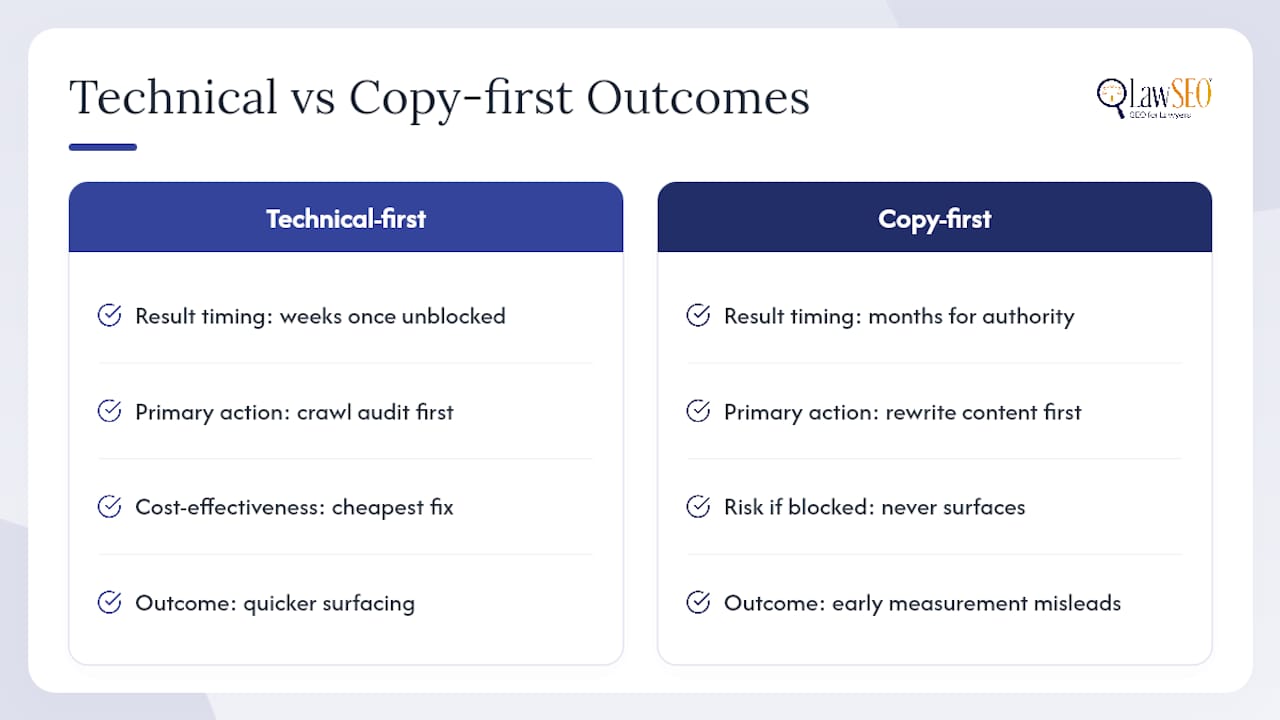
Most firms want to jump straight to rewriting content because it feels like the controllable part. But a beautifully written page behind a JavaScript wall or a blocked robots.txt file never gets a chance to compete. We start every GEO engagement with the crawl audit because it is the cheapest fix with the highest failure rate when ignored.
Realistic timelines matter too. Quick surfacing in instant mode can happen within weeks once technical blockers clear. Durable authority, the kind that shows up consistently across thinking-mode citations, takes months of consensus-building through mentions, listicles, and community presence… Clients who expect the first kind of result on the second kind of timeline usually end up disappointed, not because the strategy failed, but because they measured it too early.
— TODD
Sources
Start with OpenAI’s own documentation on ChatGPT search behavior and workspace controls, since crawling rules and permissions shift without much public announcement. Search Engine Land’s breakdown of the retrieval stack remains the clearest technical explainer available. HubSpot’s AI discovery guide covers schema impact with real citation-rate data. For hands-on verification, use an SSR inspector to see your page the way a crawler does, check Bing Webmaster Tools for AI-related crawl reports, and watch for OpenAI crawl-date endpoints as they roll out more broadly.
- How to Optimize Content for ChatGPT: An AI Discovery Guide
- Inside ChatGPT’s retrieval stack: The index, cache, and pages it actually reads
- How to Optimize for ChatGPT Search: An 8-Step Guide