

Many law firms have cut client intake time in half using AI-powered chatbots. Yet confusion persists about their true role, legal compliance requirements, and practical benefits. This guide clarifies how AI chatbots enhance law firm operations and client interaction while addressing common misconceptions about privacy, ethics, and implementation strategies that help you make informed decisions.
Table of Contents
- Understanding AI-Powered Chatbots In Legal Practice
- How AI Chatbots Work For Law Firms
- Benefits Of AI-Powered Chatbots In Legal Practice
- Ethical And Legal Compliance Considerations
- Common Misconceptions About AI Chatbots In Law Firms
- Technology Integration And Implementation Strategies
- Practical Implementation And Customization For Law Firms
- Enhance Your Law Firm’s Technology With Expert SEO And AI Solutions
Key takeaways
| Point | Details |
|---|---|
| AI chatbots augment legal workflows | Chatbots handle routine client inquiries and intake automation, freeing attorneys for complex casework. |
| Engagement and efficiency gains | Firms report 30% higher client engagement and 25% faster response times after chatbot deployment. |
| Compliance is critical | Attorney-client privilege, data privacy laws, and ethical transparency requirements must be met. |
| Integration determines success | Seamless connection with CRM and case management systems prevents common deployment failures. |
| Phased rollout reduces risk | Pilot programs, staff training, and ongoing optimization ensure smooth adoption and ROI. |
Understanding AI-powered chatbots in legal practice
AI-powered chatbots are software applications specifically designed to interact with law firm clients through natural, conversational text exchanges. Unlike generic customer service bots, legal chatbots are customized to understand legal terminology, practice area nuances, and the unique communication needs of prospective and current clients seeking legal assistance.
These intelligent systems handle several core functions that directly support law firm operations. They automate initial client intake by collecting essential case information, contact details, and urgency assessments. They triage incoming inquiries by categorizing requests based on practice area, complexity, and priority level. They answer frequently asked questions about services, fees, and processes without human intervention.
Typical chatbot interactions in legal settings include gathering basic facts about a potential personal injury claim, screening divorce clients for conflict checks, scheduling consultations with available attorneys, and providing immediate responses to common billing or case status questions. The goal is not to provide legal advice but to streamline communication and ensure no potential client falls through the cracks due to delayed response times.
For firms exploring AI in legal marketing 2026 strategies, chatbots represent a front-line technology that complements broader digital transformation efforts. When properly configured, they create a 24/7 client engagement channel that captures leads even outside business hours, providing an immediate competitive advantage in markets where response speed directly correlates with client conversion rates.
How AI chatbots work for law firms
Natural language processing enables chatbots to interpret diverse client queries expressed in everyday language rather than rigid command structures. This technology analyzes sentence structure, identifies key legal terms, and infers user intent to generate relevant responses that feel conversational rather than robotic.
Legal-specific chatbots undergo training on carefully curated data sets containing legal terminology, common client questions, and firm-specific information about practice areas, attorney profiles, and service offerings. This specialized training distinguishes them from generic chatbots that lack the context to handle legal inquiries appropriately. The quality and breadth of training data directly determine chatbot accuracy and usefulness.
The triage system represents the operational backbone of legal chatbots. It filters routine inquiries such as office hours or fee structures, escalates urgent matters like criminal charges or impending deadlines to attorneys immediately, and routes practice-area-specific questions to the appropriate department or attorney. This intelligent routing ensures clients receive timely, relevant responses while protecting attorney time for substantive legal work.
Pro Tip: Involve your IT and compliance teams from day one when evaluating chatbot solutions. Their early input prevents costly technical integration issues and ethical compliance gaps that could derail deployment.
Common pitfalls significantly undermine chatbot performance. Lack of proper training data and poor integration with existing legal software lead to frustrated users and abandoned implementations. Chatbots that cannot access your case management system or CRM will fail to provide contextualized responses, forcing staff to manually transfer information and defeating the efficiency purpose.
Successful implementations require continuous refinement based on user interactions and feedback. For comprehensive guidance, explore our AI optimization for law firms guide which covers technical setup, training strategies, and performance monitoring frameworks tailored to legal practices.
Benefits of AI-powered chatbots in legal practice
Quantified benefits demonstrate why forward-thinking law firms prioritize chatbot technology. Studies show firms experience a 30% increase in client engagement and 25% faster response times after implementing AI-powered chatbots. These improvements translate directly to higher client satisfaction scores and increased conversion rates from initial inquiry to retained client.

| Metric | Improvement | Impact |
|---|---|---|
| Client engagement | 30% increase | More interactions, higher conversion |
| Response time | 25% faster | Reduced wait, improved satisfaction |
| Intake efficiency | 50% time reduction | Staff focus on complex work |
| After-hours capture | 40% more leads | 24/7 availability advantage |
Client intake times represent one of the most dramatic efficiency gains. Firms report cutting intake processes by up to 50%, freeing paralegals and administrative staff for higher-value tasks like case research, document preparation, and client relationship management. This time savings compounds across hundreds of client interactions monthly, creating substantial cost savings.
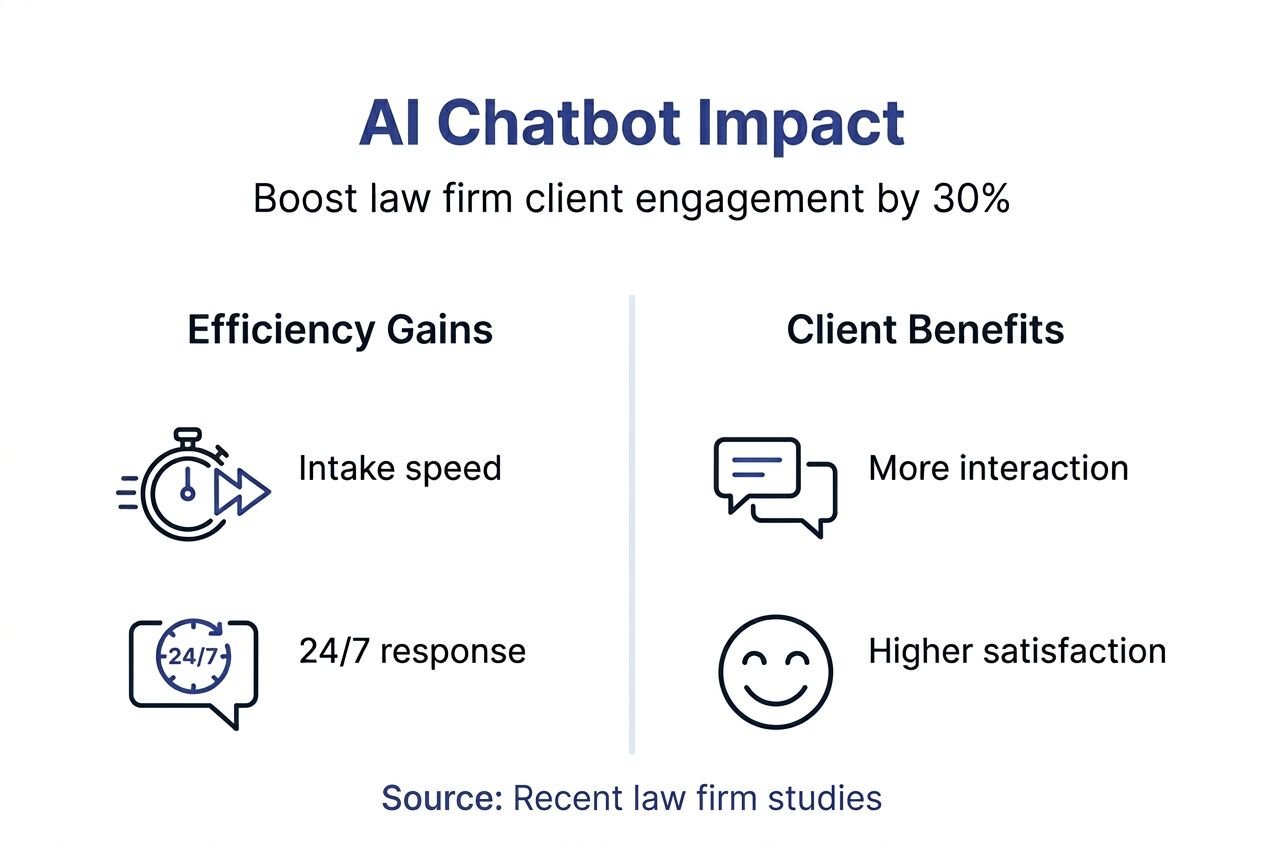
Demographic insights reveal generational preferences that make chatbots increasingly essential. Younger clients, particularly those under 40, prefer digital-first interactions and often abandon firms that require phone calls for initial contact. Chatbots meet these expectations while simultaneously serving clients who value immediate responses regardless of time zone or business hours.
Cost savings extend beyond labor efficiency. Automating routine inquiries reduces the need for additional reception staff as firm volume grows. It minimizes missed opportunities from unanswered calls or delayed email responses. For practices evaluating advantages of AI in law marketing, chatbots deliver measurable ROI through both revenue protection and operational cost reduction.
The combination of faster response times, improved lead capture, and reduced administrative burden creates a virtuous cycle. Attorneys spend more time on billable work, clients receive better service, and firm profitability increases without proportional headcount growth.
Ethical and legal compliance considerations
Attorney-client privilege protection requires robust security protocols when implementing chatbots. All client communications must be encrypted both in transit and at rest. Chatbot providers must sign business associate agreements similar to those required under HIPAA, acknowledging their role as custodians of confidential information and agreeing to safeguard it accordingly.
Transparency mandates form the foundation of ethical chatbot deployment. Clients must receive clear disclosure that they are interacting with an AI system, not a human attorney or legal assistant. The chatbot interface should prominently state its limitations, clarify that it cannot provide legal advice, and explain when and how human attorneys will become involved in their matter.
Compliance with data privacy laws varies by jurisdiction but universally demands careful attention. GDPR in Europe requires explicit consent for data collection and processing, with clear opt-out mechanisms. CCPA in California grants consumers rights to know what data is collected and request deletion. Your chatbot implementation must accommodate these requirements through configurable privacy controls and audit trails.
“The key to ethical AI chatbot use in law firms is transparency about capabilities and limitations, combined with ironclad data security that preserves attorney-client privilege at every interaction point.”
Ethical chatbot design prevents unauthorized practice of law by clearly distinguishing informational responses from legal advice. The system should never diagnose legal problems, recommend specific legal strategies, or create the impression that an attorney-client relationship exists solely through chatbot interaction. Proper disclaimers and intake forms establish these boundaries explicitly.
Pro Tip: Draft and display a dedicated chatbot privacy policy separate from your general website privacy policy. This focused document should explain exactly what data the chatbot collects, how it’s used, who has access, and how long it’s retained.
Proactive disclosure builds client trust and mitigates malpractice risk. When clients understand they’re receiving preliminary information gathering rather than legal counsel, expectations align appropriately. This transparency, combined with prompt human follow-up on substantive matters, creates a seamless experience that respects both client needs and professional responsibilities. Learn more about maintaining standards through ethical SEO for attorneys practices that extend to all digital client touchpoints.
Common misconceptions about AI chatbots in law firms
The replacement myth persists despite clear evidence to the contrary. AI chatbots augment rather than replace lawyer-client communication by handling administrative and informational tasks. They free attorneys from repetitive intake questions, allowing focus on substantive legal analysis, strategy development, and courtroom advocacy that require human judgment and expertise.
Privacy and security fears often stem from general AI concerns rather than specific legal chatbot implementations. When firms deploy chatbots with enterprise-grade encryption, regular security audits, and compliance certifications, data protection often exceeds that of email or phone communications. The key is selecting providers who understand legal industry requirements and build security into their architecture from the ground up.
Concerns about AI bias and inaccuracies have merit but can be effectively managed. Legal-specific training on verified, high-quality data sets minimizes hallucinations and incorrect information. Human oversight through regular chatbot transcript reviews identifies and corrects errors before they compound. Limiting chatbot scope to factual information gathering rather than legal analysis further reduces risk.
“Successful chatbot deployment relies on treating AI as a tool that extends human capability rather than a replacement for professional judgment. The technology handles volume; lawyers handle complexity.”
The cost barrier misconception deters some smaller firms from exploring chatbot solutions. Modern legal chatbots offer tiered pricing models starting at a few hundred dollars monthly, making them accessible even to solo practitioners and small firms. When measured against the cost of missed client opportunities or additional administrative staff, the investment often pays for itself within months.
For firms worried about keeping pace with technology trends, resources like AI SEO tools for law firms 2025 provide practical guidance on selecting and implementing solutions appropriate to your practice size and technical capabilities. The goal is strategic adoption based on firm needs, not technology for its own sake.
Technology integration and implementation strategies
Integration with existing technology stacks determines chatbot success or failure. Your chatbot must connect seamlessly with your CRM system to log client interactions, your case management platform to check conflict status, and your calendar system to schedule consultations. Without these connections, staff waste time manually transferring data and clients experience delays that negate the chatbot’s speed advantage.
| Platform | Key Features | Best For | Integration Complexity |
|---|---|---|---|
| Clio Virtual Assistant | Native Clio integration, intake automation | Clio users, mid to large firms | Low |
| LawDroid | Customizable workflows, multi-language | Firms needing customization | Medium |
| LexChat | Simple setup, FAQ focus | Solo/small firms, quick start | Low |
Popular legal chatbot platforms vary in their integration capabilities and target markets. Clio Virtual Assistant offers the smoothest experience for firms already using Clio, with native integration that requires minimal technical configuration. LawDroid provides extensive customization options for firms with specific workflow requirements or multiple practice areas needing distinct interaction paths. LexChat focuses on simplicity and speed to value, making it ideal for smaller practices wanting basic functionality without technical complexity.
Phased rollout minimizes disruption and builds internal buy-in. Follow this sequence:
- Pilot program with one practice area or attorney to test functionality and gather feedback
- Staff training covering chatbot capabilities, escalation procedures, and monitoring responsibilities
- Soft launch to existing clients for beta testing in a lower-stakes environment
- Full public launch with marketing support to drive awareness and adoption
- Continuous optimization based on transcript analysis and user feedback surveys
Pro Tip: Create a cross-functional implementation team including attorneys, IT staff, marketing, and client services. Each perspective identifies potential issues the others might miss, and shared ownership increases adoption success.
Common integration failures stem from inadequate training data and poor software compatibility. Before purchasing, request a technical integration assessment that maps your existing systems to the chatbot’s API capabilities. Ensure the vendor provides implementation support beyond basic setup, including custom workflow configuration and staff training sessions.
For comprehensive technology comparisons, review our top SEO platforms for lawyers comparison which uses similar evaluation frameworks. Additional guidance on aligning AI tools with firm strategy appears in our AI optimization for law firms guide.
Practical implementation and customization for law firms
Successful chatbot implementation begins with honest assessment of your firm’s specific needs and constraints. Analyze your current inquiry volume, peak contact times, most common questions, and response time benchmarks. These metrics establish your baseline and define success criteria for measuring chatbot impact post-deployment.
Follow this implementation framework:
- Needs assessment: Document current pain points in client communication and intake processes
- Vendor selection: Evaluate 3-5 chatbot providers against your compliance, integration, and budget requirements
- Customization: Configure chatbot personality, response templates, and escalation rules to match your firm’s brand and workflows
- Testing: Run internal trials with staff acting as clients to identify gaps and refine responses
- Training: Educate all staff on chatbot capabilities, monitoring responsibilities, and hand-off procedures
- Deployment: Launch to public with clear messaging about the new communication channel
- Monitoring: Review chatbot transcripts weekly initially, then monthly as performance stabilizes
- Optimization: Refine training data, update FAQs, and adjust escalation triggers based on real usage patterns
Pro Tip: Start with a narrow scope focused on one high-volume, low-complexity interaction like consultation scheduling or general practice area questions. Master this before expanding to more complex intake scenarios.
Choose chatbot solutions specifically designed for legal compliance rather than adapting generic business chatbots. Legal-specific platforms understand attorney-client privilege requirements, include appropriate disclaimers, and offer features like secure data handling and audit trails that generic solutions lack. The compliance risk of using inappropriate technology far exceeds any cost savings.
User experience design matters enormously for client satisfaction. Your chatbot should use conversational language that matches your firm’s tone, whether that’s formal and traditional or approachable and modern. Avoid legal jargon in chatbot responses unless you immediately define it. Provide clear pathways for clients who want to speak with a human immediately rather than forcing them through multiple chatbot interactions.
Measure ROI through concrete metrics. Track intake completion time before and after chatbot deployment. Monitor lead response time and conversion rates. Calculate staff hours saved on routine inquiries. Survey clients about their chatbot experience. These data points justify continued investment and guide optimization priorities.
Regular refinement separates mediocre implementations from excellent ones. Schedule quarterly reviews of chatbot analytics to identify frequently misunderstood questions, dead-end conversation paths, and opportunities to add new capabilities. Update training data to reflect new practice areas, attorney additions, or service offerings. For broader AI strategy guidance, explore SEO and AI for law firms and AI search optimization for law firms resources that contextualize chatbots within comprehensive digital marketing approaches.
Enhance your law firm’s technology with expert SEO and AI solutions
AI-powered chatbots represent just one component of a comprehensive technology strategy for modern law firms. LawSEO.com specializes in helping legal practices integrate AI tools with proven SEO strategies that drive qualified leads and improve operational efficiency. Our founder, Todd R. Stager, brings 29 years of search optimization experience exclusively focused on the legal sector.
We offer detailed guidance on AI optimization for law firms, covering everything from chatbot selection to content strategies that position your firm prominently in both traditional search results and emerging AI platforms. Our top SEO platforms for lawyers comparison helps you evaluate technology investments with the same rigor you apply to case strategy.
Explore LawSEO.com to discover how our exclusive, founder-led approach can enhance your firm’s digital presence and client acquisition systems.
FAQ
Are AI-powered chatbots compliant with attorney-client privilege?
Yes, properly configured chatbots comply with attorney-client privilege through end-to-end encryption and secure data handling protocols. Firms must ensure chatbot providers sign confidentiality agreements and implement security measures that meet legal industry standards for protecting sensitive client communications.
Can AI chatbots fully replace human lawyers in client communication?
No, AI chatbots augment rather than replace attorney-client interactions by automating routine inquiries and intake processes. Complex legal matters, strategic advice, and substantive legal analysis always require licensed attorney involvement and cannot be delegated to AI systems.
What are best practices for integrating AI chatbots with existing law firm software?
Ensure compatibility with your CRM and case management platforms before selecting a chatbot solution. Plan a phased rollout that includes IT staff involvement, comprehensive user training, and regular transcript reviews. Update chatbot training data quarterly based on actual usage patterns and client feedback to maintain accuracy and relevance.