


Nearly 60 percent of American law firms now use artificial intelligence technology in key marketing areas. For legal marketing directors, staying ahead in a fast-evolving digital world means understanding how these modern tools affect client acquisition and online visibility. This overview breaks down which AI strategies matter most, highlights practical applications, and pinpoints how firms can use technology to attract more client leads and stand out in competitive markets.
Table of Contents
- Defining AI in Legal Marketing Today
- Types of AI Tools Used by Law Firms
- Key Applications: From SEO to Content Automation
- Compliance, Ethics, and Regulatory Challenges
- Risks, ROI, and Common Implementation Mistakes
Key Takeaways
| Point | Details |
|---|---|
| AI Transforms Legal Marketing | AI technologies enhance client acquisition and engagement, allowing law firms to personalize communications and improve marketing workflows. |
| Diverse AI Tools are Essential | Law firms utilize a variety of AI tools like research automation and predictive analytics to streamline operations and enhance marketing effectiveness. |
| Strategic Adoption is Crucial | Successful AI implementation requires careful planning, risk assessment, and ongoing team training to effectively integrate with existing processes. |
| Compliance and Ethics Matter | Legal professionals must navigate ethical and regulatory challenges associated with AI, maintaining integrity and client privacy in all marketing strategies. |
Defining AI in Legal Marketing Today
Artificial Intelligence (AI) in legal marketing represents a transformative technology enabling law firms to reimagine client acquisition, engagement, and strategic communication. Legal marketing technology studies reveal AI is not a monolithic concept but a nuanced ecosystem of intelligent tools designed to augment human capabilities rather than completely replace them.
At its core, AI in legal marketing encompasses advanced technologies that mimic human cognitive functions like reasoning, natural language processing, and predictive analysis. These technologies enable law firms to personalize client interactions, optimize content strategies, and streamline complex marketing workflows. The American Bar Association’s 2024 Legal Technology Survey confirms AI adoption is currently concentrated in specific functional areas such as online legal research and client interaction platforms, with larger firms leading technological integration efforts.
The practical applications of AI in legal marketing are rapidly expanding. Modern AI tools can now generate targeted content, predict potential client behaviors, automate lead scoring, and provide sophisticated demographic insights. These capabilities transform traditional marketing approaches by enabling hyper-personalized communication strategies that respond dynamically to individual client needs and preferences.

Pro tip: Start by conducting a comprehensive audit of your current marketing technology stack to identify specific areas where AI can provide immediate, measurable improvements in efficiency and client engagement.
Types of AI Tools Used by Law Firms
Law firms are increasingly adopting a diverse range of AI technologies to enhance their marketing and operational capabilities. Stanford Law School’s comprehensive research highlights the evolving landscape of generative AI tools across legal practices, revealing sophisticated technologies that go far beyond simple automation.
The primary categories of AI tools utilized by law firms include advanced research platforms, content generation systems, client interaction technologies, and predictive analytics engines. The American Bar Association’s 2024 Technology Report identifies key AI solutions like ChatGPT, Thomson Reuters CoCounsel, and specialized legal research platforms such as Lexis+ AI and Westlaw AI. These tools are designed to support critical functions including document analysis, legal research, content drafting, and strategic client communication.
Modern AI tools in legal marketing can be categorized into several sophisticated segments:
- Research Automation Tools: Platforms that rapidly scan and synthesize complex legal documents
- Predictive Analytics Engines: Systems that forecast client behaviors and marketing effectiveness
- Content Generation Platforms: AI-driven solutions creating targeted marketing materials
- Client Interaction Technologies: Intelligent chatbots and personalized communication systems
- Compliance and Risk Assessment AI: Tools that evaluate potential legal and marketing risks
Pro tip: Conduct a systematic evaluation of your current marketing workflows to identify specific AI tools that can provide measurable improvements in efficiency and client engagement.
Here’s a summary of how major types of AI tools impact legal marketing business outcomes:
| AI Tool Type | Main Function | Example Vendor/Platform | Business Impact |
|---|---|---|---|
| Research Automation | Scans legal documents | Lexis+ AI, Westlaw AI | Faster legal research |
| Predictive Analytics | Forecasts client behaviors | Thomson Reuters CoCounsel | Improved lead targeting |
| Content Generation | Creates marketing materials | ChatGPT, Jasper | More efficient content output |
| Client Interaction | Answers client questions | Custom Chatbots | Enhanced client engagement |
| Compliance/Risk Assessment | Evaluates legal risks | Onna, Relativity Trace | Minimizes regulatory exposure |
Key Applications: From SEO to Content Automation
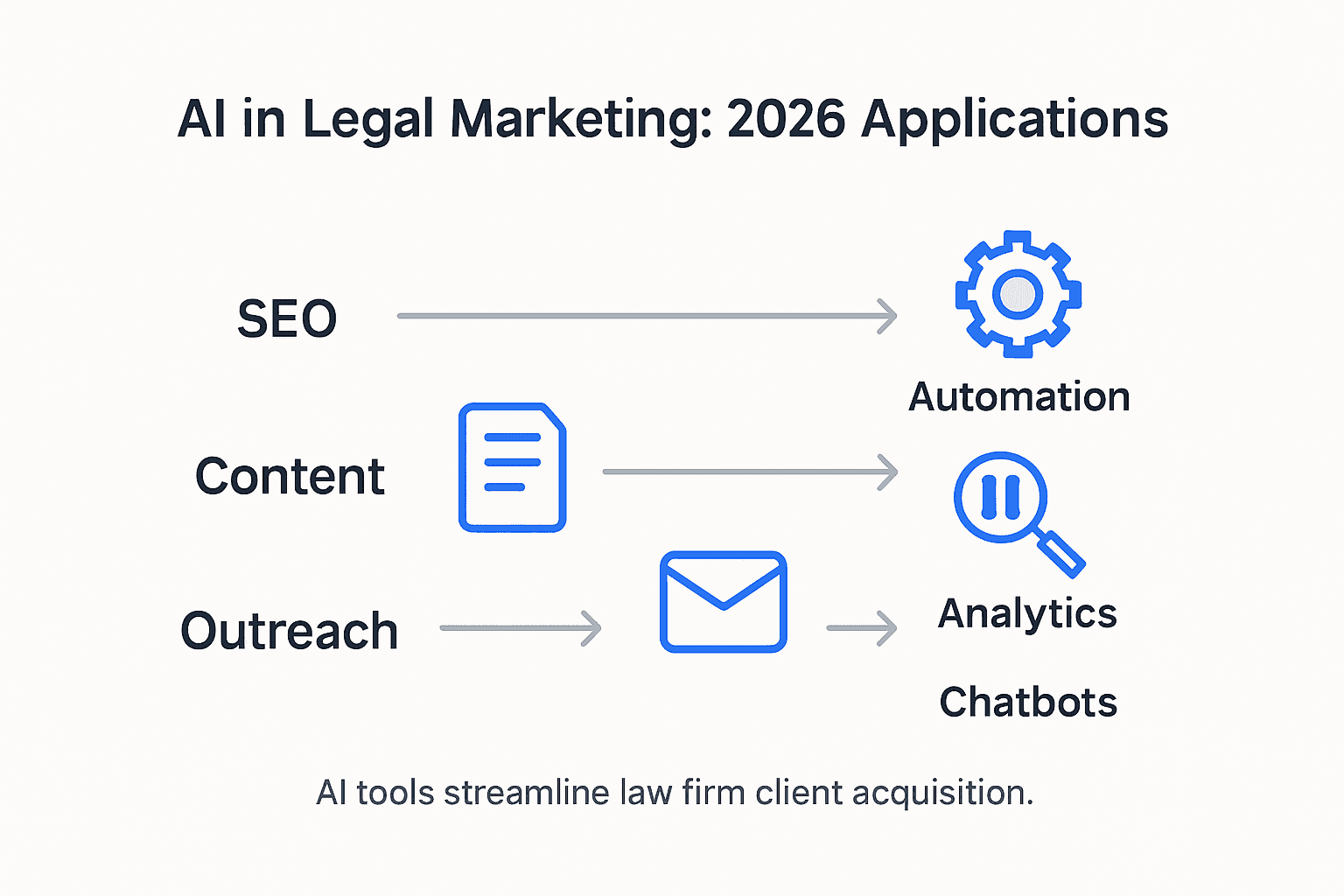
AI technologies are revolutionizing legal marketing by transforming core operational strategies across multiple domains. Recent studies highlight how AI supports the entire marketing funnel, enabling law firms to optimize content output with unprecedented precision and efficiency, fundamentally reshaping how legal professionals approach client acquisition and engagement.
Google’s AI Overview is dramatically changing search dynamics, compelling law firms to adapt their content strategies for AI-generated search intermediaries. This technological shift demands a sophisticated approach to content creation that balances algorithmic optimization with genuine authoritative insights. The key applications span several critical marketing domains:
- SEO Optimization: AI-powered tools analyzing keyword trends and content relevance
- Content Generation: Automated drafting of practice area descriptions, blog posts, and client guides
- Predictive Lead Scoring: Intelligent systems identifying high-potential client prospects
- Email Marketing Personalization: Dynamic content adaptation based on client interaction data
- Competitive Intelligence: Real-time tracking of market positioning and competitor strategies
Pro tip: Implement a quarterly AI tool audit to ensure your marketing technology stack remains cutting-edge and aligned with emerging industry capabilities.
Compliance, Ethics, and Regulatory Challenges
The integration of AI technologies in legal marketing introduces complex ethical and regulatory considerations that demand careful navigation from legal professionals. Law firms must balance technological innovation with strict adherence to professional responsibility standards, ensuring that AI-driven marketing strategies maintain the highest levels of integrity and transparency.
Stanford Law School’s comprehensive analysis warns of significant structural challenges in deploying AI within legal contexts, highlighting critical areas of concern that law firms must address. These challenges encompass multiple dimensions of legal and ethical compliance:
- Data Privacy: Protecting client information and ensuring secure AI interactions
- Transparent Disclosure: Clearly communicating AI’s role in client communications
- Accuracy and Accountability: Verifying AI-generated content for factual correctness
- Professional Conduct: Maintaining ethical standards in AI-assisted marketing
- Regulatory Compliance: Adapting to evolving legal guidelines for AI technologies
Pro tip: Develop a comprehensive AI governance framework that includes regular ethical audits and clear guidelines for AI tool implementation and usage.
Risks, ROI, and Common Implementation Mistakes
The American Bar Association’s 2024 technology report reveals critical insights into the complex landscape of AI implementation for law firms, highlighting that successful AI adoption requires strategic planning and nuanced understanding of potential risks and returns. Legal marketing professionals must approach AI technologies with a balanced perspective, recognizing both transformative potential and inherent challenges.
The 2024 Legal Marketing Technology Ecosystem Study emphasizes that implementation mistakes can dramatically undermine AI investment returns, revealing critical areas where law firms frequently stumble. Understanding these potential pitfalls is crucial for developing robust AI strategies that deliver genuine value.
Key risks and implementation challenges include:
- Overreliance on AI: Neglecting critical human oversight and verification
- Data Security Vulnerabilities: Inadequate protection of sensitive client information
- Unrealistic Expectations: Assuming AI will instantly solve complex marketing problems
- Poor Integration: Failing to align AI tools with existing workflow processes
- Insufficient Training: Not investing in team education and skill development
- Ethical Compliance Gaps: Overlooking regulatory requirements and professional standards
Pro tip: Conduct a comprehensive AI readiness assessment, mapping current technological capabilities against strategic marketing objectives to identify precise implementation opportunities.
To help law firms plan successful AI adoption, here is a comparison of common risks versus best practices:
| Risk or Mistake | Impact on Law Firm | Best Practice Solution |
|---|---|---|
| Overreliance on AI | Reduced content quality | Maintain human oversight |
| Data Security Vulnerabilities | Potential data breaches | Implement robust encryption |
| Poor Integration | Workflow disruptions | Align AI with existing processes |
| Insufficient Team Training | Low tool utilization | Provide targeted education |
| Ethical Compliance Gaps | Reputational harm | Develop clear AI governance rules |
Unlock the Power of AI to Drive Legal Leads in 2026
The article highlights key challenges law firms face today in successfully integrating AI to enhance client acquisition through personalized marketing and SEO strategies. If you are struggling with optimizing your content for emerging AI-driven search platforms or balancing ethical compliance while maximizing ROI, you are not alone. Critical pain points include leveraging predictive analytics, automating content without sacrificing quality, and adapting to the rapidly changing AI landscape impacting legal marketing strategies.
At LawSEO.com, we specialize exclusively in helping law firms overcome these hurdles. Our founder-led team understands the unique ethical considerations and competitive dynamics of legal marketing. Using a proven, comprehensive approach we optimize content to be found both in traditional Google rankings and generative AI tools that serve as new front doors for clients. We integrate local SEO, content production, and advanced AI optimization, empowering your firm to attract more qualified leads.
Don’t let AI complexities stall your growth. Take control of your law firm’s lead generation today by partnering with the experts at LawSEO.com. Learn how our exclusive, attorney-focused digital marketing solutions can deliver measurable results in this new AI-driven environment. Start your journey toward online dominance now and position your firm for success in 2026 and beyond.
Frequently Asked Questions
What are the main benefits of using AI in legal marketing?
AI in legal marketing enhances client acquisition, engagement, and operational efficiency by facilitating hyper-personalized communication strategies, automating lead scoring, and optimizing content strategies to meet individual client needs.
How can AI improve SEO strategies in legal marketing?
AI technologies analyze keyword trends and optimize content relevance, allowing law firms to create targeted content that aligns with search engine algorithms, ultimately improving online visibility and client outreach.
What types of AI tools are commonly used by law firms for marketing purposes?
Law firms utilize various AI tools, including research automation platforms, content generation systems, predictive analytics engines, and client interaction technologies, to streamline workflows and enhance marketing effectiveness.
What are the potential risks associated with AI adoption in legal marketing?
Key risks include overreliance on AI without human oversight, data security vulnerabilities, unrealistic expectations from AI capabilities, poor integration with existing workflows, and ethical compliance gaps that may arise during implementation.