


TL;DR:
- Effective reputation management requires law firms to analyze their online presence, respond ethically to reviews, and optimize AI and search visibility continuously. Prioritizing consistent review acquisition, strategic content, and compliance-driven responses fosters trust and improves search rankings. Regular measurement and adjustments ensure sustained growth and authoritative recognition in competitive legal markets.
A prospective client searching for a personal injury attorney in your city reads two Google Business profiles side by side. Your firm has 11 reviews averaging 3.8 stars, several unanswered. Your competitor has 87 reviews, a 4.9 average, and a thoughtful response to every comment. The decision takes seconds. This scenario plays out thousands of times daily, and the firms that understand reputation management as a continuous operational system, not a one-time cleanup task, are the ones consistently growing their client intake. This guide walks through auditing where your firm stands, building reliable systems to improve it, and measuring real impact.
Key Takeaways
| Point | Details |
|---|---|
| Start with an audit | Assess online reputation across search, reviews, and AI to find improvement opportunities. |
| Systematize reviews ethically | Adopt structured, compliance-focused workflows for acquiring and responding to client reviews. |
| Boost search and AI visibility | Regularly monitor your firm’s presence and authority signals in both Google and leading AI search platforms. |
| Track key metrics | Go beyond review counts by measuring branded search, AI citations, and benchmark conversion rates. |
| Prioritize confidentiality | Always protect client privacy when managing online reputation, especially in review responses. |
Assessing your law firm’s online reputation: where to start
Once you understand what’s at stake, the next step is to establish a clear baseline of your current online presence. You cannot fix what you haven’t measured, and in reputation management, assumptions are expensive.
A practical first step is a baseline audit: check your current visibility across search results, review platforms, social media, and AI platforms before you decide what to fix or where to invest. That means running your firm name through Google, checking your Google Business Profile, scanning Avvo, Martindale-Hubbell, Justia, Yelp, and even Facebook. Document exactly what you find.
What to look for during your audit:
- Inconsistent NAP data (Name, Address, Phone) across directories, which suppresses local search rankings
- Missing or unclaimed profiles on legal-specific platforms like Avvo and FindLaw
- Unanswered negative reviews that signal poor client service to prospective clients
- Thin or outdated “About” content that fails to establish E-E-A-T (Experience, Expertise, Authoritativeness, and Trustworthiness)
- Low volume of recent reviews, which reduces algorithmic trust in your profile
You should also assess your AI-driven search visibility as part of this initial audit. AI-generated answers in tools like ChatGPT, Perplexity, and Google’s AI Overviews are now surfacing law firm recommendations before users even click a link. If your firm isn’t cited in those answers, you’re invisible to an entire category of prospective clients.
Audit results tracking table:
| Channel | Status | Issues Found | Priority |
|---|---|---|---|
| Google Business Profile | Claimed/Unclaimed | Missing hours, few reviews | High |
| Avvo | Active/Inactive | No peer endorsements | Medium |
| Martindale-Hubbell | Listed/Missing | Outdated practice areas | Medium |
| Social media (LinkedIn, Facebook) | Active/Dormant | No recent posts | Low |
| AI chatbot citations | Mentioned/Absent | Not appearing in answers | High |
| Yelp | Claimed/Unclaimed | Negative review unaddressed | High |
Tracking your findings in a structured format like this allows you to prioritize by impact and urgency rather than guessing where to spend time. Reputation work done without prioritization leads to effort scattered across low-value fixes while critical problems go unresolved. Improving law firm SEO metrics tracking alongside this audit gives you a measurable starting point for progress.
Pro Tip: AI search visibility can be assessed by prompt testing. Open ChatGPT or Perplexity and type queries like “Who are the best family law attorneys in [your city]?” or “Find me a personal injury lawyer near [your market].” If your firm isn’t mentioned, you have an AI citation gap that requires structured content strategy to close.
You should also use legal research strategies to understand how prospective clients search for legal services, which directly informs the content and citation signals your profiles need to generate.
Building a review system: acquisition, response, and compliance
With visibility gaps identified, you need reliable systems to repair and maximize positive signals. A review strategy that depends on random client goodwill will never generate the volume or consistency that drives real trust signals.
Step-by-step system for ethical review acquisition:
- Identify the right moment. The best time to request a review is immediately after a successful matter resolution, when client satisfaction is highest. Don’t wait weeks; the emotional window closes fast.
- Send a personalized request. Generic emails perform poorly. Reference the outcome of the matter and the specific aspect of service the client valued most, without disclosing confidential information.
- Make it simple. Include a direct link to your Google Business Profile review form. Every additional step reduces follow-through.
- Follow up once. A single polite follow-up email seven days later is appropriate. More than that risks appearing aggressive or damaging the client relationship.
- Log all requests. Track who was asked, when, and whether they responded. This protects you in the event of ethics inquiries and helps you refine your process.
Review acquisition and response should be systematic: solicit reviews after matters are resolved, respond professionally to every review, and for negative reviews, respond with empathy and a private, offline resolution path while avoiding confidentiality issues.
Responding publicly to negative reviews requires particular care. You cannot confirm or deny whether someone was your client without their explicit consent. Your public response should acknowledge the concern, express a commitment to service quality, and invite the reviewer to contact your office directly. This approach protects confidentiality, demonstrates professionalism, and signals to prospective clients that your firm handles conflict with maturity.
“The response to a negative review is as important as the review itself. A calm, empathetic, and non-defensive reply often does more to build trust with prospective clients than the original complaint damages it.”
Ethics rules around review solicitation constrain how lawyers request Google reviews. The duty under Rule 1.9© means there is a real risk that review solicitation may use former-client confidential information, including identity, contact details, or the nature of the representation. Always consult your jurisdiction’s ethics guidance and, where necessary, obtain explicit client consent before any public-facing review campaign.
Use review workflow playbooks to systematize the process across your team. Consistency in how staff members handle requests and responses reduces error and ethical exposure.
Manual vs. automated review management:
| Approach | Advantages | Limitations |
|---|---|---|
| Manual outreach | Highly personalized, lower ethics risk | Time intensive, inconsistent volume |
| Automated platforms | Scalable, trackable | Risk of impersonal tone, requires careful ethics review |
| Hybrid (templates + personalization) | Balances efficiency with compliance | Requires training and oversight |
Pro Tip: Maintain email templates for review requests, but always customize the opening sentence to reference the client’s specific matter type. Personalized messages generate significantly higher response rates than boilerplate text, and they reduce the risk of appearing to disclose confidential details inappropriately.
You can use tracking review impact data to identify which matter types and outreach methods generate the most reliable review responses, then optimize accordingly.
Enhancing and monitoring search and AI visibility
Once your review engine is reliable, search visibility becomes the multiplier for those positive signals. A firm with 90 five-star reviews but no search presence still loses to a competitor that ranks on page one with 40 reviews.

Boosting your presence across both traditional Google search and AI-driven search requires a parallel strategy. Google’s algorithm continues to reward E-E-A-T signals, while AI platforms like Perplexity and ChatGPT favor structured, authoritative, and frequently cited content. These aren’t mutually exclusive goals. Content optimized for E-E-A-T naturally tends to earn citations in AI-generated answers.
Core actions to boost search and AI visibility:
- Publish detailed, practice-area-specific content that demonstrates firsthand legal knowledge
- Earn authoritative backlinks from legal directories, bar association sites, and local media outlets
- Keep your Google Business Profile updated with current hours, attorney bios, and recent posts
- Use schema markup (structured data added to your website’s code) to help search engines categorize your content accurately
- Build entity recognition by ensuring your firm name, attorney names, and practice areas are consistently referenced across the web
AI search visibility is measurable through prompt testing. When your firm appears in AI-generated summaries for queries like “best DUI attorney in [city]” or “who handles employment discrimination cases near me,” you are capturing attention at the very earliest stage of the client decision process.
Top metrics to monitor with target ranges:
| Metric | Target Range | Why It Matters |
|---|---|---|
| Organic search CTR | 4% to 7% | Measures how compelling your listing appears |
| Conversion rate (contact/call) | 3% to 6% | Tracks lead generation effectiveness |
| Review star average | 4.5 or above | Influences first impressions and click decisions |
| Review response rate | 100% | Signals active management to Google and clients |
| AI citation frequency | Increasing monthly | Measures Generative Engine Optimization progress |
| Branded search volume | Growing quarter over quarter | Indicates awareness and authority growth |
According to 2026 law firm marketing benchmarks, a search click-through rate of 4% to 7% and a conversion rate of 3% to 6% are the published reference ranges for the legal sector. These numbers vary significantly by practice area and how well E-E-A-T signals are established in your content and profiles.
Reviewing AI search benchmarks for the legal industry gives you a realistic comparison point for where your firm should be aiming as generative search grows in influence.
Pro Tip: Schedule a monthly “prompt audit.” Set a recurring calendar reminder to run ten to fifteen specific queries in ChatGPT, Perplexity, and Google’s AI Overviews. Document whether your firm is cited. If competitors are consistently appearing and you are not, your content strategy needs recalibration around the topics driving those citations.
Understanding responsible AI best practices is also increasingly relevant as law firms integrate AI into their marketing workflows. Governance matters when client data is involved.
Tracking results and continuous optimization
Improvement is only meaningful if it’s measured consistently and leads to actionable insights. Too many law firms invest in reputation management, then evaluate success purely by how many reviews they’ve accumulated. That’s the wrong lens.
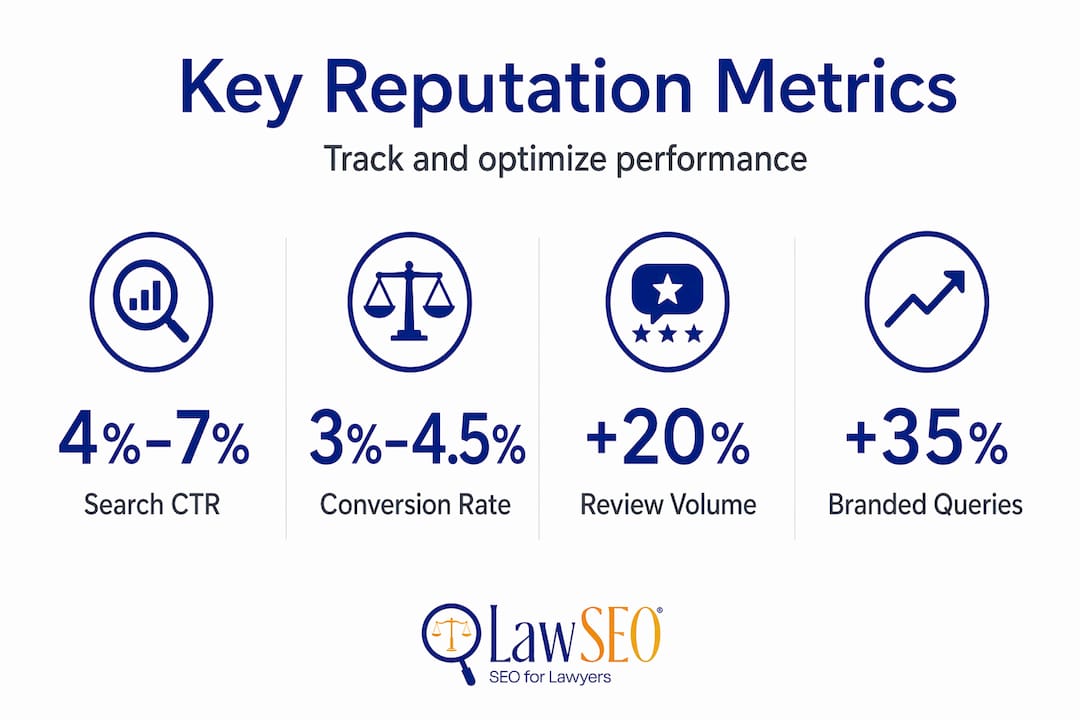
Measuring improvement requires more than counting reviews. You must include response patterns and signals of authority and trust (E-E-A-T style signals) plus branded search growth, and whether AI systems cite or summarize your firm for priority practice areas. These multi-dimensional signals reflect how search engines and AI tools actually evaluate your authority.
Key continuous improvement actions:
- Run monthly prompt tests across your priority practice area queries
- Monitor Google Search Console for branded query growth and click-through improvements
- Review your Google Business Profile insights weekly for call volume, direction requests, and profile views
- Conduct a quarterly profile audit to update photos, bio content, and hours
- Track new review volume and average star rating monthly using a simple spreadsheet or dashboard
- Check your profile consistency across all directories every six months
Additional signals worth monitoring:
- Mentions in local media or bar association publications
- Inbound links from credible legal or civic sources
- Response time on reviews, as Google factors engagement into local rankings
- Client intake source data, specifically whether referrals mention finding you online
Statistical callout: 2026 law firm marketing benchmarks cite a search click-through rate range of 4% to 7% and a conversion rate of 3% to 6% as the reference framework for law firm digital channels. These figures should be interpreted with care because practice area, geography, and the strength of your authority signals all affect where your firm lands within or beyond those ranges.
Use conversion rate optimization for attorneys strategies alongside reputation tracking to ensure that traffic improvements actually translate into new client consultations. Strong reputation signals drive clicks; optimized intake processes convert them.
Tracking critical SEO metrics on a regular schedule ties your reputation work to business outcomes rather than vanity indicators. The goal is always client acquisition, not just higher star ratings.
Using compliant data tracking tools is essential when your workflow involves client contact data. Compliance with data protection rules is not optional, particularly for law firms with professional responsibility obligations.
A smarter playbook: what most law firms miss about reputation management
The most common mistake law firms make is treating reputation management as a volume game. They focus almost entirely on accumulating more reviews, assuming that quantity automatically translates into authority. It doesn’t. A firm with 200 reviews and a 3.6 average, combined with inconsistent profiles and zero AI visibility, will often lose search position to a competitor with 60 well-responded reviews, consistent NAP data, and strong content citations.
The second misstep is defensive responses to negative reviews. A partner who replies to a one-star review with defensive language, or worse, with case-specific details in an attempt to disprove the complaint, creates a confidentiality exposure and signals poor professional judgment to every future reader. The better approach is to treat every review, positive or negative, as an E-E-A-T signal. A thoughtful, empathetic public response to a negative review often builds more trust with prospective clients than the original review damages.
Reputation system design should include confidentiality-aware review responses. Even when responding publicly, the goal is to avoid disclosing case details and to route conflict resolution offline. This isn’t just a legal ethics requirement. It’s a strategic advantage, because firms that handle friction professionally look more trustworthy than those that don’t.
Three advanced tactics few firms use:
- Review workflow audits. Quarterly audits of your review request process to identify which outreach methods generate responses and which don’t, then refine accordingly.
- AI prompt calibration. Monthly testing of AI tools for priority queries, followed by content updates specifically designed to earn citations in those answers.
- Periodic ethics compliance checks. An annual review of your jurisdiction’s ethics opinions on review solicitation, advertising, and client communication to ensure your reputation system stays compliant as rules evolve.
Monitoring underused SEO metrics like branded query volume and AI citation frequency is where top-performing firms are already operating. Most competitors aren’t tracking these signals yet, which means the window to gain a real advantage is still open.
Boost your firm’s reputation with proven legal marketing experts
Ready to get proactive about your firm’s reputation? Here’s how you can move from theory to expertly guided action. LawSEO.com specializes exclusively in search engine optimization and digital marketing for law firms, which means every strategy aligns with the ethical constraints and competitive dynamics unique to legal practice. The firm’s founder, Todd R. Stager, brings over 29 years of SEO experience to every client campaign, personally overseeing strategy from audit through execution. Whether you need a reputation audit, a review system, AI citation optimization, or a complete presence rebuild, the SEO for Lawyers Guide and the full range of legal digital marketing solutions at LawSEO.com offer a clear, evidence-based path forward. Start with a strategy call and let the data show exactly where your reputation opportunity lies.
Frequently asked questions
What is the first step to improving a law firm’s online reputation?
Start with a comprehensive audit across search results, review platforms, social media, and AI search engines to identify both opportunities and risks before investing in any specific tactic.
How should lawyers handle negative online reviews ethically?
Respond promptly and professionally without sharing confidential client details, guide the resolution offline, and ensure every public response reflects your jurisdiction’s professional conduct rules. Systematic response protocols protect both reputation and compliance.
Can lawyers ask former clients to submit Google reviews?
Lawyers may request reviews, but must avoid disclosing confidential information in the process. NYSBA Ethics Opinion 1286 specifically addresses how solicitation may implicate Rule 1.9© duties, and jurisdictional rules vary, so always verify local guidance before launching any outreach campaign.
What are the best metrics to track for reputation improvement?
Monitor review quality, volume, and response rates alongside branded search growth and AI citation frequency, as these multi-dimensional signals reflect how both search engines and AI tools evaluate your authority.
What is a typical click-through rate for law firm marketing?
A 2026 law firm benchmark cites a 4% to 7% click-through rate as the reference range, though actual results vary meaningfully by practice area, market, and the strength of your E-E-A-T signals.