


TL;DR:
- Potential clients scrutinize every detail to assess trust on attorney websites, which directly impacts rankings and conversions. Building credibility involves specific signals like detailed bios, verified reviews, current credentials, and secure site design that demonstrate expertise and transparency. Regular audits and updates of these trust signals are essential to maintain authority, satisfy ethical standards, and attract high-quality leads.
A professional-looking website is not enough to win clients in the legal space. Potential clients searching for an attorney are making high-stakes decisions about their finances, freedom, or family, and they scrutinize every detail before reaching out. Legal services are YMYL, meaning Your Money or Your Life content, a classification Google applies to industries where poor information could cause real harm. This guide breaks down exactly which trust signals matter most for attorney websites, why they influence both client behavior and organic rankings, and how to implement them in a way that holds up to serious scrutiny.
Key Takeaways
| Point | Details |
|---|---|
| Trust is non-negotiable | Attorney sites face higher scrutiny, so robust trust signals are essential for winning clients online. |
| YMYL standards apply | Google and clients expect law firm sites to demonstrate real expertise, transparency, and credentialing. |
| Substance trumps style | A polished design is not enough—concrete, up-to-date trust signals and bios matter most. |
| Audit and update routinely | Regularly review and refresh trust signals to maintain credibility and competitive SEO. |
Why trust signals matter for attorney websites
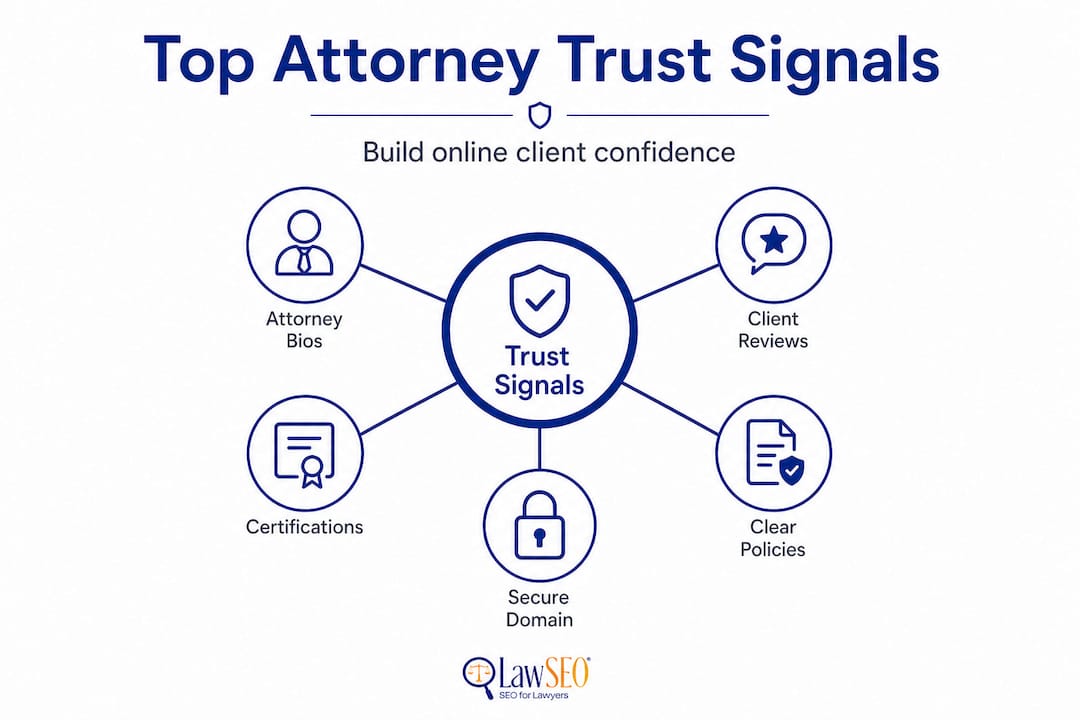
Trust operates at two levels on attorney websites: it influences whether a prospective client picks up the phone, and it shapes how Google’s algorithms evaluate your site’s overall quality. These two dynamics are more connected than most law firms realize.
When someone lands on your site after searching “divorce attorney near me” or “personal injury lawyer Chicago,” they are not just evaluating your fees or practice areas. They are asking a deeper question: Can I trust this person with something that could change my life? The answer depends on clear, verifiable signals of credibility. Credentials, transparent attorney bios, verified client reviews, awards, clear policies, and regularly updated content all work together to answer that question before the phone even rings.
“Google’s Search Quality Raters apply high scrutiny to legal sites due to the consequences for people’s safety and financial well-being.”
Google’s Search Quality Raters, who evaluate websites to help refine the algorithm, apply stricter standards to legal content precisely because the consequences of poor advice or misleading information are so serious. This is the core principle behind E-E-A-T: Experience, Expertise, Authority, and Trust. Sites that demonstrate these qualities earn better visibility. Sites that don’t, regardless of how well-optimized their metadata is, face an uphill battle.
The practical implication is straightforward. Without strong trust signals, even a firm that invests heavily in keyword targeting and technical SEO may stall in the rankings. If you want to understand the full ethical and strategic dimension of building credibility online, ethical SEO for attorneys is a subject worth exploring carefully before diving into implementation.
Core trust signals every attorney website needs:
- Detailed, credential-rich attorney bios
- Verified client reviews on third-party platforms and your own site
- Visible bar memberships, certifications, and awards
- Clear privacy policies and legal disclaimers
- Secure site with HTTPS and a professional design
- Regularly updated practice area content that demonstrates current knowledge
Now that you understand trust’s central role, let’s break down the specific types of signals that matter most for law firms online.
The essential trust signals for attorney sites
Not all trust signals carry the same weight. Some create an impression of credibility at a glance. Others provide the verifiable, specific evidence that both clients and search engines require. The strongest attorney websites stack both.
Search Quality Raters look for evidence of real expertise and thorough, specific content. Thin bios or generic practice pages consistently erode trust and send both users and algorithms a signal that the firm may not have the depth it claims.
Here are the five most critical trust signals for attorney websites, along with concrete examples of what strong versus weak implementation looks like:
1. Detailed attorney bios with verified credentials
A strong bio does more than list a law school and a practice area. It specifies bar admissions, years of experience in particular case types, notable verdicts or settlements (where ethically permissible), professional associations, speaking engagements, and published works. Weak bios read like a LinkedIn summary from 2014. Strong bios read like a professional resume backed by evidence. You can review attorney website examples to see how leading firms present this information.
2. Verified client reviews and testimonials
Reviews are not optional. Prospective clients read them. Google factors them into local search rankings. The key word is verified: reviews sourced from Google Business Profile, Avvo, or Martindale-Hubbell carry far more weight than anonymous testimonials displayed only on your own site. A mix of both is ideal. Volume matters too. A firm with 12 reviews raises more uncertainty than one with 140.
3. Awards, certifications, and bar memberships
These elements should be displayed prominently, not buried in a footer. If an attorney is board certified in a specialty area, that credential deserves a visible callout on the homepage and the relevant bio page. Logos from recognized organizations like Super Lawyers or Best Lawyers should link to the actual listing, not just sit as decorative images. Linking out to the original source signals transparency and verification.
4. Privacy policies, disclaimers, and transparent legal language
Legal websites have an ethical obligation to display clear disclaimers about attorney-client relationships and the nature of the content presented. Beyond ethics, these pages serve as trust signals. A firm with a well-written, accessible privacy policy communicates to both clients and Google that it operates with professionalism and transparency.
5. Professional design and secure domains
HTTPS is non-negotiable. An insecure site will display a browser warning, and that warning kills trust instantly. Beyond security, the visual design should communicate order and professionalism. Clean layouts, fast load times, professional photography, and accessible navigation all contribute to the first impression that keeps a visitor reading rather than bouncing.
Pro Tip: Link each attorney’s name in your bio section directly to their state bar profile. This one small step adds immediate, third-party verification that costs you nothing but builds significant credibility with both clients and search engines.
| Trust signal | Weak example | Strong example |
|---|---|---|
| Attorney bio | Generic paragraph, no specific cases | Detailed credentials, bar links, case types |
| Client reviews | 3 anonymous testimonials on homepage | 80+ verified Google reviews with responses |
| Awards | Logo image with no link | Linked award badge, active listing year |
| Privacy policy | Missing or boilerplate | Customized, clearly accessible from footer |
| Site security | HTTP, no SSL certificate | HTTPS with valid SSL, no browser warnings |
If you want specific, tactical guidance on strengthening each of these areas, reviewing strategies to boost lawyer credibility provides a solid starting point.
With these signals in mind, it’s important to understand the difference between a site that just “looks” professional and one that truly builds trust in the legal niche.
Avoiding pitfalls: common trust signal mistakes on law firm sites
Many attorney websites have the right elements in the wrong form. They have reviews, but they’re unverified. They have bios, but they’re vague. They have awards, but the listings expired two years ago. These surface-level signals can actually backfire because they draw attention to what’s missing.
“Thin practice-area content and vague attorney bios frequently cause raters to downgrade trust, harming both user trust and SEO.”
The following mistakes appear regularly on attorney websites and actively undermine credibility:
- Stock photos instead of real team photos. Clients know stock imagery when they see it. It signals that the firm is unwilling to show who they actually are, which raises doubt.
- Boilerplate bios copied from a template. Generic language like “John has extensive experience in all areas of law” communicates nothing. Specific language builds trust.
- Outdated honors and memberships. Displaying a “Rising Star” designation from 2018 in 2026 suggests the firm hasn’t earned recognition recently and hasn’t updated their site.
- Broken links to credentials. If you link to a bar profile or award listing and the link is broken, it actually harms credibility more than not linking at all.
- Review widgets with no verification. Displaying a five-star rating widget without linking to the actual review source creates doubt rather than confidence.
- Missing or outdated disclaimer language. Ethically required disclaimer language that’s generic or invisible tells informed clients and search engines the firm doesn’t take professional standards seriously.
Even a well-designed page fails if the evidence of genuine experience is absent. The design might get a visitor to read the bio. But if the bio doesn’t deliver specific, verifiable proof of experience, the visitor leaves. Understanding why online reviews matter for lawyers helps clarify just how important verified third-party validation is in that decision process.
Pro Tip: Set a calendar reminder to audit all attorney bios, award listings, and credential links once a year. Outdated information is one of the most common reasons otherwise strong attorney sites lose trust with both clients and Google’s raters.
Understanding pitfalls sets the stage for practical steps you can implement to enhance trust signals right away.
How to implement and showcase trust signals effectively
Building a credible attorney website is a deliberate process. It requires an audit of what you currently have, an honest assessment of gaps, and a systematic plan to fill them. Here is a step-by-step framework for doing exactly that.
1. Conduct a trust signal audit. Walk through your site as a prospective client would. Open every bio page. Click every credential link. Read every practice area page. Note anything that’s missing, outdated, broken, or vague.
2. Photograph your real team. Schedule professional headshots for every attorney on your site. Replace any stock imagery used for the team section. Real faces build real connection.
3. Rewrite attorney bios with specific detail. For each attorney, include: bar admissions with years, law school and graduation year, specific practice areas with case-type examples, professional associations, published articles or speaking engagements, and a short personal note that humanizes the profile.
4. Secure and display client reviews. Send a review request to past clients through Google Business Profile. Follow up with a second message. Respond to every review, positive or negative. Link your review profiles from your website footer.
5. Verify and update credentials. Confirm that all awards, certifications, and bar memberships listed on your site are current. Link to the original source for each. Remove anything expired.
6. Publish and display legal policies. Every attorney website needs a privacy policy, a disclaimer about attorney-client relationships, and a terms of use page. These should be accessible from the footer of every page.
7. Evaluate your site’s technical trust signals. Confirm HTTPS is active, page load times are under three seconds, and mobile usability passes Google’s Core Web Vitals standards. Proper website design for attorneys integrates these technical elements from the ground up.
For attorney websites, trust signals must be comprehensive and clear to both users and search engines, because higher standards apply in YMYL categories like legal services.
| Trust signal type | Primary purpose | Recommended placement |
|---|---|---|
| Attorney bio with credentials | Establish personal expertise and authority | Dedicated bio pages, homepage team section |
| Verified client reviews | Third-party social proof and local SEO | Homepage, contact page, review landing page |
| Awards and certifications | Reinforce authority and professional standing | Homepage banner, bio pages, sidebar callouts |
| Privacy policy and disclaimers | Satisfy ethical requirements and user transparency | Footer of every page, contact form |
| Case results and practice experience | Demonstrate real-world competence | Practice area pages, case results section |
Having a roadmap for implementation helps ensure you not only avoid pitfalls but move toward true credibility in the eyes of prospective clients and search engines.
The uncomfortable truth: most law firm websites miss the mark on trust
After working in legal SEO for years, the pattern is clear. Most attorney websites invest in design and neglect depth. They purchase a polished theme, add a few stock photos, publish a generic bio, and call it done. Then they wonder why the leads don’t convert at the rate their visibility would suggest.
The issue is that design creates a first impression. Trust requires evidence. These are not the same thing. Even good keyword targeting cannot compensate for thin content or the absence of meaningful trust signals. A prospective client looking for a DUI attorney or an estate planning lawyer is not impressed by a clean color palette. They want to know whether this attorney has handled cases like theirs, what past clients experienced, and whether the firm operates with the kind of transparency that signals integrity.
Google’s raters are trained to think exactly like that prospective client. When they evaluate a legal site, they look for the same things a careful, skeptical person would look for before hiring an attorney. If your site doesn’t pass that test, your rankings reflect it over time.
The solution is not more widgets or an extra badge in the sidebar. It’s a commitment to genuine substance: current credentials, real photos, specific case experience, verified reviews, and clear policies. These elements require effort to produce and maintain. That is precisely why most firms don’t do it well, and why doing it well creates a real competitive advantage.
The firms that lead their local markets in organic search and conversion rates are not always the ones with the most expensive sites. They’re the ones that give clients and algorithms a reason to trust them, and they do it consistently, not as a one-time project. Prioritizing ethical legal SEO means committing to that standard for the long term.
Take your firm’s trust signals and marketing further
Knowing what trust signals are and implementing them correctly are two very different challenges. At LawSEO.com, we specialize exclusively in SEO and digital marketing for attorneys and law firms, and trust signal optimization is a core part of every client strategy. Whether you need a full technical and content audit, help building out attorney bios that satisfy E-E-A-T requirements, or a complete legal SEO strategy built for long-term dominance, we can help. Our founder, Todd R. Stager, brings over 29 years of SEO experience directly to every client campaign. Explore our approach to digital marketing for lawyers, or review our detailed law firm website optimization guide to take the next step toward a credible, high-performing online presence.
Frequently asked questions
What are trust signals in the context of attorney websites?
Trust signals are website elements that demonstrate a firm’s credibility, expertise, and transparency to both prospective clients and search engines. Legal sites must show explicit expertise through transparent bios, verified reviews, and clear credentials to satisfy both user expectations and Google’s quality standards.
How do trust signals affect law firm SEO?
Trust signals directly influence how Google evaluates your site’s authority and relevance, especially since YMYL sites require strong E-E-A-T to earn and maintain search visibility. Detailed attorney bios, verified reviews, and proper credential display all contribute to better organic rankings.
Which trust signals matter most for lawyers?
Verified client reviews, current attorney credentials with bar association links, and transparent privacy policies and disclaimers are among the strongest trust signals for law firm websites. Legal raters look for clear evidence of credibility including verifiable reviews and specific credential documentation.
What is an example of a trust-damaging mistake?
Vague or generic attorney bios are one of the most common and damaging mistakes on law firm websites, lowering both client confidence and search rankings. Thin content in attorney bios is a documented trigger for trust downgrades in YMYL legal categories.
How often should trust signals be updated?
Attorney profiles, award listings, bar memberships, and client reviews should be reviewed and updated at least once per year to ensure accuracy and maintain credibility with both clients and search engines. Outdated information is treated as a negative signal by Google’s quality evaluation process.