


Scholarship link building is no longer a reliable SEO tactic for most law firms heading into 2026, and treating it as one risks running afoul of both Google’s spam systems and state bar advertising rules. Industry data shows most scholarship links now carry nofollow or sponsored attributes, which strips their ranking value entirely. The better move for most firms: redirect that budget into earned editorial placements and treat any scholarship program as a community relations effort, not a link-building campaign.
TL;DR:
- Most scholarship links now have nofollow or sponsored attributes, providing little to no SEO benefit for law firms.
- Genuine scholarship programs should be based on real institutional relationships and publicized winners, not just link-building attempts.
- Better results come from earned editorial placements, original research, and community partnerships that naturally attract citations and press coverage.
- Firms must verify university policies on scholarship listing and document their outreach to ensure compliance with ethical and Google’s policies.
- Investing in high-quality, earned media and content creation offers more durable authority signals than gambling on uncertain scholarship link value.
Is Scholarship Link Building Still Worth It for Law Firms?
The short answer is: rarely, and only under narrow conditions. If your firm is chasing links, this tactic will likely disappoint you. If your firm genuinely wants to fund a scholarship as part of its community presence and picks up citations or two along the way, that’s a legitimate secondary benefit.
A scholarship program makes sense when it grows out of something real: your firm’s ties to a local law school, a practice area with a natural academic tie-in (immigration law and a university’s international studies program, for example), or a genuine commitment to diversity in the profession. Those conditions matter more than most firms realize, because they’re exactly what separates a scholarship a journalist wants to write about from one that reads as a transaction.
A few conditions tend to increase the odds of an editorial mention rather than a directory listing:
- The scholarship connects to a specific academic department or student organization, not a generic “any student, any major” listing.
- Your firm has a physical, verifiable local presence near the institution.
- The award ties to a real practice specialty (a personal injury firm funding a pre-med scholarship makes more sense than a random cash grant).
- You’re prepared to publicize the winner yourselves, not just wait for a university page to link back.
Budget expectations should be realistic, especially if you consult the AI Content Optimization Guide for Legal Marketers to ensure your content meets AI-driven search criteria. Most scholarship campaigns require at least a $1,000 award plus several hours of outreach to financial aid offices, department coordinators, and student groups. Even with a properly run program, most resulting links will carry a rel="nofollow" or rel="sponsored" attribute, since many institutions now automatically tag external scholarship listings that way. Go in expecting reputational value, not a guaranteed ranking boost.
How to Run a Legitimate Scholarship With Minimal Risk
If your firm decides a scholarship still fits its brand goals, the execution matters more than the idea. A sloppy scholarship page reads as a link scheme to both journalists and Google’s automated systems. A well-built one reads as a real program that happens to generate a link.
Follow this sequence:
- Define clear eligibility criteria tied to something specific: a geographic area, a field of study, a demographic your firm genuinely serves.
- Assemble a real selection committee, ideally including someone outside your marketing team, and document how winners get chosen.
- Publish a genuine landing page with terms, deadlines, an application process, and a public announcement of past winners, not just a submission form.
- Announce winners publicly with a short case study or profile, the kind of content a student newspaper or department newsletter would actually want to run.
- Prioritize outreach to student newspapers, pre-law advisors, faculty pages, and department newsletters rather than mass-emailing financial aid offices, since these editorial channels produce citations rather than directory-style listings.
- Verify every link you receive. Check whether it carries
rel="nofollow"orrel="sponsored", confirm the page is actually indexed, and read the surrounding editorial context before counting it as a win. - Track results over 3 to 12 months, not weeks. Monitor referral traffic, link attributes, and any organic citations that mention the scholarship independent of your outreach.
Pro Tip: Before you build the landing page, search for the university’s own scholarship listing policy. Many schools now publish an explicit nofollow policy for third-party scholarships, which tells you upfront whether you’re building brand equity or chasing a link that will never count.
Document every step of this process. Beyond the SEO value, that documentation matters if a bar association or ethics counsel ever asks how the program was structured and marketed.
What Should Law Firms Do Instead of Scholarship Links?
Most firms get more return by putting the same budget toward earned coverage instead of a scholarship fund. The logic is straightforward: editors and journalists cite sources that inform their reporting, not organizations that offered them money or a listing swap.
A few approaches consistently outperform scholarship campaigns for legal marketers:
- Expert sourcing through platforms and student journalists. Responding to reporter queries or offering commentary to student newspapers builds the same kind of
.eduand news-domain citations a scholarship chases, without the pay-for-placement risk. - Original research and surveys. A firm that publishes data on, say, local traffic accident trends or small business litigation patterns gives journalists something to cite on their own initiative.
- Digital PR aimed at legal trade press and state bar journals. These placements carry topical authority a general scholarship directory never will.
- Local sponsorships and partnerships with bar associations, legal aid clinics, or community events, which tend to generate press coverage and direct referral traffic alongside any link value.
Legal SEO specialists increasingly recommend this shift, moving budget away from scholarship campaigns toward earned editorial placements and original research that attract links because the content itself is worth citing. A well-executed link building strategy for law firms treats those tactics as the foundation, with scholarships as, at best, a minor supplement.
What Are the Google Policy and Bar Ethics Risks?
Two separate risk categories apply here, and firms need to think about both before spending a dollar.
On the technical side, Google’s SpamBrain systems and its link spam policy now evaluate link patterns at the network level, not link by link. A cluster of scholarship links with similar anchor text, similar page structure, and a burst of acquisition velocity gets flagged and neutralized as a group, even when each individual link looks harmless in isolation.
On the ethics side, state bar advertising rules require attorneys to verify that online promotions comply with professional conduct standards, and a scholarship structured explicitly as a link-for-money exchange can raise real questions. Consult ethics counsel before launching any program that ties a financial award to a placement requirement.
Watch for these red flags:
- Outreach emails that explicitly request a “link back” as a condition of the award.
- Multiple scholarship pages built from the same template with identical anchor text.
- No documented selection process or committee.
- No public announcement of winners beyond the scholarship page itself.
Keep records of your selection criteria, committee composition, and public winner announcements. That documentation protects you on both fronts: it demonstrates the program is a genuine community effort, and it gives ethics counsel something concrete to review if the firm’s advertising practices are ever questioned. Our guide to ethical SEO for attorneys covers the broader compliance framework worth building around any outreach campaign.
Have Any Law Firms Made Scholarship Campaigns Work?
The firms that got real value from scholarship programs share a pattern: they built the program around a genuine institutional relationship first and treated any resulting link as a bonus, not the goal.
A personal injury firm with deep ties to a regional university, for example, that funds an award tied to a public health or pre-law program tends to generate organic pickup from student newspapers and department pages because the story is genuinely newsworthy: a local firm invests in local students. Immigration firms that sponsor scholarships tied to international studies or ESL programs see similar traction, since the connection between the firm’s practice and the award is obvious to any editor deciding whether to cover it.
Contrast that with firms that ran generic “any student, any major, $500 essay contest” programs purely to acquire .edu links. Those campaigns generated outreach emails to financial aid offices and got mostly ignored, or landed on nofollowed directory pages that added no ranking value and no press coverage. The difference wasn’t budget. It was whether the program told a story worth reporting.
The takeaway for any firm evaluating this tactic: the scholarships that “worked” did so because they functioned as real community investments first. The link was incidental.
How Do You Vet a University Partner Before Launching a Scholarship?
Picking the right institution matters as much as designing the scholarship itself. A mismatched partner wastes outreach effort and produces links with no editorial weight even when they do get published.
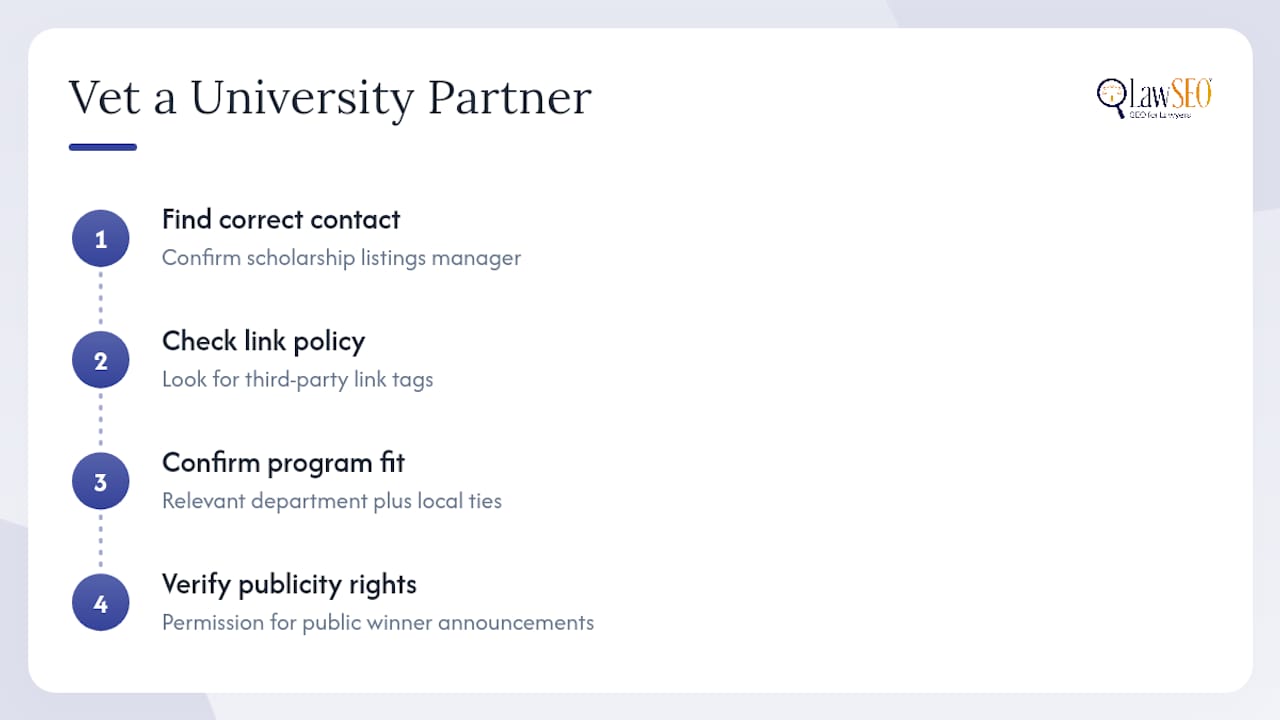
Start by confirming the department or office you’re approaching actually manages scholarship listings, not a general admissions inbox that will forward your email into a void. Most universities route these to financial aid or a specific academic department, and finding the right contact saves weeks.
Next, check the institution’s existing scholarship page for its link policy. If every third-party scholarship listed already carries a rel="nofollow" tag, that tells you upfront what to expect from this partner regardless of how well you design your program.
Then evaluate genuine fit: does the university offer the academic program your practice area would naturally support? A family law firm partnering with a social work department has a clearer editorial hook than one partnering with an engineering school. Look for existing local ties: alumni on your team, past pro bono work with the institution, or physical proximity that gives a reporter or student newspaper a reason to cover the story.
Finally, confirm the institution allows public winner announcements and case studies. Some universities restrict how student information can be shared publicly, which limits your ability to generate the kind of content that attracts organic citations later. If a university doesn’t let you publicize a winner’s story, the partnership loses much of its editorial value regardless of the eligibility criteria you build around it.
LawSEO’s Take: What Actually Moves the Needle
The industry consensus has shifted, and for good reason: scholarships went from being pitched as a reliable .edu acquisition hack to what they actually are, a reputational play with uncertain SEO upside. LawSEO’s position has stayed consistent through that shift. Prioritize earned editorial coverage and original research first, and treat any scholarship program as a CSR investment where link value is a pleasant side effect, never the objective stated in a project brief.
This recommendation comes from Todd R. Stager’s 29-plus years running SEO campaigns exclusively for law firms, watching tactics like this cycle through hype and correction more than once.
— TODD
Get Authority-Building Results Without the Scholarship Guesswork
Scholarship campaigns ask your firm to gamble a four-figure award and dozens of outreach hours on links that mostly arrive nofollowed anyway. Some agencies provide law firms a documented, ethics-reviewed path to the same goal: real authority signals that hold up under Google’s current link evaluation and bar advertising rules. Our Website Authority & Link Building work pairs with dedicated Outreach Services and digital PR placements built specifically for legal practices, so your firm earns citations from legal trade press and local media instead of chasing university coordinators who may tag your link as sponsored anyway.
Because experienced SEO professionals review every campaign and focus on legal marketing, you get a process built around bar compliance from the start, not bolted on after the fact. Some firms offer exclusivity agreements to prevent local competitors from working with the same agency. If your firm is weighing a scholarship budget against a proven alternative, request a link-building program audit through Lawseo and see where your budget would generate more durable results.
Sources
- ABA: FAQs — Attorney advertising ethics rules in the digital age (2025 winter)
- Scholarship Link Building in 2026: Why We Stopped Recommending It | PrestigeLinks
- Scholarship Link Building: Does It Still Work in 2026? | OutreachDesk
FAQ
Does Scholarship Link Building Still Work in 2026?
For most law firms, no, not as a primary SEO tactic. Industry data shows most scholarship links now carry nofollow attributes, and Google’s link spam systems increasingly neutralize clusters of similar-looking scholarship links.
Are Scholarship Links Against Google’s Policies?
Not automatically, but a scholarship built explicitly to generate links can violate Google’s link spam policy if it looks like a paid placement scheme rather than a genuine program. The safest approach treats any resulting link as a bonus, not the stated purpose.
What Should Law Firms Do Instead of Scholarship Campaigns?
Redirect the budget toward earned editorial placements, original research, and digital PR aimed at legal trade press, which legal SEO specialists now recommend over scholarship-for-links tactics. Lawseo’s link building and authority services build these placements as part of an ongoing program rather than a one-off campaign.
Do I Need to Consult an Ethics Attorney Before Running a Scholarship?
Yes, especially if the program involves any exchange tied to a link or placement requirement. State bar advertising rules require attorneys to verify compliance before launching promotional campaigns of this kind.
How Much Should a Law Firm Budget for a Scholarship Program?
Expect at least $1,000 for the award itself, plus several hours of outreach to relevant departments and student organizations. Current pricing for Lawseo’s link building and outreach programs is available directly on the services page.
