


TL;DR:
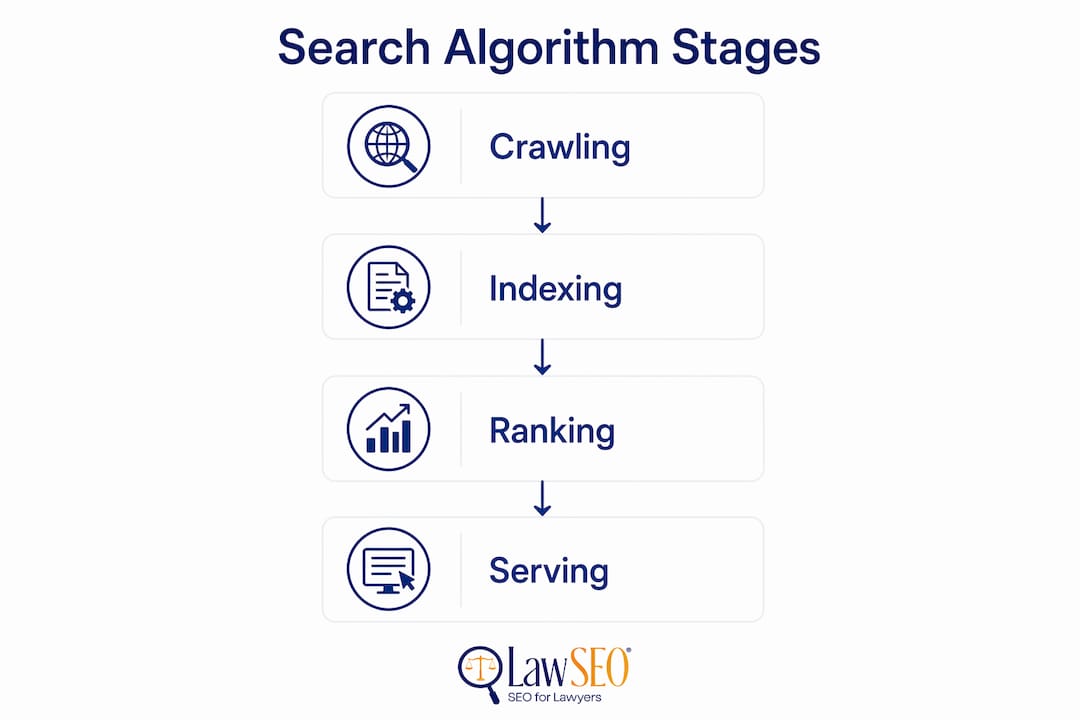
- Search engine algorithms operate through four stages: crawling, indexing, ranking, and serving, each requiring independent optimization. Failure at any point can eliminate a page’s visibility, with ranking affected by signals like content quality and backlinks, and serving influenced by SERP features and layout. Modern SEO demands comprehensive site audits, content structuring, and understanding of AI and indexing protocols to maximize online visibility effectively.
Search engine algorithms are defined as multi-stage procedural systems that govern how web content is crawled, indexed, ranked, and served to users in response to a query. Every time someone searches on Google, Bing, or any major search engine, this four-stage pipeline executes in milliseconds. For digital marketers, SEO specialists, and business owners, understanding search engine algorithms explained in full means understanding each stage independently, because a failure at any one point eliminates your visibility entirely. The stakes are high: a page that cannot be crawled never gets indexed, a page that is not indexed never ranks, and a page that ranks but misses SERP features loses clicks to competitors who do not even outrank it.
How search engine algorithms work: crawling and indexing
The first two stages of the algorithmic pipeline are crawling and indexing, and they function as gatekeepers. Crawling is the discovery process, where automated bots (Google calls its primary crawler Googlebot) follow links across the web to find new and updated pages. Indexing is what happens next: the search engine analyzes the content it has crawled, evaluates its quality and uniqueness, and decides whether to store it in the index. Unindexed pages cannot appear in search results under any circumstances.
Several technical factors control whether your pages pass through both gates successfully:
- Crawl budget: Google allocates a finite number of crawl requests per site per day. Large sites with thin or duplicate content waste this budget on low-value pages, leaving important pages undiscovered.
- robots.txt: This file instructs crawlers which sections of your site to access or avoid. A misconfigured robots.txt can accidentally block your entire site from Googlebot.
- XML sitemaps: Submitting a sitemap through Google Search Console signals which pages you consider most important, accelerating discovery.
- Indexing eligibility: Duplicate content, thin pages, noindex tags, and soft 404 errors all disqualify pages from the index regardless of how well they are written.
Pro Tip: Run a crawl of your own site using Screaming Frog or Sitebulb before assuming your pages are indexed. Many marketers discover that 20 to 30 percent of their published pages are either blocked or excluded from Google’s index.
The relationship between crawlability and indexing is sequential and unforgiving. Fix crawl issues first, then address indexing eligibility. Reversing that order wastes time.
How ranking algorithms evaluate and order search results
Once a page is indexed, it enters the ranking stage, where hundreds of signals determine its position relative to every other indexed page for a given query. This is the stage most marketers focus on, and for good reason. Ranking is where content quality, authority, and user experience signals converge into a score that places your page at position one or position one hundred.
Google’s ranking systems evaluate content across several dimensions simultaneously:
- Relevance: Does the page directly address the user’s query intent, including informational, navigational, or transactional intent?
- Authority: How many high-quality, editorially earned backlinks point to this page and to the domain overall?
- Content quality: Is the content original, expert-reviewed, and written for human readers rather than search engines?
- User experience signals: Does the page load quickly, render correctly on mobile, and avoid intrusive interstitials?
- Behavioral signals: Do users click through, stay on the page, and engage, or do they immediately return to the SERP?
Google’s Helpful Content System (HCS) operates as a site-wide ranking modifier, not a page-level filter. HCS penalizes sites that publish content primarily designed to rank rather than to inform. This means a single section of low-quality, search-engine-first content can suppress the rankings of every other page on your domain. The system runs continuously, not just during named algorithm updates.
The practical implication is significant. Sites producing aggregated, derivative, or AI-generated content without expert review face site-wide ranking penalties. One law firm that publishes fifty thin practice area pages to capture keyword volume will find that those pages drag down the performance of its genuinely strong content.
Machine learning, specifically Google’s RankBrain and later MUM (Multitask Unified Model), integrates into ranking to interpret query intent beyond exact keyword matching. These systems allow Google to understand that “car accident lawyer near me” and “auto collision attorney in my city” represent the same user need. Optimizing for intent, not just keywords, is the direct consequence of how algorithms affect SEO today.
Pro Tip: Audit your site for content that exists solely to target a keyword variation. If a page does not provide a genuinely different answer from another page on your site, consolidate them. Duplicate intent pages split authority and trigger HCS penalties.
How search engines serve and render search engine results pages
Ranking determines the order of indexed pages, but serving determines what the user actually sees. The serving stage is where feature selection, content extraction, and layout assembly occur. This stage operates with its own logic, independent of rank position, and it directly controls click-through rates.
The table below compares the most common SERP features, their content requirements, and their impact on visibility:
| SERP feature | Content requirement | Visibility impact |
|---|---|---|
| Featured snippet | Concise, direct answer in paragraph or list format | Captures position zero; can suppress clicks to ranked pages |
| People Also Ask | Question-and-answer format with clear heading structure | Expands SERP real estate; drives secondary query engagement |
| Knowledge panel | Structured data, entity recognition, authoritative sources | Builds brand credibility; reduces need for click-through |
| AI Overview | Excerpt-worthy content that retrieval systems can surface | Appears above organic results; cites multiple sources |
| Video carousel | Video content with optimized titles and transcripts | Captures visual searchers; competes with text results |
SERP feature selection operates alongside organic ranking but with independent logic. A page ranked third can win the featured snippet and receive more clicks than the page ranked first. Conversely, a page ranked first can be pushed below the fold by an AI Overview, a knowledge panel, and a People Also Ask block, resulting in near-zero organic traffic.
The practical response is to optimize for SERP feature inclusion, not just rank position. Use schema markup (FAQ schema, HowTo schema, Article schema) to signal content structure to Google’s serving systems. Write direct answers to common questions in the first paragraph of each section. For law firms specifically, winning SERP features like local packs and knowledge panels can generate client inquiries that bypass organic rankings entirely.
How AI and IndexNow are changing search algorithms in 2026
Two developments have materially changed how search algorithms operate in 2026: the integration of generative AI into search results and the adoption of the IndexNow protocol for faster indexing.

Google’s AI Overviews use retrieval-augmented generation (RAG), a process where the language model retrieves excerpts from indexed pages and synthesizes them into a direct answer. Google’s 2026 guidance confirms that AI search features build on the same core ranking and quality systems that govern organic results. AI optimization is not a separate discipline. It is an extension of foundational SEO. A page that ranks well organically is more likely to be cited in an AI Overview, but retrievability matters independently of rank.
Content that fails to appear in AI Overviews typically has a retrieval problem, not a language quality problem. The content exists in the index but is not structured in a way that allows the RAG system to extract a clean, citable excerpt. Short, direct answers at the top of each section, clear heading hierarchies, and factual specificity all improve retrievability.
| Indexing method | Speed | Search engine support | Best use case |
|---|---|---|---|
| Traditional crawl | Days to weeks | All major engines | Baseline discovery |
| XML sitemap submission | Hours to days | Google, Bing, others | Priority page signaling |
| IndexNow protocol | Near-instant | Bing, Yandex, others | Real-time content updates |
| Google Search Console URL inspection | Minutes to hours | Google only | Individual page submission |
The IndexNow protocol reduces the lag between publishing content and having it indexed by Bing and its partners from days to near-instant. This matters for time-sensitive content like legal news commentary or breaking case updates. However, Google does not support IndexNow as of 2026, so Google-specific submissions through Search Console remain necessary. IndexNow also does not bypass quality filters: a page with canonicalization errors or thin content will still be excluded from the index regardless of how quickly it is discovered.
Pro Tip: Implement IndexNow alongside your existing sitemap strategy for Bing visibility, and use AI-driven search optimization techniques to structure content for RAG retrieval. These are complementary, not competing, approaches.
Key ranking factors that shape online visibility
Understanding search algorithms in theory is useful. Knowing which specific factors to prioritize in practice is what separates strong SEO performance from stagnation. The following factors carry the most weight across modern ranking systems:
Content relevance and quality remain the top-weighted factors. Content must match user intent precisely, provide original analysis or information, and demonstrate expertise. Google’s HCS enforces this at the site level, meaning quality is not optional for any page you publish.
Technical SEO foundations determine whether your content reaches the ranking stage at all. Mobile-first indexing means Google evaluates your mobile version as the primary version of your site. Core Web Vitals (Largest Contentful Paint, Interaction to Next Paint, Cumulative Layout Shift) are confirmed ranking signals. A technically broken site cannot compensate with great content.
Backlink authority signals trust and topical relevance. A single backlink from a recognized legal publication carries more weight than fifty links from unrelated directories. Link quality has always outweighed link quantity in Google’s systems, and that relationship has only strengthened with successive algorithm updates.
User engagement signals inform ranking indirectly. High click-through rates from the SERP, low bounce rates, and extended dwell time all suggest that a page satisfies user intent. Google does not confirm using these signals directly, but the correlation between engagement metrics and ranking performance is well-documented across the SEO industry.
For law firms and legal marketers, SEO ranking factors in 2026 include local authority signals like Google Business Profile optimization, citation consistency, and proximity-based relevance, all of which layer on top of the core algorithmic factors described above.
Key takeaways
Search engine algorithms operate as a four-stage pipeline where crawling, indexing, ranking, and serving each require independent optimization to achieve and sustain online visibility.
| Point | Details |
|---|---|
| Crawling and indexing are gatekeepers | Pages that are not crawled or indexed cannot rank, regardless of content quality. |
| Ranking uses hundreds of signals | Content quality, backlinks, user experience, and HCS compliance all influence rank position simultaneously. |
| Serving stage controls click-through | SERP features like AI Overviews and featured snippets affect traffic independent of rank position. |
| AI features rely on core SEO | Google’s AI Overviews cite pages that already perform well organically; AI optimization extends, not replaces, foundational SEO. |
| IndexNow accelerates Bing indexing | The protocol delivers near-instant discovery on Bing but does not apply to Google, which requires Search Console submissions. |
What 29 years of SEO taught me about algorithm complexity
Most marketers I speak with treat search algorithms as a single system to beat. They focus entirely on ranking, optimize one or two pages, and then wonder why their traffic does not move. The reality is that the pipeline has four distinct failure points, and most visibility problems I diagnose are not ranking problems at all. They are crawl budget problems, indexing eligibility problems, or serving stage problems that no amount of keyword optimization will fix.
The shift toward AI-integrated search has made this more pronounced, not less. I have reviewed sites where technically strong pages rank in the top five organically but receive almost no traffic because an AI Overview and two SERP features consume the entire above-the-fold space. The page is not failing at ranking. It is failing at serving stage optimization. That distinction matters enormously for where you invest your time.
My consistent advice after nearly three decades in this field: audit the full pipeline before you optimize any single stage. Confirm your critical pages are indexed. Confirm they are eligible for SERP features. Confirm your content structure allows retrieval systems to extract clean excerpts. Then address ranking signals. Skipping the diagnostic step is the most expensive mistake I see digital marketers make, and it is entirely avoidable.
— Todd
How Lawseo helps law firms master search visibility
Lawseo works exclusively with law firms and attorneys to build search visibility that converts. The firm’s approach covers every stage of the algorithmic pipeline: technical SEO audits that resolve crawl and indexing gaps, content strategies aligned with Google’s Helpful Content System, and AI-focused optimization that positions law firm content for citation in AI Overviews and generative search features. Todd R. Stager, with over 29 years of SEO experience, personally reviews strategy for every client campaign. If your firm’s visibility is not where it should be, explore legal SEO solutions built specifically for the competitive demands of law firm marketing.
FAQ
What are search engine algorithms?
Search engine algorithms are procedural systems that control how search engines crawl, index, rank, and serve web content in response to user queries. Every major search engine, including Google and Bing, follows this four-stage pipeline.
How do search engine ranking factors affect my site’s visibility?
Ranking factors such as content quality, backlink authority, mobile usability, and user engagement signals collectively determine where your pages appear in search results. Google’s Helpful Content System also evaluates these factors at the site level, meaning low-quality pages can suppress your entire domain’s performance.
What is the difference between ranking and serving in search algorithms?
Ranking determines the order of indexed pages for a query, while serving determines which SERP features appear and how content is displayed. A page can rank highly but receive minimal traffic if SERP features like AI Overviews or featured snippets dominate the visible results.
Does optimizing for AI search require a different SEO strategy?
No. Google’s 2026 guidance confirms that AI search features rely on the same core ranking systems as organic results. Strong foundational SEO, combined with content structured for retrieval and excerpt extraction, is the correct approach for both traditional and AI-driven search visibility.
What is IndexNow and should I use it?
IndexNow is a push-based protocol that notifies Bing, Yandex, and other participating search engines of content updates in near-real time. It does not apply to Google, so it should be used alongside Google Search Console submissions rather than as a replacement.