

TL;DR:
- Search visibility measures a law firm’s share of organic clicks across relevant keywords, reflecting overall online presence.
- It considers rankings, CTR, SERP features, and AI summaries, providing a comprehensive metric for client acquisition potential.
- Optimizing jurisdiction-specific keywords, local profiles, content clusters, and structured data enhances visibility in both traditional and AI-driven search results.
Search visibility is defined as the estimated share of organic clicks a website receives from a target set of keyword searches, expressed as a weighted percentage. For law firms, this metric directly measures how easily potential clients find you through unpaid Google results before they ever call your office. Tools like Semrush, Moz, and Google Search Console each track this metric, though they calculate it differently. Understanding what is search visibility, and how it applies to legal practice marketing, is the first step toward building a client acquisition strategy that does not depend entirely on paid advertising.
What is search visibility and how is it calculated?
Search visibility estimates a website’s share of clicks in organic search results for a target keyword portfolio, computed by aggregating the expected click-through rate (CTR) per ranking position multiplied by each keyword’s search volume, then dividing by total possible clicks. The result is a single percentage score representing your organic presence across an entire keyword set, not just one phrase. A law firm ranking in position one for “personal injury attorney Chicago” captures a far larger share of that query’s clicks than a firm sitting in position seven, and visibility scoring reflects that difference mathematically.
How Google Search Console measures visibility signals
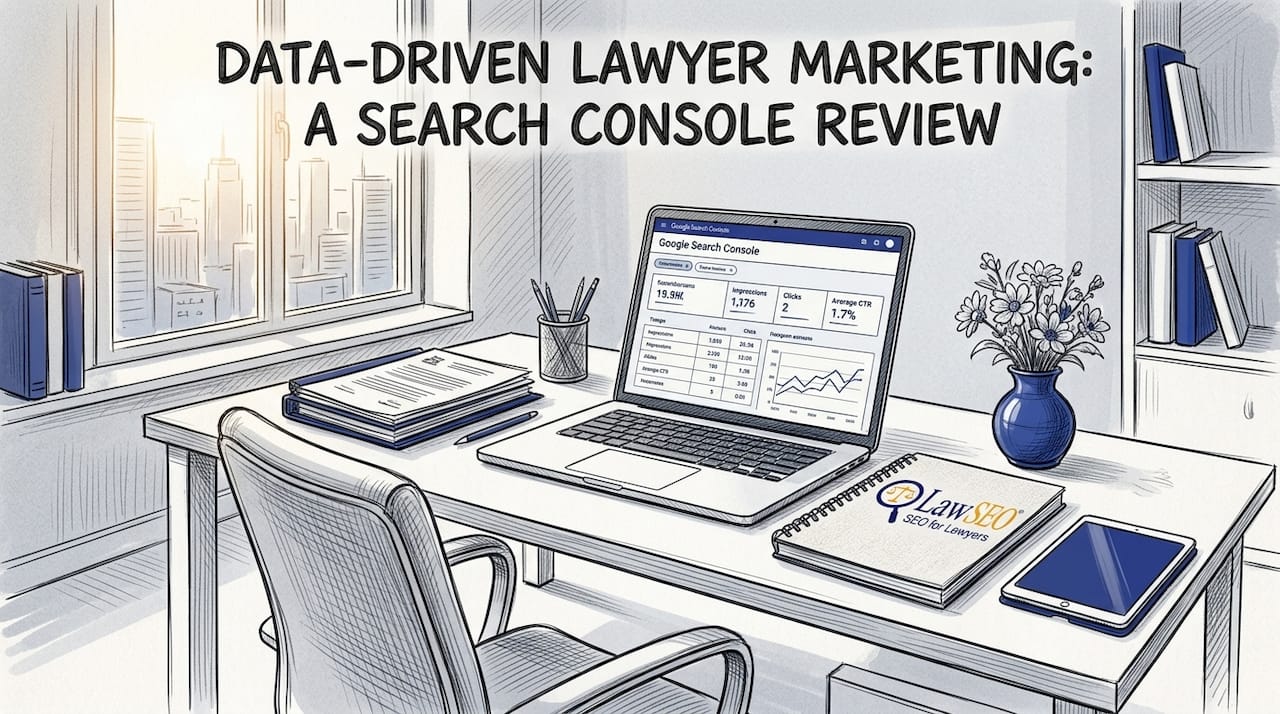
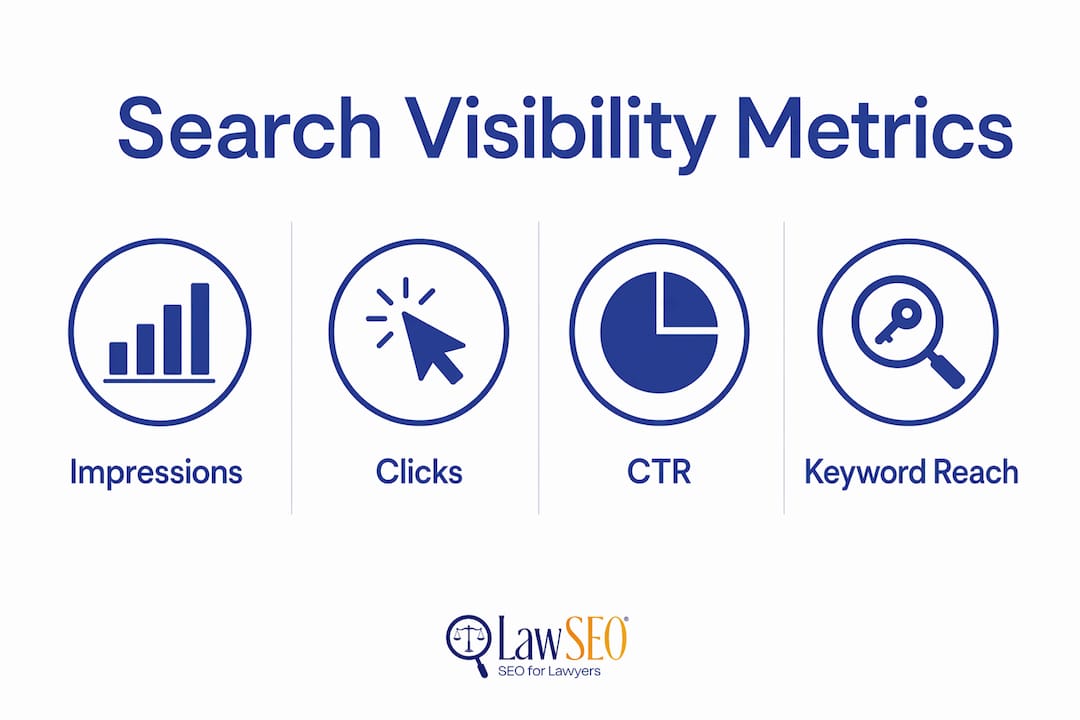
Google Search Console does not report a single visibility score, but it provides the raw signals that feed into one. Impressions and clicks are the foundational metrics: impressions count every time your site appears in a search result regardless of whether anyone clicks, while CTR is calculated as clicks divided by impressions. A firm with 50,000 monthly impressions and 1,000 clicks has a 2% CTR. That gap between impressions and clicks is where most law firms lose potential clients.
Why tool scores differ
Different SEO tools report varying visibility scores due to keyword set selection, CTR curve models, and whether SERP features like featured snippets or map packs are included in the calculation. Semrush may show a different score than Moz for the same domain because each tool tracks a different keyword database and applies its own CTR assumptions. For law firms, this means you should pick one tool and track trends over time rather than comparing absolute scores across platforms.
| Metric | What it measures | Why it matters for law firms |
|---|---|---|
| Impressions | Times your site appeared in results | Shows raw reach across relevant queries |
| Clicks | Users who visited your site | Reflects actual traffic potential |
| CTR | Clicks divided by impressions | Reveals title and snippet effectiveness |
| Visibility score | Weighted share of expected clicks | Tracks portfolio-level organic presence |
Pro Tip: In Google Search Console, filter by “Queries” and sort by impressions descending. Any query with high impressions and low CTR is a title or meta description problem, not a ranking problem. Fix the messaging before chasing a higher position.
Why search visibility matters for law firms
Organic search visibility reflects how frequently a domain appears in unpaid search results across all relevant queries, not just the handful of keywords a firm actively tracks. For legal professionals, this distinction is significant. A family law firm in Houston may rank well for “Houston divorce attorney” but have near-zero visibility for “child custody lawyer Houston,” “legal separation Texas,” or “how to file for divorce in Harris County.” Each of those queries represents a prospective client at a different stage of the decision process.
“Visibility is the foundational metric. A firm obsessing over one keyword ranking is like a retailer counting foot traffic through one door while three other entrances sit unmapped.”
Even a 1% increase in search visibility can produce disproportionate revenue growth due to compounding effects across thousands of high-intent queries. For a law firm, that compounding effect is amplified because legal services carry high client lifetime value. One additional retained client from improved visibility can represent tens of thousands of dollars in fees.
Law firm SEO differs from general SEO in three specific ways that directly affect visibility strategy:
- Jurisdiction specificity. Queries like “DUI attorney in Maricopa County” convert at higher rates than broad terms. Visibility across jurisdiction-precise keywords is more valuable than broad national presence.
- Intent alignment. Clients searching “how much does a personal injury lawyer cost” are in research mode. Clients searching “hire personal injury attorney near me” are ready to call. Visibility across both intent layers captures the full client journey.
- SERP feature presence. Law firms that appear in Google’s local map pack, featured snippets, or People Also Ask boxes gain visibility that does not show up in traditional rank tracking but directly influences client decisions.
Focusing solely on single keyword rank misses overall portfolio-level visibility growth. Law firms that broaden their SEO focus to dominate many relevant search queries build more durable client pipelines than those chasing one top-three position.
How do AI and modern SERPs affect search visibility?
The definition of search visibility has expanded. Search visibility now includes presence in SERP features like featured snippets, knowledge panels, local map packs, and AI Overviews, not just traditional blue links. Google’s AI Overviews, which now appear at the top of many legal queries, summarize answers from multiple sources. A law firm cited in an AI Overview gains brand exposure even if the user never clicks through to the website.
Brands cited in AI-generated summaries gain visibility even without traditional organic listings. This is a structural shift in how search works. AI visibility requires different optimization strategies than classic rank-based SEO. Structured content, authoritative citations, clear entity signals, and schema markup all increase the probability that Google’s AI systems reference your firm’s content. You can learn more about winning SERP features and how they apply specifically to legal websites.
The practical implication for law firms is that total search visibility now means total branded real estate on a results page. A firm that holds a position-three organic listing, appears in the local map pack, and is cited in an AI Overview for the same query occupies three distinct visibility layers simultaneously. Each layer reaches a different segment of searchers, including those who never scroll past the AI summary.
Pro Tip: Search for your firm’s primary practice area and city in an incognito browser. Count how many distinct SERP features appear before the first traditional organic result. That count tells you exactly how many visibility layers you are competing for, and likely missing.
Practical strategies to improve your law firm’s search visibility
Improving search visibility is not a single tactic. It is a portfolio-level effort that combines keyword expansion, on-page optimization, local SEO, and content authority. The following steps reflect what consistently moves the needle for law firms.
-
Expand your keyword portfolio with jurisdiction and practice area precision. Map every city, county, and practice area combination your firm serves. A criminal defense firm in Phoenix should target not just “Phoenix criminal defense attorney” but also “Scottsdale DUI lawyer,” “Mesa assault attorney,” and “Maricopa County felony defense.” Each additional relevant keyword in your tracked set is another opportunity to capture visibility.
-
Optimize titles and meta descriptions for CTR, not just ranking. Google Search Console impressions may be high but clicks low due to weak messaging or irrelevant snippets. A title like “Smith & Associates Law Firm” tells a searcher nothing. “Experienced Houston Car Accident Lawyer | Free Consultation” answers the searcher’s implicit question before they click.
-
Claim and optimize your Google Business Profile. Local map pack inclusion is one of the fastest visibility gains available to law firms. Complete every field, collect reviews consistently, and post updates regularly. Map pack positions appear above organic results for most local legal queries, meaning a firm outside the top three organic positions can still capture significant visibility.
-
Build topical authority through content clusters. A single practice area page rarely dominates a full keyword portfolio. Publishing supporting content such as FAQ pages, jurisdiction guides, and case-type explainers signals topical depth to Google and expands the number of queries your domain can rank for. The law firm visibility checklist from Lawseo outlines exactly how to structure this content architecture.
-
Track visibility trends in Google Search Console weekly. Monitor impressions, clicks, CTR, and average position for your top 20 queries. Declining impressions signal a ranking drop before traffic falls. Rising impressions with flat clicks signal a messaging problem. Both are fixable if caught early.
-
Build authority signals through backlinks and citations. Links from legal directories like Avvo, Martindale-Hubbell, and Justia, as well as local bar association websites, increase domain authority and support visibility gains across your entire keyword portfolio.
| Strategy | Primary visibility impact | Secondary benefit |
|---|---|---|
| Keyword portfolio expansion | More queries tracked and ranked | Broader client intent coverage |
| Title and meta optimization | Higher CTR from existing impressions | More traffic without new rankings |
| Google Business Profile | Map pack inclusion | Local brand credibility |
| Content clusters | Topical authority signals | Featured snippet eligibility |
| Authority link building | Domain-wide ranking support | AI citation probability |
Key takeaways
Search visibility is the single most reliable metric for measuring a law firm’s organic search presence because it captures performance across an entire keyword portfolio, not just one ranking.
| Point | Details |
|---|---|
| Visibility is a portfolio metric | It measures expected click share across all relevant keywords, not just one position. |
| Tools calculate it differently | Use one platform consistently and track trends rather than comparing absolute scores. |
| AI and SERP features expand visibility | Featured snippets, map packs, and AI Overviews are now part of total search presence. |
| CTR optimization converts impressions | High impressions with low clicks signal a title or snippet problem, not a ranking problem. |
| Law firms need jurisdiction precision | Targeting city and practice area combinations drives higher-intent, higher-converting visibility. |
Why visibility is the metric I trust most after 29 years
I have watched law firms spend years obsessing over one keyword. They celebrate hitting position one for “personal injury attorney [city]” and then wonder why their phone is not ringing more. The problem is almost always that they are visible for one phrase and invisible for the fifty related queries their potential clients are actually typing.
The shift from single-keyword rank tracking to portfolio-level visibility measurement is the most important conceptual change in legal SEO over the past decade. Organic search visibility is a more future-proof metric than individual keyword rankings precisely because it accounts for how search actually works, across hundreds of queries, multiple SERP features, and now AI-generated answers.
That said, visibility must be interpreted with business context. A firm that doubles its visibility score but sees no increase in consultations has a conversion problem, not an SEO problem. I always tell clients to track visibility alongside consultation requests and signed retainers. The metric only matters if it connects to revenue.
The firms I have seen grow most consistently are those that treat visibility as a living number to be expanded, not a target to be hit once. They add new practice area pages, publish jurisdiction guides, optimize their Google Business Profile monthly, and watch their visibility compound over time. That compounding is real, and it is the closest thing to a durable competitive advantage that exists in legal marketing today.
— TODD
How Lawseo helps law firms dominate search visibility
Lawseo works exclusively with attorneys and law firms to build the kind of search presence that generates consistent client inquiries. Todd R. Stager and the Lawseo team develop visibility strategies tailored to your practice areas, jurisdictions, and competitive market, covering everything from keyword portfolio expansion and content production to local SEO and AI citation optimization. If your firm has strong rankings for a few terms but limited presence across the broader queries your clients use, that is exactly the gap Lawseo is built to close. Explore legal SEO for law firms to see how a dedicated legal SEO strategy translates into measurable visibility growth and more signed clients.
FAQ
What is search visibility in simple terms?
Search visibility is the estimated percentage of organic clicks a website receives from a defined set of relevant keyword searches. It measures how prominently your site appears across all relevant queries, not just one keyword.
How do I check my law firm’s search visibility?
Google Search Console provides impressions, clicks, and CTR data that reflect your organic visibility. Tools like Semrush and Moz offer dedicated visibility score tracking that aggregates performance across your full keyword portfolio.
What affects search visibility for law firms?
Keyword rankings, CTR from titles and meta descriptions, local map pack inclusion, featured snippet presence, and AI Overview citations all affect visibility. Jurisdiction-specific, intent-aligned keywords produce the highest-value visibility gains for legal practices.
Is a high visibility score enough to attract clients?
Not on its own. Higher visibility does not always equate to proportional growth without strong conversion elements. You also need compelling titles, clear calls to action, and a website that converts visitors into consultation requests.
How does AI search change visibility for lawyers?
AI Overviews and generative search features now appear above traditional organic results for many legal queries. Brands cited in AI-generated summaries gain exposure without a traditional click, making structured content, schema markup, and entity optimization part of any modern visibility strategy. You can review proven legal SEO strategies that address both traditional and AI-driven visibility.