


Most SEO agencies offer month-to-month plans, three- or six-month minimums, or 12-month terms, and each has a place depending on scope. The right answer for most firms is a short initial commitment, typically a few months, that rolls into month-to-month service. Contract length matters less than what happens at exit: who owns the domain, the content, and the data. Expect early ranking movement in several months and meaningful lead volume several months later.
TL;DR:
- Shorter contracts, such as three to six months, are common for foundational work or competitive markets, while longer terms often imply higher upfront costs and more scale.
- Ownership of the website, content, and accounts is the most critical factor for exit flexibility, with lock-in risks tied to domain control, platform restrictions, and account access.
- Commercial terms such as auto-renewals and early termination penalties can strongly extend lock-in, so clients should negotiate clear notice periods and ownership clauses upfront.
- Pricing generally decreases per month with longer commitments, but firms should expect realistic SEO timelines of four to twelve months for meaningful results.
- Establishing a documented baseline of rankings, traffic, and account access before signing ensures measurable progress and protects against vague claims or hidden lock-in.
How Long Are SEO Contracts for Law Firms, Really?
Ask five agencies for a proposal and you’ll get five different contract structures. That’s not a red flag by itself. It reflects real differences in scope, risk tolerance, and how each agency prices its own uncertainty.
Month-to-month agreements are common among specialized legal marketing shops and mid-size agencies that compete on retention rather than contractual friction. A firm that delivers results has little incentive to lock a client in, and a confident vendor structures its offer accordingly. The trade-off is usually price. Because the agency can lose the account with 30 days’ notice, it prices in a small risk premium.
Three- and six-month minimums show up most often when an agency needs runway to do foundational work: a technical audit, a content buildout, a Google Business Profile cleanup, or a link campaign that takes weeks to show any signal. This is a reasonable ask if the minimum is capped at six months and converts to month-to-month afterward. It becomes a problem when it renews automatically without a clear opt-out.
Twelve-month minimums make sense in a narrower set of cases: a full website migration, a multi-office rollout across several cities, or an aggressive authority-building campaign in a saturated market like personal injury or family law. In these situations, the agency is committing significant upfront labor that it can’t recover if the client exits at month three. A 12-month term with clear milestones and exit rights is different from a 12-month term with no transparency.
Contract length and price move together in a fairly predictable pattern. Shorter contracts often carry a higher per-month price, while 6 to 12 month commitments reduce monthly costs but increase exit risk, according to pricing guidance from the legal SEO market. That’s the trade every firm is actually making, whether the sales rep says so or not: pay more for flexibility, or pay less and accept more risk if the relationship doesn’t work out.
Here’s a quick way to map your situation to what you’ll likely see offered:
- Solo practitioner or small firm, single practice area: month-to-month or a short 90-day minimum is typical and appropriate.
- Mid-size firm, moderately competitive market: three- to six-month minimums are common, especially if content production or link building is part of scope.
- Multi-office firm or highly competitive practice area (personal injury, immigration, family law in a major metro): six- to 12-month terms are more defensible given the scale of work.
- Firm undergoing a website migration or rebrand: longer minimums are reasonable because the agency is absorbing real upfront cost.
None of this changes the core advice. Length is a negotiating lever, not the actual risk. The actual risk sits in the clauses buried further down the agreement, which is where your attention should go next.
What Contract Clauses Actually Create Lock-In?
Lock-in doesn’t come from a 12-month term on its own. It comes from three specific sources: who owns the website and its source code, what the contract terms say about renewal and termination, and whether the platform itself traps you with the agency. Understanding these three is more useful than debating month counts.
1. Auto-renewal and notice windows. Many agreements renew automatically unless you cancel within a specific window, often 30 or 60 days before the term ends. A short notice window buried in month 11 of a 12-month contract effectively re-locks you in before you’ve even evaluated the first year’s results. Insist on a notice window of at least 60 days and get it written into the agreement, not just described verbally by the sales rep.
2. Early-termination penalties. Some contracts charge a flat fee to exit early. Others charge a percentage of remaining term value. A reasonable cap exists somewhere between “no penalty” and “pay out the full remaining contract.” If an agency wants more than one to two months of fees as an exit penalty, ask why. There’s rarely a good operational answer.
3. Ownership of the domain, source code, and content. This is the clause most firms skip past and the one that causes the most damage later. If your domain registrar account is registered to the agency, or if your website runs on a proprietary content management system the agency built and controls, you cannot simply leave. You’d be starting over, at a new domain, with zero accumulated ranking authority.
4. Proprietary platform restrictions. Some agencies build client sites on closed systems that only they can edit or host. That’s not inherently unethical, but it needs a portability clause: the right to export your content, database, and design files in a usable format if you terminate. Without that clause, “proprietary” quietly becomes “hostage.”
5. Account access that must stay in the firm’s name, always. This is non-negotiable regardless of contract length:
- Domain registrar account
- Google Business Profile
- Google Analytics and Google Search Console
- Any paid ad accounts (Google Ads, Meta, etc.)
- CMS admin login, even if the agency manages day-to-day updates
If an agency insists on holding any of these under its own login “for efficiency,” that’s a lock-in mechanism dressed up as convenience.
6. Deliverable clarity versus “best efforts” language. Some contracts specify concrete deliverables: a set number of published articles, links acquired, or citations built each month. Others hide behind vague “best efforts” or “ongoing optimization” language with nothing measurable attached. Both models exist for legitimate reasons, but you need to know which one you’re signing, because it determines whether you can hold the agency accountable for anything specific.
Pro Tip: Before you sign anything, request the login credentials list in writing as an exhibit to the contract, not a verbal promise. If an agency hesitates to put account ownership in writing, that hesitation tells you more than anything in the sales deck.
Realistic Pricing and How Contract Length Affects Your Bill
Retainer pricing for legal SEO spans a wide range, and the spread exists for real reasons: firm size, market competitiveness, and how much of the work is content, links, technical fixes, or a combination.
Rough bands you’ll typically encounter:
- Freelancers and solo consultants: lower monthly retainers, often best suited to single-location firms in less competitive practice areas.
- Small specialized agencies: mid-range retainers, usually month-to-month or short-term, with narrower scope (local SEO and Google Business Profile focus).
- Full-service agencies: higher retainers that bundle content production, technical SEO, link building, and reporting under one contract.
- Multi-office or highly competitive firms: the highest retainers, often paired with longer minimum terms because the scope of work (content volume, link velocity, technical infrastructure across locations) is substantially larger.
Pricing guides for legal SEO show that shorter, more flexible contracts generally cost more per month, while longer commitments lower the monthly rate but raise your exposure if the engagement underperforms. That inverse relationship is the single most useful thing to understand before negotiating price against term length.
Timeline expectations matter just as much as price, and they should shape how you judge whether a contract length is fair. SEO doesn’t move overnight, and no agency, including specialized legal ones, can compress the underlying mechanics of how search engines evaluate and re-crawl a site. Realistic expectations generally track initial ranking movement in the four-to-six-month range, with meaningful lead and consultation volume showing up closer to nine to twelve months. Practitioner analysis of legal SEO costs echoes the same four to six month window for early signal, extending to nine to twelve months for lead volume that actually moves the needle.
That timeline is exactly why a 90-day minimum, rather than a 30-day one, is the more sensible floor for most firms. Thirty days isn’t enough runway to judge anything. Ninety days gives an agency time to complete a technical audit, publish initial content, and start building the on-page foundation, while still giving you an exit ramp well before you’d need to evaluate real ranking movement.
When project-based or performance-based pricing makes sense:
Not every engagement needs a retainer. A one-time technical audit, a website migration, or a Google Business Profile cleanup can be scoped and priced as a defined project with a fixed deliverable and end date. Performance-based pricing, where fees scale with leads or ranking milestones, sounds appealing but comes with a catch: it incentivizes an agency to chase quick, sometimes fragile wins (aggressive link tactics, keyword stuffing) rather than durable authority. If an agency proposes performance-based pricing, ask exactly how “performance” is measured and whether that measurement holds up against something as basic as organic search traffic patterns across devices, which any credible reporting dashboard should already be tracking.
How Do You Evaluate and Negotiate an SEO Proposal?
A proposal is not a contract, and the gap between the two is where most law firms get burned. Before you sign, request specific baseline data. Not because you’re distrustful by default, but because you can’t measure improvement against a number nobody wrote down.
Baseline data to request before signing:
- Current keyword rankings for your priority practice areas and locations, pulled independently if possible, not just from the agency’s own tool.
- Current organic traffic from Google Analytics or Search Console, covering at least the trailing 12 months.
- Current lead or consultation volume attributable to organic search, so you have a real number to compare against six months from now.
- A full account access audit: who currently holds the domain registrar login, hosting, Google Business Profile, and analytics accounts.
Each of these matters for a specific reason. Without a documented baseline, an agency can claim credit for movement that was already happening, or explain away a flat quarter with no way for you to check the claim independently. Tracking these metrics consistently is what turns a vague monthly report into something you can actually hold an agency to.
Negotiable items, and reasonable compromises:
- Initial term length — ask for 90 days instead of six or 12 months, with an explicit conversion to month-to-month afterward.
- Trial milestones — propose a checkpoint at day 60 or 90 where specific, agreed deliverables (audit completed, content published, citations built) must be met before the contract auto-continues.
- Termination fees — negotiate a cap, ideally no more than one month’s fee, rather than a percentage of the remaining term.
- Ownership language — require a written clause stating the firm retains ownership of the domain, all content, and any custom code, regardless of who built the site.
Questions to ask, and what a confident agency answers clearly:
- “If we terminate on day 91, what exactly do we walk away with?” A strong agency answers with specifics: exported files, login handover, a written data export. A weak agency gets vague.
- “Who legally owns our domain registration right now?” This should have a one-word answer: you.
- “What’s your average client tenure, and why do clients leave when they do?” Agencies confident in their retention rarely dodge this.
- “Can you show me a sample monthly report from an existing client?” If they can’t produce one, that’s worth noting.
Pro Tip: Treat the negotiation itself as a diagnostic. An agency that pushes back hard on 90-day terms, refuses to cap termination fees, or gets defensive about ownership language is showing you, in advance, how it will behave the day you try to leave.
Exit checklist, what you must retain at termination:
- Domain registrar access and registration in the firm’s name
- Full export of the website, including source code, images, and content files
- Analytics and Search Console access with full historical data intact
- Google Business Profile ownership transferred back if the agency ever managed it
- A written log of backlinks built and content published during the engagement
Red flags worth walking away from entirely: guarantees of a specific ranking position (no agency controls Google’s algorithm), refusal to disclose link-building tactics, or resistance to putting any of the above into writing. Ethical legal SEO doesn’t need to hide its methods. If you want a longer read on what separates sound tactics from risky ones, ethical SEO standards for attorneys is worth reviewing before you sign anything.
Why Ownership Terms Matter More Than the Calendar
Twenty-nine years in this industry teaches you that the contract length question is almost always the wrong first question. Firms fixate on 12 months versus month-to-month because it’s the easiest number to compare across proposals. Meanwhile, the clause that actually determines whether they get hurt, the ownership and exit language, sits three pages deeper and gets skimmed.
Todd R. Stager has spent nearly three decades building and reviewing SEO strategy specifically for law firms, and the pattern repeats constantly: a firm signs a 12-month agreement excited about the price, discovers at month four that the agency’s work isn’t moving the needle, and then finds out the domain, the content, and the account logins all sit under the agency’s name. The 12-month term was never the real trap. The missing ownership clause was.
LawSEO structures engagements around a short initial commitment, typically framed around a documented audit and baseline period, that transitions into ongoing month-to-month service. Every domain, Google Business Profile, and analytics account stays registered to the client from day one, not the agency. That’s not a courtesy. It’s a structural decision that reflects how the firm expects to earn renewal: on measurable results, not on a locked door.
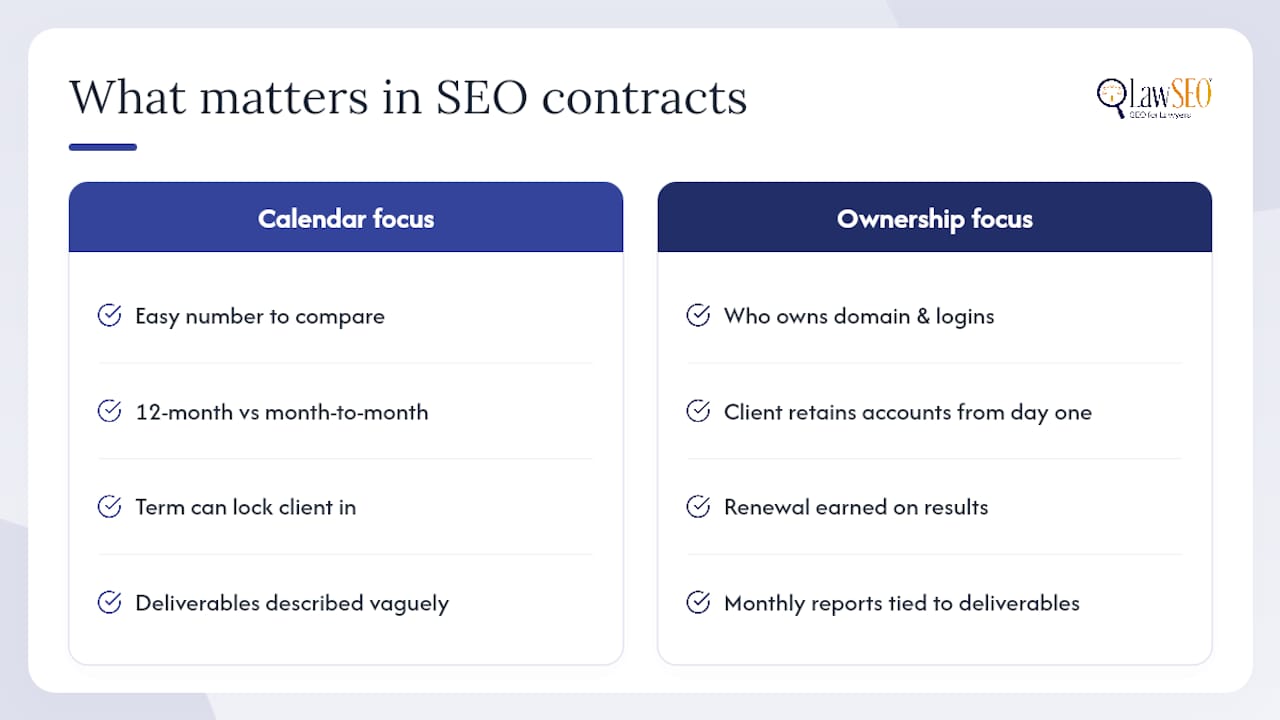
What gets documented for clients typically includes baseline rankings and traffic at the start of the engagement, monthly reporting tied to specific deliverables rather than vague “optimization” language, and a clear record of what was built, published, and linked each month. That documentation is what lets a managing partner judge, at month six or nine, whether the engagement is actually working, rather than taking it on faith.
The firms that get burned aren’t usually the ones that signed longer contracts. They’re the ones that never asked who owns the house they’re paying rent on.
— TODD
Get a Documented Baseline Audit Before You Sign Anything
Lawseo’s engagement model follows the exact protections this article recommends: a short, clearly scoped initial period, full client ownership of the domain, accounts, and content from day one, and a written exit path instead of a locked contract. Rather than asking you to commit to a long term on faith, Lawseo starts with a documented baseline audit, current rankings, traffic, and account access, so you have a real benchmark before any retainer discussion begins. That audit and the first months of work include specific deliverables and reporting tied to those baseline numbers, not vague monthly summaries.
If you’re evaluating proposals right now, the smartest next step is getting your own baseline documented independently before you sign with anyone. Visit Lawseo’s legal SEO strategy page to request a baseline audit and see exactly how a client-first contract structure should look on paper.
Sources
The claims in this article draw on legal marketing and SEO pricing guidance rather than a single source. For further reading:
- SEO Agency for Law Firms Pricing: Full 2026 Guide | BizAI
- Mobile share of US organic search engine visits — Statista