


Credentials hang on the wall. But clients check reviews before they call. Most law firms still operate under the assumption that a strong bio and a list of accolades will close the deal, yet clients trust reviews and testimonials far more than firm-authored content when choosing legal representation. Social proof, the influence created when people see others validating a choice, has become one of the most powerful forces in legal marketing. This guide walks you through what social proof is, why it works, where to use it, how to stay compliant, and exactly how to build a strategy that earns trust before a prospect ever picks up the phone.
Key Takeaways
| Point | Details |
|---|---|
| Social proof builds trust | Clients trust law firms with visible, authentic testimonials and reviews. |
| Compliance is essential | Always secure written consent and meet ABA or state bar rules when sharing social proof. |
| Strategic placement matters | Display the right kind of social proof at each stage of the client’s decision journey. |
| Variety increases credibility | Mix ratings, outcomes, and testimonials for the most authentic impact. |
| Regularly review and optimize | Audit your social proof assets yearly to maintain effectiveness and compliance. |
What is social proof in legal marketing?
Social proof is any third-party signal that confirms your firm is credible, competent, and worth hiring. It is not your firm’s own marketing copy. It is what others say about you, and that difference matters enormously to prospective clients who are often scared, confused, and making one of the most consequential decisions of their lives.
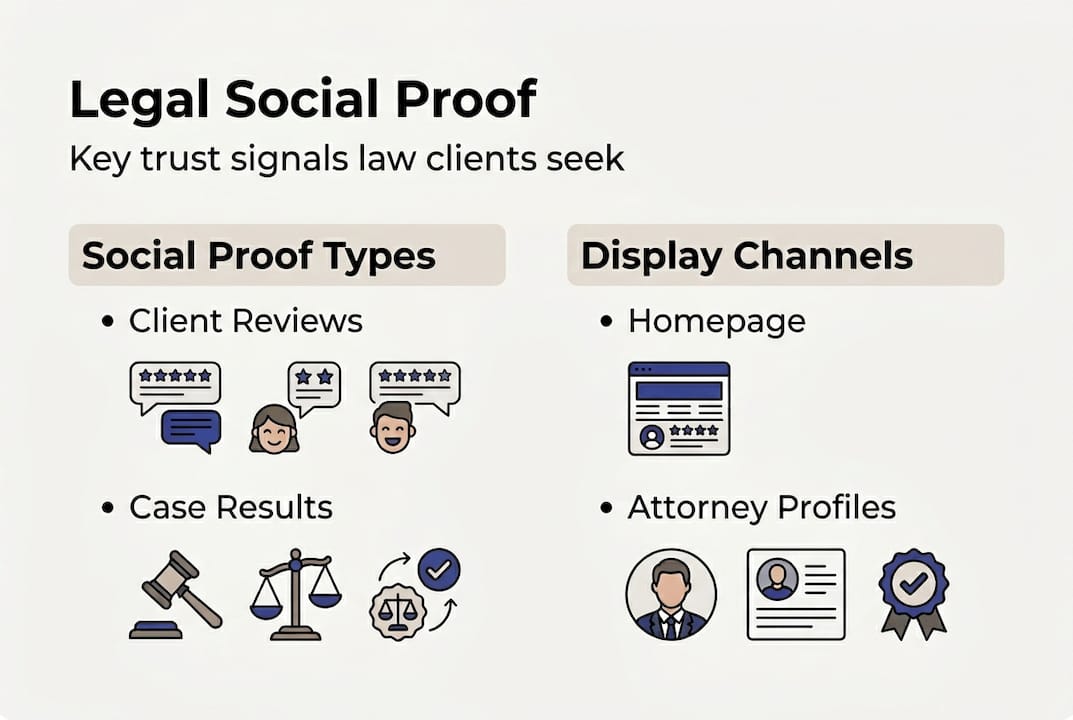
The main types of social proof relevant to law firms include:
- Online reviews on Google, Avvo, and Yelp
- Client testimonials on your website or video platforms
- Published case results showing outcomes you have achieved
- Peer endorsements from other attorneys or industry organizations
- Media mentions in news outlets or legal publications
- Third-party ratings from directories like Martindale-Hubbell or Super Lawyers
Not all social proof performs equally. Video testimonials boost conversions by up to 80%, making them the highest-converting format available to law firms today. Text reviews build volume and search visibility. Case results speak directly to outcomes-focused prospects.
“The most effective social proof matches the format to the moment. A five-star rating reassures a first-time visitor. A detailed video testimonial closes a hesitant prospect.”
You can see how firms use content strategically by reviewing law firm blog examples that attract clients at every stage of the decision process. Social proof is not a single tactic. It is a system.
Why social proof works: The psychology behind trust
Legal decisions carry high stakes and high uncertainty. A client hiring a personal injury attorney or a criminal defense lawyer cannot easily evaluate technical competence before the engagement. They rely on signals from others who have already taken that risk.
This is called herd behavior in behavioral psychology. When people are unsure, they look to what others have done. In legal marketing, this means your Google star rating, the number of reviews you have, and the specificity of client testimonials all function as decision shortcuts for anxious prospects.
Trust signals also work through authority transfer. When a respected outlet mentions your firm, or a peer attorney endorses you, some of their credibility transfers to you. This is why media mentions and bar association recognitions carry weight even with clients who have never heard of those organizations.
Different proof types work best at different stages of the buyer journey:
- Awareness stage: Star ratings and review counts reduce initial skepticism
- Consideration stage: Detailed testimonials and case summaries build confidence
- Decision stage: Video testimonials and specific outcome data push prospects to act
Strategic placement matters because early-funnel visitors respond to ratings while later-stage visitors respond to outcomes. Showing a detailed case result to someone who just landed on your homepage for the first time is less effective than showing them your overall rating and review count.
Pro Tip: Audit your website’s social proof placement by mapping each proof type to the page where visitors are most likely to be in their decision process. Your homepage needs volume signals. Your service pages need specificity.
Social proof channels: Where and how to display for impact
Knowing you need social proof is one thing. Knowing exactly where to put it is another. Placement is not a minor detail. It is the difference between proof that converts and proof that sits unread.
Here is a step-by-step approach to integrating social proof across your digital assets:
- Homepage: Feature your aggregate star rating, total review count, and one or two short client quotes near the top of the page.
- Service pages: Add practice-area-specific testimonials and relevant case outcomes directly on each service page.
- Call-to-action areas: Place a short, powerful testimonial immediately adjacent to your contact form or phone number.
- Google Ads: Use review extensions to display your star rating directly in paid search results.
- Social media: Share screenshots of client feedback (with consent), post video testimonial clips, and highlight media mentions in stories or posts.
- Email marketing: Include a client quote or outcome summary in nurture sequences to reinforce trust between first contact and consultation.
The table below summarizes optimal placements by channel:
| Channel | Primary benefit | Best proof type |
|---|---|---|
| Homepage | Reduce initial skepticism | Star ratings, review count |
| Service pages | Build practice-area confidence | Testimonials, case results |
| CTA areas | Overcome final hesitation | Short, specific client quotes |
| Google Ads | Improve click-through rate | Star rating extensions |
| Social media | Expand reach and visibility | Video clips, screenshots |
| Email campaigns | Nurture and convert leads | Outcome summaries, quotes |
Law firm website features that are built for client conversion always incorporate social proof at these critical touchpoints. And your law firm social media SEO strategy should treat testimonial content as a core asset, not an afterthought.
Compliance and authenticity: Navigating legal industry rules
Law firm marketing is not like marketing a restaurant or a software product. You operate under professional conduct rules that govern what you can say, how you can say it, and what you must disclose. Ignoring these rules does not just risk a bar complaint. It can undermine the very trust you are trying to build.
The key compliance principles every legal marketer must know:
- ABA Rule 7.1 prohibits false or misleading communications about a lawyer’s services, which includes implied guarantees in testimonials
- Written client consent is required before publishing any testimonial, review, or identifying case detail
- Disclaimers must accompany case results to clarify that past outcomes do not guarantee future results
- Negative reviews must be addressed without disclosing confidential client information
- Review authenticity matters: too many similar reviews without variety can appear fabricated and violate ABA Rule 7.1
“Compliance is not the enemy of good marketing. A firm that handles consent and disclaimers correctly signals professionalism to prospects who are already evaluating your trustworthiness.”
Annual compliance reviews using structured checklists are the most reliable way to keep your social proof assets current and clean. State bar rules vary, so what is acceptable in one jurisdiction may require additional disclosures in another.
Pro Tip: Create a simple consent form template that clients can sign at case close. Pair it with a checklist that covers disclaimer language, review authenticity, and state-specific requirements. Review the whole package once a year.
For a deeper look at staying within ethical boundaries while still marketing aggressively, explore ethical SEO for attorneys as a framework that applies directly to social proof strategy.
Case studies: Successful social proof strategies in law firms
Theory is useful. Real outcomes are more convincing. Here are three anonymized examples that illustrate what works, what does not, and why.
Firm A: Personal injury practice, video-first strategy
This firm invested in professionally produced video testimonials from past clients and placed them on their homepage and key service pages. They saw a measurable lift in consultation requests, consistent with the finding that case outcomes at the right funnel stage drive significantly more conversions. The videos were specific, emotional, and paired with written disclaimers. They worked because they were authentic and strategically placed.
Firm B: Family law practice, text review volume strategy
This firm focused on generating a high volume of Google reviews by sending a follow-up request to every client at case close. They built a strong aggregate rating over 18 months. The volume itself became a trust signal, and their Google local pack visibility improved as a result.
Firm C: Estate planning firm, overloaded with identical reviews
This firm collected dozens of reviews that all said nearly the same thing: “Great service, highly recommend.” Lack of variety reduced trust rather than building it. Prospects noticed the repetition and questioned authenticity. The lesson: volume without variety is a liability.
| Firm type | Social proof tactic | Outcome |
|---|---|---|
| Personal injury | Video testimonials on service pages | Higher consultation conversion rate |
| Family law | High-volume Google review campaign | Improved local search visibility |
| Estate planning | Repetitive text reviews only | Reduced perceived authenticity |
Key lessons from these examples:
- Variety across formats (video, text, ratings) builds more trust than volume alone
- Timing matters: ask for reviews promptly after a positive case resolution
- Placement on the right page at the right funnel stage amplifies impact
For firms ready to invest in video, the law firm video marketing guide covers production, compliance, and distribution in detail.
Action steps for your law firm: Building, managing, and optimizing social proof
Here is a practical blueprint you can implement starting this week. Each step is designed to be compliance-conscious and results-focused.
- Identify your best candidates for testimonials. After every successfully resolved case, flag clients who expressed satisfaction. These are your best sources.
- Ask at the right moment. Request a review or testimonial within one to two weeks of case close, when the positive experience is still fresh.
- Get written consent. Use a simple consent form that covers the client’s name, the type of content they are approving, and the platforms where it may appear.
- Add disclaimers to all case results. Every published outcome should include language clarifying that results vary and past performance does not guarantee future outcomes.
- Diversify your proof formats. Collect a mix of video testimonials, written reviews, star ratings, and peer endorsements to avoid the uniformity trap.
- Place proof strategically across your website and channels. Use the placement table from Section 4 as your guide.
- Monitor and respond to new reviews. Set up alerts for new Google reviews and respond promptly and professionally, without disclosing confidential information.
- Conduct an annual compliance audit. Review your social proof assets yearly using a checklist that covers consent documentation, disclaimer language, and state bar requirements.
This is not a set-it-and-forget-it system. Social proof requires ongoing sourcing, monitoring, and optimization to stay effective and compliant.
Leverage expert legal marketing for your firm’s next step
Building a social proof strategy that is both persuasive and compliant takes more than good intentions. It takes a system, and that system needs to be maintained. At LawSEO, we work exclusively with law firms to build reputation-driven marketing programs that generate real leads while staying well within ethical boundaries. Whether you need help structuring your review acquisition process, optimizing your website for trust signals, or scaling your visibility through advanced SEO for lawyers, we bring over 29 years of legal marketing experience to every campaign. Our digital marketing for lawyers services are designed to turn your firm’s credibility into a consistent pipeline of qualified prospects.
Frequently asked questions
What counts as social proof for law firms?
Social proof includes reviews, client testimonials, peer endorsements, third-party ratings, published case outcomes, and media mentions. Ratings, quotes, and outcomes each serve different roles depending on where a prospect is in their decision process.
How do we ensure our social proof complies with ABA and state rules?
Always obtain written client consent, include disclaimers on case results, and avoid any language that implies guaranteed outcomes. ABA Rule 7.1 and state bars require these safeguards and prohibit misleading statements in all marketing materials.
Where should social proof appear on our law firm website?
Place social proof on your homepage, service pages, and near call-to-action areas for maximum impact. Homepage, service pages, and CTAs are the highest-priority placements, with Google Ads, social media, and email as strong secondary channels.
What is a common mistake with social proof in legal marketing?
Overloading your site with reviews that all sound the same is one of the most common errors. Too many similar reviews signal inauthenticity to prospects and can actually reduce trust rather than build it.