


Lawyers researching an unfamiliar jurisdiction should start with four official page types: the state legislature’s statutes site, the state courts’ opinions and rules pages, the state bar’s attorney verification portal, and the state judicial law library. These are primary sources, while national aggregators like Justia or Cornell’s LII index and link to them but never replace them. Use commercial databases when you need annotations, citators, or Shepardizing, not to confirm what the law actually says.
TL;DR:
- State legislature and court websites should be your primary sources for the most current statutes, session laws, and opinions, with official sites ending in .gov or the state’s dedicated domain.
- Confirm the currency of laws by checking the “current through” date and cross-referencing recent session acts, especially when recent amendments are involved.
- Use attorney verification portals to verify license status and discipline but be aware they do not include malpractice or pending complaint information.
- Judicial law libraries and Ask-a-Librarian services are valuable for accessing older, unreported opinions and archival materials not available online.
- Always save a permanent link or PDF of your authoritative sources to ensure an audit trail if laws change or citations are challenged later.
Quick access: what each official state page type contains
Each state organizes its legal information differently, but the categories of what you need stay consistent. Knowing which page type to open first saves time and keeps your citation trail clean, something the Legal Information Institute’s state statutes resource reinforces by pointing researchers directly to primary legislative text rather than secondary summaries.
- State legislature or code site: codified statutes, session laws, and bill history from introduction to enactment.
- State courts site: published and advance opinions, docket information, and procedural rules.
- Court rules pages: filing requirements, local rules, and amendment histories tied to specific effective dates.
- State bar site: attorney lookup tools, license status, and public discipline records.
- Judicial law library: Ask-a-Librarian reference services and archival materials not available online.
- National hubs (LII, NCSC, Justia): indexing tools that point you to the right official page faster than a general search.
Treat the first five as your destination and the last as your map.
How to find a state’s legislature pages, statutes, codes, and session laws
Finding the right legislative page is mostly a matter of search discipline. A consistent pattern will get you there faster than browsing a state’s homepage.
- Search the state name plus “legislature,” “statutes,” or “code,” and add the current session year to filter out stale cached pages.
- Confirm the domain ends in .gov or the state’s official legislative branch suffix before trusting anything on the page.
- Locate the session laws or “acts” section if the codified statute looks outdated. Codification often lags behind a recent amendment by weeks or months.
- Cross-check the bill history to find the exact act number and effective date tied to a change.
- Look for a session stamp or “current through” notice near the top of the statute page. Its absence is a sign you are looking at an aggregator, not the source.
Louisiana’s legislative site is a useful example of this structure in action: its official law search tool separates codified statutes from session acts, which helps when a recent amendment has not yet been folded into the main code.
Where to find state court opinions, rules, and filing dockets
Court websites vary more than legislature sites, partly because caseloads and publication practices differ by state. The NCSC Court Statistics Project reported approximately 70 million state court filings in 2024, a 4% increase over 2023 and a 27% decrease since 2012, a volume that explains why some states publish opinions quickly while others rely heavily on clerk offices for docket-level detail.
- Most state supreme courts and appellate courts post opinions under a tab labeled “Opinions” or “Decisions,” usually sorted by date or docket number.
- Advance opinions are released before official publication and may carry different pagination than the final published version.
- Unpublished or “unreported” opinions often sit in a separate archive, sometimes restricted from citation under local rules.
- Court rule amendments typically appear first as notices, with the consolidated rules page updated later, so check both when timing matters.
- When a docket entry or filing is not posted online, the clerk’s office or the court’s law library is your next step.
State bar and attorney verification portals: checking license status and discipline
Verifying an attorney’s standing before referring a client or opposing a filing is a basic due-diligence step, and every state bar maintains a lookup tool for it. The American Bar Association’s lawyer licensing resources link out to each state’s official verification portal rather than hosting license data itself.
- Search the attorney lookup tool by name or bar number to confirm current license status.
- Check admission date, standing (active, inactive, suspended), and any public discipline history.
- Note that bar listings rarely include malpractice history or pending complaints, which are not public in most states.
- Contact the bar office directly when a record looks incomplete or when you need certified confirmation for a filing.
If you are cross-referencing a lawyer found through a third-party site, our guide to verifying attorneys listed on Yelp walks through the same verification logic applied to commercial directories, and our overview of legal directory types explains how those listings relate to the official portals above.
Judicial law libraries and “Ask a Librarian”: when and why to use them
State judicial law libraries fill the gaps that online indexes leave open, particularly for unreported opinions, local forms, and older session laws that were never digitized. Delaware’s courts system describes its Ask-a-Librarian service as a direct line to reference staff who can locate archival materials that do not appear in a standard web search.
- Law libraries often hold print reporters and local practice forms not available through any official website.
- Ask-a-Librarian services typically respond by email or phone within a business day or two.
- Use these services when a citation is old, a form is jurisdiction-specific, or an opinion predates the court’s online archive.
How to verify currency, annotations, and whether a law is still effective
Confirming that a statute or rule is currently in force takes more than reading the text once. Build the check into your workflow every time the stakes are high enough to matter.
- Check the statute’s “current through” date against the most recent legislative session to confirm it reflects the latest session laws.
- When a change looks recent, pull the session act itself rather than relying on the codified version, since codification can lag.
- Cross-check any cited court rule against the amendment notices on the judiciary’s rules page, since notices often precede the consolidated update.
- Use the NCSC’s court organization resources or the LII statutes database to confirm publication timing when a state’s own site is ambiguous.
Pro Tip: Save a PDF or permanent link of the exact page and date stamp you relied on. It becomes your audit trail if the law changes or a citation is challenged later.
Practical workflow: integrating official state pages into a lawyer’s research process
Start every matter at the official legislative or court page, not a paid database, to establish the authoritative text first, following a clear step-by-step guide for filing lawsuits. From there, capture permalinks and session-law citations before moving on.
- Open the official source first, then layer in commercial databases for annotations and citator checks.
- Escalate to Shepardizing or similar citator tools only after confirming the base text on the government site.
- Keep a short checklist in the client file: source URL, date accessed, and session or publication stamp.
- Document which pages you relied on so another attorney in the matter can retrace the research without starting over.
Why relying on official state pages protects accuracy and client trust
Primary sources carry a kind of built-in honesty that secondary summaries cannot replicate: they say exactly what the government says, nothing more. Linking directly to a legislature’s statute page or a court’s opinion, rather than paraphrasing a third-party summary, gives clients and opposing counsel a shared, verifiable reference point. That habit reduces disputes about what the law actually said on a given date and builds the kind of client trust that a polished brief alone cannot.
— TODD
Another option: how LawSEO can help law firms publish and surface authoritative resource hubs
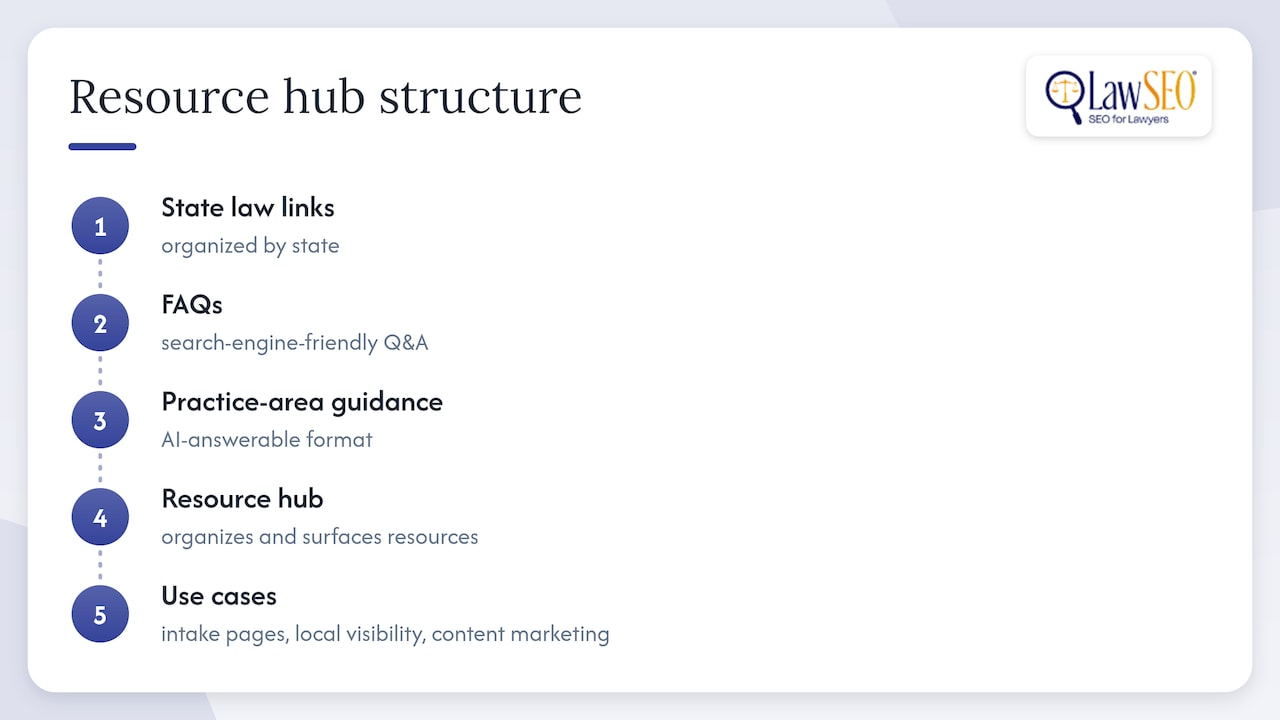
Firms that want clients to find this kind of primary-source guidance on their own websites, rather than searching for it elsewhere, often need help structuring and promoting it. Some firms build resource hubs that organize state law links, FAQs, and practice-area guidance in a format search engines and AI answer tools can surface directly. This fits naturally into client intake pages, local visibility campaigns, and ongoing content marketing for firms that handle multi-state matters. If your firm wants its own research resources to show up where potential clients are searching, our services page outlines how we approach discoverability and AI search optimization for law firms.
This article is general information, not a substitute for advice from a qualified lawyer. Consult a qualified legal professional about your own circumstances before acting on anything here.
FAQ
What not to say in a demand letter?
Avoid admissions of weakness in your client’s case, specific settlement figures stated as threats, and language that could be read as extortion or a violation of professional conduct rules. Keep the letter factual, cite the applicable law when relevant, and leave negotiation specifics for direct counsel-to-counsel communication.
Is $900 an hour a lot for a lawyer?
Hourly rates vary widely by practice area, region, and attorney experience, so there is no single market-wide figure to compare against. A rate in that range is more common among senior partners at large firms or specialists in complex litigation than among solo practitioners or general practice attorneys.
What are red flags for lawyers?
Red flags include an inactive or suspended license status, a pattern of public discipline on the state bar’s verification portal, and an unwillingness to put fee arrangements in writing. Checking the attorney’s status directly on the state bar’s lookup tool, rather than relying on a directory listing, is the most reliable first step.
How accurate is the show Suits?
Suits is a legal drama built for entertainment, and it takes significant liberties with courtroom procedure, licensing requirements, and day-to-day law firm practice. Viewers researching actual state bar admission rules or court procedure should consult the jurisdiction’s official bar and court pages rather than the show’s portrayal.
Sources
- NCSC Court Statistics Project data
- Legal Information Institute — State statutes and codes
- ABA resources for lawyer licensing and verification
Short list of authoritative national hubs and indexes to bookmark
These hubs will not replace a state’s own legislature or court site, but they speed up the search for the right one.
- NCSC: offers court structure data and the Court Statistics Project for understanding caseloads and publication practices across states.
- Cornell LII: provides consolidated access to state statutes and codes, useful as a starting index before confirming on the official site.
- ABA directories: link out to each state’s attorney licensing and verification portal.
- Justia and state judiciary portals: index court opinions and dockets, though the judiciary site remains the authoritative source for the actual filing.