


TL;DR:
- Sitewide SEO for law firms involves optimizing technical infrastructure, content, and local strategies to rank higher on Google and attract clients. Continuous monitoring, authoritative backlinks, and thorough content development are essential for long-term success in competitive legal markets. Treating SEO as infrastructure rather than a campaign helps firms build sustainable online authority and client acquisition channels.
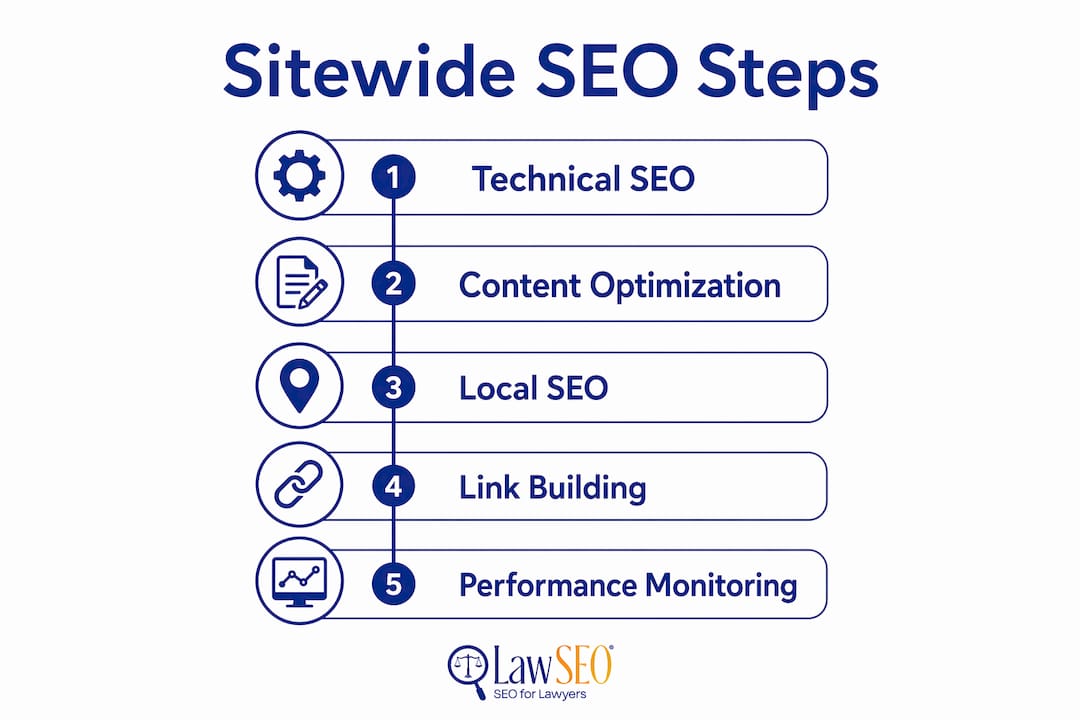
Sitewide SEO for law firms is a structured, multi-layer process that improves every page of your website so Google ranks you higher and prospective clients find you first. The step by step sitewide SEO for lawyers covered in this guide addresses technical infrastructure, content depth, local search dominance, authority building, and ongoing performance monitoring. Each phase builds on the last. Miss one, and the others underperform. Follow all five, and your firm competes at the top of search results for the practice areas and locations that matter most to your business.
How to build a strong technical SEO foundation for law firm websites
Technical SEO is the infrastructure every other optimization depends on. Without it, even the best legal content fails to rank.
Core Web Vitals: the numbers that matter
Google’s Core Web Vitals set the performance floor for law firm websites. Largest Contentful Paint under 2.5 seconds and an Interaction to Next Paint score under 200ms are the two thresholds that determine whether Google treats your site as fast or slow. Slow sites lose rankings and lose clients. Over 60% of legal searches happen on mobile devices, which means mobile Core Web Vitals scores carry as much weight as desktop scores. A personal injury firm with a 4-second mobile load time is handing leads to the competitor next door.
Site architecture and schema markup
Flattening your site architecture so no practice area page sits more than 3 clicks from the homepage directly improves Googlebot’s ability to crawl and index your highest-value pages. Group related practice area pages into silos. A family law firm, for example, should cluster divorce, child custody, and spousal support pages under a single /family-law/ parent directory. This preserves topical authority and makes internal link equity flow efficiently. You can review the structural principles behind this approach in Lawseo’s guide to law firm website structure.

Schema markup is where most law firms leave ranking signals on the table. Implement Person, LegalService, and FAQ schema using nested JSON-LD. Fine-tuned LegalService schema helps AI-driven search platforms like Google’s Search Generative Experience verify attorney authority and surface your firm in generative answers. Configure your XML sitemap to include only canonical, indexable URLs, and use Google Search Console to identify and fix crawl errors monthly.
Pro Tip: Host your law firm website on a server geographically close to your primary market, and deploy a CDN like Cloudflare to reduce latency for users in surrounding counties. Local server proximity is a minor but real ranking signal for geo-targeted queries.
| Technical element | Target benchmark |
|---|---|
| Largest Contentful Paint (LCP) | Under 2.5 seconds on mobile and desktop |
| Interaction to Next Paint (INP) | Under 200ms for all interactive elements |
| Site link depth | No critical page more than 3 clicks from homepage |
| Schema types | Person, LegalService, FAQ in nested JSON-LD |
How to optimize content across practice area and attorney pages
Content is the primary signal Google uses to determine what your firm does, where you do it, and whether you deserve to rank above competitors. Thin pages do not rank in competitive legal markets.
Building practice area pages that convert
Practice area pages with 2,000 to 3,500 words that fully answer client questions consistently outrank thin pages in competitive legal verticals. Each page must cover the legal process specific to your jurisdiction, common client questions, relevant statutes, and a clear call to action. A DUI defense page in Phoenix, for example, should explain Arizona’s implied consent law, the arraignment process, and what happens at a DMV hearing. Generic national content does not serve local searchers and does not rank for local queries.
Attorney bio pages require the same depth. Include bar admissions, law school credentials, case results, and media mentions. These signals build E-E-A-T (Experience, Expertise, Authoritativeness, and Trustworthiness), which Google’s quality raters use to evaluate legal content. Weak bios with a headshot and three sentences actively hurt your firm’s authority score.
Content structure for topical authority
Organize your content using topic clusters. One authoritative pillar page covers a broad practice area, and supporting pages cover specific subtopics with internal links pointing back to the pillar. This structure signals topical depth to Google and keeps users on your site longer.
- Write a pillar page for each core practice area (minimum 2,500 words).
- Create supporting pages for each subtopic, procedure, or jurisdiction variant.
- Link every supporting page to its pillar page with descriptive anchor text.
- Build FAQ sections on every practice area page targeting featured snippet queries.
- Update each page quarterly to reflect legal changes, new case results, or updated statutes.
Integrating live chat on law firm websites increases lead volume by 30% when configured to load asynchronously without blocking initial page rendering. Pair live chat with clear CTAs above the fold on every practice area page. Lawseo’s resource on attracting more law firm clients covers conversion-focused content strategies in greater detail.
How to implement local SEO strategies that dominate map pack rankings
Local SEO determines whether your firm appears in the Google Map Pack, which captures a significant share of clicks for high-intent queries like “divorce attorney near me” or “criminal defense lawyer Chicago.”
- Claim and fully optimize your Google Business Profile. Select the most specific practice area categories available. A firm practicing only immigration law should not select “Law Firm” as its primary category when “Immigration Attorney” is available.
- Standardize your NAP across all directories. Consistent name, address, and phone number across Avvo, Justia, FindLaw, and the State Bar directory directly impacts local search rankings. A single address discrepancy across 40 citations dilutes your local authority.
- Generate and manage client reviews ethically. Request reviews from satisfied clients through a direct Google review link sent via email or text. Respond to every review, positive or negative, within 48 hours.
- Create location-specific pages for each office or service area. Each page must contain unique content about the local legal market, nearby courthouses, and community-relevant legal issues. Do not duplicate content across location pages.
- Apply for Google Local Service Ads and pursue the Google Screened badge. The Google Screened badge requires background checks and bar license verification, and it appears above organic results. It is one of the strongest trust signals available to attorneys in paid local search.
Pro Tip: When responding to negative reviews, acknowledge the concern professionally without disclosing any client information. A measured, respectful response signals professionalism to prospective clients reading the exchange, often converting skeptics into inquiries.
Combining organic SEO, Local Service Ads, and Google Business Profile optimization creates a market dominance effect that multiplies lead volume beyond what any single channel achieves alone. Use the Lawseo local SEO checklist for law firms to audit your current local presence against each of these criteria.
What link-building tactics boost your law firm’s SEO authority
Domain authority in the legal sector is earned through the quality and relevance of sites linking to yours. Volume without quality is counterproductive.
The most effective link sources for law firms are:
- Bar association directories and state legal aid websites. These carry high topical authority and are trusted by Google as legitimate legal references.
- HARO (Help a Reporter Out) and media placements. Responding to journalist queries on legal topics earns links from Law360, Reuters, local news outlets, and national publications. Links from bar associations, Law360, and media quotes improve domain authority measurably.
- Detailed legal guides and local legal data. Publishing a county-specific guide to small claims court procedures or a statistical analysis of local DUI conviction rates earns organic citations from other legal websites and local news.
- Guest contributions to legal publications. Writing for state bar journals, legal blogs, or continuing education platforms builds both backlinks and E-E-A-T signals simultaneously.
- Avoiding mass directory submissions. Submitting to hundreds of low-authority general directories produces no ranking benefit and can trigger manual penalties. Prioritize fewer, higher-quality placements.
Law firm SEO demands a shift from traditional volume-based link strategies to AI-aware optimization using LegalService schema alongside earned backlinks. The two work together. Schema tells AI systems what your firm does; authoritative backlinks confirm you are credible enough to recommend.
How to monitor SEO performance and maintain sitewide optimization long-term
SEO monitoring for lawyers is not a monthly checkbox. It is a continuous process of measuring, diagnosing, and adjusting.
The core monitoring stack for law firm SEO includes:
- Google Search Console for tracking impressions, clicks, crawl errors, and Core Web Vitals failures by page.
- Google Analytics 4 for measuring session quality, conversion events (form submissions, phone clicks), and user behavior by traffic source.
- Call tracking software such as CallRail to attribute inbound calls to specific pages and keywords.
- Rank tracking tools to monitor keyword positions for practice area and location queries weekly.
Ongoing SEO requires continuously updating content to reflect legal changes, refining CTAs based on conversion data, and adapting to new search technologies as they emerge. A personal injury page that references a statute amended two years ago signals outdated content to both users and Google. Schedule a content review calendar tied to legislative sessions in your state.
Pro Tip: Monitor your click-through rate in Google Search Console for your top 20 ranking pages. If a page ranks in positions 4 through 7 but has a CTR below 3%, rewrite the title tag and meta description to include a specific benefit or urgency signal. CTR improvements translate directly to more traffic without requiring any new links.
Law firm SEO campaigns require 6 to 12 months before significant organic results and ROI become visible. Firms that abandon their strategy at month four because rankings have not moved are making a costly mistake. Track leading indicators like crawl coverage, indexed page count, and referring domain growth in the early months. These metrics predict ranking gains before they appear.
| Monitoring metric | Tool and frequency |
|---|---|
| Crawl errors and index coverage | Google Search Console, monthly |
| Keyword ranking positions | Rank tracker, weekly |
| Conversion events (calls, forms) | GA4 and CallRail, weekly |
| Backlink profile growth | Ahrefs or Semrush, monthly |
Key takeaways
Sitewide SEO for law firms requires integrating technical performance, authoritative content, local optimization, earned backlinks, and consistent monitoring to generate sustainable client acquisition.
| Point | Details |
|---|---|
| Technical foundation first | Fix Core Web Vitals, site architecture, and schema before investing in content or links. |
| Content depth wins | Practice area pages with 2,000 to 3,500 words outrank thin pages in competitive legal markets. |
| Local SEO multiplies results | Google Business Profile, NAP consistency, and Google Screened together dominate local search. |
| Authority requires earned links | Bar associations, media placements, and legal guides build domain authority that directories cannot. |
| Patience and monitoring | SEO ROI for law firms typically materializes between months 12 and 14 with consistent execution. |
Why most law firms underinvest in SEO until it’s too late
After nearly three decades working in SEO, with the last several years focused exclusively on law firms, I have watched the same pattern repeat. A firm spends heavily on pay-per-click advertising, gets comfortable with the lead volume, and treats organic SEO as a secondary project. Then Google adjusts its local algorithm, a well-optimized competitor enters the market, or ad costs spike, and the firm has no organic foundation to fall back on.
The legal keyword market is one of the most expensive in paid search. “Personal injury attorney Los Angeles” can cost over $100 per click. A firm generating 50 leads per month from organic search is effectively receiving the equivalent of thousands of dollars in free advertising every month. That is the ROI argument for SEO that most attorneys do not fully internalize until they see the numbers side by side.
The firms I have seen succeed long-term are the ones that treat SEO as infrastructure, not a campaign. They invest in technical audits, they publish content consistently, and they build local authority over years, not quarters. The AI optimization guide for law firms is the next layer of that infrastructure. Generative AI tools are already directing legal queries to firms with structured data and authoritative content. The firms building that foundation now will own the next wave of client acquisition.
— TODD
How Lawseo helps law firms execute sitewide SEO at every level
Lawseo is a digital marketing firm dedicated exclusively to law firm SEO, led by Todd R. Stager with over 29 years of SEO experience. The firm handles technical audits, local SEO, content production, link building, and AI-ready optimization for attorneys who want measurable results, not generic marketing packages. Every client campaign receives direct strategic oversight, and Lawseo frequently offers exclusivity agreements so your firm’s competitors do not benefit from the same strategy. If you are ready to build a search presence that generates consistent client leads, explore Lawseo’s proven law firm SEO strategies or visit LawSEO.com to discuss a tailored plan for your practice.
FAQ
What does sitewide SEO for lawyers include?
Sitewide SEO for lawyers covers technical performance, content optimization, local search, link building, and ongoing monitoring across every page of a law firm’s website. Each element must work together to produce consistent rankings and client leads.
How long does law firm SEO take to show results?
Law firm SEO campaigns typically require 6 to 12 months before significant organic results appear, with ROI often materializing between months 12 and 14. Early indicators like indexed page growth and referring domain increases signal progress before rankings move.
What schema markup should law firm websites use?
Law firm websites should implement Person, LegalService, and FAQ schema using nested JSON-LD. LegalService schema specifically helps AI-driven search platforms verify attorney credentials and surface your firm in generative search results.
How do I improve my law firm’s local SEO rankings?
Fully optimize your Google Business Profile with specific practice area categories, maintain consistent NAP across Avvo, Justia, and FindLaw, generate client reviews actively, and create unique location-specific pages for each market you serve.
What is the most effective link-building strategy for attorneys?
The most effective link-building strategy for attorneys combines bar association directory listings, HARO media placements, and original legal guides that earn organic citations. Links from Law360, state bar websites, and local news outlets carry the highest authority for legal SEO purposes.