


TL;DR:
- Content clusters are groups of interconnected web pages centered around a main pillar page, signaling topical authority to search engines and AI. Building comprehensive, well-structured clusters is now essential for effective SEO and AI citation in 2026, especially for law firms and digital marketers. Maintaining relevance through regular updates and precise intent alignment ensures sustained authority and improved rankings across traditional and AI search platforms.
Content clusters are defined as groups of interlinked web pages organized around a central pillar topic, designed to signal topical authority to search engines and AI citation engines alike. The role of content clusters in SEO has shifted from a useful tactic to a structural requirement. Google’s algorithms, along with AI engines like Perplexity and ChatGPT, now evaluate whether a site comprehensively covers a subject before awarding rankings or citations. For law firms and digital marketers, this means building interconnected content hubs is no longer optional. It is the foundation of any credible SEO content strategy in 2026.
What components make up an effective content cluster?
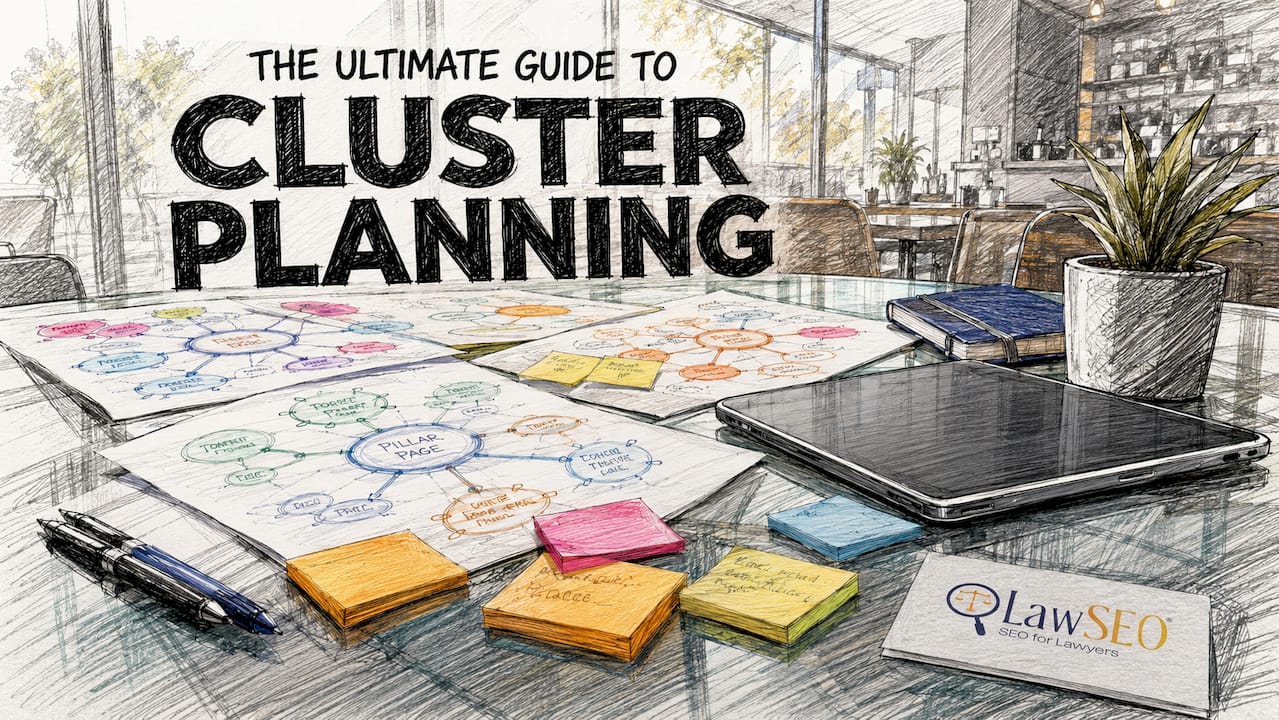
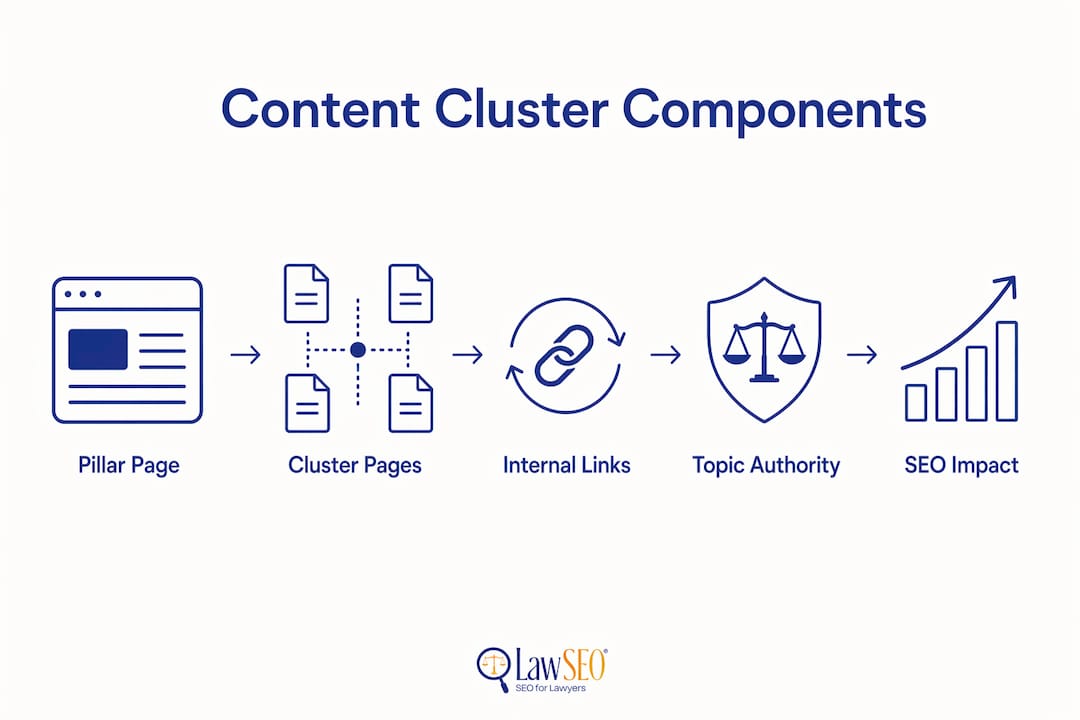
A content cluster has two core elements: a pillar page and a set of cluster pages. The pillar page acts as the definitive, broad-topic hub. It covers the subject at a high level and links out to every cluster page within that topic. Cluster pages go deep on specific subtopics, each targeting a distinct user intent.
The standard architecture for a well-built cluster looks like this:
- Pillar page: One authoritative page that defines the topic and serves as the “source of truth” for that subject area
- Cluster pages: Five to fifteen supporting pages, each focused on a specific subtopic or question within the pillar’s scope
- Internal links: Bidirectional links connecting the pillar to each cluster page, and cross-links between related cluster pages
- Schema markup: Structured data nested to reflect the hierarchy between pillar and cluster pages, helping both search engines and AI engines interpret content relationships
- Anchor text: Descriptive, semantically relevant anchor text on every internal link, not generic phrases like “click here”
Interlinked clusters are three times more frequently referenced in AI-generated content responses than isolated pages. That gap is significant. A standalone page, no matter how well written, cannot match the citation weight of a fully connected cluster.
| Cluster element | Function |
|---|---|
| Pillar page | Broad topic hub; establishes authority and links to all cluster pages |
| Cluster pages | Deep-dive subtopics; each targets a specific user intent |
| Internal linking | Distributes link equity and signals semantic relationships |
| Schema markup | Helps AI and search engines read content hierarchy |
| Named entities | Increases AI citation extraction and topical credibility |
Pro Tip: Build your pillar page first and publish it before any cluster pages. This gives search engines a clear authority signal from day one, and every cluster page you add afterward strengthens the pillar’s position rather than competing with it.
How do content clusters improve SEO and website authority?
Content clusters shift SEO focus from chasing individual keywords to owning a topical territory. Topical authority concentrates internal link equity on pillar pages, solving the common problem of scattered content that under-ranks because no single page carries enough weight. When a site covers a subject end to end, search engines recognize it as a credible source and rank it accordingly.
The benefits extend beyond traditional search. AI answer engines like Perplexity and ChatGPT pull citations from sites that demonstrate comprehensive, structured coverage. A site with a single strong article on a topic will lose to a site with a full cluster, even if the single article is technically better written. The cluster signals depth. Depth signals authority.
“Content clusters help solve the issue of scattered content under-ranking by concentrating internal link equity on pillar pages, creating an understandable site hierarchy that search engines reward with higher rankings across multiple pages simultaneously.”
User experience also improves measurably with a cluster structure. Readers who land on a cluster page find clear pathways to related content. They stay longer, visit more pages, and signal positive engagement metrics back to search engines. Internal linking signals semantic relationships between pages, helping search engines understand comprehensive coverage and improving both rankings and user experience.
The ranking distribution effect is worth noting separately. A well-built cluster does not just rank one page. It ranks multiple pages for related queries, giving a site several positions on a single search results page. That kind of coverage is nearly impossible to achieve with isolated pages.
What are the technical SEO considerations when implementing content clusters?
Technical execution determines whether a cluster performs or stalls. The structural work matters as much as the content itself. Follow these steps to get the technical foundation right:
-
Nest schema markup to reflect hierarchy. Use Article, FAQPage, and HowTo schema types on cluster pages. Nest them to show the relationship between pillar and cluster content. Nested schema markup raises AI engine citations by up to 40%. That is not a marginal gain. It is a structural advantage over competitors who skip this step.
-
Use semantic anchor text on every internal link. Generic anchors like “read more” or “learn here” waste the SEO value of internal links. Anchor text should describe the destination page’s topic precisely. This is how search engines map the semantic relationships within your cluster.
-
Audit for orphaned cluster pages. A cluster page with no inbound internal links from the pillar or other cluster pages is invisible to search engines in the context of the cluster. Run a crawl after publishing each new cluster page to confirm all links are in place.
-
Write claim-shaped opening sentences on every cluster page. AI answer engines prefer “claim-shaped” opening sentences that provide clear, concise answers extractable for citations. This means starting each page with a direct definition or assertion, not context-setting or background.
-
Track cluster performance with AI citation metrics. Traditional rank tracking shows Google positions. You also need to monitor how often your cluster pages appear in AI-generated responses. Tools that track AI citations are now a standard part of a complete SEO measurement stack.
Pro Tip: After publishing a cluster, submit the pillar page URL for indexing through Google Search Console. Search engines will crawl outward from the pillar to discover all linked cluster pages faster than waiting for a standard crawl cycle.
How to develop and maintain a content cluster strategy that drives business value?
The biggest failures in SEO content strategies arise from skipping topical territory definition and jumping straight to keyword lists. Keyword lists produce scattered content. Topical territories produce clusters. The distinction is critical.
A cluster strategy that drives business value starts with these decisions:
- Define your topical territories first. Choose subjects where your firm has genuine expertise and where your target clients have real questions. For a law firm, this might mean owning “personal injury claims” or “business contract disputes” as full topical territories, not just targeting individual keywords within those subjects.
- Map cluster pages to buyer intent stages. Some cluster pages answer awareness-level questions. Others address decision-stage queries. A cluster that covers the full intent spectrum captures clients at every point in their research process.
- Build for coverage and defensibility. A cluster with fifteen well-researched pages is far harder for a competitor to displace than a single pillar page. Depth creates a moat. Each new cluster page adds to the authority of the whole structure.
- Close content gaps continuously. Use search query data and AI citation monitoring to find questions your cluster does not yet answer. Add cluster pages to fill those gaps before a competitor does.
- Align cluster topics with conversion goals. A cluster that ranks well but never connects to a service page or contact form produces traffic without revenue. Every cluster needs at least one clear path to a conversion point.
The goal of a modern cluster strategy is to drive measurable revenue impact by mapping content to pipeline stages, not just ranking for keywords. That reframe changes how you prioritize which clusters to build first. Start with the topics closest to your highest-value services, then expand outward.
A proven content cluster approach also treats SEO and AI optimization as a single program. Building clusters for Google rankings while ignoring AI citation structure means leaving half the visibility surface unaddressed. A content marketing strategy integrating both SEO and AI answer engine optimization simultaneously yields faster organic growth and stronger pipeline influence than building one and adding the other later.
Pro Tip: Review your cluster’s pillar page every quarter. Update statistics, add new cluster page links, and refresh any outdated claims. Search engines treat freshness as a quality signal, and AI engines are more likely to cite pages that reflect current information.
Key Takeaways
Content clusters are the most reliable structure for building topical authority that ranks in both traditional search and AI citation engines simultaneously.
| Point | Details |
|---|---|
| Cluster structure drives authority | One pillar page plus 5–15 cluster pages concentrates link equity and signals topical depth to search engines. |
| Schema markup multiplies AI citations | Nesting schema to reflect pillar and cluster relationships raises AI citation rates by up to 40%. |
| Topical territory beats keyword lists | Define subject areas first; keyword selection follows from territory mapping, not the other way around. |
| Clusters must map to business outcomes | Each cluster should connect to a conversion path, not just a ranking goal. |
| Continuous updates protect authority | Quarterly pillar page reviews and ongoing gap closure keep clusters competitive as search algorithms evolve. |
What 29 years of SEO taught me about content clusters
Most SEO professionals understand the mechanics of content clusters. Fewer understand why so many well-built clusters still underperform. After nearly three decades working in search, I have seen the same mistake repeat itself: marketers build the structure but neglect the intent architecture inside it.
A cluster page that targets the wrong intent stage does not just fail to rank. It actively confuses search engines about what the pillar page is supposed to represent. I have audited sites where a single misaligned cluster page was suppressing the entire pillar’s rankings. The fix was not more content. It was removing one page and redirecting it.
The shift toward AI citation engines has made this problem more visible. AI search engines reward clusters where every page reinforces the pillar’s authority signal. A weak or off-topic cluster page dilutes that signal in ways that traditional SEO tools do not always surface clearly.
My advice for 2026 is to treat your cluster as a product, not a publishing schedule. Every page needs a defined role, a clear intent target, and a measurable contribution to the cluster’s authority. If you cannot articulate why a specific cluster page exists, it probably should not exist. Quality and coherence matter more than volume.
For law firms specifically, the legal content strategy opportunity is significant. Most law firm websites are still built around practice area pages with no cluster architecture beneath them. That is a structural gap that a well-executed cluster strategy can close quickly, and the competitive advantage it creates is durable.
— TODD
Lawseo’s content cluster expertise for law firms
Lawseo builds and manages content cluster strategies exclusively for attorneys and law firms. The firm’s approach integrates traditional SEO for law firms with AI citation optimization, ensuring that every cluster performs across both Google rankings and AI-generated search responses. Todd R. Stager and his team design pillar and cluster architectures grounded in legal practice area expertise, not generic content templates. Each campaign includes schema implementation, internal link auditing, and ongoing cluster expansion to close content gaps as they emerge. Law firms that want a content structure built to dominate their topical territory can review Lawseo’s full service offering and request a consultation directly through the website.
FAQ
What is a content cluster in SEO?
A content cluster is a group of interlinked web pages built around one central pillar page and multiple supporting cluster pages, each covering a specific subtopic. The structure signals topical authority to search engines and AI citation engines.
How many pages should a content cluster have?
A well-structured content cluster includes one pillar page and 5–15 supporting cluster pages. That range gives search engines enough depth to recognize comprehensive topical coverage without creating redundant or cannibalized content.
Why do content clusters improve AI search citations?
Interlinked clusters are three times more frequently referenced in AI-generated responses than isolated pages. AI engines like Perplexity and ChatGPT prioritize sites that demonstrate comprehensive, structured coverage of a subject.
What is the difference between content silos and content clusters?
Content silos and content clusters both organize pages by topic, but clusters emphasize bidirectional internal linking and semantic relationships between pages, while silos often use strict one-directional hierarchies. Clusters are better suited to modern AI and search engine algorithms.
How often should you update a content cluster?
Review and update your pillar page at least quarterly. Add new cluster pages whenever search query data or AI citation monitoring reveals unanswered questions within your topical territory.