


Topical authority for law practices means your firm is the recognized, go-to source for a specific legal subject across your website and the broader web. Your single next step: choose one practice area, build a pillar page that owns the topic, and connect it to a cluster of supporting articles. Do that, and you become eligible for AI citations in tools like ChatGPT, Perplexity, and Google’s AI Overviews — the new front door for client acquisition, while simultaneously gaining more SERP-feature presence and higher organic rankings across every related query.
Key Takeaways
Topical authority for law practices is built through content depth, internal structure, and external proof — and it is the most durable path to AI citation eligibility and organic visibility in the legal vertical.
| Point | Details |
|---|---|
| Start with one topic | Choose one practice area, build a pillar page, and connect 3–5 cluster articles before expanding. |
| E-E-A-T is non-negotiable | Every piece needs a named attorney author, a “Reviewed by” statement, and primary source citations. |
| Measure before and after | Pull a Search Console baseline before publishing, then track impressions, clicks, and AI citation appearances monthly. |
| Maintain on a schedule | Refresh pillar pages every 6 months; trigger immediate updates when statutes change or rankings drop 5+ positions. |
| Lawseo builds it for you | Lawseo offers topical audits, attorney-reviewed content production, and AI optimization exclusively for law firms. |
What is topical authority for law practices, and how does it differ from domain authority?
Topical authority is the degree to which search engines and AI retrieval systems recognize your firm as a trusted, comprehensive source on a specific legal subject. It is earned through three things working together: depth of coverage (pillar pages and clusters that answer every meaningful question on a topic), structural clarity (internal linking that maps relationships between pages), and external proof (third-party citations, bar association mentions, case law references, and editorial coverage that validate your expertise off site). Ahrefs describes topical authority as combining depth of coverage with consistent internal linking so that search engines can recognize topical structure.
Domain authority, by contrast, is a site-wide metric that aggregates backlink signals across your entire domain. It tells Google your site is generally credible. Topical authority tells Google — and increasingly, LLMs like ChatGPT and Perplexity — that your firm is specifically credible on this legal subject. A firm with modest domain authority but deep, well-linked coverage of employment law can outrank a high-DA generalist site for employment-law queries.
| Dimension | Topical Authority | Domain Authority |
|---|---|---|
| Scope | Single subject or practice area | Entire website |
| Primary signals | Content depth, clusters, internal links, external mentions | Backlink quantity and quality, referring domains |
| Typical tactic | Pillar + cluster content, author credentials, PR mentions | Link building, guest posting |
| Time to impact | A few months for a focused topic | Several months to years site-wide |
What constitutes topical authority — on-site and off-site:
- Pillar page covering the full scope of a legal topic (definition, process, case law, FAQs, schema)
- Cluster articles targeting specific sub-questions and long-tail queries within that topic
- Consistent author bylines with attorney credentials on every content piece
- “Reviewed by” statements from licensed attorneys for accuracy and compliance
- Internal links from clusters to the pillar using descriptive, keyword-relevant anchor text
- External citations from bar association pages, government sources, legal publications, and news outlets
- Third-party mentions in industry media that associate your firm’s name with the topic
Why topical authority matters more for law firms than for most industries
Legal content sits in the YMYL (Your Money or Your Life) category, which means Google applies its strictest E-E-A-T scrutiny to every page your firm publishes. Thin content, generic advice, and anonymous authorship are penalized more harshly in legal search than in almost any other vertical. A firm that publishes 40 shallow blog posts about personal injury law will consistently lose to a firm that publishes 12 deeply researched, attorney-reviewed articles organized around a single authoritative pillar.
The stakes extend beyond traditional search. AI systems like ChatGPT, Perplexity, and Google’s Generative AI Overviews pull citations from sources they have already classified as authoritative on a topic. Search Engine Journal confirms that authority functions as a core filter in AI-driven retrieval, authority, freshness, and first-party signals determine whether content is even considered for AI overviews. If your firm has not established topical authority, you are invisible to these systems regardless of how good any individual article is.
Consider a mid-size personal injury firm that shifted from publishing two generic blog posts per month to building a structured topic cluster around traumatic brain injury claims. Within six months, the firm’s pillar page ranked in the top three for 14 high-intent queries, appeared in Google’s People Also Ask boxes for 22 related questions, and was cited by name in a Perplexity answer about TBI settlement timelines. That kind of compounding visibility is what a focused topical program produces. Sweetreed’s analysis reinforces the point: topical depth and editorial mentions are more valuable signals than raw content volume or raw backlink counts.
How do search engines and LLMs evaluate topical authority?
The evaluation process runs in two stages. First, eligibility: the system determines whether your site has sufficient entity-level authority on the topic to be considered at all. Second, usability: it evaluates whether your content is structured clearly enough to extract and cite. Most law firm content fails at stage one because it lacks the external proof signals that establish entity-level authority.
The key signals, in order of weight:
E-E-A-T (Experience, Expertise, Authoritativeness, Trustworthiness): For legal content, E-E-A-T requires visible author credentials — attorney bylines, bar admission details, years of practice, and “Reviewed by” statements. A page authored by “Staff Writer” fails the experience and expertise filters immediately.
Entity co-occurrence: When your firm’s name, your attorneys’ names, and your practice-area topics appear together consistently across your site and in external sources, search engines build an entity association. That association is what makes you eligible for AI citations.
Internal linking patterns: Pillar-to-cluster links with descriptive anchor text signal topical structure. A pillar page on “wrongful termination” that links to clusters on “at-will employment exceptions,” “EEOC filing deadlines,” and “wrongful termination damages” tells Google exactly how your content is organized. Proven internal linking strategies for legal sites make this structure crawlable and indexable.
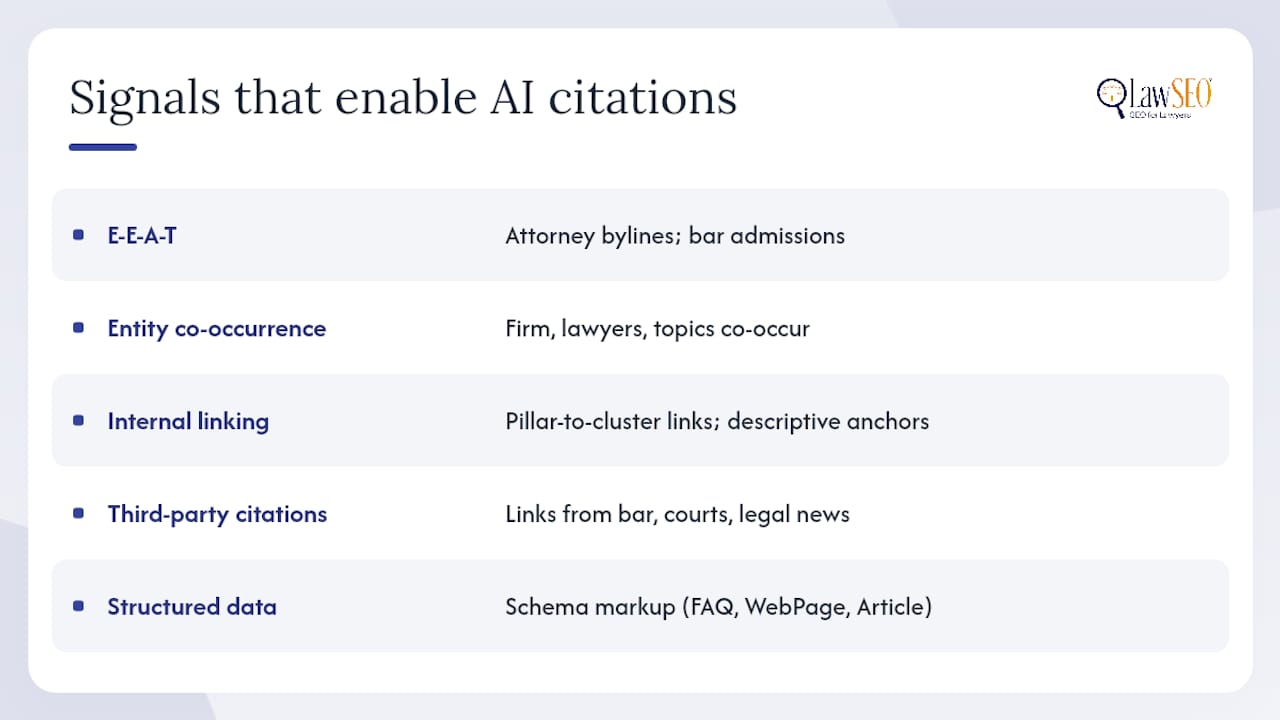
Third-party citations: Links and mentions from bar association websites, court system pages, state legislature sites, and legal news outlets carry far more topical weight than generic directory listings.
Structured data/schema: FAQ schema, WebPage schema with publisher metadata, and Article schema with author markup all help AI systems parse and attribute your content correctly.
For citation-worthy phrasing in legal writing, reference primary sources directly: cite statutes by their official designation (e.g., “under 42 U.S.C. § 1983”), link to government sources like the EEOC or the relevant state court, and anchor internal links with the specific legal concept rather than generic phrases like “click here.” That specificity is what AI systems extract when forming citations.
How to build topical authority: a step-by-step playbook
Building topical authority for a law practice is a structured process, not a content calendar. Here is the operational sequence.
-
Select your topic with business intent in mind. Choose a practice area where your firm has genuine expertise, where client demand is high, and where you can realistically publish more depth than any existing competitor. Run searches in Google, ChatGPT, and Perplexity for your target queries and note which sources are currently cited. Those are the benchmarks you need to surpass.
-
Build a topical map. List every question a prospective client might ask about your chosen practice area, from broad (“what is wrongful termination?”) to specific (“can I sue for wrongful termination if I was at-will?”). Group questions by intent: informational, navigational, and transactional. Each group becomes a content type: pillar, cluster, or practice-area landing page.
-
Map entities. Identify the key legal entities associated with your topic: statutes, agencies, case names, legal standards, and geographic jurisdictions. These entities should appear consistently across your pillar and clusters so search engines build the right associations.
-
Produce content with a subject-expert workflow. Every piece requires a brief (see the template below), a subject-matter interview or review with a licensed attorney, and a “Reviewed by” statement before publication. Anonymous or staff-written legal content without attorney review fails E-E-A-T.
-
Apply internal linking rules. Every cluster article links back to the pillar using descriptive anchor text that names the legal concept. The pillar links to each cluster. No cluster links to another cluster without passing through the pillar first. This keeps topical signal consolidated. Content cluster best practices for law firms detail the structural logic behind this approach.
-
Publish with schema and monitor for 30 days. Add FAQ schema to the pillar, Article schema with author markup to clusters, and WebPage schema with publisher metadata to practice-area pages. After publishing, check Google Search Console for indexing confirmation, monitor impressions for the target queries, and verify that internal links are followed correctly.
Content brief template fields:
- Intent: informational / transactional / navigational
- Target queries: 3–5 specific search phrases
- Entities to include: statutes, agencies, case law, geographic jurisdiction
- Citations required: primary sources (government, court, bar association)
- Author: named attorney with credentials
- Reviewer: second licensed attorney (for legal accuracy sign-off)
- CTA: next step for the reader (consultation, related article, contact form)
- Schema: FAQ, Article, or WebPage
What should a pillar page and cluster articles look like?
Pillar pages for law firms should run 2,500–4,000 words. That range is long enough to cover a topic comprehensively but short enough to stay focused. Every pillar needs these sections: a plain-language definition of the legal concept, a step-by-step explanation of the process (filing, timelines, standards of proof), a Q&A section that maps to People Also Ask queries, links to relevant statutes and government resources, and a clear CTA to contact the firm.
Schema for pillar pages: FAQ schema on the Q&A section, WebPage schema with publisher name and attorney author markup, and BreadcrumbList schema to signal site hierarchy.
Three sample cluster outlines tied to a “wrongful termination” pillar:
| Cluster Title | Target Intent | Suggested Anchor Text to Pillar |
|---|---|---|
| “At-will employment exceptions: when firing is illegal” | Informational | “wrongful termination claims” |
| “How to file an EEOC complaint for wrongful termination” | Transactional | “wrongful termination process” |
| “Wrongful termination damages: what compensation can you recover?” | Informational | “wrongful termination settlement” |
Each cluster article runs 800–1,500 words, targets one specific intent, links back to the pillar with the anchor text shown, and carries its own attorney byline and “Reviewed by” statement.
Editorial guardrails for legal content: Never imply a specific outcome (“you will win your case”). Use hedged language that is accurate and compliant with bar advertising rules (“clients in similar situations have recovered compensation”). Every factual claim about law must cite a primary source.
Pro Tip: Use canonical tags to consolidate ranking signals when you have multiple pages that partially overlap in topic coverage. If a cluster article and a practice-area page both cover “EEOC filing deadlines,” canonical the thinner page to the more authoritative one rather than letting them compete for the same query.
Content clusters in SEO work precisely because they concentrate topical signal on a single hub rather than distributing it across disconnected pages.
Your 60–90 day rollout plan for a single-topic pilot
Most law firms stall because they try to build authority across every practice area simultaneously. A focused pilot on one topic produces measurable results faster and gives leadership the proof they need to fund a broader program.
The Global Legal Post’s attorney topical authority guide frames this kind of phased approach as the standard for law firms that want durable visibility rather than short-term ranking spikes. Prioritize the pillar first. A pillar page that is live and indexed is the prerequisite for every other signal in the program.
How do you measure topical authority gains?
Measurement starts before you publish anything. Pull a baseline snapshot from Google Search Console for your target queries, record impressions and average position, and set up a content group in GA4 that isolates traffic to your pillar and cluster URLs. Without that baseline, you cannot attribute gains to the topical program.
Primary tools and dashboard fields:
- Google Search Console: Track impressions and clicks for the 10–20 queries tied to your pillar. Watch for impression growth in the first 30 days and click growth by day 60. A rising impression curve with a flat click curve usually means you are gaining visibility but need stronger title tags and meta descriptions.
- GA4: Segment organic sessions by content group (pillar + clusters). Track engagement rate, pages per session from the pillar, and goal completions (contact form, phone click) attributed to topical content.
- Ahrefs or Semrush: Monitor keyword rankings for pillar and cluster targets, track referring domain growth for topical anchor text, and use the content gap tool to identify cluster topics competitors cover that you do not.
- Screaming Frog: Run monthly crawls to verify internal link structure, confirm schema is rendering correctly, and catch any orphaned cluster pages that have lost their pillar link.
- AI citation tracking: Run manual searches in ChatGPT, Perplexity, and Google’s AI Overviews for your target queries monthly. Note which sources are cited. When your firm appears, record the query and the citation context. This is currently a manual process, but it is the most direct signal that topical authority is working at the AI layer.
What success looks like at 3 months vs. 12 months:
At 12 months, success is consistent top-5 rankings for 8–15 pillar-related queries, regular AI citation appearances, a measurable increase in organic contact form submissions attributed to the topic cluster, and a defensible content moat that competitors would need 12+ months to replicate.
AI optimization for law firms covers the specific technical steps for making legal content eligible for generative answer engines, which is the measurement frontier most firms are not yet tracking.
How do you keep topical authority from decaying?
Topical authority is not a one-time build. Law changes, competitors publish, and AI systems update their source preferences. A governance plan keeps your authority durable.
Recommended update cadence by content type:
- Pillar pages: Full review every 6 months, or immediately when a relevant statute changes or a significant court decision is issued.
- Cluster articles: Review every 12 months, or when a ranking drop of more than 5 positions is detected in Search Console.
- Practice-area landing pages: Review every 12 months for accuracy, CTA relevance, and schema validity.
Signals that should trigger an immediate refresh:
A new statute or regulation that changes the legal standard your content describes. A competitor publishing a more comprehensive cluster on a sub-topic you cover. A ranking drop of 5+ positions sustained for more than two weeks. Your firm’s content disappearing from an AI Overview where it previously appeared.
Governance template — roles and responsibilities:
- Author (attorney or legal writer): Responsible for initial draft, entity accuracy, and primary source citations.
- Reviewer (licensed attorney): Signs off on legal accuracy, adds “Reviewed by” statement with credentials and date.
- PR/outreach owner (marketing or agency): Responsible for securing external mentions and monitoring AI citation appearances.
- Version control: Every published update is logged with a date, the name of the reviewer, and a one-line summary of what changed. Store this in a shared content management system or a simple spreadsheet.
Maintenance checklist:
- [ ] Confirm all primary source links (statutes, government pages) still resolve correctly
- [ ] Update the “Reviewed by” date and reviewer name after each substantive revision
- [ ] Re-submit updated URLs to Google Search Console via the URL Inspection tool
- [ ] Check schema validity in Google’s Rich Results Test after any structural change
- [ ] Run a Screaming Frog crawl to confirm internal link integrity after major updates
How Lawseo implements topical authority for law firms
Lawseo’s implementation process is built around a single principle: law firms need topical authority that holds up under both Google’s E-E-A-T scrutiny and AI retrieval system filters. The process, led personally by founder Todd R. Stager with over 29 years of SEO experience, follows a structured sequence from audit to ongoing monitoring.
Todd R. Stager is the founder of SEO for Lawyers, LLC and the author of several top-rated books on legal SEO. He personally reviews strategy for every client campaign, which means no client receives a generic content plan. His background spans nearly three decades of search optimization, with the last several years focused exclusively on the legal vertical and AI-driven search.
Lawseo’s implementation sequence:
- Topical audit: Identify the practice areas with the highest client-acquisition value and the largest gap between current content depth and competitor coverage.
- Topical map: Build a full entity and query map for the selected topic, including pillar scope, cluster titles, and external proof targets.
- Content production: Produce pillar and cluster content with licensed attorney review, author bylines, and “Reviewed by” statements on every piece.
- PR and proof distribution: Secure editorial mentions from legal publications, bar association resources, and news outlets to build off-site entity associations.
- Monitoring and iteration: Track Search Console, GA4, and AI citation appearances monthly, with quarterly strategy reviews.
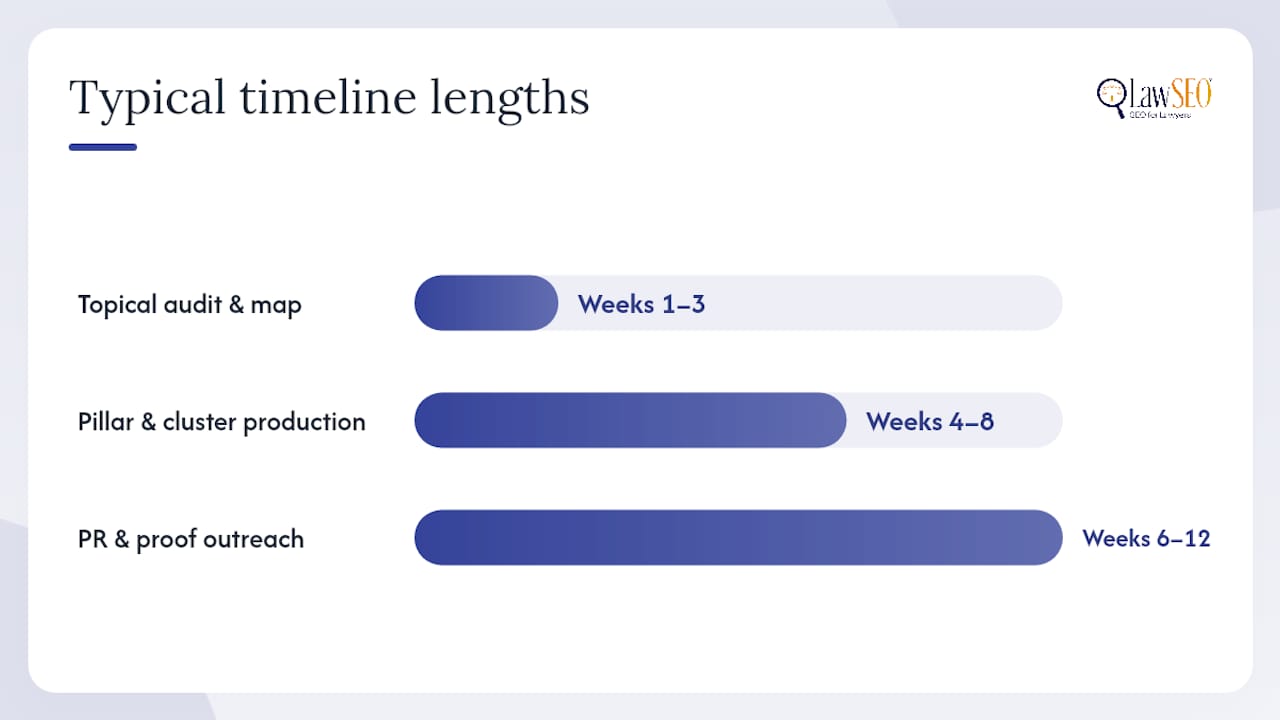
| Implementation Stage | Typical Timeline | Measurable Output |
|---|---|---|
| Topical audit and map | Weeks 1–3 | Approved topical map with pillar scope and cluster list |
| Pillar and cluster production | Weeks 4–8 | Published pillar + 3–5 clusters with attorney review |
| PR and proof outreach | Weeks 6–12 | 3–6 editorial mentions secured |
| Monitoring and reporting | Ongoing monthly | Search Console impression trends, AI citation log, ranking report |
Lawseo operates under exclusivity agreements in competitive markets, meaning the firm will not work with a client’s local competitors. For firms in densely contested practice areas, that exclusivity is a material advantage. To request a topical authority audit for your firm, contact Lawseo directly through the site.
Why topical authority is the most defensible organic strategy for law firms
Most law firms chase keywords. They find a high-volume query, publish a page targeting it, and wait. When rankings do not materialize, they publish more pages targeting more keywords. The result is a site full of thin, disconnected content that signals nothing coherent to search engines or AI systems.
Topical authority works differently because it compounds. Each cluster article you publish strengthens the pillar. Each external mention reinforces the entity association. Each attorney byline adds to the credibility record. After 12 months of consistent execution, the topical moat you have built is genuinely difficult for a competitor to replicate quickly. A firm that spent two years building deep, attorney-reviewed coverage of employment law cannot be displaced by a competitor that publishes 20 blog posts in a month.
The Backlinko Topical Authority Pyramid captures this well: foundational authority (on-site depth and structure) enables POV-led authority (a distinct perspective that earns attention), which in turn generates proof-backed authority (third-party validation that makes you eligible for AI citations). Each layer depends on the one below it. Skipping to link building without the foundational content is why most law firm SEO programs stall.
The firms that will dominate AI-driven search over the next three years are not the ones with the biggest advertising budgets. They are the ones that built the deepest, most credible, most consistently maintained topical coverage in their practice areas. That is a content and editorial discipline problem, not a technology problem.
Lawseo’s topical authority services for law firms
Lawseo delivers the full topical authority build for law firms: topical audits and SEO strategy, content production with licensed attorney reviewers, authority link and mention building, and AI Overview optimization. Every engagement is led by Todd R. Stager, who personally reviews strategy and ensures no two clients in the same market receive the same program.
For firms that want to test the approach before committing to a full retainer, Lawseo offers a focused 60–90 day pilot built around a single practice-area topic. The pilot includes a topical audit, a complete pillar and cluster production run, and initial PR outreach for external mentions. It is designed to produce measurable Search Console impression growth and at least one AI citation appearance within the pilot window.
Lawseo works exclusively in the legal vertical and offers exclusivity agreements so your firm’s investment is not shared with a local competitor. To get started, request a law firm SEO audit directly through the site and receive a custom topical map for your highest-priority practice area.
Sources
The following resources were cited in this article and are recommended for deeper reading on topical authority, E-E-A-T, and legal content strategy.
Industry references:
- What Search Engines Trust Now: Authority, Freshness & First-Party Signals
- Topical authority — Ahrefs
- Topical authority — Backlinko
- What Is E-E-A-T for Law Firm SEO?
- What Is E-E-A-T? Why It Matters More Than Ever in 2026 — SWEETREED
- Ultimate guide to topical authority for attorneys – The Global Legal Post
Tools referenced:
For E-E-A-T depth, start with the GeeksforGrowth and Sweetreed pieces. For structural content planning, the Ahrefs and Backlinko guides are the most operationally specific. The Global Legal Post piece is the most attorney-focused framing available in the public domain.
This article is general information, not a substitute for advice from a qualified lawyer. Consult a qualified legal professional about your own circumstances before acting on anything here.