


An unlinked brand mention is any published reference to your firm’s name, attorneys, or campaigns that carries no clickable link back to your site. These references still build entity recognition and now feed AI citation models, but they pass zero direct link equity until someone converts them. The right first move is simple: run a brand-monitoring query today, sort results by recency and traffic, and start outreach on the mentions published in the last 90 days.
TL;DR:
- Monitoring unlinked brand mentions involves tracking variants, product names, people, and event references across multiple placements, especially editorial content.
- Use layered search techniques, including alerts, Google operators, backlink profile checks, and reverse image searches, to identify mentions with no existing link.
- Prioritize outreach based on the mention’s recency, page traffic, relevance, and placement, focusing on high-value, recent editorial mentions within 90 days.
- Speed is crucial; outreach within 48 to 72 hours greatly improves the chances of converting mentions into links or citations.
- Recurring monitoring and a structured workflow maximize the value of mentions, affecting AI citations, branded search, and overall authority beyond just backlinks.
What Are Unlinked Brand Mentions, and Why Do They Matter Now?
Google’s own advocates, including John Mueller, have confirmed that plain-text mentions of your brand don’t function as PageRank or link-graph signals the way a hyperlink does, according to Search Engine Journal. That single fact surprises a lot of marketers who assume any mention of their firm’s name is doing SEO work behind the scenes. It isn’t, at least not directly.
What it does do is build entity recognition, the process by which search engines and AI models associate your brand name with a consistent set of attributes, services, and reputation signals. Industry analysis on how brand visibility feeds large language models suggests unlinked mentions and reclaimed links solve two different problems: mentions build the entity picture that AI systems draw on when generating answers, while a converted link adds the direct equity that traditional ranking systems reward, per B2BMention. You need both, and treating unlinked mentions as a permanent write-off wastes an asset most competitors never bother collecting.
Search Engine Land’s guide to unlinked mentions makes the case even more directly: mentions matter for SEO and PR value regardless of whether they carry a link, because they still shape how algorithms and readers perceive your authority. For a law firm, that means every quote in a local news story, every mention in a bar association newsletter, and every “according to attorney Jane Smith” reference is a candidate for review, not a dead end.
Types of Unlinked Mentions to Include in Your Monitoring
Most marketing teams monitor one thing: the exact brand name. That leaves a lot of value on the table. A comprehensive tracking setup should catch several distinct mention categories, each of which behaves differently in outreach.
- Brand name variants and misspellings — including abbreviated firm names, common typos, and shorthand your staff uses in press interactions.
- Product, campaign, and case names — settlement names, class-action titles, or named legal programs your firm runs.
- People mentions — partner names, associate attorneys quoted in articles, spokespeople, and staff who speak at events.
- Event and sponsorship references — conference panels, CLE presentations, or community sponsorships where your firm is named but not linked.
- Image and video use — logo appearances, headshots reused in press coverage, and video transcripts where your firm’s name is spoken but never displayed as text.
Placement matters as much as the mention type. A mention buried in a comment thread or an aggregator sidebar carries far less weight than one sitting inside the editorial body of a news article, because editorial placements signal that a human writer or editor chose to include your name deliberately. Comments and forum mentions are worth logging for reputation tracking, but they rarely justify outreach time. Sidebar widgets and syndicated republications fall somewhere in between: useful for visibility monitoring, low priority for link reclamation.
How to Find Unlinked Brand Mentions: Tools and Step-by-Step Methods
Finding these mentions requires layering a few different techniques, because no single tool catches everything. Here’s a workflow that scales from a quick manual check to an ongoing monitoring program.
- Set up brand-monitoring alerts with a “without backlinks” filter. Most monitoring platforms let you build a query for your brand name, then filter out results that already contain a hyperlink to your domain. Semrush documents this exact workflow, showing how to combine brand terms with exclusion operators to isolate mentions that still need a link, according to Semrush’s guide.
- Build layered search queries using Google operators. A query like
"your firm name" -site:yourdomain.comstrips out your own pages, and adding-inurl:yourdomainfilters further. Export results into a spreadsheet for manual review rather than trusting the first page of results. - Reverse-engineer backlink profiles tied to your team’s social handles. Ahrefs recommends checking backlink reports for the personal or professional social accounts of your attorneys and spokespeople, since journalists often link to a LinkedIn or Twitter profile instead of the firm site, per Ahrefs’ guide to unlinked mentions.
- Run reverse image searches on your logo and staff photos. Google Images and TinEye can surface press placements that reused your firm’s headshots or logo without any accompanying text link, which text-based monitoring tools will always miss.
- Check video and podcast transcripts. A mention spoken aloud in an interview or webinar recording won’t show up in a standard crawl. Search transcript text (many platforms auto-generate these) or use the platform’s own search function for your firm name.
- Verify every candidate with a link checker or crawler before adding it to your outreach list, confirming the page genuinely has no existing link to your domain and hasn’t been deindexed or removed.
Ahrefs’ own analysis of scraped mention samples found a meaningful share of all brand references across the web carry no link at all, which is why a single scan rarely captures the full opportunity. Running the process quarterly, rather than once, is what turns this into a real pipeline instead of a one-time cleanup.
Pro Tip: Combine your brand-monitoring tool’s alert feed with a saved Google Alert on your firm’s exact name plus common misspellings. The overlap between the two catches mentions that either system misses on its own, especially newer articles that haven’t been fully indexed yet.
How to Evaluate and Prioritize Mentions for Outreach
Not every mention deserves an email. Chasing low-traffic, low-relevance placements burns hours you could spend converting the mentions that will actually move the needle. Build a simple scoring system and stick to it.
The checklist that matters most:
- Page-level traffic — does this specific page get organic visits, or is it buried on page nine of an old archive?
- Topical relevance — does the surrounding content relate to your practice areas, or is your name a passing reference in an unrelated story?
- Placement — is the mention in the editorial body, or tucked into a sidebar, footer, or comment section?
- Author and editor contactability — can you find a real byline, author page, or editorial contact, or is the piece anonymous and unmaintained?
- Recency — was this published in the last 90 days, or is it three years old and likely forgotten by its author?
Search Engine Land’s prioritization framework recommends weighting traffic and placement above raw domain authority, and that ordering makes sense once you think about it from the editor’s side. A high-authority domain with a dead, unmaintained article is far less likely to respond than a mid-tier legal blog with an active editor and a page still pulling monthly visits. Page-level traffic tells you whether anyone is actually reading the piece today; domain authority just tells you the site was strong at some point.
Add the columns and anything scoring 9 or above goes to the top of your outreach queue. Search Engine Land also notes that recent, high-traffic editorial mentions convert at materially higher rates than older or buried ones, which is the entire reason recency carries equal weight to traffic in this model rather than being an afterthought.
Outreach Playbook: Messages, Timing, and Follow-Up That Convert
Converting a mention into a link is one of the higher-return link-building tactics available, precisely because the editorial relationship already exists. The author already decided your firm was worth naming. You’re not cold-pitching a stranger; you’re asking someone to finish a job they already started, as Search Engine Land points out.
- Reference the exact sentence. Quote the specific line where your firm is mentioned so the recipient doesn’t have to search their own article to find it.
- Suggest the exact link placement and URL. Don’t make the writer guess where the link should go or which page to link to. Hand them both.
- Explain the reader benefit, not your benefit. Frame the link as helping the writer’s audience verify a source or find more detail, not as a favor to your marketing team.
- Find the right contact. Start with the byline author using their author page or social profile; only escalate to a general editorial contact if the author is unreachable or the piece is unattributed.
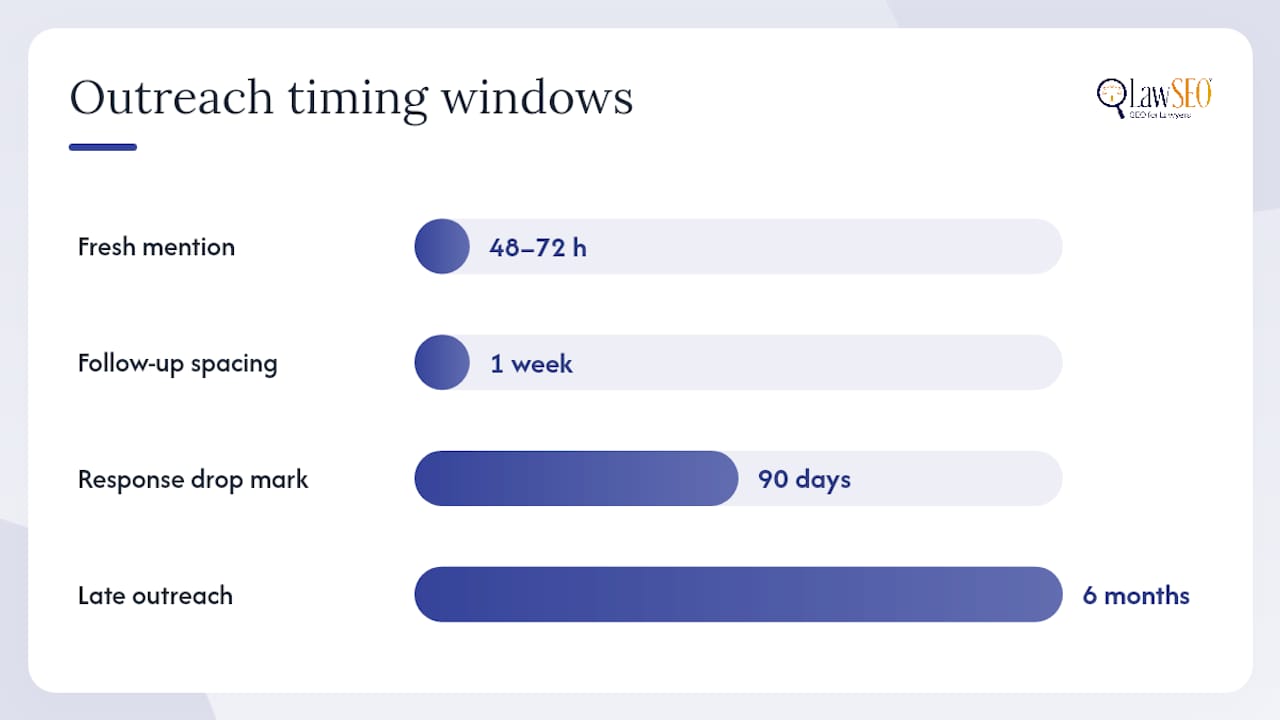
- Send within 48 to 72 hours when the mention is fresh. Industry practitioners consistently report that outreach response rates drop sharply the longer a mention sits, particularly once it passes the 90-day mark, so speed is a real lever here even without a hard published benchmark to cite.
Timing dictates almost everything about your conversion rate. A mention published yesterday, while the writer’s attention is still on that article, converts far more easily than the same request sent six months later when the piece has scrolled off their radar entirely.
For follow-ups, one or two polite reminders spaced a week or so apart is the ceiling. Beyond that, you’re better off trying an alternative channel, like a direct message to the author on social media or a submission through the outlet’s contributor platform, than sending a third email that starts to look like pressure. Semrush’s outreach framework treats this cadence as standard practice across monitoring and reclamation workflows.
Pro Tip: Keep your first email under 100 words. Editors and freelance writers get pitched constantly, and a short, specific request that names the exact sentence and exact link gets read in full. A long email explaining SEO benefits gets skimmed and ignored.
Log every response, whether it’s a yes, a no, or silence, in a shared tracking sheet. That record becomes your data on which publications, writers, and mention types convert best, which makes your next quarter’s prioritization sharper than this one.
Monitoring Unlinked Mentions at Scale
A one-time audit finds your backlog. A recurring system finds new mentions the week they are published, which is when they are most likely to convert. Building that system means combining automated alerts with a lightweight human review process.
- Set brand-monitoring alerts filtered specifically for “no backlink” results so your team isn’t re-reviewing pages that already link to you.
- Export new mentions weekly into a tracking sheet or CRM with status fields: new, contacted, linked, rejected, no response.
- Automate away low-value noise, like aggregator republications and spam directories, so human reviewers only spend time on top-tier prospects.
- Run both a traditional brand-monitoring scan and a separate AI-visibility report, since Semrush notes these tools are increasingly split into two distinct monitoring streams, one for web mentions and one for how often your brand surfaces inside AI-generated answers.
Automating the repetitive backlink-checking layer frees your team to focus on judgment calls, like which editor is worth a personal follow-up call versus a template email. Practical guidance on setting up automated monitoring pipelines, including scheduling and filter logic, is covered in Baby Love Growth’s guide to automatic backlink monitoring, which pairs well with the manual verification steps above.
For KPIs, track mentions found per month, outreach send rate, response rate, and conversion-to-link rate as your core reporting set. Those four numbers tell you whether the program is actually working or just generating activity.
Measuring Impact: Links, Branded Search, and AI Citations
A converted mention shows up in more places than your backlink report. Track all of them, or you’ll undersell the program’s real value.
- Links gained and referral sessions from each converted mention, tracked individually rather than lumped into a general backlink count.
- Branded search volume and branded-phrase SERP movement, since reclaimed mentions often coincide with more people searching your firm’s name directly.
- AI/LLM citation share, which you can baseline with manual prompt tests across major AI platforms or through emerging AI-visibility reports that Semrush and similar tools now offer as a separate metric from web mentions.
- Time to impact, which runs longer than most teams expect: downstream traffic and ranking effects from reclaimed mentions typically take 60 to 180 days to fully materialize.
Remember that the mention itself never carried link equity, per Search Engine Journal’s reporting on Google’s own statements. The value you’re measuring comes entirely from what happens after conversion, plus whatever entity-recognition lift the raw mention contributed before you ever sent an email.
LawSEO’s Practical Playbook for Law Firm Mention Reclamation
Law firms face a wrinkle general e-commerce or SaaS brands don’t: not every mention deserves equal weight, and outreach language has to stay professional given the ethical scrutiny legal marketing already receives.
Practice-area weighting should come first in your scoring model. A mention on a personal injury settlement roundup carries different value for a plaintiff-side firm than for a corporate defense practice, so score mentions against the specific practice pages they’d realistically support, not against your homepage.
- Weight plaintiff-side mentions higher when they appear on personal injury, malpractice, or consumer-advocacy coverage.
- Weight defense-side and corporate mentions higher on business press, trade publications, and regulatory coverage.
- Treat local news and bar association mentions as high priority regardless of practice area, since they carry community trust weight AI systems and readers both register.
Outreach language for legal publishers should reference the exact sentence and offer something useful in return, such as a relevant case summary, a practitioner quote, or clarifying commentary, rather than a generic SEO-flavored request. LawSEO’s guidance on brand mentions frames this as a reader-service request first and a link request second, which keeps outreach ethical and improves response rates with legal journalists who are wary of anything that smells like pure promotion.
Reclamation only works when the ask still centers the reader. The moment an outreach email reads like a marketing request instead of a correction or a helpful addition, legal journalists disengage, and rightly so. The firms that convert mentions consistently are the ones that make the editor’s job easier, not the ones with the cleverest subject line.
A first-month sprint for a law firm should look like this: run a full mention audit in week one, score and rank the top 25 candidates in week two, send targeted outreach across weeks two and three using the practice-area weighting above, and report on responses, conversions, and next-month priorities by week four. LawSEO builds this exact cadence into ongoing SEO retainers, treating mention reclamation as a recurring line item rather than a one-off project, alongside broader link acquisition strategy and AI visibility work.
Your 7-Day Starter Checklist
- Run a full brand-monitoring audit and export every unlinked mention you can find.
- Score the top 25 using the traffic, relevance, placement, and recency model.
- Send targeted, short outreach emails to the highest scorers within the first 72 hours.
- Log every response in a shared tracking sheet with clear status fields.
- Reassess monthly, and once in-house capacity maxes out, consider shifting new mention generation to a PR-driven strategy while keeping reclamation in-house.
Expect modest but real gains within 60 to 180 days: a handful of converted links, a small lift in branded search, and better raw material for AI citation.
Why This Matters More Than the Conventional Playbook Admits
Most link-building content still treats unlinked mentions as a backlink shortcut, full stop. That framing is outdated. The research is clear that Google doesn’t pass PageRank through plain text, but it’s just as clear that entity recognition, the thing AI models actually lean on when deciding who to cite, builds from every mention whether it’s linked or not. Treating reclamation purely as a link tactic means you’ll walk past mentions that never convert to a link but still shape whether an AI answer engine names your firm next month.
The conventional advice also underweights speed. Everyone talks about prioritization criteria, but few outreach guides push hard enough on the 48 to 72 hour window. A mention loses conversion potential fast, and most teams still batch outreach weekly instead of treating fresh mentions as time-sensitive.
If you take one thing from this, prioritize recency and page traffic over domain authority, and build the AI-visibility check into your monitoring from day one instead of bolting it on later. Firms that combine both those habits are positioning themselves for whatever search looks like next, not just what it looked like last year.
— TODD
If your firm needs a structured system for finding, scoring, and converting these mentions instead of chasing them ad hoc, LawSEO builds mention reclamation directly into its legal SEO strategy for law firm clients, pairing it with the link building, content, and AI-visibility work that turns a scattered outreach effort into a measurable growth channel.