


TL;DR:
- AI-generated content is created automatically by models like ChatGPT and Midjourney, which learn from large datasets. Nearly three-fourths of new webpages now contain AI-produced text, and visual content is rapidly expanding. Using hybrid workflows with human oversight ensures better quality, accuracy, and transparency in AI-driven content creation.
AI-generated content is defined as any digital media — text, images, audio, or video — produced autonomously by generative machine learning models rather than direct human creation. As of April 2026, 74.2% of new webpages carry AI-generated text, and 71% of social media images are AI-produced. Those numbers tell you this is no longer a niche experiment. Tools like ChatGPT, Midjourney, and Claude now sit at the center of professional content workflows, and understanding how they work is a prerequisite for any creator or marketer who wants to stay competitive.
What is AI-generated content and how does it differ from traditional writing?
AI-generated content, also called synthetic or automated content in industry terminology, is produced by generative AI models that learn statistical patterns from massive training datasets. The output is original in the sense that the model constructs it from scratch, not by copying stored text. That distinction matters because it separates generative AI from a search engine or a database lookup.
Traditional writing starts with a human idea, research, and deliberate word choice. AI-generated writing starts with a prompt and a probability calculation. The model predicts the most likely next word, then the next, until it produces a complete response. The result can be fluent and useful, but it carries no inherent understanding of truth or context.
For content creators and marketers, the practical difference is speed and scale. A human writer might produce 1,000 words per hour. A well-prompted AI model produces that in seconds. The trade-off is accuracy and brand nuance, which is why human oversight remains the standard in professional workflows.
How does AI generate content? The technology explained
Generative AI uses neural networks trained on massive datasets to predict the most statistically probable next token when generating content. A token is roughly a word fragment, and the model processes billions of them during training to learn language patterns, facts, and stylistic conventions.
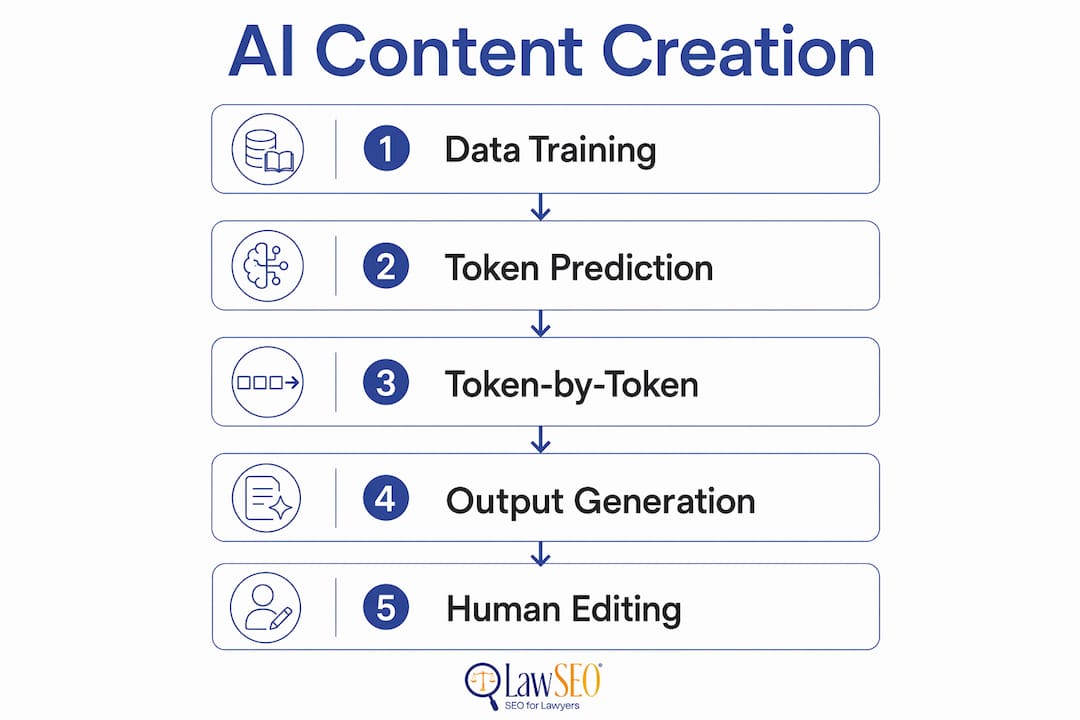
The architecture behind most modern text generators is the transformer model, first introduced by Google researchers in 2017. Models like GPT-4 from OpenAI and Claude from Anthropic are built on this foundation. Image generators like Midjourney use a related but distinct approach called diffusion modeling, which progressively refines a noisy image toward a target based on a text prompt.
Here is what the generation process looks like in practice:
- Training: The model ingests billions of web pages, books, and documents to learn language structure and factual associations.
- Prompt intake: A user submits a text prompt describing the desired output.
- Token prediction: The model calculates probability distributions and selects the most contextually appropriate next token, one at a time.
- Output assembly: Tokens combine into sentences, paragraphs, or full articles.
- Post-processing: Many platforms apply filters, style guides, or safety layers before delivering the final output.
Critically, AI content is generated token-by-token from scratch, not retrieved from a database. This explains why AI models sometimes produce confident but factually wrong statements, a phenomenon called hallucination.
Pro Tip: Treat AI as a collaborator, not an autonomous author. The quality of your output depends directly on the specificity of your prompt. Vague prompts produce generic content; detailed prompts with context, tone guidance, and examples produce content worth editing.
What types of AI-generated content exist?
The scope of AI content creation extends well beyond blog posts. Generative models now produce professional-grade output across every major content format.
| Content Type | AI Tools Commonly Used | Typical Use Cases |
|---|---|---|
| Long-form text | ChatGPT, Claude, Jasper | Blog posts, whitepapers, legal summaries |
| Social media copy | ChatGPT, Copy.ai | Captions, ad copy, engagement posts |
| Product descriptions | ChatGPT, Jasper | E-commerce listings, catalog entries |
| Images and graphics | Midjourney, DALL-E, Adobe Firefly | Social visuals, ad creative, web design |
| Audio and voiceover | ElevenLabs, Murf | Podcasts, explainer videos, IVR scripts |
| Video content | Synthesia, Runway | Training videos, product demos, social clips |
Text remains the dominant format by volume. Product descriptions represent one of the clearest wins for AI content creation: a retailer with 50,000 SKUs cannot staff enough writers to produce unique descriptions for each item, but a well-configured AI workflow can handle that output in hours.
Visual content is the fastest-growing category. Midjourney and Adobe Firefly now produce images that pass casual inspection as photography. That capability has significant implications for brand identity and advertising, where visual consistency drives recognition.
Hybrid workflows are the professional standard. AI drafts curated and edited by humans produce higher quality, more brand-aligned content than raw AI output. A skilled editor reviewing an AI draft catches factual errors, adjusts tone, and adds the specific examples that make content credible and useful.
What are the benefits of AI-generated content for creators and marketers?
The core benefit of AI content creation is the ability to produce more output without proportional increases in cost or time. That efficiency compounds across several specific use cases.
-
High-volume production at scale. An e-commerce brand launching 500 new products can generate first-draft descriptions for all of them in a single afternoon. A law firm publishing weekly educational articles can maintain that cadence without hiring additional writers.
-
Rapid content adaptation. AI models can reformat a single piece of content into multiple formats: a blog post becomes a LinkedIn summary, a Twitter thread, and an email newsletter in minutes. That repurposing capability multiplies the value of every original piece.
-
Personalization at volume. AI tools can generate variations of the same message tailored to different audience segments, geographic markets, or buyer personas. This is impractical at scale with human writers alone.
-
Cost efficiency. Professional AI content platforms integrate writing, design, and video editing with subscriptions around $15 per month. That price point gives independent creators access to production capabilities that previously required agency budgets.
-
SEO content velocity. Search engines reward consistent, topically authoritative publishing. AI tools allow content teams to maintain publishing frequency while keeping human effort focused on strategy, research, and quality control.
Pro Tip: Use AI to handle the first draft and the formatting. Reserve human time for the research, the specific examples, and the final editorial pass. That division of labor produces better content faster than either approach alone.
Generative AI excels at summarizing, repurposing, and drafting product descriptions, which frees content teams to focus on strategy and audience relationships. The productivity gain is real, but it requires deliberate workflow design to capture it.
AI-generated vs. AI-assisted content: what is the difference?
The industry draws a clear line between two categories. Understanding that distinction shapes how you disclose, evaluate, and deploy AI content in your strategy.
AI-generated content is fully produced by a generative model with minimal human input beyond the initial prompt. The model writes the draft, selects the structure, and determines the tone. A human may review it, but the creative decisions are the model’s.
AI-assisted content is human-led work where AI tools support specific tasks. A writer uses Grammarly for grammar checking, ChatGPT to brainstorm headlines, or an AI summarizer to condense research. The human makes the core creative decisions; the AI handles supporting functions.
The distinction matters for three reasons:
- Quality control. Pure AI-generated content often lacks the specific examples, verified facts, and nuanced judgment that make content credible. Human-assisted workflows catch these gaps.
- Platform compliance. Meta, TikTok, and YouTube now require AI content disclosure for synthetic media involving real people. Knowing which category your content falls into determines your disclosure obligations.
- Audience trust. Readers and viewers are increasingly aware of AI content. Transparency about AI involvement builds credibility rather than undermining it.
Verification technology is evolving to support these distinctions. Emerging standards like C2PA and watermarking are replacing unreliable AI detection methods for verifying content origin and authenticity. Cryptographic content credentials embedded at creation time provide a verifiable record of how content was produced.
Best practices for using AI-generated content responsibly
Responsible AI content use requires more than running a prompt and publishing the output. The following practices define the professional standard in 2026.
- Disclose AI involvement transparently. Regulatory bodies and major platforms mandate disclosure for synthetic media. Apply that standard proactively, even where it is not yet legally required. Audiences reward honesty.
- Fact-check every output. AI models generate plausible-sounding text, not verified facts. Every statistic, legal claim, or technical assertion in AI-generated writing requires independent verification before publication.
- Invest in prompt engineering. The quality of AI output is directly proportional to the quality of the input. Detailed prompts that specify audience, tone, format, and key points produce drafts that require less editing.
- Maintain a brand voice guide. Feed AI tools your brand guidelines, sample content, and style preferences. Consistent inputs produce consistent outputs that align with your established voice.
- Apply human editorial review. Hybrid workflows combining AI drafts with expert human editing consistently outperform raw AI output on quality, accuracy, and engagement metrics.
- Monitor platform policy changes. AI disclosure requirements are evolving rapidly. Assign someone on your team to track policy updates from Meta, Google, TikTok, and YouTube on a quarterly basis.
Pro Tip: Build a prompt library for your most common content tasks. A tested, refined prompt for product descriptions or social captions saves setup time on every project and produces more consistent results than starting from scratch each time.
Transparency about AI involvement and compliance with platform disclosure mandates is the defining credibility standard for content professionals in 2026. Treat it as a non-negotiable part of your publishing process.
Key takeaways
AI-generated content delivers real efficiency gains for creators and marketers, but quality, accuracy, and transparency require deliberate human oversight at every stage of the workflow.
| Point | Details |
|---|---|
| Definition and scale | AI-generated content is produced autonomously by generative models; 74.2% of new webpages now carry AI-generated text. |
| How generation works | Models predict tokens one at a time from learned patterns, which means output is original but not always factually accurate. |
| Content types | Text, images, audio, and video are all AI-producible; hybrid workflows combining AI drafts with human editing produce the best results. |
| Disclosure requirements | Meta, TikTok, and YouTube require AI content disclosure; C2PA and watermarking are the emerging verification standards. |
| Best practice | Use AI for volume and speed; reserve human effort for fact-checking, brand voice, and editorial judgment. |
My take on where AI content is actually headed
After nearly three decades in SEO and digital marketing, I have watched a lot of technologies get overhyped and underdelivered. AI-generated content is not one of them. The productivity gains are genuine, and the floor on output quality keeps rising.
What concerns me is the assumption that AI content is a set-and-forget solution. The creators and marketers I see getting real results from tools like ChatGPT and Midjourney are the ones who treat the AI as a first-draft engine, not a finished product. They invest time in prompt refinement, maintain strict editorial standards, and disclose AI involvement without hesitation.
The legal sector, where Lawseo operates, faces a sharper version of this challenge. A hallucinated statute citation in a law firm blog post is not just an embarrassment. It is a credibility risk that can cost clients. That reality makes the hybrid workflow model not just best practice but a professional obligation.
The future of AI content is not fully automated publishing. It is a tighter collaboration between human expertise and machine speed. The professionals who build that collaboration deliberately will produce content that outperforms both pure AI output and purely manual work. The ones who skip the human layer will produce volume without value.
For AI-driven content strategy to deliver long-term results, the human judgment layer cannot be optional. That is the lesson I keep coming back to.
— TODD
How Lawseo helps you turn AI content into search visibility
Understanding AI-generated content is the first step. Turning it into measurable search visibility requires a strategy built for how AI-driven platforms actually rank and cite content. Lawseo specializes in exactly that. With over 29 years of SEO experience, Todd R. Stager and the Lawseo team build content strategies that perform in both traditional Google rankings and emerging AI search platforms like ChatGPT and Perplexity. If you are ready to make your content work harder in the AI era, explore Lawseo’s SEO services and see how a purpose-built strategy can drive more qualified leads to your practice.
FAQ
What is AI-generated content in simple terms?
AI-generated content is digital material produced autonomously by a generative AI model, such as ChatGPT or Midjourney, based on patterns learned from large training datasets rather than direct human authorship.
Is AI-generated content reliable?
AI-generated content is not inherently reliable because models generate output token-by-token from learned patterns, which can produce factually incorrect statements known as hallucinations. Every AI-generated claim requires human fact-checking before publication.
How does AI-generated content affect SEO?
Search engines evaluate content quality, accuracy, and user value regardless of whether a human or AI produced it. Pure AI output without human editing often ranks poorly; hybrid workflows that combine AI drafts with expert human review consistently perform better in search results.
What are the disclosure rules for AI-generated content in 2026?
Meta, TikTok, and YouTube require disclosure of synthetic media involving real people. Emerging standards like C2PA provide cryptographic content credentials that verify content origin, replacing less reliable AI detection tools.
What is the difference between AI-generated and AI-assisted content?
AI-generated content is fully produced by a generative model with minimal human input. AI-assisted content is human-led work where AI tools support specific tasks such as grammar checking, headline brainstorming, or content summarization.