

Generative AI has become a flashpoint in legal marketing, with some attorneys worried about hallucinations and bar sanctions while others embrace the technology for efficiency gains. The truth lies between these extremes. When implemented with proper oversight and structured workflows, generative AI transforms how law firms attract clients, optimize content, and scale marketing operations. This guide explains the mechanics of AI tools in legal marketing, outlines compliance-focused best practices, addresses hallucination risks, and presents real conversion data to help you make informed decisions about integrating AI into your firm’s growth strategy.

Key takeaways
| Point | Details |
|---|---|
| AI transforms workflows | Generative AI in legal marketing uses large language models for content and chatbots for 24/7 lead qualification with predictive analytics. |
| Human oversight is critical | Attorney review of all AI outputs mitigates hallucinations and ensures compliance with bar rules and ethical standards. |
| Accuracy requires grounding | Source-grounded, jurisdiction-specific prompts combined with retrieval-augmented generation drastically reduce fabricated citations and outdated information. |
| Conversion gains are measurable | AI-driven intake and lead scoring deliver 30-60% conversion improvements, but hybrid human-AI approaches optimize final results. |
| Balance efficiency with compliance | Structured workflows that assign marketing teams for tone and attorneys for legal accuracy offer the best path forward. |
Understanding generative AI mechanics in legal marketing
Generative AI tools in legal marketing operate through distinct technologies that serve different functions. Large language models generate blog posts, practice area pages, and FAQ content tailored to legal topics by predicting word sequences based on training data. AI chatbots handle lead intake around the clock, answering prospect questions and qualifying cases to reduce missed opportunities. Predictive lead scoring applies machine learning algorithms to historical conversion data, identifying which prospects have the highest likelihood of becoming clients. Personalized outreach uses natural language processing to craft targeted email sequences and social media messages that resonate with specific practice area audiences.
These technologies work best in hybrid workflows. AI generates initial drafts, marketing teams refine tone and messaging, and attorneys verify legal accuracy before publication. This division of labor maximizes efficiency while maintaining quality standards.
Pro Tip: Start with low-risk content like blog intros or FAQ answers to test AI outputs before deploying the technology for client-facing communications or complex legal explanations.
The mechanics matter because different AI applications carry different risk profiles. Content generation for SEO pages poses lower stakes than automated client intake responses. Understanding these distinctions helps you allocate oversight resources appropriately. AI in legal marketing 2026 trends show firms increasingly adopt tiered approaches, using AI extensively for research and drafting while maintaining strict human review for anything prospects or clients see directly.
Key workflow components include:
- Topic intake systems that feed AI generators with jurisdiction-specific prompts and current legal developments
- Draft review protocols assigning marketing staff to check brand voice and attorneys to verify legal substance
- Publication approval gates requiring final sign-off before content goes live
- Performance monitoring to track which AI-generated materials drive engagement and conversions
This structured approach transforms AI from a risky shortcut into a scalable marketing engine. The technology handles repetitive tasks like drafting initial outlines or answering common questions, freeing your team to focus on strategy, relationship building, and complex legal analysis that genuinely requires human expertise.
Best practices and compliance: hybrid workflows and attorney oversight
Ethical AI adoption in law firms demands attorney oversight at every stage. The ‘lawyer-in-the-loop’ protocol ensures all AI outputs receive human review before publication, protecting against hallucinations and compliance violations. Structured workflows reduce AI hallucinations and bar rule violations by establishing clear review responsibilities. Marketing teams verify brand consistency and readability while attorneys confirm legal accuracy and jurisdiction-specific details.
Source-grounded prompting forms the foundation of reliable AI content. Instead of asking AI to generate legal explanations from memory, provide current statutes, recent case summaries, or authoritative legal guides as source material. This approach anchors outputs in verified information rather than the model’s potentially outdated training data. Jurisdiction specificity matters enormously because legal rules vary by state and change frequently. A prompt requesting “personal injury statute of limitations” without specifying California versus New York will produce generic, potentially misleading content.
Pro Tip: Maintain a library of jurisdiction-specific source documents and regulatory updates that you can feed into AI prompts, ensuring outputs reflect current law rather than outdated training data.
Implement these workflow stages:
- Topic intake with jurisdiction and practice area specifications
- AI drafting using source-grounded prompts and current legal materials
- Marketing review for tone, readability, and brand alignment
- Attorney verification of legal substance, citations, and compliance
- Final approval and publication with version tracking
- Ongoing monitoring for performance and accuracy issues
This staged approach creates accountability checkpoints that catch errors before they reach prospects or clients. Assign specific team members to each stage so responsibility is clear. Document your workflow in writing and train everyone on their role in the AI review process.
Regular monitoring of AI outputs helps you spot patterns in errors or hallucinations. If you notice the AI consistently struggles with certain legal concepts or jurisdictions, adjust your prompts or increase human oversight for those topics. AI in legal marketing 2026 best practices emphasize continuous improvement, treating AI implementation as an evolving process rather than a one-time setup. Track which content performs well and which generates client confusion, then refine your approach accordingly.
Compliance extends beyond accuracy to include ethical advertising rules. AI-generated content must avoid guarantees, comparisons to other firms, or misleading statements about results. Your attorney reviewers should specifically check for language that violates bar advertising guidelines, even if the content is factually accurate.
Navigating challenges: hallucinations, risks, and risk mitigation
AI hallucinations pose serious risks in legal contexts. Hallucination rates range from 58-88% depending on query complexity, with legal questions triggering higher error rates than general topics. These fabrications include invented case citations, non-existent statutes, and incorrect procedural rules. The consequences extend beyond embarrassment to bar sanctions, malpractice liability, and destroyed client trust.
Risks break down into several categories. Ethical violations occur when AI-generated content makes false claims about firm capabilities or results. Sanctions follow when attorneys rely on fabricated citations in court filings or client advice. Liability emerges if prospects make decisions based on inaccurate AI-generated legal information published on your website. Reputational damage compounds these risks when errors become public.
“The legal profession’s adoption of AI must balance innovation with the fundamental duty to provide competent, ethical representation. Hallucinations aren’t just technical glitches; they’re potential bar violations.”
Retrieval-augmented generation (RAG) drastically reduces hallucinations by fetching real documents during the generation process. Instead of relying solely on training data, RAG systems search your knowledge base or approved legal databases for relevant information, then use those sources to ground responses. This approach transforms AI from a creative writer into a research assistant that synthesizes verified materials.
Fine-tuning models on your firm’s practice areas and jurisdictions improves accuracy for specialized queries. A model trained on California employment law will outperform a general legal AI when answering questions about meal break requirements or independent contractor classification. However, fine-tuning requires technical expertise and ongoing updates as laws change.
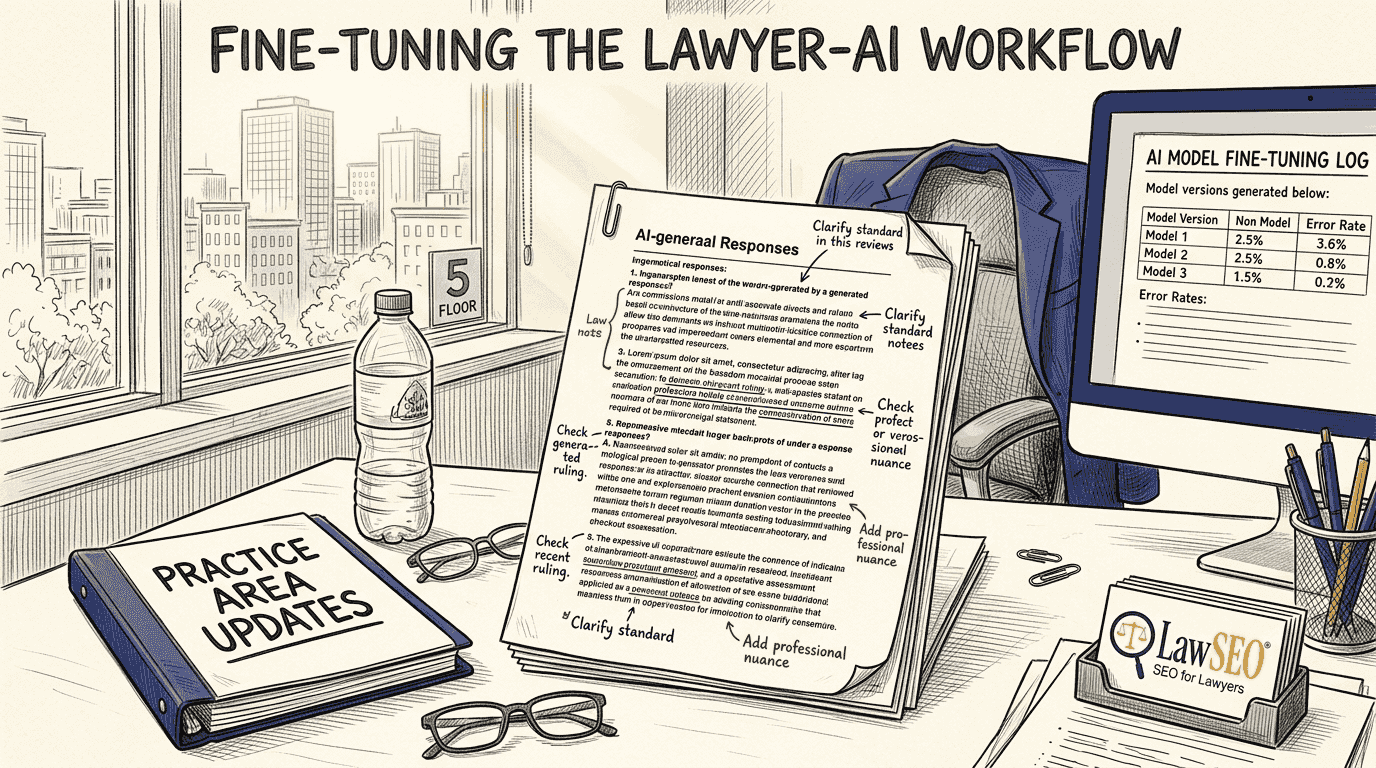
Human verification remains the most reliable safeguard. Even with RAG and fine-tuning, assign attorneys to check every legal claim, citation, and procedural statement before publication. This verification step catches the remaining errors that technical solutions miss.
| Mitigation Strategy | Hallucination Reduction | Implementation Complexity | Ongoing Cost |
|---|---|---|---|
| Attorney review | 95%+ | Low | Medium |
| Retrieval-augmented generation | 70-85% | High | Low |
| Model fine-tuning | 60-75% | Very high | High |
| Source-grounded prompts | 50-65% | Low | Low |
Structured AI safety models increase contract accuracy but may refuse more queries to avoid errors. This trade-off between helpfulness and safety requires calibration based on your risk tolerance. For client-facing chatbots, err toward safety even if it means some questions receive “consult an attorney” responses rather than specific answers.
Combine multiple mitigation strategies for best results. Use source-grounded prompts with RAG, then add human verification as the final check. This layered approach addresses different error types and provides redundancy when individual safeguards fail. AI in legal marketing 2026 leaders implement comprehensive safety protocols rather than relying on single solutions.
Key risk mitigation practices:
- Maintain updated legal source libraries for RAG systems
- Flag high-risk content types for enhanced attorney review
- Document all AI-generated content with version history and reviewer names
- Establish error reporting channels so team members can flag hallucinations quickly
- Review competitor AI implementations to learn from their mistakes
Real-world impacts: conversion gains, lead quality, and ROI benchmarks
Empirical data shows measurable benefits from well-implemented AI marketing. AI-driven intake delivers 30-60% conversion improvements and 50-60% lead quality gains when combined with predictive scoring. AI chatbots provide 24/7 availability, answering 99.9% of incoming inquiries and reducing missed opportunities that cost firms an average of $250,000 annually in lost cases.
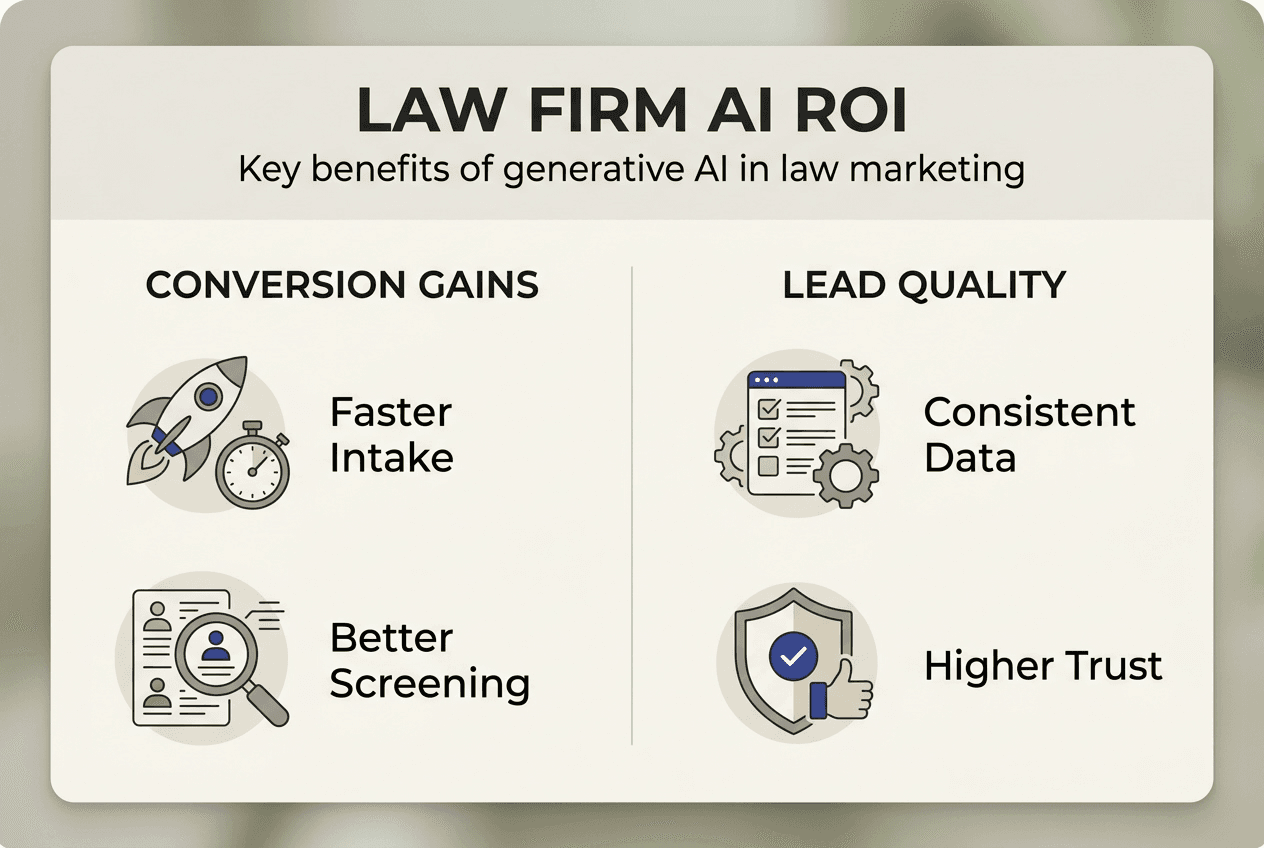
Conversion rate improvements stem from faster response times and consistent qualification processes. AI chatbots engage prospects immediately rather than forcing them to wait for business hours. This instant interaction captures leads who might otherwise contact competitors or lose interest. Predictive lead scoring helps intake teams prioritize follow-up, focusing human attention on prospects most likely to convert.
Lead quality gains result from better qualification questions and data capture. AI chatbots ask consistent screening questions, gathering case details that help attorneys assess viability before investing time in consultations. This filtering reduces wasted effort on low-value inquiries while identifying high-potential cases quickly.
Pro Tip: Balance AI chatbot automation with human follow-up by having attorneys personally contact qualified leads within hours, combining AI efficiency with the personal touch that closes cases.
AI-generated content itself shows no direct ranking correlation in search algorithms, but supports broader marketing goals. Blog posts and FAQ pages created with AI assistance build topical authority, provide answers for voice search queries, and create entry points for prospects researching legal issues. The content feeds your marketing funnel even if individual pages don’t rank highly.
| Metric | Traditional Approach | AI-Enhanced Approach | Improvement |
|---|---|---|---|
| Lead response time | 4-24 hours | Instant | 95%+ |
| Qualification consistency | Variable | Standardized | 80%+ |
| After-hours capture | 0-20% | 95%+ | 300-400% |
| Cost per qualified lead | $200-400 | $120-250 | 30-40% |
ROI measurement requires piloting specific use cases before firm-wide deployment. Start with FAQ pages or practice area content where stakes are lower and results are easier to track. Measure traffic, engagement, and conversion rates against industry benchmarks, then expand successful implementations while adjusting or abandoning approaches that underperform.
Key performance indicators to track:
- Lead volume and quality scores before and after AI implementation
- Conversion rates from initial contact through signed retainer
- Cost per acquisition compared to traditional marketing channels
- Attorney time spent on intake versus substantive legal work
- Client satisfaction scores for AI-assisted versus traditional intake
Balance automation with human connection. While AI handles initial qualification efficiently, prospects still want to speak with attorneys before making hiring decisions. The optimal approach uses AI to handle repetitive tasks and data gathering, freeing attorneys to focus on relationship building and case assessment during consultations. AI chatbots boost client engagement when deployed as part of a hybrid strategy rather than complete automation.
Some firms report slightly lower final conversion rates with pure AI intake compared to human-only approaches, suggesting prospects value personal interaction at decision points. The solution isn’t abandoning AI but rather using it strategically for tasks where automation excels while preserving human touchpoints that build trust and close cases. This nuanced implementation delivers efficiency gains without sacrificing the relationship-focused approach that distinguishes successful law firms.
Enhance your law firm marketing with AI optimization solutions
Transforming these AI insights into results requires specialized expertise in both legal marketing and emerging technologies. SEO for Lawyers, LLC combines 29 years of search optimization experience with cutting-edge AI strategies designed specifically for law firms. Our founder-led approach ensures every campaign receives expert oversight, implementing the compliance-focused workflows and hybrid human-AI systems outlined in this guide. We help firms deploy AI chatbots, optimize content for generative AI search platforms, and build predictive lead scoring systems while maintaining strict ethical standards. Explore our comprehensive SEO for lawyers guide or dive into specialized AI search optimization for law firms resources to start leveraging these technologies effectively.
What is generative AI in legal marketing?
Generative AI uses machine learning models to create marketing content, automate lead intake conversations, and personalize outreach based on prospect behavior and case characteristics. It helps law firms scale content production, maintain 24/7 client engagement, and improve online visibility across traditional search engines and emerging AI platforms. When combined with attorney review and structured workflows, generative AI enhances efficiency without compromising accuracy or ethical compliance.
How can law firms manage AI hallucination risks?
Use attorney oversight protocols requiring human verification of all AI outputs before publication or client delivery. Implement retrieval-augmented generation systems that ground AI responses in verified legal sources rather than relying on potentially outdated training data. Create jurisdiction-specific prompts that include current statutes and case law. Regularly update your AI training materials and monitor outputs for fabricated citations, incorrect procedural rules, or outdated legal information.
What measurable benefits can law firms expect from generative AI?
Expect 30-60% improvements in lead conversion rates and 50-60% increases in lead quality when using AI for intake and predictive scoring. AI chatbots reduce missed calls and after-hours lead losses, potentially saving firms hundreds of thousands annually in lost cases. Content production efficiency gains range from 40-70%, freeing marketing teams to focus on strategy and relationship building. ROI varies based on implementation quality, with hybrid human-AI workflows consistently outperforming pure automation approaches.
Should law firms use AI for client-facing communications?
AI can handle initial client intake questions and qualification through chatbots, but human attorneys should review complex inquiries and make final case assessments. Use AI to gather case details, schedule consultations, and provide general information about practice areas. Reserve human interaction for relationship building, legal advice, and decision points where prospects evaluate whether to hire your firm. This hybrid approach combines AI efficiency with the personal connection that converts prospects into clients.
How do I measure ROI from AI marketing investments?
Start with pilot projects in low-risk areas like FAQ content or blog post drafting. Track lead volume, qualification rates, and conversion percentages before and after AI implementation. Measure cost per qualified lead compared to traditional marketing channels. Monitor attorney time allocation to quantify efficiency gains from AI handling routine tasks. Compare your results against industry benchmarks, then scale successful implementations while refining or eliminating underperforming approaches based on data rather than assumptions.