


Citation building is the process of creating and managing online mentions of your business name, address, phone number, and related details so that search engines and customers can consistently find and verify you. The single most useful action you can take right now is a NAP audit: check that your Name, Address, and Phone number are identical on your own website and your Google Business Profile before you build a single new listing.
- What it is: Citation building creates and maintains accurate business mentions across directories, review sites, and editorial sources to support local SEO.
- Immediate next step: Run a NAP audit on your website footer, your Google Business Profile, and your top three directory listings before adding anything new.
- Why audit first: Fixing mismatched legacy data frequently improves Local Pack rankings faster than creating new listings.
Pro Tip: Before you claim a single new directory listing, search your phone number in Google. Every result that shows a different address or business name is a citation error that needs fixing first.
What citation building actually means (and the two types you need to know)

A citation, in local SEO terms, is any online reference to your business that includes at least your name, address, and phone number. Those three fields are collectively called NAP. Most high-value citations also include your website URL, business category, hours of operation, and a description. Citation building focuses on accurate listings and discoverability rather than purely backlink authority, which is what separates it from link building.
Every citation falls into one of two categories.
Structured citations are standardized directory-style listings where every business fills in the same fields. The platform controls the format.
- Google Business Profile
- Yelp
- Bing Places
- Apple Maps (via Apple Business Connect)
- Yellow Pages
Unstructured citations are editorial mentions in running text: a local news article that names your firm, a community blog post about a sponsorship, an association member directory, or an event page listing your business as a sponsor. Unstructured citations require more outreach but carry higher editorial relevance and stronger trust signals, especially for AI-driven search results.
Some sources blend both types. A Facebook business page has structured fields (address, phone, hours) but also allows free-form posts and reviews that function as unstructured mentions. Local bar association directories often work the same way: a structured profile with editorial context around it.
Here is a quick illustration of each type in practice:
- Structured example: Your law firm’s Yelp listing, with your firm name, suite address, direct phone number, practice areas, and hours all entered in Yelp’s standard fields.
- Unstructured example: A local legal news site publishes a profile of your firm after a notable case verdict, mentioning your firm name, city, and phone number in the article body.
Why citation building improves your local search rankings
Search engines do not simply trust what your Google Business Profile says. Google’s local ranking algorithm cross-references your GBP against hundreds of external citation sources to validate your business identity and location. When those external sources confirm your GBP data, your local prominence score rises. When they contradict it, your prominence drops.
The practical consequences are significant:
- Local Pack visibility: Consistent citations across major platforms increase the likelihood your business appears in the three-pack of local results.
- Accurate knowledge panels: Agreed-upon NAP data across sources produces cleaner, more complete knowledge panels in Google Search.
- Fewer misdirected contacts: Customers calling an old phone number or navigating to a former address represent lost business, not just an SEO problem.
- AI answer inclusion: Unstructured mentions supply descriptive context that generative AI tools synthesize when answering questions like “Who is the best personal injury attorney near me?”
Consider a concrete risk scenario: a law firm moves offices but updates only its GBP. Dozens of directories still show the old address. Google’s algorithm sees conflicting data across sources and reduces its confidence in the firm’s location. The firm drops from the Local Pack for its primary practice area keywords, and calls from prospective clients go to the old number still listed on Avvo and Yellow Pages.
Updating GBP alone is often insufficient because legacy data persists on secondary directories long after the primary listing is corrected.
Where your citations should appear: a prioritized source list
Not all citation sources carry equal weight. The most efficient strategy is to claim major platforms first, then layer in industry-specific and geo-specific directories.
High-priority structured sources (claim these first):
- Google Business Profile — the single most important citation source; directly influences Local Pack rankings
- Bing Places — feeds Microsoft’s search and Cortana; often overlooked but straightforward to claim
- Apple Business Connect — controls how your business appears in Apple Maps and Siri results
- Facebook — high-traffic, high-trust; also feeds third-party data aggregators
- Yelp — major consumer review platform with strong domain authority
- Yellow Pages — legacy authority; still feeds several downstream aggregators
High-priority unstructured and industry-specific sources:
- Avvo — the dominant legal directory; a claimed, optimized Avvo profile is a trust signal for law firms that prospective clients actively check
- Justia — free legal directory with strong domain authority and attorney profile pages
- Local news sites and community blogs — editorial mentions that carry genuine trust weight
- State and local bar association member directories — high-authority, niche-relevant
- Community sponsorship and event pages — unstructured but credible
| Source | Type | Ease to Claim | Typical Cost |
|---|---|---|---|
| Google Business Profile | Structured | Easy (online verification) | Free |
| Bing Places | Structured | Easy (import from GBP) | Free |
| Apple Business Connect | Structured | Moderate (Apple ID required) | Free |
| Structured/Unstructured | Easy | Free | |
| Yelp | Structured | Easy | Free (paid upgrades available) |
| Yellow Pages | Structured | Moderate | Free basic listing |
| Avvo | Structured/Unstructured | Moderate | Free (paid tiers available) |
| Justia | Structured | Easy | Free |
How to build citations step by step

This process works whether you handle it yourself or hand it to an agency. Follow the steps in order.
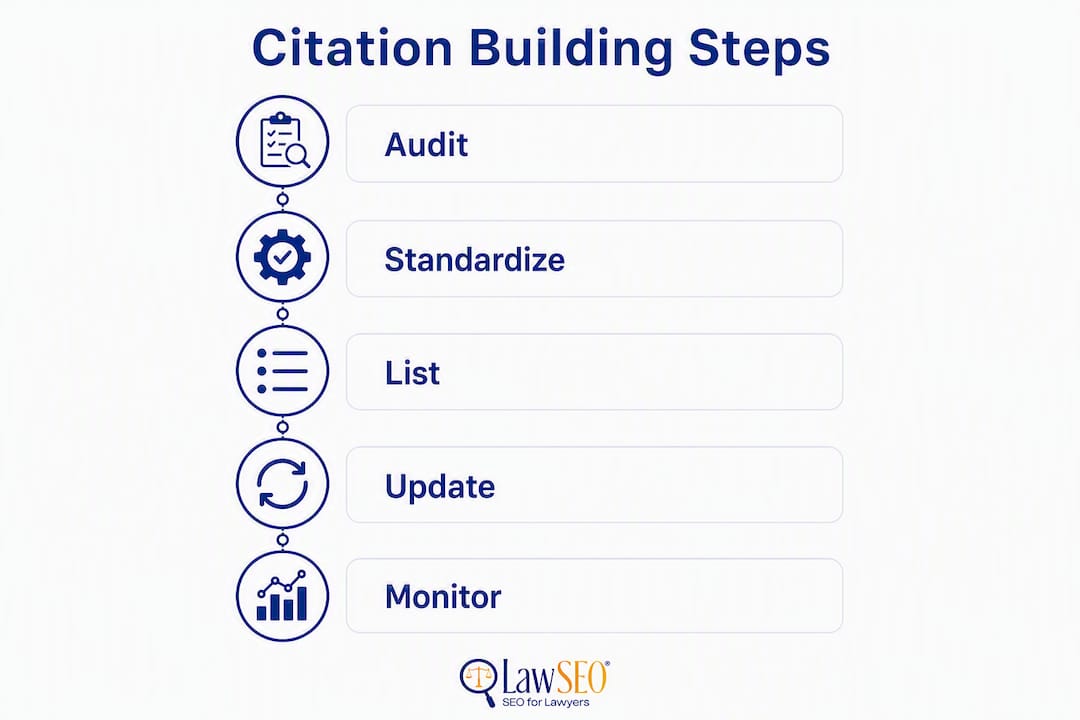
Step 1: Audit your existing citations
Search your business name, phone number, and address in Google. Record every listing you find in a spreadsheet: the platform, the NAP data shown, whether it is claimed, and any discrepancies. Note duplicates. Your spreadsheet becomes your citation master record.
- Tools to use: Google Search (manual), BrightLocal, Moz Local, or Flento for automated scanning
- What to record: canonical NAP, current listed NAP, claimed status, duplicate listings, incorrect phone numbers
Step 2: Establish your canonical NAP and update your website
Pick one exact format for your business name, address, and phone number. Character-for-character consistency matters: “Suite 400” and “Ste. 400” are different strings to a search engine. Inconsistent schema.org markup versus GBP values is a common overlooked source of NAP mismatch. Update your website footer and your LocalBusiness schema markup to match this canonical form exactly.
Step 3: Claim and fully optimize high-priority structured listings
Work through Google Business Profile, Bing Places, Apple Business Connect, Yelp, and Facebook in that order. For each:
- Verify ownership through the platform’s process
- Fill every available field (name, address, phone, website, categories, hours, description, photos)
- Use your canonical NAP exactly as established in Step 2
Step 4: Build niche and local directory listings
For law firms, this means Avvo and Justia at minimum. Beyond those, target your state bar’s member directory, local legal associations, and community organizations where your firm has a presence. Pursue unstructured mentions through PR outreach: local news, community blogs, and sponsorship pages. See local citation examples for lawyers for a more detailed breakdown of legal-industry sources.
Step 5: Fix inconsistencies and set a monitoring cadence
Merge or close duplicate listings. Update old phone numbers and addresses on every platform in your spreadsheet. Many SMBs don’t discover citation inconsistencies until rankings drop, so set a quarterly review date in your calendar now.
Pro Tip: Fix before you build. Cleaning up three conflicting phone numbers on legacy directories will move your Local Pack ranking faster than submitting to twenty new directories with the same inconsistent data.
Best practices and common mistakes in citation management
Getting citations right is less about volume and more about precision. Here are the practices that hold up over time.
Best practices:
- Use one canonical format for your business name, address, and phone number and never deviate from it
- Include suite numbers, floor numbers, and building identifiers consistently across every listing
- Link to your main website URL, not a campaign landing page or social profile
- Select the most accurate business categories available on each platform
- Keep a citation spreadsheet updated every time you make a change
Common red flags and what to do about them:
- Mismatched phone numbers: Update every instance to your canonical number; do not leave old numbers active on any platform
- PO boxes or virtual office addresses: Google’s guidelines prohibit listing a PO box or virtual address as your business location; use your actual office address
- Abandoned listings with outdated hours: Claim them, update the information, and mark them as permanently closed if the location no longer exists
- Bulk low-quality citation submissions: Aggregator submissions alone deliver mixed SEO outcomes compared to authoritative directories and editorial mentions; volume-first strategies can introduce inaccuracies at scale
The danger of chasing volume is real. A service that submits your business to 300 directories in 48 hours often creates listings with slightly wrong addresses, truncated names, or outdated phone numbers pulled from old data. Each inaccurate listing is a new data conflict for Google to weigh against your GBP. Accuracy is the priority: mismatched phone numbers and addresses are major red flags compared with minor abbreviation differences.
How to measure citation health and which tools help
Knowing your citation health requires tracking a handful of specific metrics, not just counting how many listings you have.
Key metrics to monitor:
- NAP consistency rate: The percentage of your active listings that match your canonical NAP exactly
- Duplicate count: The number of duplicate listings on any single platform
- Unclaimed high-priority listings: How many of your top-tier platforms remain unverified
- Time-to-propagation: How long after a GBP update it takes secondary directories to reflect the change
- Indexation checks: Whether Google has indexed your key directory listings
| Tool Category | Importance for Citation Work | Ease of Use | Typical Cost Model |
|---|---|---|---|
| Manual (spreadsheet + Google Search) | High for initial audit | Moderate (time-intensive) | Free (time cost only) |
| SMB SaaS audit tools | High for ongoing monitoring | Easy (automated scans) | Monthly or one-time fee |
| Enterprise listing manager | High for multi-location or high-volume | Moderate (setup required) | Monthly subscription |
For law firms evaluating tool options, Lawseo’s guide to best local SEO tools for lawyers covers tool categories and selection criteria specific to legal practices.
A manual audit using Google Search is a reasonable starting point for a solo practitioner or small firm. Search your phone number in quotes, then your business name in quotes, and review every result. An SMB SaaS tool automates this scan and produces a prioritized fix list, which is more efficient once you have more than a dozen active listings to track.
Research insights: why accuracy beats volume, and what AI search changes
The role of citations in local SEO has shifted. Through most of the 2010s, citation building was largely a volume game: more listings meant more signals. That calculus has changed. Citation value has evolved from a volume metric to a trust-verification signal, and unstructured mentions now play a larger role in generative AI search results.
When a user asks ChatGPT, Perplexity, or Google’s AI Overviews for a recommendation, the AI synthesizes answers from editorial content, not just directory listings. An unstructured mention in a local legal publication, a bar association spotlight, or a community news article provides the descriptive context those systems use to characterize your firm. For law firms specifically, unstructured citations such as local legal news mentions and association spotlights often deliver stronger trust and reputation signals than generic directory listings.
The practical implication for small businesses and law firms is an audit-first, quality-first approach. Prioritize high-authority platforms and industry-specific mentions over bulk submissions. For attorneys, a well-maintained Avvo profile, an accurate Justia listing, and a mention in your state bar’s newsletter carry more weight than fifty low-authority directory submissions combined. Lawseo’s work on why citations matter in legal SEO covers this trust-signal dynamic in depth for legal practices.
Todd R. Stager, founder of Lawseo with over 29 years of SEO experience, has consistently observed that law firms with clean, accurate citations across a focused set of authoritative sources outperform competitors who chase volume on low-quality directories.
What citation work actually costs and how long it takes
Setting realistic expectations prevents two common mistakes: expecting overnight results and underestimating the ongoing maintenance commitment.
Typical timeline:
- Initial NAP audit: 1–2 days for a small business with fewer than 20 active listings; longer for multi-location firms
- High-priority claims and fixes: 2–6 weeks to claim, verify, and fully optimize GBP, Bing Places, Apple Business Connect, Yelp, and Facebook
- Broader structured build: 1–3 months to work through industry directories, local associations, and niche platforms
- Ongoing monitoring: Quarterly checks for most small businesses; monthly for active practices with frequent changes (new attorneys, address updates, phone changes)
Cost shapes by approach:
- DIY: No direct cost beyond your time; realistic for a solo practitioner willing to invest 10–20 hours upfront and a few hours per quarter
- SMB SaaS tools: One-time or low monthly fees for audit and monitoring tools; practical for businesses that want automation without full agency management
- Agency or managed service: Monthly retainer covering audit, cleanup, ongoing submissions, schema fixes, and monitoring; appropriate for busy practices where time is the binding constraint
The local SEO checklist for law firms from Lawseo pairs well with this timeline if you want a structured implementation plan to follow alongside citation work.
Businesses that fix NAP inconsistencies typically see Local Pack ranking improvements within weeks, according to Flento’s analysis of citation audit outcomes. That window assumes the fixes propagate across major platforms, which is why starting with GBP, Yelp, and Apple Maps matters most.
Key Takeaways
Accurate, consistent citations across authoritative platforms improve local search visibility faster than adding volume to low-quality directories, making an audit-first approach the most efficient path to Local Pack rankings.
| Point | Details |
|---|---|
| Audit before you build | Fixing existing NAP mismatches delivers faster Local Pack gains than creating new listings. |
| Accuracy over volume | Mismatched phone numbers and addresses are major red flags; minor abbreviation differences are not. |
| Claim GBP and top platforms first | Google Business Profile, Bing Places, Apple Business Connect, Yelp, and Facebook are the highest-priority structured citations. |
| Pursue unstructured mentions | Editorial mentions in news, bar associations, and community sites feed AI search answers and build trust signals. |
| Lawseo for law firms | Lawseo provides citation audits, schema fixes, and ongoing monitoring as part of its legal SEO services for attorneys. |
Why citation quality defines local SEO outcomes for law firms
Most of the firms that come to Lawseo for help have the same problem: they updated their GBP when they moved or changed their phone number, assumed that was sufficient, and then watched their Local Pack rankings erode over the following months. The issue is almost always legacy data on secondary directories that never got updated.
What I have seen consistently, across hundreds of law firm campaigns, is that the firms with the cleanest citation profiles outperform competitors with more listings but messier data. A personal injury attorney with accurate, consistent citations on 15 high-authority platforms will outrank a competitor with 200 inconsistent directory submissions. The math is not about quantity.
For law firms, the stakes are higher than for most small businesses. A prospective client searching for an attorney at 10 PM is not going to call back if they reach a disconnected number or navigate to an empty office suite. That lost contact is a lost case. Lawseo’s approach starts with a full citation audit for every client, and we hold exclusivity by geography, meaning we will not work with your direct local competitors. If you want to understand where your citation profile stands, requesting an audit is the right first step.
Lawseo’s citation-building services for law firms
Lawseo handles the full citation workflow for attorneys and law firms: initial NAP audit, claiming and verifying high-priority structured listings, schema.org LocalBusiness markup corrections, unstructured mention outreach to legal publications and bar associations, and ongoing quarterly monitoring. The firm works exclusively in the legal sector, which means every recommendation is calibrated to the directories, trust signals, and competitive dynamics that actually move the needle for law practices.
If your firm has recently moved, changed phone numbers, or simply never audited its citation profile, the gap between your GBP and your secondary listings is likely costing you Local Pack visibility right now. To see where you stand, review Lawseo’s legal SEO strategies for law firms or contact the team directly at lawseo.com to request a citation audit for your practice.
Useful sources and further reading
The following sources were used in this article and are worth bookmarking for your own citation work:
- NAP Consistency: What It Is, Why It Matters, and How to Fix It — Flento’s detailed breakdown of NAP mechanics, including how Google cross-references GBP against external sources and typical ranking recovery timelines.
- What is NAP in local SEO? — Moz’s authoritative overview of NAP accuracy, including why conflicting phone numbers and addresses are treated as major trust red flags.
- NAP Consistency Checker 2026: Local Citation Audit — Practical audit methodology, tool recommendations, and the case for fixing before building.
- Structured vs. unstructured citations for local SEO — Search Engine Land’s guide to how citation types differ in SEO value and AI search relevance.
- How to build local citations and increase your visibility — Semrush’s prioritized approach to citation building, including major platforms and niche directories.
- What are local citations? — WordStream’s clear explanation of how citations differ from link building and why discoverability is the core goal.
- Local SEO NAP: Definition, Formatting & Consistency — Birdeye’s formatting guide covering how search engines use NAP data across directories, review sites, and aggregators.