


TL;DR:
- Legal blogging effectively attracts clients, improves search visibility, and enhances authority.
- Consistent, in-depth posts targeting specific client questions yield the best results.
- Ethical compliance and attorney review are essential to maintain professionalism and avoid risks.
Legal blogging is widely dismissed as a time sink with unclear returns. That assumption is wrong. 53% of lawyers with active blogs gain clients directly or through referrals, according to industry research. For most law firms, that single statistic reframes the conversation entirely. This guide walks you through what legal blogging actually is, how to execute it correctly, what measurable results you can realistically expect, and how to stay within the ethical boundaries that govern attorney communications. If you have been on the fence about blogging, the data and strategies here should move you off it.
Key Takeaways
| Point | Details |
|---|---|
| Defines legal blogging | Legal blogging means publishing client-focused, SEO-optimized articles to drive leads and build authority. |
| Delivers measurable ROI | Firm blogs yield substantial gains in website traffic and client inquiries with proper strategy. |
| Requires ethical compliance | Avoiding confidential information and following ABA guidelines is critical for reputation and legal safety. |
| Strategy outperforms frequency | Client pain points, quality, and SEO matter more than posting every week. |
What is legal blogging and why does it matter?
Legal blogging is the practice of attorneys and law firms publishing informative blog posts to attract potential clients, improve SEO, and generate leads. It is not simply writing about the law in the abstract. Effective legal blogs speak directly to the questions, fears, and decisions that real potential clients are wrestling with right now.
Think about how a prospective client behaves before hiring an attorney. They search. They read. They compare. A well-written blog post that answers their specific legal question puts your firm in front of them at exactly the right moment, before they have called anyone. That is the core strategic value.
The goals of legal blogging fall into three broad categories:
- Client acquisition: Blog content attracts organic search traffic from people actively looking for legal help, converting readers into leads.
- Search visibility: Publishing consistent, relevant content signals authority to search engines, improving your rankings for competitive keywords.
- Thought leadership: Quality articles position individual attorneys as trusted experts, which builds credibility with both prospective clients and referral sources.
From a cost perspective, blogging compares favorably to traditional legal marketing channels. Print ads, billboards, and paid television all require ongoing spend with no residual value. A well-optimized blog post, by contrast, can generate traffic and leads for years after publication. That asymmetry matters for firms managing marketing budgets carefully.
For a grounding in blog SEO basics, understanding how search engines evaluate and rank content is a prerequisite before you invest significant time in writing.
“Core benefits include cost-effective marketing, SEO improvement, authority building, and direct client acquisition.” — Best Lawyers
Key benefits of legal blogging at a glance:
- Increased organic search traffic from practice-area queries
- Direct lead generation from readers seeking legal help
- Enhanced domain authority through consistent content publishing
- Stronger referral networks as peers recognize your expertise
- Long-term asset accumulation, each post continues working after publication
The evidence is clear. Legal blogging, done well, is one of the highest-ROI marketing activities available to a law firm. The challenge is execution.
How legal blogging works: Mechanics and best practices
Knowing why legal blogging matters is the easy part. Actually building a blog that produces consistent results requires a repeatable process. Key strategies for legal blogging include focusing on client pain points, using SEO best practices, and editorial calendar planning.
Here is a practical six-step workflow that high-performing legal blogs follow:
- Keyword and topic research: Identify what potential clients are actually searching for, not just what attorneys want to write about. Use tools like Google Search Console and keyword planners to surface real queries.
- Outline based on client intent: Structure every post around a specific client question or problem. Organize headings to mirror how a reader thinks through the issue.
- Write with clarity and authority: Plain language wins. Legal readers are often stressed and overwhelmed. Clear explanations build more trust than dense legalese.
- SEO optimization: Incorporate target keywords naturally, write a compelling meta description, use internal links strategically, and ensure proper header hierarchy.
- Attorney review for accuracy and ethics: Every post must be reviewed by a licensed attorney before publication. This is not optional. It protects the firm and ensures E-E-A-T (Experience, Expertise, Authoritativeness, Trustworthiness) standards are met.
- Publish, promote, and analyze: Distribute posts through email newsletters and social channels. Track performance using Google Analytics and Search Console, then refine based on what drives results.
Consistency is critical. Publishing one exceptional post per month outperforms a burst of mediocre content followed by silence. Most SEO professionals recommend a minimum of twice-monthly publishing to maintain search momentum. An editorial calendar, planned three months out, is the single most practical tool for sustaining that rhythm.
For legal blog topic ideas that resonate with your target audience, look to the questions your intake team hears repeatedly. Those are your best starting topics.
Pro Tip: Use a pillar-cluster content structure to accelerate topical authority. Write one long-form pillar post on a broad practice area topic, then publish multiple shorter cluster posts addressing specific subtopics that link back to the pillar. This signals deep expertise to search engines and dramatically improves rankings across an entire topic area. Review successful law firm blogs for real-world examples of this strategy in action.
Author bios on every post also matter. A brief bio with the attorney’s credentials, bar admission, and photo strengthens E-E-A-T signals that Google explicitly evaluates. Pair this with technical SEO for law firms to ensure your site infrastructure supports the content you are creating.
Measuring ROI: What results can attorneys expect?
Knowing what to do is one thing. Understanding the measurable benefits is what drives real commitment to a blogging program.
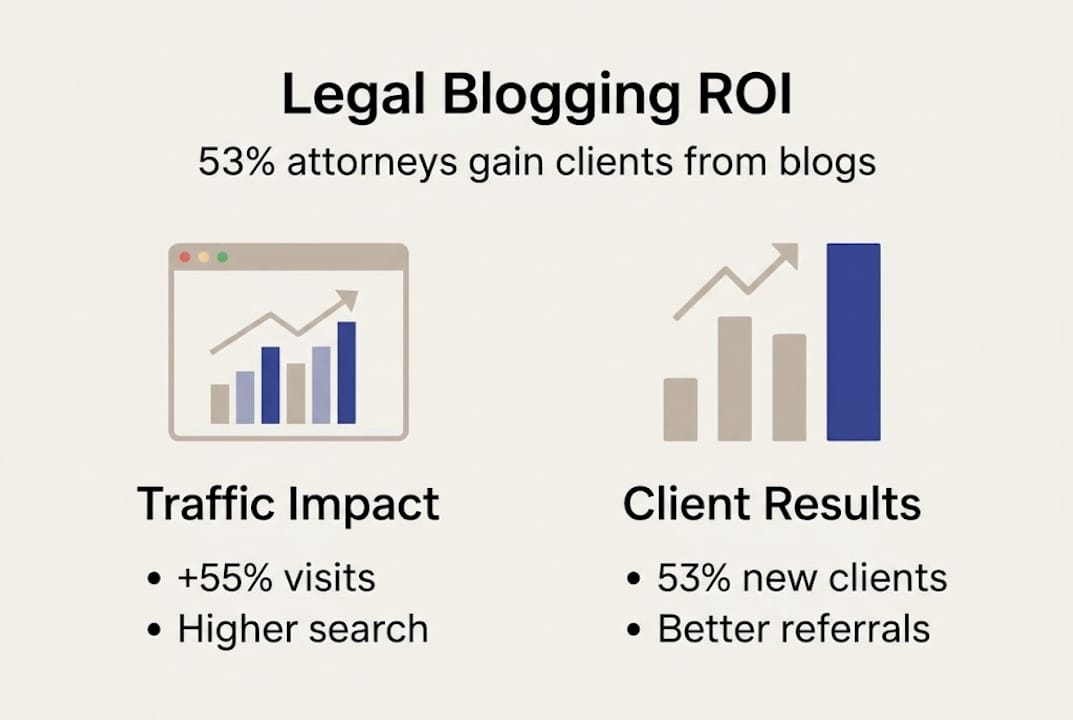
The numbers for legal blogging ROI are striking. Law firms with active blogs see 55% more web traffic than firms without blogs. Sustained campaigns show an average ROI of 526% over three years, making blogging one of the most efficient long-term investments in legal marketing.

| Metric | Typical result for blogging firms |
|---|---|
| Client acquisition rate | 53% gain clients via blog or referrals |
| Website traffic increase | 55% more than non-blogging competitors |
| Average 3-year ROI | 526% |
| Organic search conversion rate | Highest of all inbound marketing channels |
| Time to meaningful traffic | 6 to 12 months for competitive keywords |
Organic search consistently outperforms paid channels for conversion quality in the legal sector. A visitor who found your firm by searching “what to do after a car accident in [city]” and reading your blog post arrives far more ready to engage than someone who clicked a display ad. They have already self-qualified.
Referral impact is also significant. When colleagues, journalists, or other attorneys encounter your blog content and find it authoritative, they share it and link to it. That drives both direct traffic and domain authority improvements, compounding your SEO results over time.
For documented case studies for law firm blogs that illustrate these results in practice, reviewing real firm outcomes reinforces what the data suggests at a broader level.
The realistic timeline to expect: most firms see initial traffic movement within three to six months and meaningful lead generation within six to twelve months. Blogging is not an overnight channel. It is a compounding asset.
Legal ethics, risks, and compliance in legal blogging
Before you launch or relaunch your legal blog, reviewing the ethical and regulatory boundaries for attorney communications is not optional. It is a professional obligation.
Attorneys who blog are subject to bar rules governing advertising and communications. Common pitfalls include confidentiality breaches, misleading statements, and inappropriate commentary about pending matters. Blogs must avoid confidential information, comply with ABA Opinions 480 and 98-411, and steer clear of false statements about judges under Rule 8.2 or prejudicial extrajudicial statements that could affect proceedings.
| Ethical blogging practice | Unethical blogging practice |
|---|---|
| Using hypothetical client scenarios | Describing a real client’s situation, even without naming them |
| General legal education posts | Posts that constitute specific legal advice to readers |
| Balanced commentary on published rulings | Personal attacks or disparaging statements about judges |
| Clear disclaimers that content is not legal advice | Omitting any disclaimer on practice-area content |
| Citing public case law accurately | Misrepresenting legal standards or outcomes |
Rule 8.2 prohibits false statements about the qualifications or integrity of judges. Rule 3.5 governs improper contact with judicial officials. Both apply when attorneys write publicly about litigation or judicial proceedings, which blog posts frequently touch on.
A hypothetical example illustrates the risk: an attorney writes a post about a case they recently won, including enough detail that a sophisticated reader could identify the client. Even without a name, that disclosure may violate confidentiality rules and subject the firm to disciplinary action.
For guidance on building a compliant content program, ethical SEO for attorneys covers the intersection of search optimization and professional responsibility.
Pro Tip: Always include a clear disclaimer at the bottom of every blog post stating that the content is for informational purposes only and does not constitute legal advice or create an attorney-client relationship. Never use client-identifying information, even in anonymized form, without explicit written consent.
The reality: What most firms miss in legal blogging
After working with law firms across practice areas and markets, one pattern stands out above all others: most firms prioritize frequency over substance, and it costs them dearly.
Posting twice a week about broad topics that any attorney could have written generates almost no authority. What actually moves rankings and generates leads is depth. A 1,500-word post that thoroughly answers a highly specific client question, say, “Can I sue my landlord for a habitability violation in Texas if I’m already behind on rent?” will outperform ten generic posts about “tenant rights” every time.
The second critical gap is the missing call to action. Many legal blogs educate readers and then let them leave. Every post needs a clear, relevant next step, whether that is a contact form, a related practice page link, or a consultation offer.
On the AI drafting question: tools that accelerate content production are genuinely useful, but attorney review ensures E-E-A-T and ethical compliance that no AI can guarantee on its own. A draft is a starting point, not a finished product.
Finally, use your blog to answer ultra-specific client FAQs and then link those posts directly to your main practice area pages. This internal linking strategy builds topical authority while guiding readers toward conversion. For more tactical guidance, blog lead generation basics is a practical starting point.
Accelerate your law firm’s growth with strategic legal blogging
Execution is what separates firms that see measurable results from those that abandon their blogs after six months. Strategy, consistency, and compliance are the three pillars that underpin long-term blogging success. If your firm is ready to move from theory to results, LawSEO.com offers specialized support built exclusively for attorneys. Explore our proven legal SEO strategies to see how content and technical SEO work together for law firms. Our full approach to legal SEO for law firms covers everything from blog architecture to local rankings. And if compliance is a concern, our ethical SEO strategies keep your content program within professional responsibility boundaries.
Frequently asked questions
What is the main purpose of legal blogging for attorneys?
Legal blogging primarily aims to attract new clients by addressing their legal questions, boosting search visibility, and establishing professional authority in specific practice areas.
How often should a law firm publish blog posts?
Most experts recommend publishing at least twice a month, but quality and optimization matter more than sheer posting frequency for sustainable SEO gains.
What are the top mistakes to avoid in legal blogging?
Common mistakes include sharing confidential client information, using unexplained legal jargon, and neglecting clear calls to action. Blogs must avoid confidential info and communicate in accessible language.
Can AI-generated content be used for legal blogging?
AI can help draft legal blog posts efficiently, but all content must be reviewed by an attorney. Attorney review ensures accuracy, ethical compliance, and the E-E-A-T standards that Google rewards.