


Local pack ranking is the process by which Google selects the top three local business listings to display prominently at the top of search results for geographically relevant queries. These three listings, collectively called the Google Local Pack (also known as the 3-Pack or Snack Pack), appear above traditional organic results and are integrated with a Google Maps panel. Each listing surfaces direct engagement options such as call, directions, and website links. For any business competing in a local market, appearing here is the single highest-value outcome in local SEO.
Understanding local pack ranking means understanding why these three slots matter so much:
- Businesses in the Local Pack receive 40–60% more clicks than the organic results listed below them.
- Users searching with local intent are typically ready to act, making Local Pack clicks high-conversion traffic.
- The Local Pack appears on both desktop and mobile, but on mobile it often occupies the entire visible screen before a user scrolls.
- Local Pack placement is earned through organic signals and is not influenced by paid advertising campaigns.
- Traditional organic local SEO listings appear below the Local Pack and receive significantly less attention from users who find what they need in the top three.
For law firms, medical practices, and any service-area business, local pack optimization is not a secondary concern. It is the primary arena where new client acquisition begins.
What does the Google Local Pack actually show you?
The Local Pack is a structured SERP feature that Google renders when it detects local intent in a search query. That intent can be explicit, such as “personal injury attorney in Chicago,” or implicit, such as “divorce lawyer near me.” Google also uses device location data to trigger the Local Pack even when no city name appears in the query.
Each of the three listings within the pack displays a consistent set of data points pulled directly from the business’s Google Business Profile (GBP):
- Business name and primary category
- Address and map pin location
- Phone number and click-to-call functionality
- Star rating and total review count
- Hours of operation, including open/closed status in real time
- Photos sourced from the GBP listing
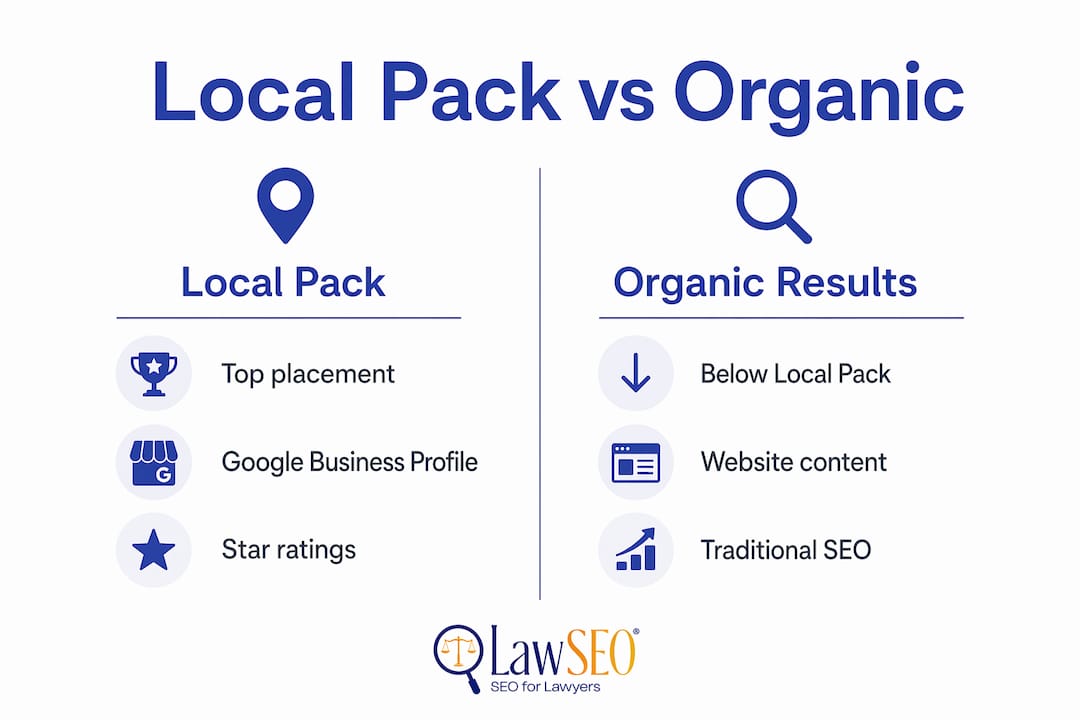
How the Local Pack differs from organic results
The distinction between Local Pack results and traditional organic results matters for strategy. They are governed by different algorithms, draw from different data sources, and reward different optimization signals.
| Feature | Local Pack | Organic Results |
|---|---|---|
| Position on SERP | Above organic, below ads | Below Local Pack |
| Data source | Google Business Profile + website | Website content + backlinks |
| Primary ranking pillars | Relevance, Distance, Prominence | Authority, relevance, technical SEO |
| Click-through rate | 40–60% higher than organic | Lower for local queries |
| Purchasable placement | No (earned organically) | No (earned organically) |
| Direct user actions | Call, Directions, Website | Website visit only |
| Schema markup impact | High | Moderate |
Google Business Profile is the data backbone of every Local Pack listing. Without a claimed, verified, and actively managed GBP, a business has no realistic path to Local Pack placement, regardless of how strong its website SEO may be. The benefits of local SEO for law firms are most fully realized when GBP and website signals work together.
Why Local Pack ranking drives real business results
The click-through rate advantage of Local Pack placement is substantial. Businesses appearing in the Local Pack receive 40–60% more clicks than the organic results below them on the same page. For a law firm or local service business, that gap translates directly into phone calls, direction requests, and website visits from prospects who are actively looking for help.
The Local Pack is where local search intent converts. Users who trigger a Local Pack result are not browsing casually. They are evaluating options and ready to contact a business. The three slots in the pack capture the majority of that intent-driven traffic, leaving the organic listings below to compete for whatever remains.
User behavior reinforces this pattern. When a Local Pack appears, most users engage with it before scrolling to organic results. The map visualization, star ratings, and one-tap call functionality reduce friction to near zero. A prospect can go from search query to phone call in under ten seconds without ever visiting a website.
For law firms specifically, this behavioral pattern has a direct revenue implication. A single new client acquired through a Local Pack call can represent thousands of dollars in legal fees. The ROI of Google rankings for local service businesses is highest precisely in this channel, where intent is strongest and the path to contact is shortest.
Local Pack presence also builds trust passively. Users see the star rating, review count, and business details before making any decision. A firm with 4.8 stars and 120 reviews displayed in the Local Pack carries implicit social proof that no paid ad can replicate.
Key factors that determine local pack rankings in 2026
Google’s local ranking algorithm operates on three foundational pillars: Relevance, Distance, and Prominence. In 2026, the weight distribution across signals within these pillars has continued to shift, with Google Business Profile signals now accounting for approximately 32–36% of total ranking power.
Relevance
Relevance measures how well a business listing matches the searcher’s query. Google evaluates:
- Primary GBP category: The single most important field in your profile. Selecting the wrong primary category is one of the most common and costly mistakes in local SEO.
- Secondary categories: Supporting categories that capture additional service areas without diluting the primary signal.
- GBP services and descriptions: Keyword-rich service descriptions within the profile feed relevance signals directly to the algorithm.
- On-page website content: Location pages, service pages, and hyperlocal content on the business website reinforce the GBP’s relevance signals.
- Local citations: Consistent NAP (Name, Address, Phone) data across directories like Yelp, Avvo (for attorneys), and local chamber listings.
Distance
Distance is the most straightforward pillar and the least controllable. Google calculates the physical proximity between the searcher’s location and the business address. A firm located downtown will naturally rank for downtown searches more easily than one located in the suburbs. The practical implication: ensure your GBP address is accurate and your service area settings reflect where you actually serve clients.
Prominence
Prominence captures how well-known and trusted a business is, both online and offline. This pillar draws from:
- Review volume and velocity: The total number of reviews matters, but review velocity (a steady, ongoing flow of new reviews) now carries more weight than a large but stagnant review count.
- Review recency and ratings: Recent high-star reviews signal active, satisfied clients to Google’s algorithm.
- Backlinks from authoritative local sources: Links from local bar associations, legal directories, and local news outlets carry strong prominence signals.
- Behavioral engagement signals: Click-through rate, click-to-call actions, and direction requests contribute approximately 7–9% of total ranking weight in 2026.
- Schema markup:
LocalBusinessschema on the website bridges structured data to the Local Pack, with proper implementation increasing Local Pack appearances by approximately 30%.
2026 ranking signal weight distribution
| Ranking Signal Category | Approximate Weight (2026) |
|---|---|
| Google Business Profile signals | 32–36% |
| Behavioral engagement signals | 7–9% |
| Citation and NAP consistency | 6–8% |
| Schema markup and structured data | contribute a meaningful portion of ranking factors. |
The signal weights in this table reflect the current understanding of local search ranking factors as of 2026. GBP signals dominate because Google controls that data source directly. Every other signal category functions as a corroborating layer that either reinforces or undermines the GBP’s claims.
How to improve your local pack ranking with proven 2026 strategies
Improving your local pack position requires a structured approach across three interconnected systems: your Google Business Profile, your website, and your reputation signals. Here is a step-by-step framework built around the 2026 ranking environment.
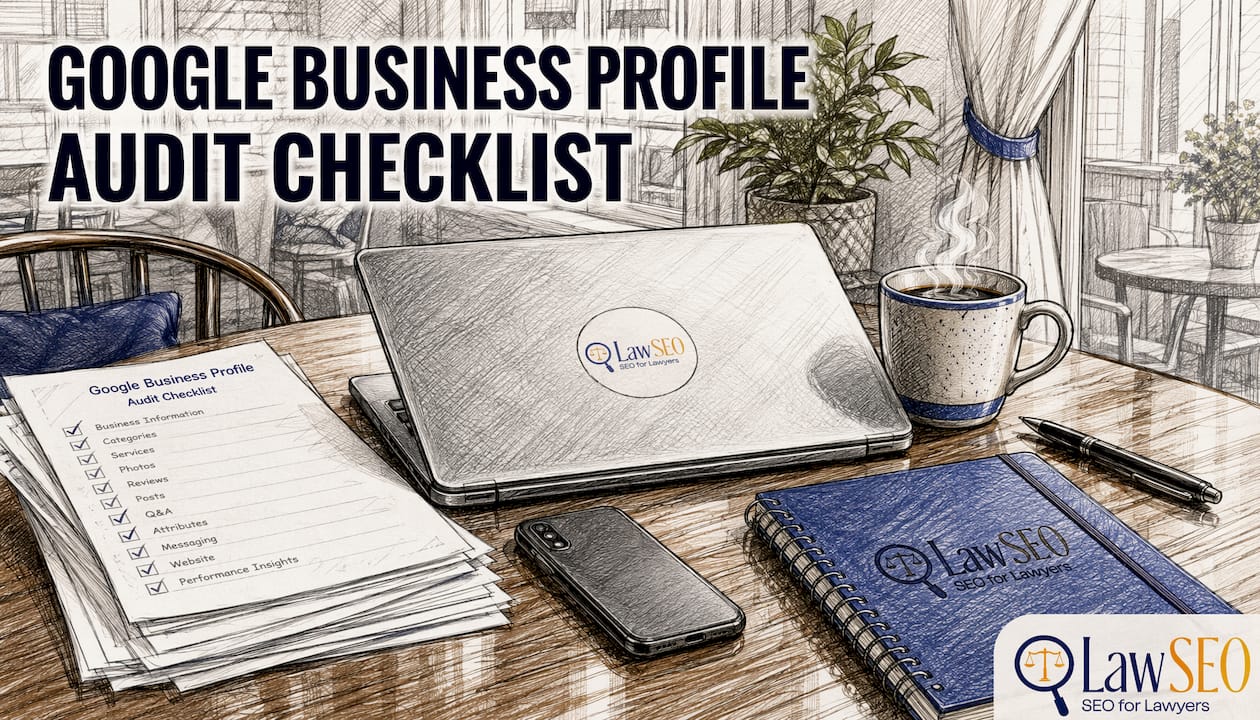
1. Claim, verify, and fully complete your Google Business Profile
A GBP that is unclaimed or only partially filled out is leaving ranking potential on the table. Verification is the prerequisite for everything else. Once verified, complete every available field: business name, address, phone, website, hours, primary category, secondary categories, services, products, and business description. The description should incorporate your primary practice areas and city naturally, not as a keyword list.
Pro Tip: Audit your GBP primary category quarterly. Google periodically adds new, more specific categories. A firm that selected “Law Firm” in 2023 may now have access to “Personal Injury Attorney” or “Family Law Attorney” as a primary category, which is a more precise relevance signal for those specific queries.
2. Select your primary category with precision
The primary category is the single highest-impact field in your GBP. It tells Google what your business fundamentally is. For a law firm, “Personal Injury Attorney” will outperform “Law Firm” for personal injury queries because it is a more specific relevance match. Research which category your top-ranking local competitors use, then select the most specific accurate option available.
3. Build keyword-rich service descriptions
The Services section of GBP allows you to list individual services with names and descriptions. Each description is an opportunity to incorporate practice area keywords and city names naturally. “Representing clients in car accident claims throughout Cook County” is more useful to the algorithm than “Auto accident cases.” Keep descriptions accurate and specific.
4. Develop a consistent review acquisition strategy
Review velocity matters more than raw count. A firm that consistently receives new reviews will outperform competitors with large but stagnant counts. Build a repeatable process: send review request emails or texts to clients at case conclusion, include a direct GBP review link, and respond to every review (positive and negative) within 48 hours. Responses signal active profile management to Google.
5. Implement LocalBusiness schema markup on your website
LocalBusiness schema (specifically LegalService for law firms) structured data on your website creates a direct bridge between your site content and Google’s Local Pack data. Proper implementation can increase Local Pack appearances significantly. Include your NAP data, practice areas, service area, and attorney credentials within the schema. This is one of the most underutilized tactics among law firms.
6. Optimize website content with hyperlocal signals
Your website reinforces your GBP’s relevance claims. Create dedicated location pages for each city or county you serve. Each page should include the city name in the title tag, H1, and naturally throughout the body content. Service pages should reference the geographic area you serve. Internal linking between location pages and practice area pages strengthens the topical and geographic relevance signals Google reads from your site. The local SEO checklist for law firms covers the full on-page optimization sequence.
7. Build citations and authoritative local backlinks
Citation consistency across Yelp, Avvo, FindLaw, Justia, and local bar association directories is a baseline requirement. Inconsistent NAP data across these sources creates conflicting signals that suppress Local Pack rankings. Beyond citations, pursue backlinks from local legal publications, bar associations, and community organizations. These links carry prominence signals that citations alone cannot provide.
8. Monitor and respond to behavioral engagement data
Search engine signals like click-through rate and click-to-call actions now account for approximately 7–9% of Local Pack ranking weight. You can influence these signals by ensuring your GBP listing is compelling: use high-quality photos, keep hours accurate, and write a business description that prompts action. Track your GBP Insights data monthly to identify which queries are driving impressions and calls, then optimize accordingly.
Pro Tip: Use Google Business Profile’s “Questions & Answers” section proactively. Seed it with the questions your prospective clients actually ask, and answer them with keyword-rich responses. This content is indexed by Google and contributes to relevance signals.
Advanced insights on local pack ranking: what the data reveals in 2026
The surface-level advice on local pack optimization, “complete your GBP and get reviews,” is necessary but insufficient for competitive markets. In 2026, the firms that hold Local Pack positions in high-value practice areas are doing several things that most competitors are not.
GBP signal dominance and the AI interplay
Google Business Profile signals account for 32–36% of Local Pack ranking power, making GBP optimization the highest-leverage activity in local SEO. But the relationship between GBP and on-page signals is becoming more interdependent as Google’s AI-driven systems evaluate content quality alongside profile data. A strong GBP paired with a thin website will underperform a moderately optimized GBP backed by authoritative, well-structured website content. The Local Pack combines signals from the GBP, the business website, and external reputation signals simultaneously. Weakness in any one of these three areas reduces overall ranking potential.
“Treating your Google Business Profile as a ‘set it and forget it’ asset is one of the most common and costly mistakes in local SEO. Active management, frequent category audits, and keyword-rich service descriptions are what separate firms that hold Local Pack positions from those that watch competitors take them.”
This reflects the consensus among local SEO practitioners tracking 2026 ranking factor shifts.
Review velocity as a competitive differentiator
The shift from valuing review volume to rewarding review velocity is one of the most significant changes in the 2026 local ranking environment. Google’s algorithm now discourages review bursts and rewards businesses that demonstrate consistent, ongoing client satisfaction. A firm that averages three new reviews per week for six months sends a fundamentally different signal than one that ran a review campaign and collected 80 reviews in two weeks. The former signals sustained quality; the latter can trigger algorithmic skepticism.
Behavioral signals: the ranking factor most firms ignore
- Click-through rate from the Local Pack: When users see your listing and choose to click your website or call button over competitors, that action registers as a positive engagement signal.
- Click-to-call frequency: High call volumes from your GBP listing indicate that your business name, category, and reviews are compelling enough to prompt direct contact, which Google interprets as relevance confirmation.
- Direction requests: Users requesting directions to your location signal physical intent and local relevance, particularly valuable for practices with a physical office.
- Photo engagement: Listings with recent, high-quality photos receive more profile views, and that engagement feeds back into prominence signals.
A law firm case study in Local Pack recovery
A mid-size personal injury firm in a competitive metro market had held a Local Pack position for three years before dropping out following a Google algorithm update in late 2024. The firm’s GBP had not been updated in over a year, its primary category was the generic “Law Firm” rather than “Personal Injury Attorney,” and its review acquisition had stalled at 47 reviews with no new additions in eight months.
The recovery strategy focused on three areas: updating the primary category to “Personal Injury Attorney,” launching a structured review request process targeting one to two new reviews per week, and implementing LegalService schema markup across all practice area pages. Within four months, the firm returned to the Local Pack for its primary target queries. The schema implementation alone was credited with a measurable increase in Local Pack impressions within the first 60 days.
For law firms ready to build or recover Local Pack presence, Lawseo’s Google Maps ranking strategies for law firms provide a detailed tactical framework built specifically for the legal market.
Key Takeaways
Local Pack ranking is determined by Google Business Profile signals, website authority, and reputation factors working together, with GBP signals alone accounting for 32–36% of ranking power in 2026.
| Point | Details |
|---|---|
| GBP is the ranking foundation | Google Business Profile signals account for 32–36% of Local Pack ranking power; claim, verify, and actively manage it. |
| Local Pack outperforms organic | Businesses in the Local Pack receive 40–60% more clicks than organic results on the same page. |
| Review velocity beats volume | A steady flow of new reviews outperforms a large but stagnant count; Google’s 2026 algorithm discourages review bursts. |
| Schema markup is underutilized | Proper LocalBusiness schema implementation can increase Local Pack appearances by approximately 30%. |
| Behavioral signals matter | Click-through rate and click-to-call actions contribute approximately 7–9% of total Local Pack ranking weight. |