


TL;DR:
- Semantic search interprets the intent and meaning behind queries, not just the words used. Law firms should focus on creating topic clusters and structured data to build trust and semantic authority. AI-driven search advances highlight the importance of content that reflects real client situations and demonstrates expertise.
Semantic search is defined as a search technology that interprets the intent and contextual meaning behind a query, not just the words themselves. Google’s systems handle 15% of daily queries that are entirely new, meaning no exact keyword match exists in its index. Semantic search fills that gap by using natural language processing (NLP) and machine learning to understand what a person actually needs. For law firms, this shift is significant. A prospective client searching “what happens if I get hurt at work in Texas” is not typing legal keywords. They are describing a situation, and semantic search connects that situation to your practice area, your jurisdiction, and your expertise.
What is semantic search, and how does it work?

Semantic search works by analyzing three things simultaneously: the query’s intent, the entities involved, and the relationships between those entities. Traditional search engines matched words. Semantic search engines match meaning.
The core technology behind this process includes several components:
- Natural language processing (NLP): NLP allows search engines to parse grammar, context, and phrasing. A query like “wrongful termination lawyer near downtown Chicago” gets broken into entities: legal service type, location, and proximity intent.
- Knowledge graphs: Google’s Knowledge Graph maps relationships between entities. It knows that a “personal injury attorney” is related to “negligence,” “tort law,” “medical bills,” and specific jurisdictions. Your content earns relevance by fitting into that graph.
- Machine learning models: RankBrain, BERT, and DeepRank translate both queries and documents into numerical vectors. The engine then measures how closely those vectors align using cosine similarity, which is a mathematical way of comparing meaning without requiring identical words.
- Embeddings and vector space: Every page on your site gets represented as a point in a high-dimensional space. Pages that cluster around related legal concepts rank together for semantically related queries.
This architecture explains why a law firm page about “car accident settlements” can rank for “how much money will I get after a crash” even without that exact phrase appearing in the content.
Pro Tip: Structure your legal content around client situations, not just practice area labels. A page titled “What to Do After a Slip and Fall in a Grocery Store” maps to far more semantic queries than a generic “Premises Liability” page.
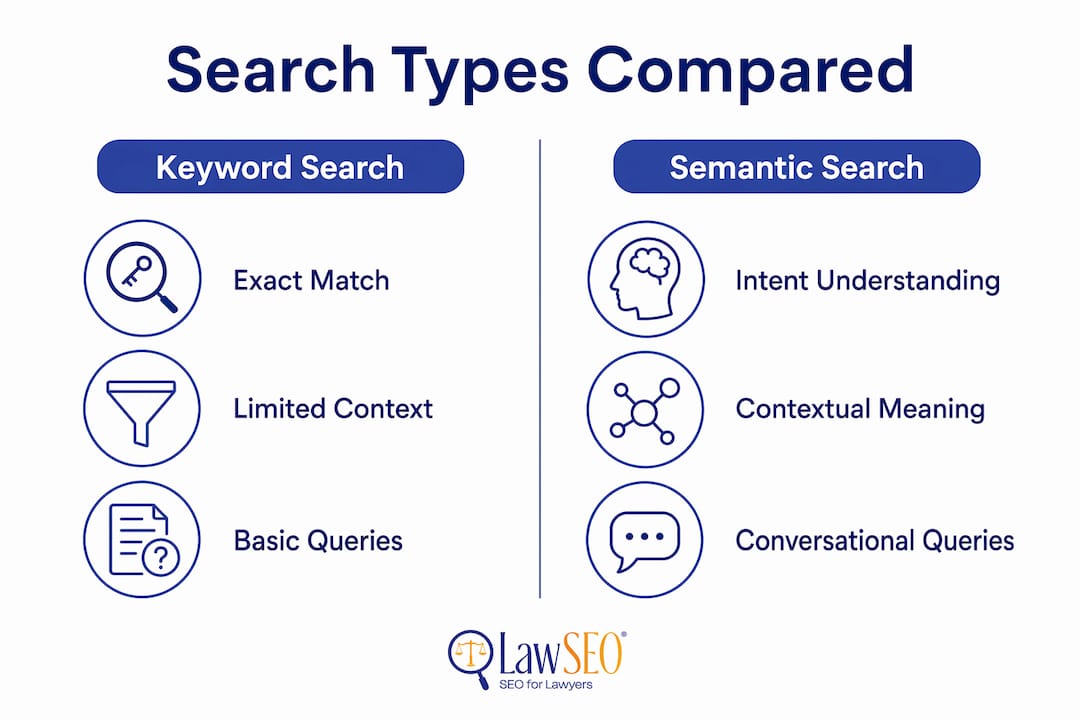
How does semantic search differ from keyword search for law firms?
The difference between keyword search and semantic search is the difference between a filing cabinet and a legal brief. Keyword search retrieves documents containing specific terms. Semantic search retrieves documents that address a specific need.
| Factor | Keyword search | Semantic search |
|---|---|---|
| Query matching | Exact or near-exact word match | Intent and meaning match |
| Query type handled | Short, precise terms | Conversational, long-tail, ambiguous |
| Content signal | Keyword frequency and density | Topical coverage and entity relationships |
| Law firm impact | Ranks for “DUI attorney Dallas” | Ranks for “what happens if I refuse a breathalyzer in Texas” |
| SEO approach | Target individual keywords | Build topic clusters and trust architecture |
Semantic search does not replace keywords entirely. Effective law firm SEO uses a hybrid approach: precise legal terminology anchors the content, while semantic depth captures the full range of how clients actually phrase their problems. A firm that publishes only keyword-optimized pages misses the majority of real client queries. A firm that builds topical clusters around practice areas, client situations, and jurisdictions captures both.
The practical benefit for law firms is significant. Clients rarely search with legal precision. They search with fear, confusion, and urgency. Semantic search rewards the firm that speaks their language.
How to implement semantic SEO for your law firm
Building semantic authority requires a structured approach. The goal is to create what practitioners call a “trust architecture,” which is a web of connected content that signals expertise, jurisdiction, and client relevance to both search engines and AI systems.
-
Build topical clusters around practice areas. Each practice area should anchor a cluster of related pages: attorney profiles, jurisdiction pages, client situation pages, and FAQs. Topical architecture captures dozens of related long-tail queries that individual keyword pages cannot reach.
-
Apply structured data markup. Schema types like
LegalService,Person, andAttorneytell search engines exactly what your firm does, who your attorneys are, and where you practice. Structured data should reflect your visible content and align with your professional profiles. Do not mark up services you do not offer. -
Satisfy E-E-A-T signals. Google’s quality guidelines emphasize Experience, Expertise, Authoritativeness, and Trustworthiness. For law firms, this means attorney bio pages with bar admission details, case result pages with appropriate disclaimers, and content updated to reflect current law.
-
Address local intent with semantic depth. Local SEO for law firms goes beyond “near me” signals. Local semantic clarity connects your office location to specific courts, jurisdictions, consultation formats, and client situations. A page that mentions “Cook County Circuit Court,” “Illinois personal injury statute of limitations,” and “free phone consultations” satisfies multiple local intent dimensions at once.
-
Maintain content quality with authorship and disclaimers. Legal content carries high stakes. Pages should identify the authoring attorney, include appropriate legal disclaimers, and reflect current statutes. This protects your firm ethically and signals trustworthiness to semantic algorithms.
Pro Tip: Link your attorney profile pages directly to every practice area page they handle. This creates an explicit entity relationship between the person and the service, which knowledge graph algorithms use to confirm expertise.
What does the future of AI-driven semantic search mean for law firms?
The next phase of semantic search is already active. Google now deploys AI models like MUM and Gemini for deep language understanding and AI-generated overviews. These systems do not just retrieve pages. They synthesize answers from multiple sources and cite the most authoritative ones.
For law firms, this creates both a risk and an opportunity:
- Risk: Firms with thin, keyword-only content get excluded from AI-generated answers. The AI cites sources it considers authoritative, not just highly ranked.
- Opportunity: Firms with well-structured topical clusters, clear entity relationships, and strong E-E-A-T signals get cited directly in AI overviews, which places them above traditional organic results.
- Conversational queries are growing. Voice search and AI chat interfaces push users toward natural language questions. “Can my employer fire me for filing a workers’ comp claim in Florida?” is now a common query format. Firms that answer these questions clearly and completely earn citations.
- Zero-click behavior is increasing. AI-generated answers reduce clicks to individual pages. The firms that get cited in those answers still win the client. The firms that do not get cited become invisible.
- Semantic SEO integrates with AI optimization. The AI optimization guide for law firms published by Lawseo details how these two disciplines now overlap. Building for semantic search and building for AI citation require the same foundational work: clear entities, structured data, and authoritative topical coverage.
The firms that treat semantic SEO as a long-term content infrastructure investment will hold a durable advantage. Those that wait for the landscape to stabilize will find the gap too wide to close quickly.
Key Takeaways
Semantic search rewards law firms that build topical authority and trust architecture, not those that chase individual keywords.
| Point | Details |
|---|---|
| Semantic search definition | It interprets query intent and context using NLP and machine learning, not just keyword matching. |
| Technology behind it | RankBrain, BERT, and knowledge graphs translate queries and content into comparable meaning vectors. |
| Law firm SEO shift | Build topic clusters connecting practice areas, attorney profiles, jurisdictions, and client situations. |
| Structured data matters | LegalService and Person schema markup creates machine-readable entity relationships that AI systems use. |
| AI citation is the new ranking | Firms with strong semantic authority get cited in AI-generated overviews, placing them above organic results. |
Why most law firms are still thinking about this the wrong way
After nearly three decades working in SEO, I have watched law firms make the same mistake repeatedly. They treat their website as a digital business card with a keyword list attached. They publish a “Practice Areas” page with six bullet points and call it content strategy.
Semantic search exposes that approach completely. The algorithm is not looking for the word “negligence.” It is looking for a firm that demonstrably understands negligence, practices it in specific jurisdictions, employs attorneys with verifiable credentials, and has explained it clearly enough that a frightened client can understand what comes next.
The firms I have seen grow organically through semantic SEO share one trait: they write for the client’s situation, not the attorney’s vocabulary. A page that explains “what to do in the first 72 hours after a car accident in Georgia” outperforms a generic “auto accident attorney” page every time. It answers a real question. It maps to real intent. It builds real trust.
The other misconception I encounter constantly is that content volume is the goal. It is not. Ten well-structured, entity-rich pages that connect logically to each other outperform 100 thin pages that share no semantic relationship. Quality and structure beat quantity. That has always been true in law, and it is now true in search.
If your firm is serious about AI-driven search visibility, start by auditing what your content actually says about who you are, where you practice, and what problems you solve. The answer will tell you exactly where your semantic gaps are.
— TODD
Lawseo builds semantic authority for law firms
Lawseo works exclusively with attorneys and law firms, which means every strategy we build reflects the specific demands of legal marketing. We construct the topical clusters, structured data markup, and trust architecture that semantic search and AI citation systems reward. Our founder, Todd R. Stager, personally reviews every campaign with over 29 years of SEO experience behind each recommendation. If your firm wants to appear in AI-generated answers and rank for the full range of queries your clients actually use, our legal SEO services are built for exactly that outcome. Contact Lawseo to discuss a strategy tailored to your practice areas and markets.
FAQ
What is the semantic search definition in plain terms?
Semantic search is a method that search engines use to understand the meaning and intent behind a query, rather than matching exact words. It uses NLP and machine learning to connect queries to relevant content even when the phrasing differs.
How does semantic search work differently from keyword search?
Keyword search retrieves pages containing specific terms. Semantic search interprets what the user actually needs and matches that need to content based on meaning, entity relationships, and topical context.
What is semantic indexing, and why does it matter for law firms?
Semantic indexing is the process by which search engines map content to concepts and entity relationships rather than just words. For law firms, it means your pages get associated with practice areas, jurisdictions, and client situations rather than just the keywords they contain.
What are the benefits of semantic search for attorneys?
Semantic search allows law firms to rank for the conversational, situation-based queries that prospective clients actually use. It also positions well-structured legal content for citation in AI-generated search overviews, which now appear above traditional organic results.
How do I start improving my law firm’s SEO with semantic search?
Start by building topical clusters that connect your practice area pages to attorney profiles, jurisdiction pages, and client situation content. Add structured data markup using LegalService and Person schema, and review your content against E-E-A-T standards for authorship, accuracy, and legal disclaimers.