

TL;DR:
- Zero-click search now accounts for over 68% of Google queries, shifting focus from traffic to visibility. Marketers must optimize for conversational queries, topical authority, and consistent entity data to succeed in this environment. Success depends on building brand recall and AI citation, not just click volume.
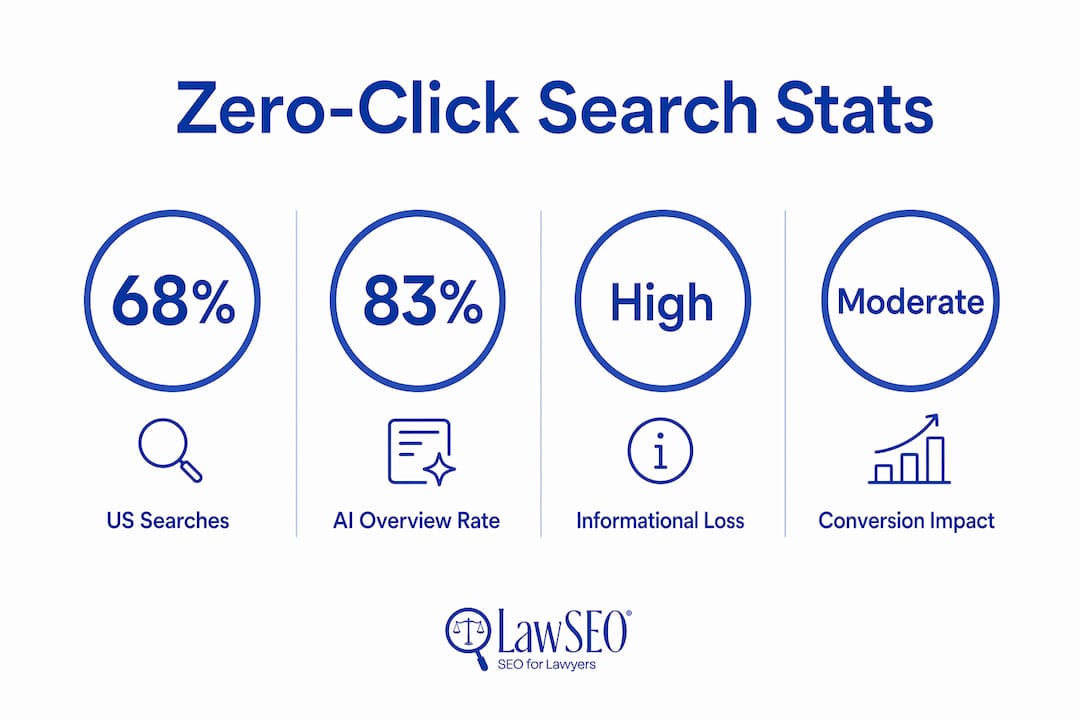
Zero-click search is defined as a search behavior where users receive a complete answer directly on the search engine results page, without clicking through to any external website. This is not a fringe phenomenon. 68.01% of all Google searches in the U.S. now end without a single click to an external site, up from 60.45% in 2024. For every 1,000 Google searches, only about 360 result in a visit to an external website. For digital marketers and SEO professionals, that number reframes every traffic forecast, every content brief, and every client report. Understanding zero-click search is no longer optional. It is the foundation of any credible visibility strategy in 2026.
What is zero-click search and how does it work?
Zero-click search, also called a zero-click SERP, occurs when Google surfaces the answer to a query directly on the results page through a SERP feature. The user reads the answer and leaves without clicking anything. Several distinct features drive this behavior.
Featured snippets pull a direct answer from a single page and display it at the top of results, often in a paragraph, list, or table format. AI Overviews go further. They synthesize information from multiple sources and generate a new summary response, meaning no single website gets credited or clicked. People Also Ask boxes expand inline to answer follow-up questions, keeping users on the SERP longer. Local packs show a map and three business listings for location-based queries, answering “who” and “where” without requiring a click to a directory or website.
The distinction between traditional featured snippets and AI Overviews matters strategically. A featured snippet still links to one source page. An AI Overview cites several sources in small footnotes, but AI-generated responses synthesize multiple sources rather than quoting any one verbatim. The practical result is that brand visibility in AI Overviews depends on consistent topic association across many pages, not on a single optimized post.
Mobile and voice search accelerate zero-click behavior further. Voice assistants read one answer aloud. There is no second result. That single spoken response is the entire SERP experience, making the stakes for appearing in position zero considerably higher on mobile than on desktop.
Pro Tip: Test your target queries on a mobile device in incognito mode. If Google answers the question before the first organic result appears, you are already operating in zero-click territory for that keyword.
How does zero-click search impact traffic and SEO metrics?
The traffic impact is real, but it is not uniform. AI Overview presence increases the zero-click rate to about 83%, and in dedicated AI Mode it can reach 93%. That translates to a 15–25% decline in organic web traffic across many sectors. Publishing, telecom, and healthcare faced steep 12% organic traffic drops in Q4 2025, while e-commerce saw only minor fluctuations.
The variation by query type is the most important nuance for SEO professionals to internalize.
| Query type | Zero-click impact | Click-through resilience |
|---|---|---|
| Informational | Highest traffic loss | Low. AI Overviews answer most directly. |
| Branded | Moderate impact | Higher. Users seeking a specific brand still click. |
| Local | High for map pack queries | Moderate. Phone calls replace clicks for many. |
| Transactional | Lower impact | High. Purchase intent drives clicks to product pages. |
The conversion story is more nuanced than the traffic story. Users who click through from zero-click encounters often carry higher intent and convert at better rates than casual searchers who were satisfied by the SERP answer. Zero-click mostly captures early-funnel users who were never going to convert anyway. The visitors who do arrive at your site after seeing a zero-click result are self-selected for deeper interest.
This means the right response is not panic over traffic volume. The right response is a shift in measurement. SEO KPIs must expand to include AI reach, search impression visibility, and brand recall quality, not just session counts. Downstream branded search volume is a strong proxy for zero-click influence: if people see your brand name in an AI Overview and later search for it directly, that signal shows up in your branded query data.
Pro Tip: Track branded search volume month over month in Google Search Console. A rising branded query trend alongside flat or declining organic traffic is a strong indicator that your zero-click presence is working.
Effective strategies for optimizing in a zero-click world
The core strategic shift is treating the SERP itself as a destination, not just a gateway. Zero-click marketing measures success through brand recall, citation frequency, and downstream branded search demand rather than clicks or traffic. Think of it as the billboard model: the goal is visibility, not a click.
Concrete tactics fall into five categories.
-
Optimize for conversational, long-tail queries. Search behavior now favors longer, chattier queries that trigger AI summaries. Content structured around natural questions, with direct answers in the first paragraph, performs better in AI Overviews than content written for keyword density. Use FAQ schema, HowTo schema, and speakable schema to signal answer-readiness to Google’s crawlers.
-
Build topical authority, not just page authority. AI Overviews draw from brands that own a topic across many pages, not from a single high-ranking post. Publish content clusters that cover a subject from multiple angles: definitions, comparisons, case studies, and local variations. Lawseo applies this approach for law firms by building deep content libraries around practice areas rather than isolated keyword pages.
-
Govern your entity data. Consistent name, address, phone number, and category data across Google Business Profile, legal directories, and schema markup determines how accurately AI systems represent your brand. Review your knowledge panel accuracy at least quarterly and correct any discrepancies immediately.
-
Integrate video into your content mix. Video results appear in featured positions for how-to and explainer queries. A short, well-titled video on a practice area question can capture SERP real estate that text alone cannot. For law firms, video also builds the personal trust that drives a phone call, which is the conversion that matters most.
-
Coordinate paid, organic, and social channels. Zero-click visibility is cumulative. A user who sees your brand in an AI Overview, then in a paid ad, then in a social post is far more likely to search for you by name. Cross-channel consistency reinforces brand recall at every SERP touchpoint.
For legal marketers specifically, the guide on AI content optimization for legal marketers provides a useful framework for structuring practice-area content to appear in AI-generated answers.
Common misconceptions about zero-click results
The biggest misconception is that zero-click search is purely a threat. It is not. Zero-click is a behavior, not a punishment. Google surfaces answers because users want them fast. Brands that appear in those answers gain exposure without paying for an ad. The threat is real only for sites that relied entirely on informational traffic that was never converting.
A second misconception conflates zero-click search (a user behavior) with zero-click marketing (a deliberate strategy). They are related but distinct.
- Zero-click search describes what users do: they get an answer on the SERP and leave.
- Zero-click marketing describes what brands do in response: they optimize to appear in those SERP answers and measure brand impact rather than click volume.
Treating them as the same concept leads to the wrong strategic response. Marketers who only try to prevent zero-click lose. Marketers who prioritize zero-click optimization tactics to appear prominently in AI-generated answers and SERP features gain a new front door to customers.
A third misconception is that short-tail keywords are sufficient. Optimizing only for short, high-volume keywords risks invisibility in AI-driven results. AI Overviews favor content that directly answers the specific, conversational questions real users type. Ignoring long-tail query optimization leaves the most rapidly growing segment of search unaddressed.
“The brands that will win in zero-click search are not the ones that fight the SERP. They are the ones that become the SERP. Visibility, citation frequency, and brand recall are the new conversion metrics. Clicks are a downstream effect of getting those three things right.”
For a deeper look at how AI-driven search is reshaping visibility strategy, the analysis on AI-driven search visibility covers the broader implications for digital marketers across industries.
Key Takeaways
Zero-click search now captures more than two-thirds of all Google queries, making brand visibility on the SERP itself the primary measure of SEO success in 2026.
| Point | Details |
|---|---|
| Zero-click prevalence | 68.01% of U.S. Google searches end without a click to an external site. |
| AI Overview impact | AI Overviews push the zero-click rate to 83%, causing 15–25% organic traffic declines in many sectors. |
| Query type variation | Informational queries lose the most traffic; transactional and branded queries remain more resilient. |
| Conversion quality holds | High-intent users who do click through convert at better rates, so traffic quality improves even as volume falls. |
| Strategic shift required | Success metrics must expand from click volume to AI citation frequency, brand recall, and downstream branded search. |
What 29 years in search taught me about zero-click
I have watched search evolve through every major algorithm update since the late 1990s. Each shift produced the same initial reaction: panic, followed by adaptation, followed by competitive advantage for the firms that moved first. Zero-click search is no different, but the adaptation required is more fundamental than anything I have seen since the move from directory listings to organic rankings.
The marketers who struggle most with zero-click are the ones still measuring success by session counts. Sessions are a proxy for revenue, not revenue itself. When I audit a law firm’s search presence and their branded query volume is rising while their organic sessions are flat, that is a healthy sign, not a crisis. The firm is building recognition at the top of the funnel through SERP visibility, and that recognition converts downstream.
My practical advice: stop optimizing for clicks and start optimizing for citation. Ask yourself whether your content is the clearest, most direct answer to the questions your prospective clients type into Google. If it is not, a competitor’s content will appear in the AI Overview instead, and your brand will be invisible at the moment of highest relevance. Continuous governance of your entity data, your knowledge panel, and your share of AI citation voice is now as important as link building was a decade ago.
The firms that treat zero-click as a visibility opportunity rather than a traffic problem will own their categories in AI-driven search. The ones that wait will find the gap very difficult to close.
— TODD
How Lawseo helps law firms win in a zero-click SERP
Law firm SEO operates in one of the most competitive zero-click environments online. Prospective clients ask Google direct questions: “Do I need a lawyer for a DUI?” or “How much does a personal injury attorney cost?” Those queries now trigger AI Overviews that answer the question before a single law firm website appears. Lawseo builds the content depth, entity governance, and AI Overview optimization that positions law firms inside those answers, not below them. Every campaign is reviewed personally by Todd R. Stager, with over 29 years of SEO experience. If your firm’s visibility strategy still measures success by session volume alone, the legal SEO strategies Lawseo applies in 2026 are built for exactly this environment.
FAQ
What is zero-click search in simple terms?
Zero-click search occurs when a user types a query into Google and gets a complete answer directly on the results page, without clicking any website. Featured snippets, AI Overviews, and local packs are the most common causes.
Is zero-click search bad for SEO?
Zero-click search reduces raw traffic for informational queries but does not necessarily reduce conversions. Users who still click through after seeing a zero-click result carry higher intent and convert at better rates, so overall lead quality often holds steady.
How does an AI Overview differ from a featured snippet?
A featured snippet pulls content from one source page and links directly to it. An AI Overview synthesizes information from multiple sources and generates a new summary, making consistent topical authority across many pages more important than a single optimized post.
How do I optimize my content for zero-click results?
Structure content around direct, conversational questions with clear answers in the first paragraph. Use FAQ schema and HowTo schema, build topical authority across content clusters, and maintain consistent entity data across all web properties.
What metrics should I track in a zero-click environment?
Track branded search volume, AI citation frequency, search impression counts, and knowledge panel accuracy alongside traditional traffic metrics. Rising branded queries alongside flat organic sessions often signal that zero-click visibility is working.