

Over 77.67% of legal queries now trigger AI Overviews, fundamentally reshaping how potential clients discover attorneys. Traditional SEO strategies alone no longer guarantee visibility in this AI-driven search landscape. Law firms must adapt their content optimization to capture citations in AI-generated summaries while maintaining strong organic rankings. This guide reveals proven strategies to dominate both AI Overviews and traditional search results, helping you convert more qualified leads. You’ll learn how to structure content for AI crawlers, leverage platform-specific optimization tactics, and implement technical adjustments that triple your referral conversion rates.
Key takeaways
| Point | Details |
|---|---|
| AI Overviews dominate legal search | More than three-quarters of legal queries now generate AI-powered summaries, making traditional organic listings less visible. |
| AI referrals convert better | Visitors arriving from AI platforms convert to clients at three times the rate of standard organic search traffic. |
| Technical SEO remains essential | AI crawlers rely on sitemaps, structured data, and internal linking just like traditional search bots do. |
| Citations boost all traffic | Pages featured in AI Overviews earn 35% more organic clicks and 91% more paid clicks than competitors. |
| Platform-specific strategies work | Different AI search engines require tailored optimization approaches based on their unique architectures. |
Understanding AI overviews and their impact on legal search
AI Overviews are AI-generated summaries that appear at the top of search results, synthesizing information from multiple sources to answer user queries directly. These summaries fundamentally change how potential clients interact with search results by providing immediate answers without requiring clicks to individual websites. For law firms, this shift represents both a challenge and an opportunity in client acquisition strategies.
The growth trajectory of AI Overviews has been remarkable. AI Overviews expanded from 6.49% to over 50% of all queries within just 10 months, demonstrating the rapid adoption of AI-powered search features. Legal queries particularly attract AI Overview generation because they often involve complex questions requiring authoritative, trustworthy answers. When someone searches for personal injury statute limitations or divorce filing requirements, AI systems recognize these as high-stakes queries deserving comprehensive responses.
ChatGPT has emerged as the dominant player in AI referral traffic. Research shows 87.4% of AI referral traffic originates from ChatGPT, making it the primary platform law firms must optimize for when targeting AI-driven client acquisition. Other platforms like Claude, Perplexity, and Google’s Gemini contribute smaller but growing shares of AI referrals.
The implications for law firm visibility are profound:
- Traditional organic listings get pushed below AI Overviews, reducing their visibility
- Firms cited within AI Overviews gain credibility through algorithmic endorsement
- Zero-click searches increase as users find answers without visiting websites
- Citation within AI summaries creates new pathways for client discovery
AI referral traffic behaves differently than traditional organic visitors. These users arrive with higher intent because they’ve already received preliminary answers and seek deeper expertise. They’ve been pre-qualified by the AI system’s assessment of your content quality and relevance. This explains why AI-referred visitors demonstrate superior conversion characteristics compared to standard search traffic.
“The shift to AI-powered search isn’t replacing traditional SEO, it’s adding a new layer of optimization requirements that forward-thinking law firms must master to maintain competitive advantage.”
Understanding Google AI Overview SEO principles helps law firms adapt their content strategies to succeed in this evolving landscape. The firms that recognize AI Overviews as a new client acquisition channel rather than a threat will capture disproportionate market share in 2026 and beyond.
Core SEO and AI optimization principles law firms must master
Successful AI optimization builds on traditional SEO foundations rather than replacing them. Law firms must strengthen core ranking signals while adding AI-specific optimizations to maximize visibility across both traditional and AI-driven search results. This dual approach ensures you don’t sacrifice existing organic performance while pursuing AI Overview citations.

E-E-A-T signals remain critical in the AI era. AI systems evaluate Experience, Expertise, Authoritativeness, and Trustworthiness when selecting content to cite in overviews. For attorneys, this means prominently displaying credentials, case results, bar admissions, and professional recognition throughout your content. Author bios should detail specific legal experience rather than generic qualifications. Court victories, published legal opinions, and speaking engagements all strengthen E-E-A-T signals that AI systems recognize.
Technical SEO infrastructure supports AI discoverability. AI crawlers utilize sitemaps, robots.txt, and internal links just like traditional search bots do. Your website must maintain clean crawl paths, fast load times, and mobile responsiveness to ensure AI systems can efficiently access and analyze your content. Structured data markup helps AI crawlers understand content context, relationships between pages, and the specific legal services you offer.
Content clustering amplifies AI understanding of your expertise. Rather than creating isolated pages, organize content into topical clusters with pillar pages covering broad legal topics and supporting pages addressing specific subtopics. This architecture signals comprehensive knowledge to AI systems:
- Create pillar content for major practice areas like personal injury or estate planning
- Link supporting pages covering specific issues back to pillar content
- Use consistent terminology and internal linking to reinforce topical relationships
- Update clusters regularly to maintain freshness signals
Keyword intent drives effective content structuring for AI optimization. Different query types require different content approaches. Informational queries seeking legal definitions benefit from concise, authoritative explanations. Navigational queries looking for specific attorneys need clear service descriptions and contact information. Transactional queries from users ready to hire require compelling case results and consultation calls-to-action.
Pro Tip: Map your content calendar to the complete client journey, creating pieces that address awareness stage questions, consideration stage comparisons, and decision stage conversion factors. AI systems favor comprehensive coverage that serves users at every stage.
Integrating traditional SEO with AI-specific signals creates synergistic benefits. Strong organic rankings improve the likelihood of AI citation because systems prioritize already-validated content. Simultaneously, AI Overview citations boost organic click-through rates by establishing credibility. This virtuous cycle rewards firms that excel at both optimization approaches. Understanding SEO and AI for law firms helps you develop integrated strategies that maximize returns across all search channels.
Navigating AI search architectures to maximize law firm visibility
Different AI search platforms employ distinct technical architectures that influence how they select and present content. Understanding these architectural differences allows law firms to tailor optimization strategies for maximum visibility across multiple AI systems. While all platforms share common elements, their implementation details create opportunities for platform-specific optimization.
AI search architecture typically includes several key components working together. Embedding-based retrieval converts your content into mathematical representations that enable semantic matching with user queries. Reranking layers evaluate retrieved content based on relevance, authority, and freshness signals. Large language models then synthesize selected sources into coherent responses. AI platforms implement these components differently, creating variation in which content gets cited.
Google AI Overviews prioritize content already ranking well organically, making traditional SEO signals particularly important for this platform. The system heavily weights domain authority, backlink profiles, and historical ranking performance when selecting sources. Google also favors content from websites with strong technical foundations and consistent publishing patterns.
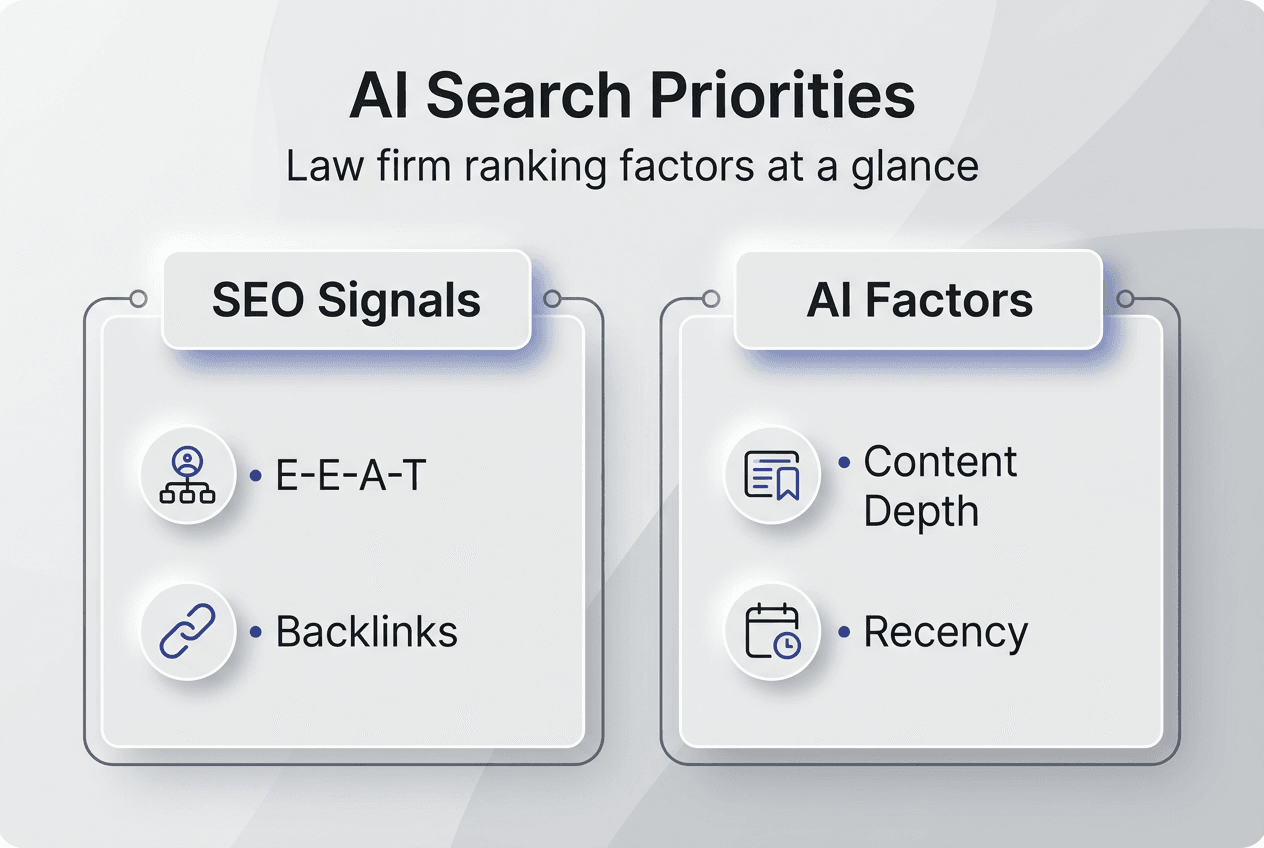
ChatGPT relies more heavily on content quality and comprehensiveness than domain authority metrics. The platform performs well with detailed, well-structured content that directly answers user questions. ChatGPT’s architecture benefits from clear headings, logical information hierarchy, and explicit connections between concepts. Lists, tables, and step-by-step explanations receive favorable treatment in ChatGPT’s selection algorithms.
Claude emphasizes accuracy and nuance, often selecting sources that acknowledge complexity and provide balanced perspectives. This platform responds well to content that addresses counterarguments, explains limitations, and cites supporting evidence. Legal content that demonstrates thorough analysis rather than oversimplification performs better in Claude’s citation decisions.
Perplexity focuses on recency and source diversity, frequently citing newer content and combining information from multiple sources. The platform’s architecture rewards regular content updates and comprehensive topic coverage. Perplexity also values transparent sourcing and clear attribution within content.
| Platform | Primary Ranking Factors | Content Preferences | Update Frequency Impact |
|---|---|---|---|
| Google AI | Domain authority, backlinks, organic rankings | Established websites with strong SEO | Moderate |
| ChatGPT | Content quality, structure, comprehensiveness | Detailed explanations, clear formatting | Low to moderate |
| Claude | Accuracy, nuance, balanced perspectives | Thoughtful analysis, cited evidence | Moderate |
| Perplexity | Recency, source diversity, transparency | Fresh content, multiple viewpoints | High |
Retrieval-augmented generation (RAG) improves AI search reliability by grounding AI responses in actual web content rather than relying solely on training data. This architectural choice means AI systems actively retrieve and analyze your current content when generating responses, making optimization efforts immediately impactful. Unlike traditional search where algorithm updates happen periodically, RAG-based systems continuously evaluate content against current queries.
Pro Tip: Maintain consistent content across platforms while emphasizing different strengths for each. Use strong technical SEO for Google AI, comprehensive structure for ChatGPT, nuanced analysis for Claude, and frequent updates for Perplexity.
Platform-specific optimization doesn’t mean creating entirely different content for each AI system. Instead, build comprehensive, well-structured content that satisfies multiple architectural preferences simultaneously. Focus on creating genuinely valuable resources that serve user needs, then fine-tune presentation and update frequency based on your priority platforms. Exploring AI search optimization for law firms reveals additional platform-specific tactics that enhance multi-channel visibility.
Practical steps for law firms to optimize content for AI overviews in 2026
Implementing AI optimization requires systematic changes to content creation, technical infrastructure, and performance tracking. These actionable steps help law firms capture more AI Overview citations while maintaining strong traditional search performance. Each tactic builds on the foundational principles covered earlier, translating strategy into concrete implementation.
Follow this step-by-step optimization process:
- Audit existing content for E-E-A-T signals and add missing credentials, case results, and author expertise details to high-value pages
- Restructure content into topical clusters with clear pillar pages and supporting articles linked through strategic internal linking
- Implement comprehensive structured data markup including Attorney, LegalService, and FAQPage schemas to help AI systems understand content context
- Optimize page speed and Core Web Vitals since AI crawlers factor technical performance into content selection decisions
- Create FAQ sections answering common legal questions in concise, citation-friendly formats that AI systems can easily extract
- Add regular content updates to existing pages rather than only publishing new articles, signaling ongoing expertise and freshness
- Build authoritative backlinks from legal directories, bar associations, and industry publications to strengthen domain credibility
Optimizing content clusters requires strategic planning and execution. Identify your most valuable practice areas and create comprehensive pillar content covering foundational concepts, common questions, and key considerations. Each pillar page should link to 5-10 supporting articles addressing specific subtopics in depth. Use consistent terminology across the cluster and create a clear information hierarchy that guides both human readers and AI crawlers through related content.
Technical SEO adjustments critical for AI crawlability include:
- Ensure XML sitemaps include all important pages and update automatically when new content publishes
- Optimize robots.txt to allow AI crawler access while blocking low-value pages
- Implement canonical tags to prevent duplicate content confusion
- Create descriptive, keyword-rich URLs that signal content topics
- Add alt text to images explaining visual content for AI systems that process multimedia
Tracking AI referral traffic requires setting up proper analytics configurations. Create custom segments in Google Analytics to isolate traffic from ChatGPT, Claude, Perplexity, and other AI platforms. Monitor conversion rates, engagement metrics, and lead quality from AI referrals compared to organic search traffic. This data reveals which optimization efforts drive the best results and where to focus future improvements.
| Metric | Tracking Method | Target Benchmark | Optimization Signal |
|---|---|---|---|
| AI referral traffic volume | Custom analytics segment | 10-15% of total traffic | Growing share indicates successful optimization |
| AI referral conversion rate | Goal tracking by source | 3x organic rate | Higher conversions validate AI traffic quality |
| Pages cited in AI Overviews | Manual monitoring tools | 20+ citations monthly | More citations expand visibility |
| Organic CTR on cited pages | Search Console data | 35% above baseline | Citations boost all traffic types |
Research confirms pages cited in AI Overviews earn 35% more organic clicks and 91% more paid clicks than competitors, demonstrating the compounding benefits of AI optimization. The credibility signal from AI citation improves performance across all marketing channels, not just AI referrals.
The conversion advantage is equally impressive. AI-referred visitors convert at 3x the rate of organic visitors because they arrive pre-qualified and seeking deeper expertise after receiving initial answers from AI systems. This higher conversion rate means AI optimization delivers disproportionate ROI compared to traffic volume alone.
Pro Tip: Avoid over-optimizing for AI at the expense of user experience. Content written primarily for algorithms rather than humans typically underperforms in both AI citations and organic rankings. Focus on creating genuinely helpful resources that serve your target audience, then apply technical optimizations to maximize discoverability.
Common pitfalls to avoid include keyword stuffing in attempts to manipulate AI selection, neglecting mobile optimization despite AI systems prioritizing mobile-friendly content, and failing to update older content that may contain outdated legal information. Regular content audits identify pages needing refreshes to maintain accuracy and relevance. Learning to master AI optimization for law firms helps you implement these tactics effectively while avoiding counterproductive shortcuts.
Enhance your law firm marketing with expert AI SEO strategies
Navigating the complexities of AI optimization while maintaining strong traditional SEO performance requires specialized expertise in legal marketing. Our team focuses exclusively on helping law firms dominate both AI-powered and traditional search results to maximize client acquisition. We’ve developed proven strategies that integrate AI optimization with comprehensive SEO programs tailored specifically for attorneys. Explore our legal SEO strategies for law firms to see how we help practices achieve online dominance. Our detailed AI optimization for law firms guide reveals additional tactics for capturing more qualified leads. Discover how our law firm SEO services can transform your digital marketing results in 2026.
Frequently asked questions
What are AI Overviews and why do they matter for law firms?
AI Overviews are AI-generated summaries appearing at the top of search results that synthesize information from multiple sources to answer queries directly. They matter because over 77% of legal queries now trigger these overviews, fundamentally changing how potential clients discover attorneys. Firms cited in AI Overviews gain algorithmic credibility and attract higher-converting traffic.
How does optimizing for AI Overviews differ from traditional SEO?
Traditional SEO focuses on ranking individual pages in organic listings through keywords, backlinks, and technical optimization. AI optimization targets citation within AI-generated summaries by emphasizing content structure, comprehensive topic coverage, and clear E-E-A-T signals. Both approaches share foundational requirements like technical excellence and quality content, but AI optimization adds specific formatting and freshness considerations.
What practical steps can law firms take now to improve their AI Overview presence?
Start by strengthening E-E-A-T signals through prominent credential displays, detailed author bios, and case result documentation. Restructure content into topical clusters with pillar pages and supporting articles connected through strategic internal linking. Ensure technical infrastructure supports AI crawlability through optimized sitemaps, structured data markup, and fast page speeds.
Which AI platforms should law firms prioritize for optimization efforts?
ChatGPT generates 87.4% of AI referral traffic, making it the top priority for most law firms. Google AI Overviews matter because they appear in traditional search results where many potential clients still begin their attorney search. Perplexity and Claude represent growing opportunities worth monitoring as their user bases expand.
How can law firms measure the ROI of AI optimization investments?
Track AI referral traffic volume through custom analytics segments separating ChatGPT, Claude, and other AI platform traffic from organic search. Monitor conversion rates from AI referrals compared to other traffic sources, typically seeing 3x higher conversion rates from AI visitors. Measure citation frequency in AI Overviews and correlate with overall organic traffic growth, as cited pages earn 35% more organic clicks.