


More than 90 percent of American legal clients start their attorney search online, yet many law firms still rely on outdated strategies that miss today’s digital realities. For the American attorney, visibility is no longer optional if growth and credibility are priorities. Unraveling what truly sets legal SEO apart helps small and mid-sized law practices attract clients who are already searching for their expertise and services.
Table of Contents
- What Legal SEO Is And Common Misconceptions
- Understanding How Search Engines Drive Clients
- Key Elements Of Effective Law Firm SEO
- Legal Ethics And Online Marketing Compliance
- Mistakes Law Firms Make With SEO
Key Takeaways
| Point | Details |
|---|---|
| Understanding Legal SEO | Legal SEO is tailored for law firms, focusing on credibility and client trust, unlike general SEO. |
| Importance of Local Search | Optimizing local search visibility is crucial as potential clients search using specific geographical terms. |
| Ethical Marketing Compliance | Law firms must adhere to strict ethical guidelines and maintain transparent communication in digital marketing. |
| Common SEO Pitfalls | Avoid neglecting local SEO, technical performance issues, and generic content to enhance online visibility and client engagement. |
What Legal SEO Is and Common Misconceptions
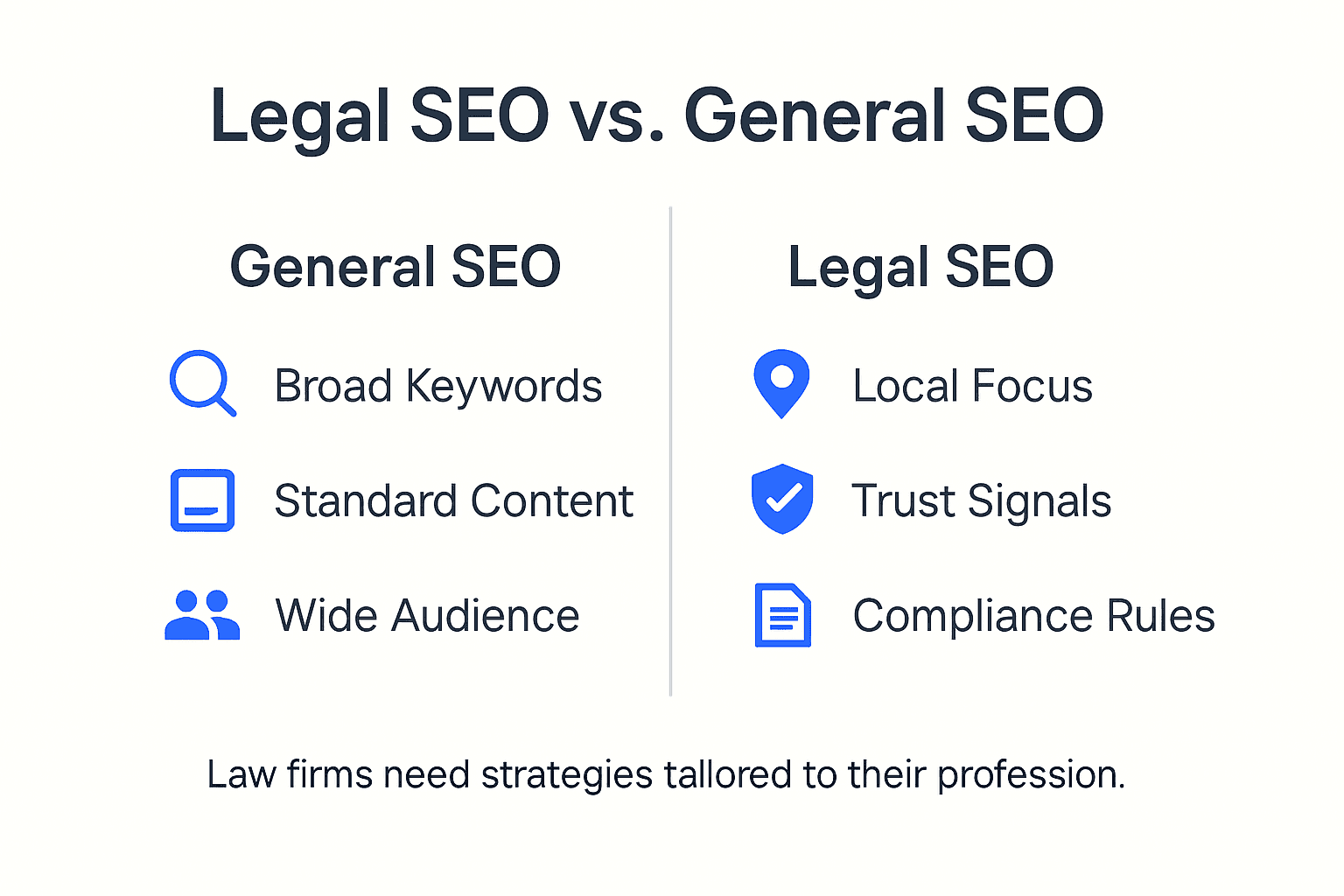
Legal SEO represents a specialized digital marketing approach designed specifically for law firms to enhance their online visibility and attract potential clients through strategic search engine optimization techniques. Unlike generic business SEO, legal search optimization requires nuanced understanding of professional ethics, client trust, and complex regulatory environments. SEO strategies for law firms demand sophisticated approaches that transcend traditional keyword placement.
The most pervasive misconception among attorneys is that SEO operates uniformly across industries. Legal SEO distinguishes itself through critical elements like professional credibility, localized search prominence, and adherence to strict ethical advertising guidelines. Attorneys must recognize that search engine optimization is not merely about ranking high but about establishing digital authority that reflects professional competence and trustworthiness.
Successful legal SEO integrates multiple sophisticated strategies, including targeted geographic optimization, content development addressing specific legal queries, technical website performance improvements, and strategic link building within professional networks. Law firms must approach digital marketing as a comprehensive ecosystem that communicates expertise while maintaining regulatory compliance and client confidentiality.
Here’s a quick comparison of General SEO and Legal SEO requirements:
| Aspect | General SEO Approach | Legal SEO Approach |
|---|---|---|
| Content Strategy | Broad topics, general info | Legal-focused, precise, ethical |
| Compliance Needs | Few industry restrictions | Strict ethical and regulatory rules |
| Link Building Focus | Authority sites, diversity | Reputable legal directories/networks |
| Performance Measure | Rankings and traffic | Trust, client confidence, compliance |
Pro tip: Conduct a comprehensive audit of your current online presence, examining website performance, content relevance, and local search visibility at least quarterly to stay ahead of evolving search engine algorithms and competitive legal marketing landscapes.
Understanding How Search Engines Drive Clients
Search engines function as sophisticated digital matchmakers, connecting potential legal clients with attorneys who can precisely address their specific legal challenges. Search engine optimization for law firms operates through complex algorithmic processes that evaluate website relevance, credibility, and user experience to determine which legal practices appear most prominently in search results.

Modern search engines utilize advanced techniques to assess a law firm’s digital presence, including analyzing website content quality, technical performance, geographic relevance, client reviews, and professional authority signals. Potential clients typically conduct targeted searches using specific legal problem descriptions, location-based queries, or practice area keywords, expecting immediate, credible information that matches their precise legal needs.
The client acquisition process through search engines involves multiple sophisticated ranking factors. Law firms must develop comprehensive digital strategies that demonstrate expertise through high-quality, informative content, maintain technically optimized websites, accumulate positive client testimonials, and build authoritative professional networks. Success requires understanding that search engine visibility is not just about ranking high, but about communicating professional competence and trustworthiness to potential clients actively seeking legal assistance.
Pro tip: Develop a strategic content approach that directly addresses common client questions, integrates location-specific keywords, and provides clear, actionable information to improve your law firm’s search engine discoverability and client engagement.
Key Elements of Effective Law Firm SEO
Effective law firm SEO encompasses a comprehensive strategy that goes far beyond simple keyword placement. Critical law firm website optimization techniques require a multifaceted approach addressing technical performance, content quality, and strategic visibility across digital platforms. Attorneys must understand that modern search engine algorithms evaluate websites through complex lenses that prioritize user experience, professional credibility, and precise information relevance.
The three core pillars of law firm SEO include relevance, authority, and user experience. Relevance demands creating targeted content that directly addresses potential clients’ specific legal challenges, using precise practice area keywords and addressing nuanced search intents. Authority is built through high-quality backlinks from reputable legal directories, professional associations, and credible local business networks. User experience involves maintaining a technically robust website with fast loading speeds, mobile responsiveness, clear navigation, and intuitive information architecture that helps potential clients quickly find the legal guidance they need.
Successful law firm SEO requires continuous optimization across multiple digital channels. This includes maintaining accurate local business listings, generating authentic client testimonials, developing practice area specific content, and ensuring technical website elements like schema markup, page speed, and mobile compatibility meet the highest professional standards. Lawyers must view their digital presence as an extension of their professional reputation, carefully curating an online ecosystem that communicates expertise, trustworthiness, and client-focused service.
Pro tip: Conduct a quarterly comprehensive digital audit analyzing your website’s technical performance, content relevance, and local search visibility to stay ahead of evolving search engine algorithms and maintain a competitive online presence.
Legal Ethics and Online Marketing Compliance
Law firms navigating digital marketing must carefully balance aggressive online visibility with stringent professional ethical standards. Law firm marketing strategies require meticulous attention to regulatory guidelines established by state bar associations, which impose strict limitations on attorney advertising and professional representation.
Ethical online marketing for attorneys demands transparent, truthful communication that avoids misleading claims, guarantees of outcomes, or comparative statements about legal services that cannot be substantiated. Fundamental ethical considerations include protecting client confidentiality, preventing potential conflicts of interest, maintaining professional integrity, and ensuring all digital content accurately represents the lawyer’s qualifications, experience, and potential service capabilities. Law firms must develop comprehensive digital marketing protocols that align with American Bar Association guidelines and state-specific professional conduct rules.
The complex landscape of legal marketing compliance requires attorneys to implement robust review processes for all digital content. This includes carefully screening website copy, blog posts, social media communications, and paid advertising to ensure they meet professional standards. Critical areas of focus involve avoiding language that could be interpreted as solicitation, protecting client privacy, providing clear disclaimers, and maintaining a professional tone that reflects the gravity of legal services while remaining approachable and informative.
Pro tip: Establish a comprehensive internal review process that involves both legal marketing professionals and practicing attorneys to audit all digital content, ensuring strict compliance with professional ethics guidelines and minimizing potential regulatory risks.
Mistakes Law Firms Make With SEO
Law firms frequently undermine their digital marketing potential by committing critical SEO errors that dramatically reduce their online visibility. Common law firm SEO pitfalls reveal systematic mistakes that prevent attorneys from effectively reaching potential clients through digital channels. These errors range from technical website problems to fundamental misunderstandings about how search engines evaluate legal professional websites.
One of the most significant mistakes is neglecting local search optimization. Many law firms fail to understand that potential clients overwhelmingly search for legal services using geographically specific terms. This means inconsistent business listings, incomplete Google Business Profile information, and a lack of location-specific content can render a law firm virtually invisible in local search results. Additionally, attorneys often overlook the importance of generating authentic client reviews, which play a crucial role in both search rankings and establishing professional credibility.
Technical SEO shortcomings represent another critical area of vulnerability for law firms. Websites with slow loading speeds, poor mobile responsiveness, inadequate security protocols, and complicated navigation structures consistently underperform in search rankings. Many legal practices also make the fundamental error of producing generic, keyword-stuffed content that fails to address potential clients’ specific legal questions or demonstrate genuine expertise. Successful law firm SEO requires a strategic approach that balances technical optimization, high-quality content, and a deep understanding of potential clients’ search behaviors.
To better understand SEO priorities, here is a summary of law firm SEO mistakes and solutions:
| Common Mistake | Impact on Firm | Recommended Solution |
|---|---|---|
| Ignoring local search | Low local visibility | Optimize Google Business Profile |
| Weak technical performance | Poor user experience | Improve site speed and security |
| Generic/non-informative content | Low client engagement | Develop focused legal content |
| Lacking client reviews | Less credibility | Request and display client feedback |
| Inconsistent business listings | Confused search engines | Maintain accurate, updated profiles |
Pro tip: Conduct a monthly comprehensive digital audit that evaluates your website’s technical performance, content quality, local search visibility, and competitive positioning to systematically identify and address potential SEO weaknesses.
Unlock Your Law Firm’s Full Potential with Expert Legal SEO
The article highlights common challenges law firms face with SEO such as local search neglect, weak technical performance, and ineffective content. These pain points can leave attorneys struggling to build trust and attract new clients in an increasingly competitive digital space. If you want to transform your law firm’s online presence by mastering specialized legal SEO techniques tailored for ethical and effective marketing, partnering with a dedicated expert is essential.
At LawSEO.com, our founder-led approach combines nearly three decades of SEO experience with exclusive focus on the legal sector. We understand nuances like compliance, client confidentiality, and AI-driven search platforms to help your firm achieve online dominance. From local SEO and compelling content development to authoritative link building and advanced web design, our comprehensive services create a powerful digital ecosystem that grows your client base.
Don’t let technical glitches or generic strategies hold you back. Visit LawSEO.com now to schedule a consultation and unlock new clients by elevating your law firm’s search engine visibility today.
Frequently Asked Questions
What is legal SEO and why is it important for lawyers?
Legal SEO is a specialized digital marketing approach designed for law firms to enhance online visibility and attract potential clients through search engine optimization techniques. It is important for lawyers because it helps establish digital authority, improve client trust, and ensure compliance with professional ethics in advertising.
How can SEO improve my law firm’s client acquisition efforts?
SEO can improve client acquisition by increasing your firm’s visibility in search engine results when potential clients search for legal services. A well-optimized website, with high-quality content that addresses specific legal issues, can attract more targeted traffic and convert visitors into clients.
What are common SEO mistakes law firms should avoid?
Common SEO mistakes include neglecting local search optimization, poor technical website performance, producing generic content, lacking client reviews, and maintaining inconsistent business listings. Correcting these mistakes can significantly enhance your firm’s online presence and client engagement.
How frequently should law firms audit their SEO strategy?
Law firms should conduct a comprehensive audit of their SEO strategy at least quarterly. This includes evaluating website performance, content relevance, and local search visibility to stay current with search engine algorithms and maintain a competitive edge in the digital landscape.