


TL;DR:
- Legal content classified as “Your Money or Your Life” requires law firms to meet the highest accuracy standards, impacting search rankings and trustworthiness. Google evaluates law websites through the E-E-A-T framework, emphasizing experience, expertise, authoritativeness, and trustworthiness, with concrete signals like attorney photos and verified contact information. Ongoing maintenance of credentials, technical SEO, and transparent design are essential to ensure continuous YMYL compliance and effective search visibility.
Legal content is classified as “Your Money or Your Life” (YMYL), meaning Google holds it to the highest accuracy and trust standards of any content category. For law firms, this classification is not a technicality. It is the foundation of your entire search visibility strategy. 37% of people find their attorney through online search, and 61% use click-to-call features on mobile when making legal decisions. If your site fails YMYL guidelines for law websites, you lose rankings before a potential client ever reads a word you wrote.
What are the core YMYL criteria Google uses to evaluate law websites?
Google evaluates law websites through the E-E-A-T framework, which stands for Experience, Expertise, Authoritativeness, and Trustworthiness. Experience is the most critical signal for legal content specifically, because Google wants evidence that the people behind the content have handled real cases, not just written about legal theory. A personal injury attorney who documents actual case outcomes demonstrates experience in a way that a general content writer cannot replicate.
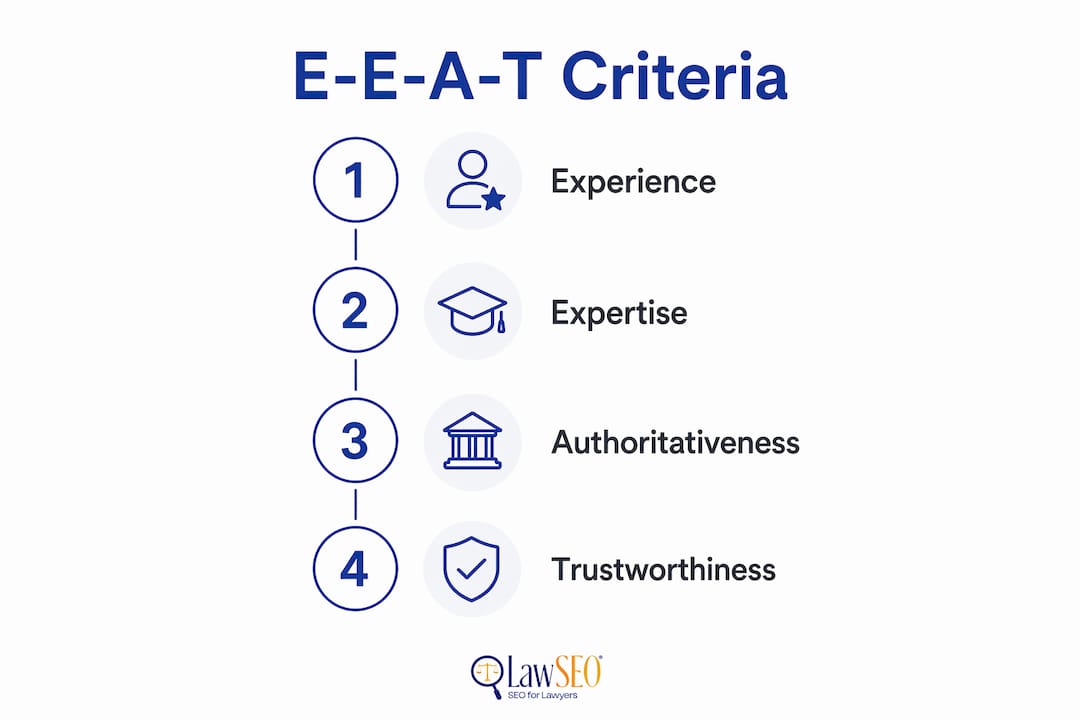
Each component of E-E-A-T maps to specific, verifiable site elements Google’s quality raters check during manual reviews. These are not abstract principles. They are concrete signals your site either has or does not have.
Core E-E-A-T signals Google checks on law websites:
- Attorney photos on every page: Google’s E-E-A-T standards require visible attorney photos sitewide, not just on the About page, to confirm real people stand behind the content
- Physical address and phone number: A verifiable office location signals the firm is a legitimate, accountable entity
- Detailed About and attorney bio pages: These must include bar admissions, practice area credentials, years of experience, and links to state bar verification pages
- Legal disclaimers and attorney advertising notices: Required by most state bar associations and read by Google as a compliance signal
- Privacy policy and terms of service: Clear privacy policies and verified physical location data build user trust and reinforce YMYL compliance
- HTTPS security: An unsecured law website is an automatic trust failure under Google YMYL criteria
Pro Tip: Link your attorney bio pages directly to your state bar’s public directory listing. This single step gives Google a third-party verification source for your credentials and strengthens your Authoritativeness score measurably.
How should legal content creators meet YMYL content standards?
YMYL content must be written or reviewed by qualified legal professionals with verifiable credentials, and those credentials must be prominently displayed alongside the content. Publishing a blog post about wrongful termination law without identifying the reviewing attorney is a direct YMYL compliance failure. Google’s quality raters are trained to flag exactly this gap.
Follow this process to build a content pipeline that meets Google’s legal content guidelines:
-
Assign a credentialed author or reviewer to every piece. Every article, FAQ, and practice area page must display the name, photo, and bar admission details of the attorney who wrote or reviewed it. Anonymous legal content fails YMYL standards by definition.
-
Verify accuracy before publication. Legal statutes change. A personal injury damages cap updated by your state legislature last year makes last year’s article inaccurate today. Build a review calendar that checks high-traffic pages at least twice per year.
-
Add transparent attribution with verification links. The author byline should link to a full bio page. That bio page should link to the state bar directory. This chain of verification is what Google means by “prominent display of credentials.”
-
Run a content audit every six months. Identify pages with outdated statutes, changed procedural rules, or superseded case law. Update or redirect them. Stale legal content is a YMYL liability, not just an SEO problem.
-
Separate legal information from legal advice. Every page must include a clear disclaimer stating the content is informational and does not constitute legal advice. This protects the firm ethically and signals compliance to Google’s quality raters.
Pro Tip: Create a master content log in Google Sheets or Notion that tracks every published page, its reviewing attorney, the date of last review, and the next scheduled review date. This turns compliance from a reactive scramble into a managed process.
What technical SEO practices support YMYL compliance for law sites?
Technical SEO is not separate from YMYL compliance. It is part of it. HTTPS security, page speed, mobile experience, and structured data are all direct signals Google uses to evaluate whether a law website meets the baseline quality threshold for YMYL content. Core Web Vitals affect both rankings and user engagement. A slow, unsecured law firm website communicates untrustworthiness before a user reads a single sentence.
Schema markup: the most underused YMYL trust signal
Attorney schema markup enhances entity understanding by Google and supports richer search results, which increases click-through rates and user engagement. Most law websites deploy no schema at all, which means they leave a significant trust and visibility advantage on the table.
| Schema type | What it communicates to Google |
|---|---|
| Attorney | Confirms the individual is a licensed legal professional with verifiable credentials |
| LegalService | Identifies the practice area, service area, and firm type for local search matching |
| LocalBusiness | Validates NAP data (name, address, phone) and ties the entity to a geographic location |
| FAQPage | Marks up question-and-answer content for featured snippet eligibility |
Local SEO as a YMYL compliance layer
Local SEO is the highest-ROI channel for law firms and a direct YMYL compliance factor. Google Map Pack listings capture the majority of clicks for local legal searches. Consistent NAP data across your website, Google Business Profile, and legal directories like Avvo and Justia is not optional. Inconsistent NAP data signals to Google that your firm’s identity is unverified, which directly undermines trustworthiness scores.
Managing partners frequently underestimate the impact of an incomplete or unmanaged Google Business Profile on both YMYL compliance and lead generation. An active profile with updated hours, photos, and responses to reviews is a trust signal Google reads alongside your on-site content. Learn how to rank in Google Maps to capture high-intent local clients who are ready to call.
Key technical priorities for law firm website optimization:
- Deploy HTTPS across every page, including contact forms and consultation pages
- Achieve a Largest Contentful Paint (LCP) under 2.5 seconds on mobile
- Implement Attorney, LegalService, and LocalBusiness schema on all relevant pages
- Maintain identical NAP data across your website, Google Business Profile, Avvo, FindLaw, and Justia
- Acquire local backlinks from bar associations, local chambers of commerce, and legal directories
How do YMYL guidelines affect law firm website design?
Website design is a direct YMYL compliance factor because Google’s quality raters evaluate user experience as part of their trustworthiness assessment. A law firm website that buries attorney credentials, hides contact information, or uses deceptive design patterns will fail a quality review regardless of how strong its content is. Design and compliance are inseparable for legal websites.
Design elements that directly affect YMYL trust scores:
- Attorney photos in the header or navigation: Placing attorney photos sitewide, not just on the About page, confirms to both users and Google that real, accountable professionals are behind the content
- Simplified consultation forms: Reducing form fields increases completion rates by 5%–10% per field removed. A five-field form outperforms a ten-field form every time
- Prominent legal disclaimers: Disclaimers must appear on every page that contains legal information, not just in the footer of the homepage
- Verified office location display: Embedding a Google Maps widget showing your physical office location reinforces the legitimacy signals Google looks for in YMYL sites
- Privacy policy and terms of service in the footer: These pages must be accessible from every page on the site, not buried in a sitemap
Avoiding deceptive design patterns is equally important. Pop-ups that obscure contact information, fake urgency timers, or misleading “free consultation” claims that contradict the actual intake process all create bounce risk and penalty exposure. Clean, transparent design is not just good UX. It is a YMYL compliance requirement.
Key takeaways
YMYL compliance for law websites requires simultaneous investment in content quality, technical infrastructure, local SEO, and transparent design, because Google evaluates all four layers together.
| Point | Details |
|---|---|
| E-E-A-T drives rankings | Display attorney credentials, bar admissions, and verification links on every content page. |
| Expert authorship is mandatory | Every legal page must show the name and credentials of the attorney who wrote or reviewed it. |
| Schema markup builds trust | Deploy Attorney, LegalService, and LocalBusiness schema to validate your firm’s identity to Google. |
| Local SEO reinforces YMYL | Consistent NAP data and an active Google Business Profile are direct trustworthiness signals. |
| Design affects compliance | Simplified forms, visible disclaimers, and attorney photos sitewide reduce bounce and build user confidence. |
Why YMYL compliance is the wrong thing to treat as a checklist
I have worked with law firms for nearly three decades, and the most common mistake I see is treating YMYL compliance as a one-time audit rather than an ongoing operating standard. A firm will update its attorney bios, add schema markup, and call it done. Six months later, a statute changes, a partner leaves, or a new practice area launches without proper attribution. The site quietly falls out of compliance while the firm assumes nothing has changed.
The legal SEO firms that consistently outrank their competitors are not the ones with the most technically perfect sites at launch. They are the ones with internal processes that keep credentials current, content reviewed, and local data consistent across every directory. Google’s quality raters do not grade on a curve. They evaluate what the site looks like on the day they review it.
The other misconception I encounter regularly is that YMYL compliance and SEO performance are separate goals. They are the same goal. Every trust signal you add for Google’s quality raters also makes your site more credible to the prospective client reading it at 11 p.m. after an accident. The benefits of local SEO for law firms compound when your site already demonstrates the trust signals YMYL demands. Build compliance into your editorial calendar, your technical roadmap, and your design standards. Then maintain it.
— TODD
How Lawseo helps law firms meet YMYL standards
Lawseo specializes exclusively in SEO for attorneys and law firms, which means every strategy we build accounts for Google YMYL criteria from the ground up. We handle attorney schema implementation, content review pipelines, Google Business Profile management, and local backlink acquisition as integrated parts of a single compliance-focused campaign. Our founder, Todd R. Stager, personally reviews strategy for every client. If your firm is ready to build a site that ranks and earns trust, start with our law firm SEO services or explore the 2026 advanced SEO strategy guide built specifically for legal practices competing in high-stakes local markets.
FAQ
What does YMYL mean for a law firm website?
YMYL stands for “Your Money or Your Life,” a Google classification applied to legal content because inaccurate legal information can directly harm a user’s legal standing. Law websites face stricter quality evaluation than most other content categories.
How does E-E-A-T apply to legal website SEO?
E-E-A-T (Experience, Expertise, Authoritativeness, Trustworthiness) requires law websites to display verifiable attorney credentials, expert-reviewed content, and transparent contact and location information on every page.
Which schema types should a law firm use?
Law firms should implement Attorney, LegalService, and LocalBusiness schema markup. These three types validate credentials, practice area, and geographic location data, which directly supports YMYL trustworthiness signals.
How often should legal content be reviewed for YMYL compliance?
Legal content should be reviewed at least twice per year, and immediately following any change to relevant statutes, procedural rules, or case law in your practice area.
Does local SEO affect YMYL compliance?
Yes. Consistent NAP data, an active Google Business Profile, and local backlinks from bar associations and legal directories are direct trustworthiness signals that Google evaluates as part of YMYL compliance for law websites.