

Nearly seventy percent of American law firm websites struggle to generate meaningful leads without a strategic blog SEO plan. For marketing directors and SEO specialists, understanding the nuances of legal content optimization can be the difference between obscurity and authority. This guide lays out key SEO strategies tailored for legal blogs, addressing stubborn myths, ranking factors, ethical rules, opportunities in AI-driven search, and the most common mistakes made by American firms.
Table of Contents
- Defining Legal Blog SEO And Key Myths
- Core Ranking Factors For Legal Blogs
- Unique Ethical Rules And Compliance In SEO
- Optimizing For AI-Driven Search Platforms
- Common Legal Blog SEO Mistakes To Avoid
Key Takeaways
| Point | Details |
|---|---|
| Legal Blog SEO Importance | Tailor SEO strategies to address unique legal constraints and client search behaviors for better visibility. |
| Ethical Compliance | Ensure all legal content adheres to professional standards to protect reputations and client interests. |
| AI Optimization | Shift to creating contextually rich content that aligns with AI-driven search platforms for improved client engagement. |
| Common Mistakes | Avoid keyword stuffing and ensure technical SEO best practices to maintain online credibility and visibility. |
Defining Legal Blog SEO and Key Myths
Legal Blog SEO represents a strategic digital marketing approach specifically tailored to help law firms improve their online visibility and attract potential clients through targeted, optimized content. Unlike generic SEO practices, legal blog SEO requires understanding unique professional constraints, ethical guidelines, and the specialized search behaviors of individuals seeking legal services. Search intent becomes paramount in this niche, where potential clients are often researching complex legal questions before engaging an attorney.
The most persistent myth surrounding legal blog SEO is that simply publishing content guarantees website traffic. In reality, successful legal blog optimization demands nuanced keyword strategies, authoritative content development, and a deep understanding of SEO for Lawyers: Advanced Strategy that goes beyond basic website optimization. Law firms must craft content that not only ranks well but also demonstrates expertise, addresses specific client concerns, and builds trust through substantive, legally accurate information.
Key aspects of effective legal blog SEO include developing content that answers specific user questions, utilizing long-tail keywords related to practice areas, and creating comprehensive resources that showcase the firm’s specialized knowledge. This approach requires understanding semantic search principles, where search engines prioritize context and depth over keyword density. Successful legal blogs integrate technical SEO elements like proper header structures, meta descriptions, and schema markup while maintaining a conversational tone that resonates with potential clients seeking legal guidance.
Pro tip: Conduct monthly content audits to identify underperforming blog posts and systematically update them with current legal information, fresh keyword research, and more comprehensive insights to maintain competitive search rankings.
Here’s a clear summary of key SEO components unique to legal blogs:
| SEO Component | Legal Blog Focus | Business Impact |
|---|---|---|
| Search Intent | Addresses complex legal questions | Attracts qualified clients |
| Long-Tail Keywords | Specific to practice areas and locations | Improves targeted traffic |
| Technical SEO | Proper headers and schema markup | Enhances search rankings |
| Ethical Compliance | Adheres to legal standards | Protects firm reputation |
Core Ranking Factors for Legal Blogs
Successful legal blog SEO hinges on several critical ranking factors that distinguish high-performing legal content from generic online publications. Search engine algorithms now prioritize expertise, authoritativeness, and relevance specific to legal content, meaning law firms must develop sophisticated content strategies that go beyond traditional keyword optimization. Understanding these nuanced ranking criteria is essential for law firms seeking to improve their digital visibility and attract potential clients through organic search results.

The primary ranking factors for legal blogs include comprehensive content depth, technical optimization, and demonstrable subject matter expertise. Law firms must create in-depth articles that thoroughly address user questions, incorporating AI-driven SEO strategies for law firms to enhance their content’s contextual relevance. This means developing long-form content that provides substantive legal insights, uses precise legal terminology, and offers clear, actionable information that potential clients find valuable. Technical elements like proper header structures, mobile responsiveness, page loading speed, and schema markup also play crucial roles in determining search engine rankings.
Keyword selection represents another fundamental ranking factor, with legal blogs requiring a strategic approach to topic selection and language use. Long-tail keywords specific to practice areas, geographic locations, and particular legal challenges help law firms target precise audience segments. Successful legal blogs integrate these specialized keywords naturally within comprehensive, authoritative content that answers specific user queries. Search engines increasingly reward content that demonstrates deep understanding of legal topics, using semantic search principles to evaluate the comprehensiveness and expertise reflected in blog posts.
Pro tip: Implement a quarterly content audit to analyze your legal blog’s performance, identifying high-performing topics and updating existing posts with current legal information and emerging keyword opportunities.
Unique Ethical Rules and Compliance in SEO
Legal blog SEO demands an exceptional level of ethical consideration, distinguishing it from standard digital marketing practices. Attorneys must navigate a complex landscape of professional responsibility, ensuring their online marketing strategies strictly adhere to SEO professional codes of ethics while maintaining the highest standards of legal advertising regulations. Ethical compliance is not merely a recommendation but a fundamental requirement that protects both the law firm’s reputation and potential clients’ interests.
The unique ethical constraints for legal blog SEO encompass multiple critical dimensions. Law firms must avoid misleading content, guarantee absolute accuracy in legal information, protect client confidentiality, and ensure transparent representation of legal services. This means meticulously avoiding claims that could be construed as guaranteeing specific legal outcomes, which violate professional conduct rules. Search engine optimization strategies must be carefully crafted to provide genuine value, offering substantive legal insights without engaging in manipulative tactics that could compromise the firm’s professional integrity.
Technical SEO practices for legal blogs require particularly nuanced implementation to maintain ethical standards. This includes implementing clear disclaimers, avoiding any language that could be interpreted as solicitation, and ensuring all content respects client privacy and professional confidentiality. Attorneys must be vigilant about potential conflicts of interest, ensuring that blog content does not inadvertently create attorney-client relationships or make promises that cannot be legally fulfilled. Sophisticated legal blog SEO demands a delicate balance between effective digital marketing and strict adherence to professional conduct guidelines.
Pro tip: Develop a comprehensive internal review process that includes legal ethics experts and marketing professionals to audit all blog content before publication, ensuring complete compliance with professional conduct rules.
Optimizing for AI-Driven Search Platforms
Law firms must fundamentally reimagine their digital content strategies to succeed in the emerging AI-powered search ecosystem. Generative search platforms are dramatically transforming how potential clients discover and interact with legal information, requiring sophisticated optimization approaches that go beyond traditional SEO techniques. AI search optimization strategies now demand a holistic approach that prioritizes comprehensive, contextually rich content designed to satisfy complex user queries and AI algorithm requirements.
The core principles of AI-driven search optimization for legal blogs center on creating highly structured, semantically meaningful content that demonstrates deep topical expertise. This involves developing content that not only answers specific legal questions but also provides comprehensive context, anticipates follow-up inquiries, and presents information in a clear, authoritative manner. Advanced semantic markup, entity optimization, and natural language processing techniques become critical, enabling AI platforms to understand and categorize legal content with greater precision. Law firms must focus on creating content that serves as definitive resources within specific legal domains, using precise terminology and demonstrating nuanced understanding of complex legal concepts.
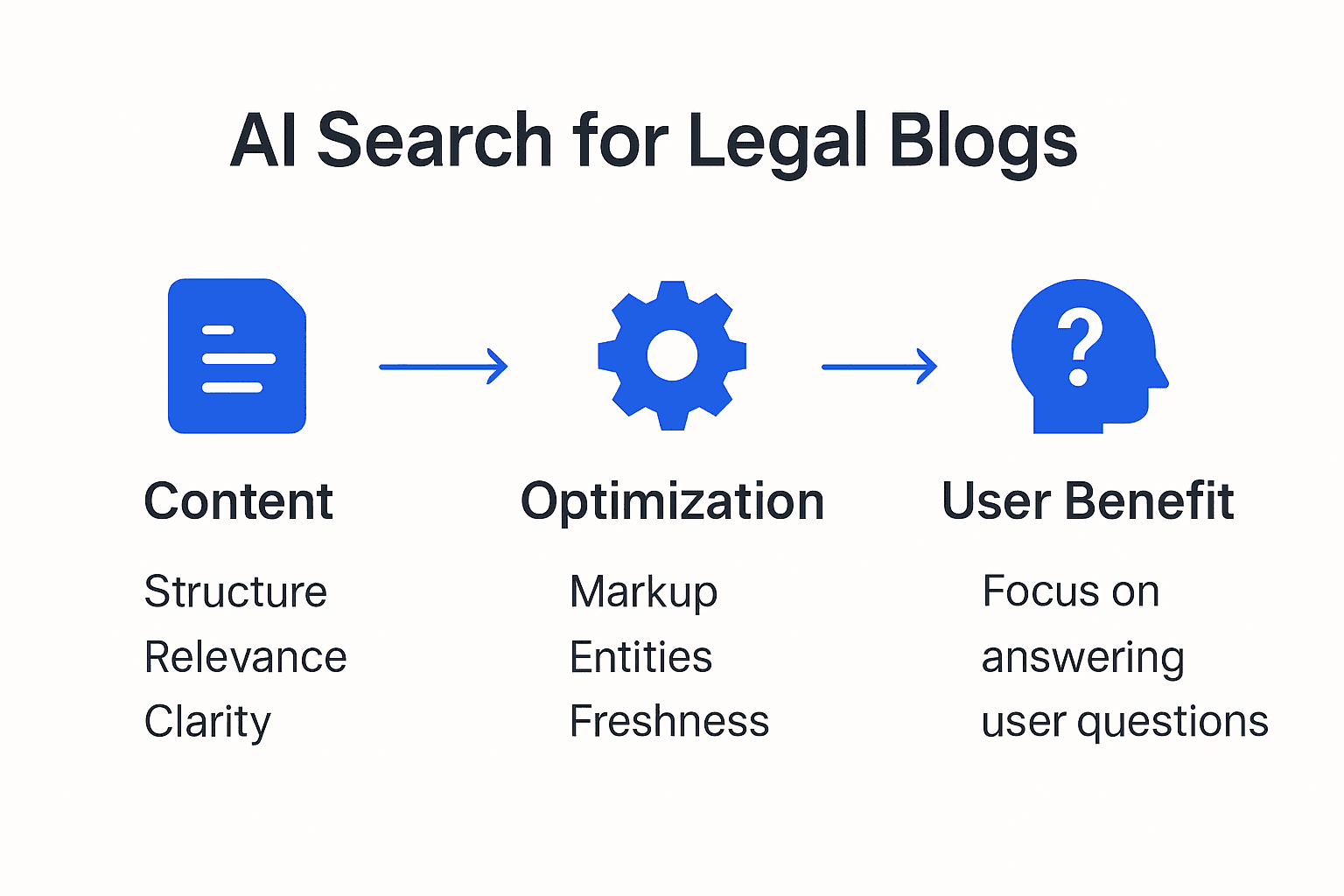
Technical optimization for AI search platforms requires a multifaceted approach that extends beyond traditional keyword strategies. Legal blogs must incorporate advanced structured data, implement schema markup that clearly defines legal concepts, and develop content with clear hierarchical information architecture. This means creating interconnected content networks that allow AI platforms to understand the relationships between different legal topics, practice areas, and specific legal scenarios. Attorneys must think like knowledge architects, designing content that can be easily parsed, understood, and reconstructed by increasingly sophisticated artificial intelligence systems.
Pro tip: Conduct monthly content audits specifically focused on AI searchability, using advanced natural language processing tools to evaluate your legal blog’s semantic richness and contextual comprehensiveness.
Compare traditional SEO methods versus AI-driven optimization for law firm blogs:
| Approach | Content Structure Focus | Optimization Techniques | User Benefit |
|---|---|---|---|
| Traditional SEO | Keyword density, meta tags | On-page SEO, manual audits | Visibility for basic search |
| AI-Driven Optimization | Semantic context, entity links | Schema markup, NLP tools, content network | Precision answers to legal queries |
Common Legal Blog SEO Mistakes to Avoid
Legal blog SEO is fraught with potential pitfalls that can significantly undermine a law firm’s digital marketing efforts. Law firm SEO strategies require precision and strategic implementation to avoid critical errors that can damage online visibility and credibility. Content quality stands as the most fundamental requirement, with many attorneys mistakenly believing that simply publishing legal articles will automatically generate client interest and search engine rankings.
One of the most pervasive mistakes legal blogs make involves keyword misuse and over-optimization. Attorneys often fall into the trap of cramming legal terminology into content without considering natural language flow or user experience. This approach not only alienates potential clients but also triggers search engine penalties for keyword stuffing. Successful legal blog SEO demands a nuanced approach that integrates specialized legal terms organically, focusing on providing genuine value through comprehensive, well-researched content that directly addresses potential clients’ specific legal questions and concerns.
Technical SEO errors can be equally damaging for law firm blogs. Common mistakes include neglecting mobile optimization, failing to implement proper schema markup, and creating inconsistent or duplicate content across practice area pages. Law firms must develop a holistic approach to technical optimization, ensuring their blogs are fast-loading, mobile-responsive, and structured in a way that allows search engines to easily understand and categorize their content. This requires ongoing technical maintenance, regular content audits, and a commitment to creating a seamless user experience across all digital platforms.
Pro tip: Implement a quarterly content and technical SEO audit that systematically reviews your legal blog’s performance, identifying and immediately addressing potential optimization gaps and content weaknesses.
Elevate Your Legal Blog SEO and Capture Qualified Leads Today
Struggling to turn your legal blog content into consistent, high-quality leads? As the article explains, mastering legal blog SEO means more than just posting articles. It requires expert strategies that focus on search intent, ethical compliance, and AI-driven optimization to truly stand out. If you want to avoid common SEO pitfalls like keyword stuffing and missed technical opportunities, partnering with a specialized firm can make all the difference.
At LawSEO.com, we understand the unique challenges law firms face when optimizing blogs to attract the right clients. Our founder-led team combines over 29 years of SEO expertise with deep knowledge of legal marketing ethics to craft authoritative content that ranks well and builds trust. We specialize in integrating advanced AI optimization techniques and comprehensive SEO services designed exclusively for attorneys. Don’t let your competitors grab the leads you deserve. Visit our main page and discover how our proven strategies can transform your blog into a powerful client generation tool starting now.
Frequently Asked Questions
What is Legal Blog SEO?
Legal Blog SEO is a specialized digital marketing strategy designed to enhance the online visibility of law firms by optimizing their blog content for search engines. It focuses on creating targeted and authoritative legal content that meets the specific search intents of individuals seeking legal assistance.
How can I improve my law firm’s blog SEO?
To improve your law firm’s blog SEO, focus on developing comprehensive content that answers user questions, utilize long-tail keywords related to your practice areas, and ensure proper technical SEO like heading structures and schema markup. Regular content audits and updates with current legal information are also essential for maintaining rankings.
What are common mistakes attorneys make in legal blog SEO?
Common mistakes include over-optimizing keywords, neglecting mobile optimization, failing to use proper schema markup, and creating duplicate or low-quality content. It’s crucial to provide valuable, well-researched information that addresses client concerns while maintaining a smooth, readable flow.
How does AI affect Legal Blog SEO?
AI is transforming Legal Blog SEO by changing how potential clients discover content. Law firms must now optimize their blogs for AI-driven search platforms, focusing on creating structured, contextually rich content that aligns with AI algorithms. This includes using advanced semantic markup and ensuring your content anticipates follow-up questions.