

Nearly 90 percent of American consumers searching for legal help start with local online queries. For managing partners at small and mid-sized law firms, capturing these local searches means staying competitive and relevant within their community. This article breaks down actionable strategies to help your practice stand out in American local search results, attract qualified clients, and build trust with those who need your expertise most.
Table of Contents
- What Local SEO Means for Law Firms
- Key Ranking Factors in Local Search
- Optimizing Google Business and AI Profiles
- Ethical Compliance and Legal Marketing Rules
- Managing Reviews, Reputation, and Local Links
- Common Local SEO Pitfalls to Avoid
Key Takeaways
| Point | Details |
|---|---|
| Local SEO Importance | Local SEO is essential for law firms to enhance visibility in their geographic area, attracting clients through targeted searches. |
| Key Ranking Factors | Factors such as consistent NAP information, online reviews, and effective location-based content are critical for improving local search rankings. |
| Google Business Profile Optimization | A complete and regularly updated Google Business Profile significantly boosts a law firm’s local presence and client engagement. |
| Avoiding Common Pitfalls | Maintaining consistent business information across all platforms and avoiding keyword stuffing are vital to preserve online credibility and search rankings. |
What Local SEO Means for Law Firms
Local SEO represents a strategic digital marketing approach specifically designed to help law firms increase their online visibility within their geographic service area. Unlike traditional SEO, local SEO focuses on attracting potential clients searching for legal services in a specific city, county, or region. Optimizing legal websites requires a nuanced understanding of how search engines connect local searchers with nearby professional services.
For law firms, local SEO involves a comprehensive strategy that goes beyond simple keyword placement. It encompasses multiple critical elements including Google Business Profile optimization, location-specific content creation, building local citations, managing online reviews, and ensuring consistent name, address, and phone number (NAP) information across digital platforms. The goal is to signal to search engines that your law firm is a credible, relevant local legal resource precisely matched to potential clients’ geographic and legal needs.
The mechanics of local SEO for attorneys involve several key tactics. Geographic keywords become essential – instead of just “personal injury lawyer,” your optimization would target “personal injury lawyer in Chicago” or “Austin family law attorney.” This hyperlocal approach helps search engines understand your precise service area. Technical elements like schema markup, which provides search engines structured data about your law firm, and location-based backlinks from local bar associations or community organizations further strengthen your local search presence.
Successful local SEO transforms how potential clients discover legal services. Rather than broad, generic searches, clients now find attorneys through highly targeted, location-specific queries that reflect immediate legal needs. A well-executed local SEO strategy means appearing prominently when someone searches “need a lawyer near me” or seeks specific legal assistance within their community.
Below is a comparison of traditional SEO and local SEO approaches for law firms:
| Approach | Focus Area | Typical Keyword Example | Key Benefit |
|---|---|---|---|
| Traditional SEO | Nationwide or broad reach | “personal injury lawyer” | Attracts general leads |
| Local SEO | City or region specific | “personal injury lawyer in Chicago” | Captures local clients |
Pro tip: Claim and completely fill out your Google Business Profile with accurate information, professional photos, and regular updates to significantly improve your local search rankings.
Key Ranking Factors in Local Search
Optimizing legal websites requires a strategic approach to local search ranking factors that go far beyond simple keyword placement. For law firms, understanding these critical ranking elements can mean the difference between being invisible and becoming the go-to legal resource in their geographic area. Search engines use complex algorithms that evaluate multiple dimensions of online presence to determine local search rankings.
The primary ranking factors for law firms include geographic relevance, website optimization, and digital credibility. Consistent business information across online platforms is fundamental – this means maintaining identical name, address, and phone number (NAP) details on your website, Google Business Profile, legal directories, and social media channels. Search engines cross-reference these details to validate your firm’s legitimacy and local presence. Local keyword targeting becomes crucial, with phrases like “criminal defense lawyer in Miami” or “estate planning attorney in Seattle” signaling precise geographic service areas.
Reviews and online reputation play a significant role in local search rankings. Google and other search platforms prioritize businesses with substantial positive reviews, treating them as trust signals. Law firms should actively encourage satisfied clients to leave detailed, authentic reviews on platforms like Google, Avvo, and Yelp. Technical SEO elements such as mobile responsiveness, page loading speed, and schema markup further enhance local search performance. Location-based backlinks from local bar associations, chamber of commerce websites, and community organizations can substantially boost a law firm’s local search credibility.
Content strategy remains a critical ranking factor for local legal SEO. Law firms must develop location-specific content that addresses local legal concerns, showcases community involvement, and demonstrates deep understanding of regional legal landscapes. This might include blog posts about local court systems, area-specific legal guides, or community event sponsorships. By creating geographically targeted, high-quality content, attorneys can signal relevance and expertise to both search algorithms and potential clients.
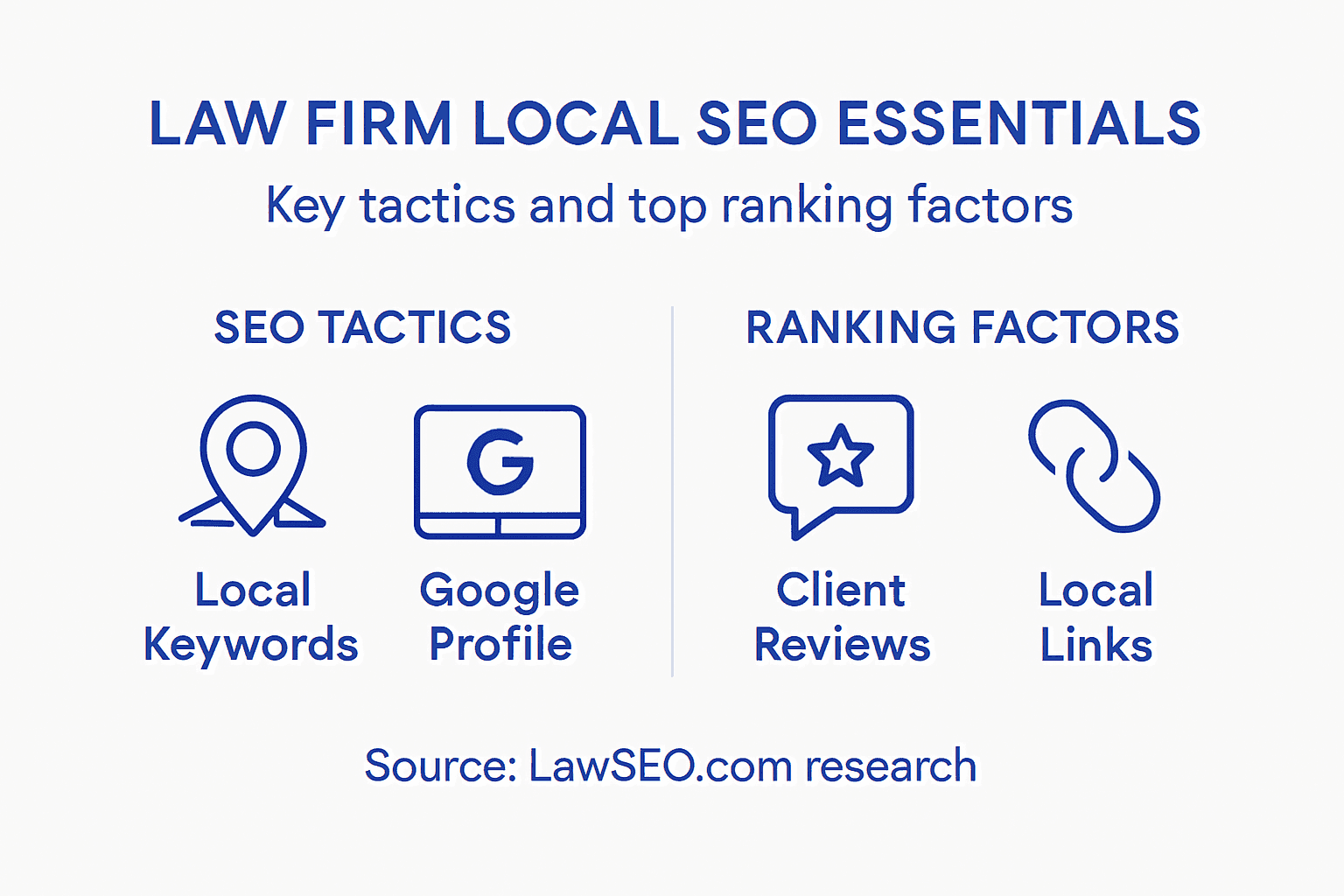
Here is a summary of critical factors influencing local search rankings for law firms:
| Factor | Description | Impact on Rankings |
|---|---|---|
| Geographic Relevance | Targets service area with keywords | Makes firm appear location-specific |
| Consistent NAP Info | Same business details everywhere | Builds online trust and authority |
| Online Reviews | Positive, diverse client testimonials | Signals credibility to search engines |
| Local Backlinks | Links from bar associations and groups | Boosts community relevance |
Pro tip: Implement a systematic review management process that encourages satisfied clients to share their experiences while maintaining strict ethical guidelines for legal professional conduct.
Optimizing Google Business and AI Profiles
Creating and optimizing your Google Business Profile represents a critical foundation for law firms seeking to enhance their local digital presence. Modern legal marketing demands a strategic approach that integrates traditional search engine optimization with emerging AI-driven technologies. By carefully crafting your online profiles, you can significantly improve your firm’s visibility and client acquisition potential.
The Google Business Profile requires meticulous attention to detail. Law firms must ensure complete and accurate information, including precise practice area descriptions, service offerings, contact details, and business hours. Professional photographs showcasing your office, attorneys, and team can dramatically increase profile engagement. Regularly updating your profile with recent client testimonials, community involvement, and professional achievements signals active management and builds trust with potential clients.
AI and the law are rapidly converging, creating new opportunities for sophisticated digital marketing strategies. Law firms can leverage AI tools to generate location-specific content, optimize keyword targeting, and personalize client interactions. Advanced AI technologies enable predictive analysis of search behaviors, allowing attorneys to anticipate potential client needs and craft hyper-targeted digital experiences. This might include developing AI-enhanced chatbots that provide immediate legal guidance or creating dynamic content that adapts to user search intent.
Optimization extends beyond traditional search parameters. Modern law firms must develop comprehensive digital profiles that function across multiple platforms, including Google, specialized legal directories, and emerging AI search interfaces. This holistic approach involves maintaining consistent branding, managing online reviews, and developing a robust content strategy that demonstrates expertise and local relevance. Technical elements like schema markup, mobile responsiveness, and rapid page loading become critical in signaling credibility to both human users and AI algorithms.
Pro tip: Develop a quarterly audit process to review and update your Google Business Profile, ensuring all information remains current and accurately represents your law firm’s evolving services and achievements.
Ethical Compliance and Legal Marketing Rules
Legal ethics form the critical foundation for law firm marketing strategies, establishing clear boundaries that protect client interests and maintain professional integrity. Modern digital marketing requires attorneys to navigate a complex landscape of regulatory requirements while still effectively promoting their services. Understanding these ethical constraints is not just about avoiding penalties but about building trust and credibility with potential clients.
The American Bar Association’s Model Rules provide a comprehensive framework for professional conduct in legal advertising. These rules mandate that all marketing communications must be fundamentally truthful, avoiding any language that could create unjustified expectations or mislead potential clients. Key ethical considerations include protecting client confidentiality, avoiding conflicts of interest, and ensuring that all promotional materials accurately represent the firm’s capabilities and experience. Law firms must carefully craft their digital presence to comply with both national guidelines and specific state bar association regulations.
ABA Model Rules of Professional Conduct emphasize several critical ethical marketing principles. These include prohibitions against false or misleading statements, restrictions on client testimonials, and guidelines for managing online reviews and ratings. Law firms must develop sophisticated compliance mechanisms that review all marketing content, including website copy, social media posts, online advertisements, and client communications. Special attention must be paid to claims about past case results, potential outcomes, and professional capabilities, ensuring that all statements are verifiable and do not create unrealistic expectations.
Ethical digital marketing for law firms goes beyond mere compliance – it represents a commitment to professional transparency and client trust. This means developing marketing strategies that prioritize clear, honest communication, demonstrate genuine expertise, and provide meaningful value to potential clients. Attorneys must balance their marketing objectives with stringent ethical guidelines, using digital platforms to educate and inform rather than simply promote. Regular training, comprehensive review processes, and a culture of ethical awareness are essential to navigating the complex intersection of legal marketing and professional responsibility.
Pro tip: Implement a multi-stage review process for all marketing materials, involving both legal marketing professionals and senior attorneys to ensure complete ethical compliance and brand integrity.
Managing Reviews, Reputation, and Local Links
Reputation management represents a critical strategic imperative for law firms seeking to build trust and credibility in the digital marketplace. Online reviews have become the modern equivalent of word-of-mouth recommendations, with potential clients increasingly relying on digital testimonials to inform their legal service choices. Understanding how to effectively cultivate, monitor, and respond to online feedback can dramatically impact a law firm’s local search visibility and client acquisition potential.
Successful reputation management involves a multifaceted approach. Law firms must develop systematic processes for encouraging satisfied clients to share their experiences while simultaneously addressing any negative feedback with professionalism and transparency. Strategic review generation requires creating multiple touchpoints where clients can easily provide feedback, including Google Business Profile, specialized legal directories, and platform-specific review sections. Firms should implement a proactive approach that includes follow-up communications, client satisfaction surveys, and clear pathways for clients to share their experiences.
Building local links and citations forms another crucial component of reputation management. These digital connections serve as trust signals for search engines, helping to validate a law firm’s local presence and credibility. High-quality backlinks from reputable local sources such as bar associations, community organizations, and professional networks can significantly enhance local search rankings. Law firms should focus on generating authentic, contextually relevant links that demonstrate genuine community involvement and professional expertise.
The technical aspects of online reputation management extend beyond simple review collection. Law firms must develop sophisticated monitoring systems that track mentions across multiple platforms, allowing for rapid response to both positive and negative feedback. Advanced reputation management strategies incorporate sentiment analysis, allowing attorneys to understand broader perceptions of their practice and identify areas for potential improvement. By treating online reviews as valuable client feedback rather than mere marketing metrics, law firms can continuously refine their service delivery and client experience.
Pro tip: Develop a standardized response protocol for online reviews that provides personalized, professional replies within 48 hours, demonstrating your firm’s commitment to client communication and satisfaction.
Common Local SEO Pitfalls to Avoid
Local search engine optimization demands precision and strategic planning for law firms seeking to maximize their digital visibility. Understanding common pitfalls can mean the difference between attracting potential clients and remaining invisible in crowded digital landscapes. The most critical errors often stem from seemingly minor oversights that can significantly undermine a firm’s online presence.
One of the most frequent mistakes law firms make involves inconsistent business information. Maintaining identical name, address, and phone number (NAP) details across all digital platforms is crucial. Discrepancies across Google Business Profile, legal directories, social media, and the firm’s website can confuse search engines and potential clients, ultimately reducing local search rankings. Many attorneys inadvertently create multiple listings or fail to update contact information after office relocations, which can fragment their digital credibility.
Optimizing legal websites requires avoiding several technical pitfalls that can harm local SEO performance. Mobile responsiveness remains a critical factor often overlooked by law firms. With over 60% of legal searches happening on mobile devices, an unresponsive website can dramatically reduce client engagement. Additionally, law firms frequently make the error of keyword stuffing – overloading content with geographic terms and practice area keywords in an attempt to manipulate search rankings. This approach not only looks unprofessional but can also trigger search engine penalties that significantly damage online visibility.
Content strategy represents another nuanced area where law firms commonly stumble. Many practices either neglect their website content entirely or produce generic, uninspired material that fails to demonstrate local expertise. Effective local SEO demands hyper-targeted content that speaks directly to community-specific legal challenges, showcases the firm’s understanding of regional legal landscapes, and provides genuine value to potential clients. Successful law firms view their digital presence as an opportunity to educate and build trust, not simply as a marketing billboard.
Pro tip: Conduct a quarterly digital audit of your online listings, ensuring 100% consistency in business information and actively removing any duplicate or outdated entries.
Unlock Local Client Growth with Expert Legal SEO Support
The article highlights the critical challenge law firms face in mastering local SEO strategies that truly connect you with clients in your specific geographic area. From achieving consistent NAP details and managing online reviews to optimizing Google Business Profiles and navigating ethical marketing rules, these are complex tasks that require deep expertise. You need more than just basics — you need specialized legal SEO tactics tailored for the competitive legal landscape.
At LawSEO.com, we understand these unique challenges and offer a comprehensive solution built exclusively for law firms. With over 29 years of experience led by Todd R. Stager, our founder, we combine proven local SEO techniques with cutting-edge AI optimization to ensure your firm stands out in organic search and emerging AI-driven platforms. Our focus on ethical compliance and managing online reputation means your firm builds trust as you gain visibility. Discover how our personalized SEO services, including local link building and tailored content production, can transform your practice’s online presence.
Ready to elevate your local search rankings and attract the right clients now? Visit LawSEO.com to learn how our exclusive legal SEO strategies can position your firm as the trusted local authority. Start your journey toward sustained client growth with expert help today.
Frequently Asked Questions
What is local SEO for law firms?
Local SEO for law firms is a digital marketing strategy aimed at increasing a firm’s visibility in local search results, focusing on attracting potential clients seeking legal services in a specific geographic area.
Why is optimizing my Google Business Profile important?
Optimizing your Google Business Profile is crucial because it provides essential information about your firm, such as services, contact details, and business hours, helping improve your online visibility and trustworthiness with potential clients.
How can reviews impact my law firm’s local SEO rankings?
Online reviews significantly impact local SEO rankings as search engines prioritize businesses with positive reviews as trust signals. Encouraging satisfied clients to leave authentic reviews can boost your firm’s credibility and online presence.
What common mistakes should law firms avoid in local SEO?
Common mistakes include inconsistent business information across platforms, neglecting mobile responsiveness, keyword stuffing in content, and failing to create locally-targeted content that addresses community-specific legal issues.