

TL;DR:
- Building online authority requires high-quality, attorney-authored content and legitimate backlinks.
- Consistent maintenance and ethical practices are crucial for long-term search ranking stability.
- Genuine authority signals, like media mentions and professional endorsements, outperform shortcuts and cheap tactics.
Your law firm may have decades of courtroom wins and marquee client results, yet when someone searches for legal help in your city, competitors with thinner track records outrank you. Online authority does not automatically follow real-world reputation. Small SEO missteps, thin content, and weak backlink profiles silently erode your digital credibility and cost you client inquiries every day. This guide provides a clear, evidence-based plan to fix that. You will learn how to audit your current authority, build high-quality content, earn the right backlinks, and sustain trust signals that keep your firm ranking ahead of the competition for years to come.
Key Takeaways
| Point | Details |
|---|---|
| Authority needs a baseline | Start with a clear audit of your law firm’s current online authority and set measurable growth goals. |
| Content quality is critical | Practice-specific, client-focused content authored by attorneys dramatically outperforms generic website pages. |
| Links must be earned | High-authority editorial, news, and .gov backlinks are safer and convert much better than mass directories. |
| Compliance sustains growth | Staying ethical and regularly reviewing your authority signals ensures you maintain long-term SEO success without penalties. |
Define your authority baseline and set clear goals
Before you can grow your authority, you need to know exactly where you stand. Law firm authority online is measured through a combination of technical and reputational signals that search engines use to decide which firms deserve top visibility.
The most important metrics to track include:
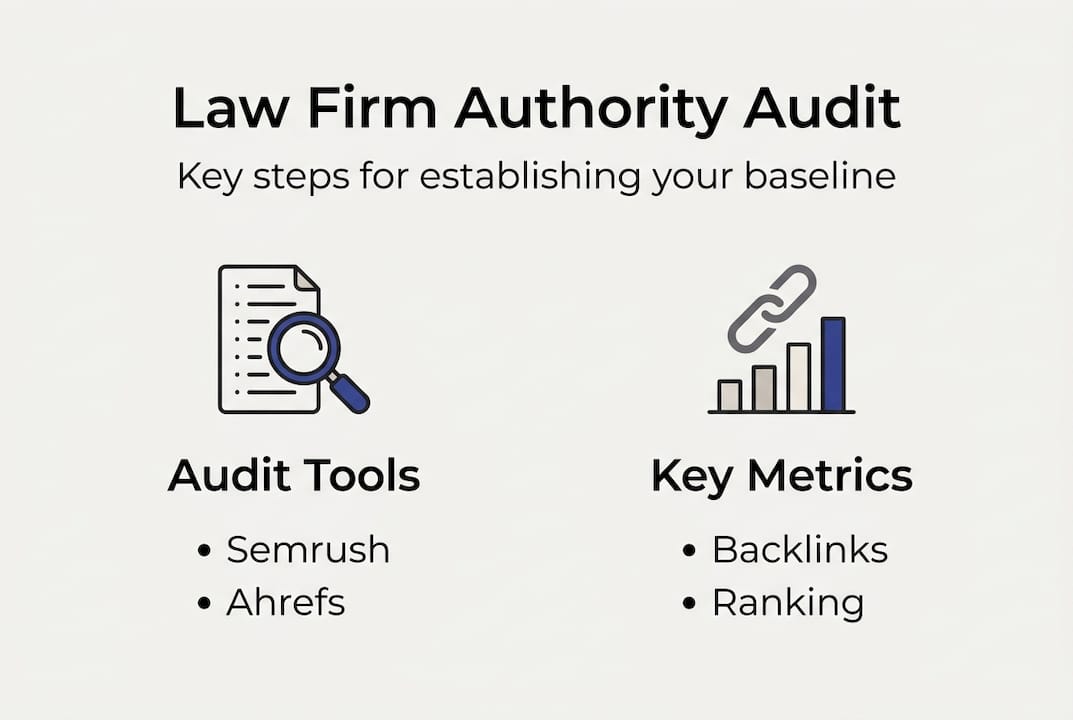
- Domain Rating (DR): A score from 0 to 100 that reflects the overall strength of your backlink profile. Tools like Ahrefs or Moz calculate this.
- Branded search volume: How often users type your firm name directly into Google. Rising branded searches indicate growing recognition.
- Referring domains: The number of unique websites linking to yours. More high-quality referring domains correlates with higher rankings.
- Topical authority: Whether your website consistently covers specific legal practice areas in depth.
To audit your current position, run your domain through a tool like Semrush, Ahrefs, or Moz. Pull a backlink report to identify the quality and diversity of sites pointing to you. Review your top practice pages to see which ones rank in Google’s top 10, top 20, or not at all.
Use boosting Google rankings as a benchmark framework when interpreting your audit data.
Once you have that baseline, set specific targets:
| Goal type | Example target | Timeframe |
|---|---|---|
| Referring domains | Increase by 25% | 6 months |
| Thought leadership pieces | Publish 8 attorney-authored posts | 6 months |
| Branded search volume | 20% increase | 12 months |
| Domain Rating | Move from 20 to 35 | 12-18 months |
Realistic expectations matter here. Proven authority-building strategies show that initial improvements take 3 to 6 months, with full authority development requiring 6 to 24 months depending on your starting point and competitive market.
Pro Tip: Avoid chasing shortcuts like mass directory submissions or purchased link packages. These tactics create ethical risks, trigger algorithmic penalties, and deliver minimal ROI compared to building authority through legitimate channels.
Build high-quality content that signals expertise
With your goals in place, the next step is to produce content that not only ranks, but inspires trust in clients and search engines alike.
Generic content fails for a predictable reason. A 300-word practice page with no attorney attribution, no real case context, and no specific legal guidance tells Google nothing useful about your expertise. It tells potential clients even less.
The authority-building content guide is clear: practice-specific pages need 1,500 to 2,500 words that address client intent directly. That means answering the exact questions your clients type into Google before they pick up the phone.
| Content type | Low-value version | High-authority version |
|---|---|---|
| Practice page | Generic “we handle DUI cases” | Attorney-written guide with local court procedures and outcomes |
| Directory listing | Name, address, phone | N/A (use these minimally for SEO) |
| Blog/article | Recycled news summary | Thought leadership with attorney attribution and cited statutes |
| FAQ page | Vague answers | Jurisdiction-specific answers signed by a named attorney |
The CMO legal content survey found that written content ranks as the most effective authority-building tactic at 57%, followed by branding at 54% and in-person speaking at 44%, according to the LMA 2025 CMO Survey.
For firms with multiple offices, geo-targeting is essential. Create a dedicated page for each location rather than a single catch-all page. Each page should reference local courts, regulations, and community context. Pair this with structured schema markup (code that helps search engines understand your content) so each location page is indexed correctly.
Top content types that consistently build legal authority:
- Attorney-authored practice area guides (1,500+ words)
- Case studies with outcomes (where permitted by bar rules)
- FAQ pages with jurisdiction-specific answers
- Thought leadership articles on emerging legal issues
- Video transcripts attributed to named attorneys
Refer to the law firm visibility checklist to make sure your content strategy covers every critical touchpoint.
Pro Tip: Always attach a real attorney’s name and credentials to every piece of content. This satisfies Google’s E-E-A-T (Experience, Expertise, Authoritativeness, Trustworthiness) guidelines and signals to readers that the advice comes from a credentialed professional, not a content mill.
Earn authoritative backlinks the right way
High-value content lays your foundation, but acquiring the right links is where sustained authority growth accelerates.
Not all backlinks are equal. A single link from a respected legal publication or a .gov website carries more authority than 200 links from generic directories. Search engines treat editorial links as third-party endorsements. They are harder to earn, which is exactly why they carry more weight.
Tier 1 editorial backlinks from legal publications, news outlets, and .gov sources consistently outperform directory listings for both SEO authority and client conversions.
Top sources for high-authority legal backlinks:
- State bar association websites and legal aid organizations
- Local and national news outlets covering legal topics
- Law school publications and academic journals
- .gov and .edu sites that reference legal resources
- Industry publications like Law360, the ABA Journal, and JD Supra
- Legal podcast platforms where attorneys appear as guests
Pitching these outlets requires a clear angle. Journalists and editors want commentary on trending legal developments, not self-promotional content. Offer data, a unique legal interpretation, or a local case precedent angle that adds real value to their audience.
“Comply with bar ethics to avoid penalties and wasted investment. Every link you earn should reflect a legitimate professional relationship, not a transactional shortcut.”
Ethics are not optional in this space. Reciprocal link schemes (trading links with unrelated sites), paid link placements, and mass directory submissions can all trigger bar association scrutiny in addition to Google penalties. Review ethical SEO tips before executing any outreach campaign to stay within both legal marketing rules and search engine guidelines.
When your backlink profile improves, the effects compound. Each new authoritative link raises your domain rating, which in turn helps new content rank faster. This momentum is why backlink authority strategies that prioritize quality over volume consistently deliver better long-term results.
Maintain authority with ongoing trust signals and ethics
With strong content and links established, shifting focus to ongoing trust and ethical vigilance ensures your gains last.
Authority is not a one-time project. It requires consistent attention to content freshness, backlink health, and compliance. Law firms that skip this maintenance phase often see rankings slip within 12 months as competitors update their content and earn new links.
The data is clear: full authority takes 6 to 24 months to build, and protecting it requires equal commitment.
Here is a practical step-by-step plan to maintain authority over time:
- Review your backlink profile monthly. Use Ahrefs or Semrush to flag low-quality or toxic links and disavow them through Google Search Console.
- Optimize existing content quarterly. Update statistics, refresh internal links, and ensure attorney attributions are current.
- Attribute all new content correctly. Every article, guide, or FAQ must have a named attorney attached before publication.
- Monitor branded search volume. A decline signals a reputation issue or a competitor gaining ground on your brand terms.
- Update attorney bios annually. Bios serve as E-E-A-T signals. Outdated credentials weaken trust with both users and algorithms.
Tools worth including in your maintenance workflow: Google Search Console (free and essential), Ahrefs or Semrush for backlink monitoring, and BrightLocal for tracking local search visibility.
Also maintain vigilance on ethical SEO practices. Bar associations continue to refine their guidance on digital advertising and content marketing. Staying ahead of those updates protects your license and your search rankings simultaneously.
Pro Tip: Schedule a formal quarterly review that covers content freshness, backlink health, compliance with bar rules, and keyword ranking shifts. Block this time in your calendar the same way you would schedule a client review meeting.
Why quick SEO hacks backfire and what actually elevates authority long-term
After covering how to maintain your hard-won authority, it is worth addressing a pattern we see repeatedly: law firm leaders who understand the strategy but still look for shortcuts when results take time.
Mass directory submissions look cheap and fast. Paid link packages promise quick domain rating gains. Neither works as advertised for law firms. Google’s algorithms have grown sophisticated enough to identify link velocity spikes and devalue them. More importantly, bar ethics rules create a layer of professional risk that other industries do not face. A penalty is not just a drop in rankings. It can trigger disciplinary review.
Real authority looks like this: a managing partner quoted in The Wall Street Journal on a case outcome, an attorney-authored article cited on a state bar website, or a client review that generates a follow-on news story. These are signals that no algorithm can fake and no shortcut can replicate.
“Real expert voices build authority. Algorithmic tricks rarely last.”
Quality over quantity in links is not just an SEO principle. It is the difference between building something defensible and building something disposable.
Invest in educating your attorneys on ethical law firm SEO. When your team understands why transparency and bar compliance protect both your license and your rankings, they become active participants in authority-building rather than passive bystanders.
Ready to boost your law firm’s authority?
Building genuine online authority requires a disciplined framework, attorney-driven content, and ethical link acquisition that holds up to both algorithmic and bar scrutiny. If you are ready to move from strategy to execution, LawSEO authority services give you a specialized team that works exclusively with law firms. We understand the compliance requirements, the competitive dynamics, and the content standards that drive real rankings. Explore legal SEO explained to see how the process works from start to finish, or review top strategies that are working for firms in competitive markets right now. Request a strategy session and put these principles to work for your practice.
Frequently asked questions
How long does it take to establish real law firm authority?
Expect initial improvements in 3 to 6 months, but full trusted authority typically requires 6 to 24 months of consistent effort. Your starting domain rating and market competitiveness directly affect that timeline.
What types of backlinks boost law firm SEO authority the most?
Tier 1 editorial backlinks from legal publications, news outlets, and .gov sources carry the highest authority and pose the lowest ethical risk. They also tend to generate direct referral traffic from qualified prospects.
Is publishing in directories still useful for firm authority?
Some established legal directories offer moderate visibility value, but Tier 1 editorial links and attorney-authored content consistently outperform directories for both SEO authority and client conversion rates.
How can law firms with multiple locations avoid diluting authority?
Create separate geo-targeted pages for each office location and implement structured schema markup on each page. This prevents authority dilution and ensures each market is indexed and ranked independently.