

TL;DR:
- Authority in legal SEO depends on high-quality backlinks, relevant content, and technical structure.
- Building genuine relationships and creating specific, intent-driven content surpass shortcut methods like link buying.
- Future search visibility relies on structured data, geographic targeting, and ethical compliance with AI and GEO considerations.
Bulk blog posts and mass link purchases feel productive. They rarely are. Law firms that chase volume over credibility consistently find themselves stuck on page two, watching competitors with sharper strategies win the clients they should be serving. True authority in legal search is built on a different foundation: high-value backlinks from credible sources, content written for specific client intent, and a technical structure that satisfies both Google’s evolving algorithms and the bar’s ethical requirements. This article walks you through each layer, from foundational trust signals to AI-ready optimization, so you can build search authority that actually converts.
Key Takeaways
| Point | Details |
|---|---|
| Quality links matter most | Editorial and professional backlinks drive significantly better legal SEO outcomes than large numbers of directory links. |
| Content must match intent | Practice-specific, client-focused content outperforms generic posts in building trust and rankings. |
| Future-proof with AI and GEO | Structured data and geographic optimization are now essential for authority and client growth. |
| Ethics shape SEO for lawyers | Bar rules and YMYL status require careful, compliant authority building strategies. |
| ROI requires patience | Authority and consistent search performance for law firms develop over 6–24 months with sustained effort. |
The foundation: Authority, trust, and legal SEO essentials
Authority in search is not a vague concept. Google measures it through a combination of signals: the quality and relevance of sites linking to yours, the depth and accuracy of your content, and how well your site demonstrates expertise on topics that matter to your practice areas. For law firms, this matters more than it does for most industries.
Legal websites fall under what Google classifies as YMYL (Your Money or Your Life) content. This means Google applies stricter scrutiny to legal sites because poor-quality or misleading information can cause real harm to users. A site offering advice on criminal defense, family law, or personal injury is held to a higher standard than a site selling shoes. You must meet that standard to rank.
Bar association rules add another layer of complexity. Attorney advertising regulations vary by state, but most prohibit misleading claims, unverified testimonials, and certain types of endorsements. These rules directly affect what you can publish and how you can promote your firm online. Ethical SEO for attorneys is not optional; it is the baseline.
Google’s primary authority markers for legal sites include:
- Editorial backlinks from recognized legal publications, news outlets, and government sources
- Consistent NAP data (Name, Address, Phone) across all directories and citations
- Author credentials clearly attributed to licensed attorneys
- Schema markup that identifies your firm’s practice areas, location, and reviews
- Engagement signals such as time on page and low bounce rates from relevant traffic
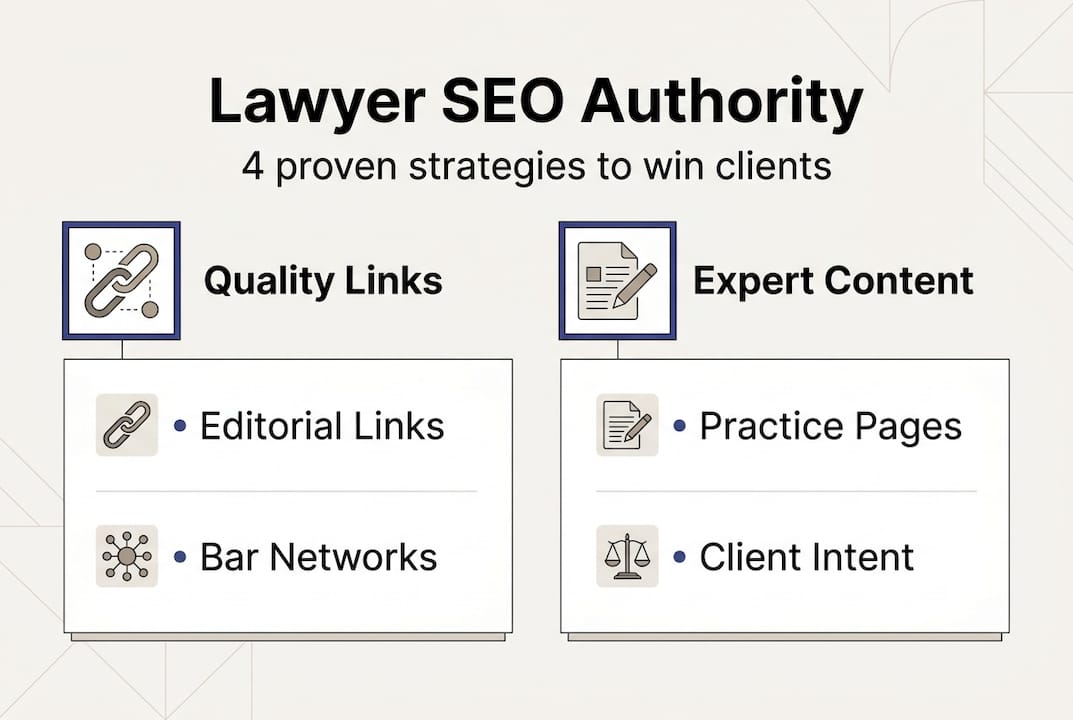
One well-placed link from a state bar website or a respected legal news outlet carries more weight than fifty links from generic directories. As noted in quality legal link building research, link building methodologies for law firms must prioritize quality over quantity, with Tier 1 editorial links from media and .gov sources at the top, followed by Tier 2 local links from chambers and regional news, and Tier 3 directories at the bottom. Spammy links create YMYL risks and potential bar ethics violations.
“A single authoritative citation from a credible legal source does more for your rankings than a hundred links from sites Google already distrusts.”
This is the core principle that separates firms that grow their authority from firms that spin their wheels.
How to earn high-authority links in the legal industry
Now that you know what establishes authority, let’s break down the strategies that deliver real ranking power and which ones can put your reputation at risk.
Not all backlinks are equal. Here is how link types compare in value for law firm SEO:
| Link type | Source examples | Authority value | Risk level |
|---|---|---|---|
| Tier 1 editorial | Legal journals, .gov, news media | Very high | Very low |
| Tier 2 local | Bar associations, chambers, local news | High | Low |
| Tier 3 directories | Avvo, Justia, FindLaw | Moderate | Low to moderate |
| Purchased/spammy | Link farms, irrelevant blogs | None to negative | Very high |
To earn Tier 1 and Tier 2 links, follow a structured process:
- Join and contribute to bar associations. Most state and local bar associations publish member directories, newsletters, and event recaps. Active participation earns natural links.
- Pitch expert commentary to legal publications. Outlets like Law360, Above the Law, and regional legal journals regularly feature attorney insights. A well-placed quote or byline earns an editorial link.
- Offer data or case studies to journalists. Reporters covering legal trends need credible sources. Position your firm as one.
- Sponsor or speak at community events. Local news often covers these events, and sponsor pages frequently include links.
- Build relationships with complementary professionals. CPAs, financial advisors, and real estate agents often link to trusted legal partners on their resource pages.
As professional legal backlinks data confirms, authority earned through professional channels converts better than generic SEO tactics, and agencies promising quick rankings through volume are a warning sign, not a solution.
Pro Tip: Review the link building workflow designed specifically for law firms before approaching any outreach campaign. Having a repeatable process dramatically increases your success rate and keeps your efforts bar-compliant.
For a curated list of vetted sources, the best legal link building services guide provides a ranked breakdown of which outreach strategies deliver the strongest ROI for attorneys.
Practice-specific content: Outranking with expertise and intent
Earning the right links is crucial, but even the best backlinks won’t deliver results without laser-focused, relevant content.

Generic legal content is everywhere. Articles titled “What is personal injury law?” or “How does divorce work?” are published by thousands of firms, and most of them rank for nothing. The firms that break through write content that matches exactly what their ideal client is searching for at the moment they need help.
Client intent falls into several categories: informational (“how does child custody work in Texas?”), navigational (“best DUI attorney near me”), and transactional (“hire a personal injury lawyer in Chicago”). Each type requires a different content approach.
Here is how generic content compares to intent-driven content:
| Content type | Example | Search match | Conversion potential |
|---|---|---|---|
| Generic | “What is estate planning?” | Broad, competitive | Low |
| Intent-driven | “How to update your will after divorce in Florida” | Specific, lower competition | High |
| Location-specific | “Wrongful termination lawyer in Austin, TX” | Geo-targeted | Very high |
| FAQ-style | “Can I sue my employer for unpaid overtime in California?” | Question-based queries | High |
The key elements of high-converting legal content include:
- Specific practice area focus rather than broad legal overviews
- Local jurisdiction references that signal geographic relevance
- Clear calls to action that guide readers toward a consultation
- Attorney attribution with credentials to satisfy YMYL standards
- Structured headers and FAQ sections that target featured snippets
As SEO content for lawyers analysis shows, content specificity tied to client intent consistently outperforms mass posting strategies for both rankings and trust. Quality wins over quantity every time.
Pro Tip: Use the legal SEO strategies framework to audit your existing content. Identify pages that target broad terms and rewrite them with specific intent, jurisdiction, and structured data. You will often see ranking improvements within 60 to 90 days.
For multi-location firms, create separate, fully developed practice area pages for each office location. Do not duplicate content across locations. Each page should reference local courts, judges, statutes, and community context to signal genuine local expertise.
Future-proofing: AI, GEO, ethical compliance, and long-term ROI
Just as specifics win today’s rankings, preparing for where SEO is headed ensures your authority stands the test of time.
Search is no longer just ten blue links. AI-powered overviews from Google, Bing Copilot, and tools like ChatGPT are increasingly becoming the first point of contact between a potential client and legal information. If your firm is not structured to appear in these AI-generated responses, you are invisible to a growing segment of searchers.
Generative Engine Optimization (GEO) is the practice of structuring your content and technical setup so that AI systems recognize and cite your firm as a trusted source. This requires a different approach than traditional SEO.
To optimize for AI and GEO search, follow these steps:
- Implement schema markup for your firm’s name, address, practice areas, attorney bios, and reviews.
- Build topical authority by covering every major question within your practice area, not just the most popular ones.
- Establish entity trust by ensuring your firm appears consistently across Google Business Profile, legal directories, and social platforms.
- Optimize for geographic precision using location-specific content and local citation consistency.
- Earn citations from authoritative sources that AI systems are trained to trust, including bar associations and legal publications.
According to AI in legal SEO research, law firms should expect a 6 to 12 month timeline before seeing meaningful ROI from authority-building efforts, with significant growth often taking up to 24 months. Patience combined with consistent execution is the formula.
The SEO platforms for lawyers comparison tool can help you identify which technical platforms best support schema implementation and AI-readiness for your firm’s size and practice mix.
“Firms that invest in structured data, entity trust, and geographic precision today are building the infrastructure that AI-driven search will reward for years to come.”
Bar ethical compliance remains non-negotiable throughout this evolution. AI-generated content must be reviewed by licensed attorneys before publication. Automated review solicitation tools must comply with your state’s advertising rules. The firms that grow sustainably are those that treat ethics as a feature, not a constraint.
For a deeper look at how GEO for law firms works in practice, Clio’s research provides a strong starting point for understanding geographic entity optimization.
Why most lawyers stall at ‘authority’ and how to beat the status quo
With a clear view of what the future holds, let’s cut through the noise and get real about what separates lasting authority from wasted SEO spend.
Most law firms plateau for the same reason. They watch a competitor rank well, copy their blog topics, match their posting frequency, and wonder why nothing changes. The answer is that you cannot copy your way to authority. Authority is earned through genuine expertise, real relationships, and consistent delivery of value that search engines can verify.
Buying links feels like a shortcut. It is actually a liability. A single manual penalty from Google for unnatural links can erase years of ranking gains overnight. The firms that recover from these penalties spend far more time and money than they would have if they had built authority correctly from the start.
The uncomfortable truth is that legal SEO explained properly is not a one-time project. It is an ongoing investment in your firm’s credibility, both online and in your community. The attorneys who win long-term are those who treat SEO as an extension of their professional reputation, not a separate marketing checkbox.
Reinvest regularly. Stay curious about algorithm changes. And resist the temptation to chase quick wins that compromise the trust you have worked to build.
Move from theory to action: Accelerate your law firm’s authority
Ready to turn advanced strategies into measurable authority and more engaged clients? LawSEO.com specializes exclusively in legal SEO, meaning every strategy we develop is built for the unique competitive and ethical landscape attorneys face. Start by reviewing the legal SEO strategies guide to identify your highest-impact opportunities. Then request a professional SEO audit for attorneys to get a clear picture of where your firm stands today. When you are ready to move forward with a dedicated partner, explore all of our law firm SEO solutions to find the right fit for your goals and budget.
Frequently asked questions
How long does it take to see results from authority building for lawyers?
Most law firms begin seeing measurable SEO results in 6 to 12 months, with significant authority gains often taking up to 24 months depending on competition and starting baseline.
What are the safest link building strategies for law firms?
Focus on Tier 1 and Tier 2 links from editorial sources, bar associations, and professional networks, and avoid mass directories or purchased links that create YMYL and ethics risks.
Why is content specificity important for law firm SEO authority?
Content written for specific practice areas and client intent builds stronger topical authority and ranking potential than generic SEO content, which rarely differentiates a firm in competitive markets.
Will AI and GEO search changes impact legal authority building?
Yes. Optimizing for structured data, entity trust, and geographic precision is now essential, as GEO for law firms becomes a primary driver of visibility in AI-generated search responses.