

Law firms competing for visibility in 2026 face a persistent challenge: without high-quality backlinks, even the best legal websites struggle to rank. While competitors secure placements on authoritative legal sites, many attorneys watch their online presence stagnate. This guide delivers a proven workflow that transforms link building from a frustrating mystery into a systematic process that drives rankings, builds client trust, and attracts qualified leads to your practice.

Table of Contents
- Understanding The Importance Of Link Building For Law Firms
- Preparing Your Lawyer Link Building Workflow: Tools And Prerequisites
- Executing The Lawyer Link Building Workflow: Step-By-Step Process
- Verifying And Optimizing Your Link Building Results
- Advance Your Law Firm’s SEO With Expert Support
- Frequently Asked Questions
Key takeaways
| Point | Details |
|——-|———||
| Authoritative backlinks boost rankings | Links from reputable legal sites signal trust to search engines and elevate your firm’s visibility. |
| Local links drive local clients | Directory citations and community backlinks improve prominence in local searches like “personal injury lawyer near me.” |
| Compliance protects your reputation | Ethical link building aligned with state bar rules prevents penalties and maintains professional integrity. |
| Structured workflows deliver results | A systematic approach to outreach, content creation, and tracking produces measurable SEO gains. |
| Real case studies prove effectiveness | Law firms implementing targeted strategies achieve 47.5% increases in booked meetings within months. |
Understanding the importance of link building for law firms
Backlinks function as digital endorsements. When authoritative legal websites link to your firm, Google interprets these connections as quality signals, boosting your credibility in search algorithms. This isn’t abstract theory. High-quality backlinks from relevant sources directly influence where your practice appears when potential clients search for legal help.
The impact extends beyond rankings. Links from established legal directories, bar associations, and respected legal blogs build client confidence before prospects ever contact you. A potential client researching attorneys sees your firm mentioned on trusted platforms and perceives you as more credible than competitors lacking these endorsements.
Local backlinks deserve special attention. Citations from chamber of commerce sites, local news outlets covering your community involvement, and regional legal organizations help you dominate searches in your geographic market. These local signals tell search engines your firm genuinely serves the community, not just a generic national audience.
Legal marketing faces unique constraints that make link building particularly challenging:
- State bar advertising rules regulate how attorneys can solicit attention and present credentials
- Ethical guidelines prohibit certain aggressive marketing tactics common in other industries
- Professional reputation concerns require careful vetting of link sources
- Competitive legal markets make quality link opportunities scarce
Pro Tip: Before launching any link building campaign, review your state bar’s advertising regulations. What works for businesses in other sectors may violate legal ethics rules and jeopardize your license.
The right legal SEO for law firms strategy respects these boundaries while still achieving competitive advantage. You can build authority through legitimate professional channels without compromising ethics or reputation.
Preparing your lawyer link building workflow: tools and prerequisites
Successful link building starts with strategic preparation, not random outreach. Begin by identifying your target practice areas and geographic markets. A family law firm in Austin pursues different link opportunities than a corporate litigation practice serving Fortune 500 clients nationwide.
Conduct thorough competitor analysis to understand the link landscape in your niche. Examine where top-ranking competitors earn their backlinks. Which legal directories list them? What guest posting opportunities have they secured? Which professional associations link to their content? This market and competitor research reveals gaps you can exploit and benchmarks for measuring your progress.
Essential tools for managing your workflow include:
- SEO platforms (Ahrefs, SEMrush, Moz) for analyzing backlink profiles and finding link opportunities
- Outreach software (BuzzStream, Pitchbox) for managing personalized email campaigns at scale
- Spreadsheets or CRM systems for tracking prospects, outreach status, and results
- Content management tools for organizing guest post drafts and thought leadership articles
| Tool Category | Primary Function | Example Platforms |
|---|---|---|
| Backlink Analysis | Identify competitor links and track your profile | Ahrefs, SEMrush, Moz |
| Outreach Management | Automate and track email campaigns | BuzzStream, Pitchbox |
| Directory Research | Find legal and local citation opportunities | Legal directories, local chambers |
| Content Planning | Organize guest posts and resources | Google Docs, Trello |
Compliance considerations must shape your entire strategy. State bar advertising rules vary significantly, with some jurisdictions imposing strict requirements on how attorneys describe their services, credentials, and results. Review these regulations before drafting any outreach emails or guest post pitches.
Set clear, measurable goals aligned with your broader marketing strategy. Rather than vague aims like “get more backlinks,” define specific targets: acquire 15 backlinks from legal directories within 60 days, secure three guest posts on state bar association blogs by quarter end, or increase local citation consistency to 95% across top platforms.
Pro Tip: Use legal marketing checklists to ensure you’ve covered all prerequisite steps before launching outreach. Missing fundamentals like incomplete directory profiles or inconsistent NAP (name, address, phone) data sabotages link building effectiveness.
Document your current baseline metrics. Record your domain authority, existing backlink count, keyword rankings for priority terms, and organic traffic levels. These benchmarks let you measure actual impact as your workflow progresses.
Executing the lawyer link building workflow: step-by-step process
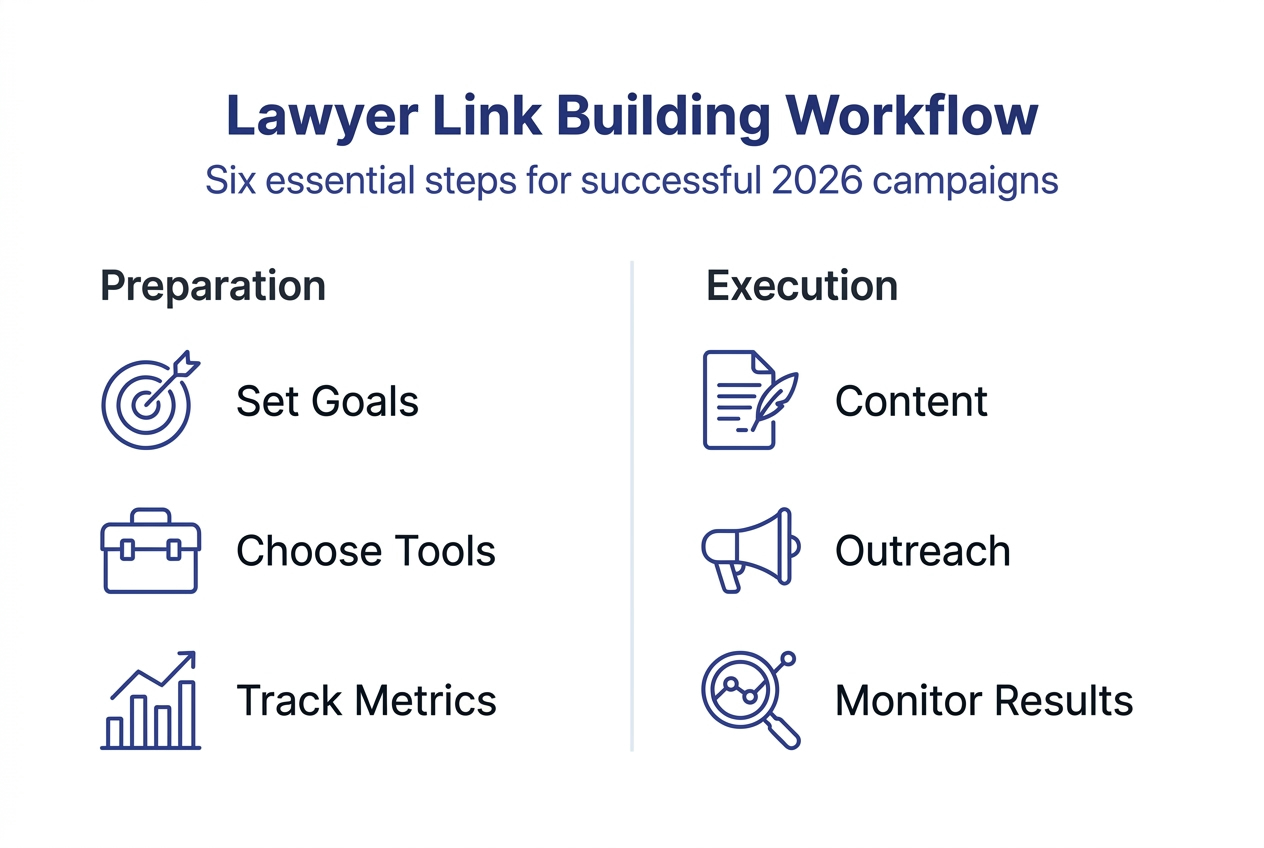
Now implement your link building campaign through systematic execution. Follow this proven sequence for maximum efficiency and results.
1. Claim and optimize legal directory profiles
Start with foundational citations in established legal directories. Platforms like Avvo, Justia, Lawyers.com, and FindLaw provide immediate backlinks while enhancing your visibility to potential clients searching these directories directly. Complete every profile field thoroughly, ensuring NAP consistency across all listings.
2. Develop linkworthy legal content
Create authoritative resources that naturally attract backlinks. Comprehensive guides on complex legal topics, original research on trends affecting your practice area, and detailed case study analyses position you as a thought leader. Courts, academics, journalists, and other attorneys link to genuinely valuable legal resources.

3. Execute personalized outreach campaigns
Identify specific link prospects: legal blogs covering your practice areas, state and local bar associations, law school publications, legal technology sites, and complementary legal practices. Craft personalized pitches explaining why a link or guest post benefits their audience, not just your SEO.
4. Leverage local community connections
Engage your local community strategically. Sponsor charitable events, participate in chamber of commerce activities, volunteer for nonprofit board positions, and contribute expert legal commentary to local news outlets. These genuine community relationships naturally generate backlinks that boost local search prominence.
5. Build professional relationships systematically
Networking produces long-term link opportunities. Collaborate with other attorneys on content projects, participate in legal conference panels, contribute to bar association publications, and engage in online legal communities. Relationships built on mutual value lead to natural link exchanges and referrals.
6. Track acquisition and follow up consistently
Maintain detailed records of every outreach attempt: who you contacted, when, their response, and outcome. Schedule systematic follow-ups for non-responders (typically one week and two weeks after initial contact). Persistence matters, but respect boundaries and avoid spam-like behavior.
| Workflow Stage | Key Actions | Success Metrics |
|---|---|---|
| Directory Submissions | Complete profiles on 10-15 top legal directories | 100% NAP consistency, all fields filled |
| Content Creation | Publish 2-3 authoritative guides monthly | Average 1,500+ words, original insights |
| Outreach | Contact 20-30 prospects weekly with personalized pitches | 15-20% positive response rate |
| Local Engagement | Participate in 2+ community events quarterly | 3-5 local backlinks per quarter |
| Relationship Building | Attend 1-2 legal networking events monthly | 2-3 new professional connections weekly |
Pro Tip: When pitching guest posts, lead with specific article ideas tailored to the target site’s audience. Generic “I’d love to contribute” emails get ignored. Detailed pitches demonstrating you understand their readers’ needs earn responses.
Focus on relevance over volume. One backlink from your state’s bar association journal delivers more SEO value than ten links from random, unrelated blogs. Quality, contextual links from authoritative legal sources drive the rankings and client trust you need.
For firms lacking internal resources, professional legal link building services handle the time-intensive outreach and relationship management while you focus on practicing law. Experienced providers understand legal ethics requirements and have established relationships with key link sources.
Implementing proven strategies for building high-quality backlinks requires patience and consistency. Results compound over time as your backlink profile strengthens and search engines recognize your growing authority.
Verifying and optimizing your link building results
Measurement transforms link building from guesswork into science. Use SEO tools to monitor your backlink profile growth weekly. Track new links acquired, their domain authority, and whether they’re followed or nofollowed. Quality metrics matter more than raw quantity.
Monitor keyword rankings for your priority terms. Are you climbing for “divorce attorney [your city]” or “business litigation lawyer”? Rankings improve gradually as link authority accumulates, typically showing noticeable movement within three to six months of consistent effort.
Analyze organic traffic patterns in Google Analytics. Look for increases in visitors from search engines, longer session durations, and lower bounce rates, all signals that higher-quality traffic finds your site through improved rankings. Filter traffic by landing page to identify which content attracts the most valuable visitors.
Track lead generation metrics directly tied to SEO performance:
- Contact form submissions from organic search traffic
- Phone calls from website visitors (use call tracking)
- Consultation bookings attributed to specific keywords
- Conversion rates for organic traffic versus other channels
Legal marketing achieves higher conversion rates than other channels when properly optimized, making these metrics crucial for ROI assessment. The 47.5% increase in booked meetings achieved by firms implementing structured SEO strategies demonstrates the business impact of effective link building.
Identify and address problematic backlinks proactively. Low-quality or spammy links can harm your rankings. Regular backlink audits reveal toxic links that require disavowal through Google Search Console. Remove or disavow links from link farms, irrelevant foreign language sites, or questionable directories.
Continuously refine your approach based on data. Which outreach tactics yield the highest acceptance rates? What content topics attract the most natural backlinks? Which link sources correlate with the biggest ranking improvements? Let evidence guide your optimization decisions.
Pro Tip: Create a monthly reporting dashboard tracking your key metrics: total backlinks, referring domains, domain authority, keyword rankings, organic traffic, and leads generated. Visual progress tracking maintains motivation and helps identify trends early.
Competitor monitoring remains essential. As you improve, competitors react. Track their new backlinks and identify emerging opportunities before saturation occurs. Proven legal SEO strategies require ongoing adaptation to maintain competitive advantage.
Review your state bar’s advertising guidance periodically. Rules evolve, and maintaining compliance protects your license and reputation. What was acceptable last year may face new restrictions.
Success stories validate your investment. Local SEO case studies show real law firms achieving dramatic visibility improvements through disciplined link building workflows. Your firm can replicate these results through systematic execution and continuous optimization.
Advance your law firm’s SEO with expert support
Mastering link building delivers undeniable benefits, but execution demands significant time, expertise, and persistence. Many law firms find that partnering with specialized professionals accelerates results while ensuring ethical compliance. LawSEO.com offers comprehensive SEO services designed exclusively for attorneys, combining technical expertise with deep understanding of legal marketing regulations. Our team implements proven legal SEO strategies that respect ethical guidelines for attorneys while driving measurable client acquisition. With over 29 years of SEO experience focused solely on law firms, we help practices dominate local search, earn authoritative backlinks, and convert online visibility into booked consultations. Discover how LawSEO.com can transform your firm’s online presence in 2026.
Frequently asked questions
What are the most effective types of backlinks for law firms?
The strongest backlinks come from authoritative legal directories (Avvo, Justia, Martindale-Hubbell), state and local bar associations, legal publications, law school websites, and local community organizations. Guest posts on respected legal blogs and mentions in news articles covering your cases also provide valuable link equity. Prioritize relevance and authority over volume. A single link from your state bar association outweighs dozens from unrelated, low-authority sites.
How can law firms ensure their link building is compliant with ethical standards?
Strictly follow your state bar’s advertising and solicitation rules when building links. Avoid purchasing links, using manipulative anchor text, or making misleading claims about your credentials or case results. Focus on earning links through legitimate professional activities: publishing authoritative content, participating in bar associations, engaging in community service, and building genuine relationships with legal peers. When uncertain about specific tactics, consult your state bar’s ethics hotline. Maintaining compliance through ethical SEO for attorneys protects your license and reputation.
What tools should I use to manage and track my link building workflow?
SEO platforms like Ahrefs, SEMrush, or Moz provide comprehensive backlink analysis, competitor research, and rank tracking capabilities. Outreach tools such as BuzzStream or Pitchbox streamline personalized email campaigns and follow-up sequences. Google Search Console offers free backlink monitoring and disavowal features. Spreadsheets or CRM systems help organize prospects, track outreach status, and measure results. Many firms also use project management tools like Trello or Asana to coordinate content creation and link building tasks. Legal marketing checklists ensure you cover all essential workflow steps systematically.
How long does it take to see results from lawyer link building?
Most law firms notice measurable SEO improvements within three to six months of consistent link building. Some firms achieve top rankings within three months when implementing comprehensive strategies combining link building with content optimization and technical SEO. Search engines need time to crawl new backlinks, evaluate their quality, and adjust rankings accordingly. Early-stage results often include increased indexed pages and minor keyword movement, with substantial ranking gains and traffic increases appearing after sustained effort. Patience and ongoing optimization are essential. Firms that maintain consistent link building see compounding returns as authority accumulates over time.