

Rising above other law firms in Google search results often feels like a race with no clear finish line. As mid-sized American law firms contend with new competitors and smarter search technologies, simply having a website is no longer enough. Understanding competitive analysis in legal SEO empowers your firm to pinpoint exactly where you stand, identify your true rivals, and use that knowledge to shape targeted online strategies that attract qualified clients.
Table of Contents
- Defining Competitive Analysis In Legal SEO
- Main Types Of Legal SEO Competitors
- Key Metrics And Tools For Law Firm Analysis
- Adapting To AI And Local Search Shifts
- Common Mistakes And Ethical Pitfalls To Avoid
Key Takeaways
| Point | Details |
|---|---|
| Competitive Analysis is Essential | Law firms must conduct thorough competitive analysis to understand market positioning and identify differentiation opportunities. |
| Identify Different Competitor Types | Recognizing direct, indirect, and potential market entrants is crucial for effective strategy formulation. |
| Utilize Key Metrics and Tools | Employing analytical tools and tracking key metrics helps measure SEO effectiveness and refine digital marketing strategies. |
| Stay Ethical in SEO Practices | Adhering to ethical standards is vital for maintaining credibility and ensuring compliance with legal advertising regulations. |
Defining Competitive Analysis in Legal SEO
Competitive analysis in legal SEO represents a strategic approach for law firms to understand and outmaneuver their online competitors. At its core, this process involves comprehensive market research to evaluate how other law firms are positioning themselves digitally and identifying opportunities for differentiation.
The strategic framework of legal SEO competitive analysis encompasses several critical dimensions:
- Identifying direct and indirect online competitors in your practice area
- Analyzing competitors’ keyword targeting strategies
- Evaluating search engine ranking performance
- Assessing content quality and engagement metrics
- Understanding local SEO positioning
Successful competitive analysis goes beyond surface-level observations. Legal SEO strategists must dive deep into understanding how competitors are leveraging digital marketing techniques, including emerging AI-driven search optimization strategies. Advanced search optimization techniques now require law firms to consider not just traditional search rankings, but also AI-influenced search behaviors.
Effective competitive analysis provides law firms with actionable insights to refine their digital marketing approach. By systematically examining competitors’ strengths and weaknesses, firms can develop targeted strategies that distinguish their online presence and attract potential clients more effectively.
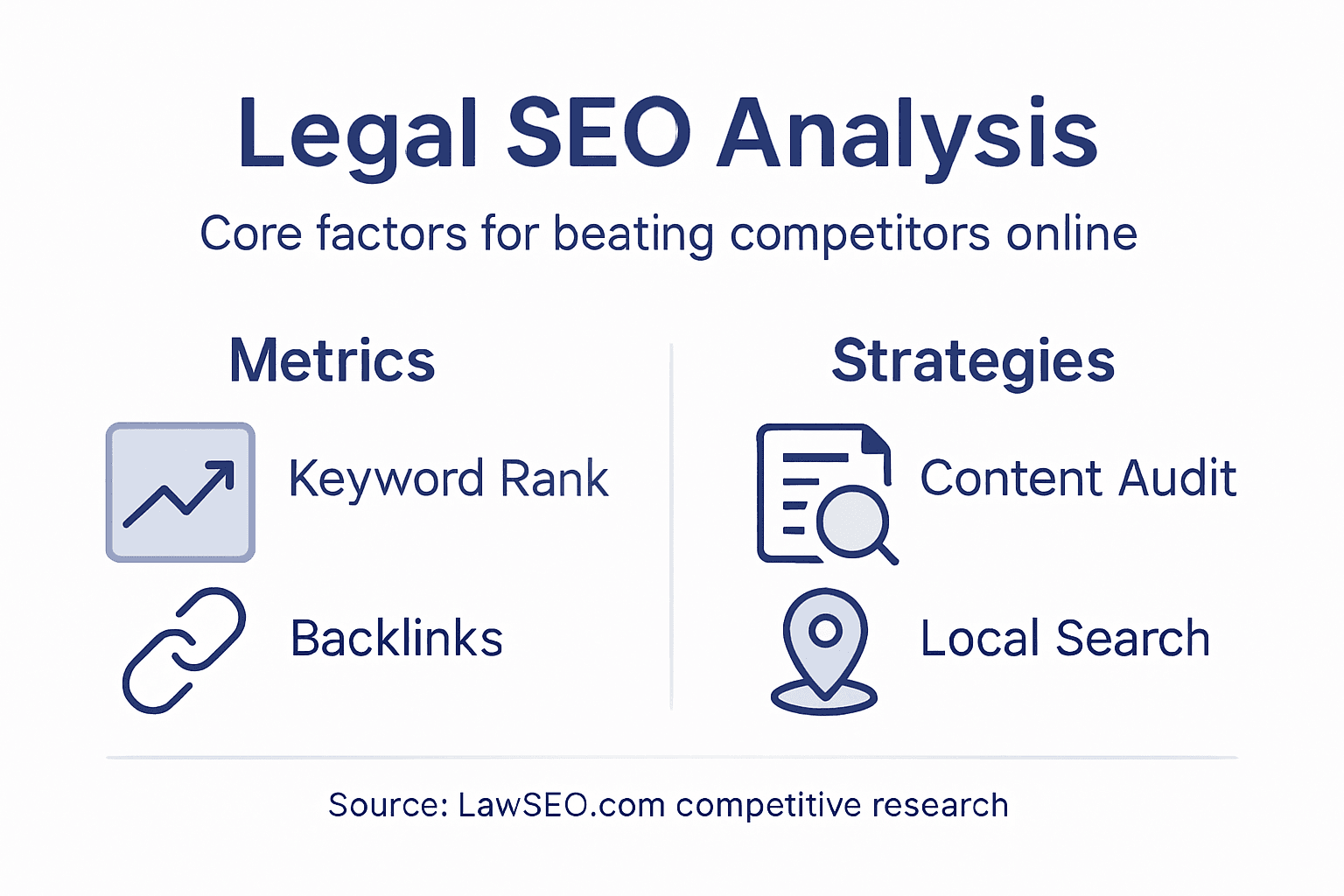
Pro tip: Create a quarterly competitive analysis spreadsheet tracking your top three competitors’ keyword rankings, content publication frequency, and local search visibility to maintain a strategic edge.
Main Types of Legal SEO Competitors
Legal SEO competitors can be strategically categorized into distinct groups that law firms must carefully analyze. Competitor analysis frameworks reveal three primary types of competitors that impact a law firm’s digital marketing strategy: direct, indirect, and potential market entrants.
Direct Competitors represent law firms that:
- Operate in the same geographic region
- Offer identical or very similar practice areas
- Target the same client demographic
- Compete for the same local search keywords
- Serve comparable market segments
Beyond direct competition, Indirect Competitors introduce additional complexity to the digital marketing landscape. Competitive market research reveals these competitors include online legal platforms, legal technology services, and alternative dispute resolution providers that may not traditionally be considered law firms but still capture potential client market share.

Potential market entrants represent the most dynamic category of legal SEO competitors. These emerging players might include technology-driven legal services, national firms expanding into local markets, and innovative platforms offering streamlined legal solutions. Understanding these potential disruptors allows law firms to anticipate and proactively respond to shifting market dynamics.
Pro tip: Conduct a comprehensive quarterly audit of your top five direct and indirect competitors’ online presence, tracking their content strategy, keyword rankings, and client engagement metrics.
Below is a comparison of direct, indirect, and potential market entrant competitors in legal SEO:
| Competitor Type | Key Risk to Law Firm | Strategic Advantage | How to Monitor |
|---|---|---|---|
| Direct Competitor | Loss of local clients | Benchmark similar services | Track local rankings |
| Indirect Competitor | Erosion of market share | Adapt new tech solutions | Analyze platform trends |
| Potential Market Entrant | Disruption of pricing models | Early service innovation | Watch industry news |
Key Metrics and Tools for Law Firm Analysis
Legal SEO performance metrics provide critical insights into a law firm’s digital marketing effectiveness. Understanding these metrics requires a comprehensive approach that goes beyond traditional marketing analytics, focusing specifically on the unique challenges of legal digital marketing.
Key performance metrics for law firm SEO include:
- Organic search rankings
- Keyword performance
- Website traffic sources
- Backlink quality and quantity
- Conversion rates from online leads
- Local search visibility
- Click-through rates for practice area pages
Analytical Tools play a crucial role in capturing and interpreting these metrics. Competitive analysis platforms offer law firms sophisticated ways to track and benchmark their online performance. These tools typically provide detailed insights into search engine rankings, audience engagement, and competitive positioning.
Advanced legal SEO analysis requires a multi-dimensional approach. Law firms must leverage specialized tools that can track performance across different search platforms, including traditional Google rankings and emerging AI-driven search environments. This comprehensive approach allows firms to adapt their digital marketing strategies dynamically and stay ahead of competitive trends.
Pro tip: Create a dashboard that consolidates key SEO metrics from multiple tools, allowing for quick visual comparison of your firm’s online performance against primary competitors.
Here is a summary of popular legal SEO analytical tools and their primary focus:
| Tool Name | Primary Function | Best For |
|---|---|---|
| SEMrush | Competitive keyword research | Tracking rival keyword shifts |
| Ahrefs | Backlink profile analysis | Monitoring link quality |
| Google Analytics | Traffic source insights | Understanding user behavior |
| Moz | Local search tracking | Improving local SEO presence |
Adapting to AI and Local Search Shifts
Legal SEO strategies must evolve rapidly to address the transformative impact of artificial intelligence on search technologies. The traditional approach of keyword optimization has given way to more sophisticated, context-aware search algorithms that demand a nuanced understanding of user intent and local search dynamics.
Key strategic considerations for law firms include:
- Optimizing for semantic search and natural language queries
- Developing AI-friendly content structures
- Enhancing local search visibility
- Implementing structured data markup
- Creating location-specific content
- Managing Google My Business profiles
- Generating authentic local reviews
Technical SEO adaptation requires a multifaceted approach. Local search optimization techniques now demand precise location-based keyword integration and maintaining accurate, comprehensive local business listings. Law firms must go beyond traditional SEO tactics, understanding that AI-driven search platforms prioritize contextually relevant, geographically precise content.
The emerging search landscape rewards law firms that can demonstrate deep local expertise through sophisticated, AI-compatible content strategies. This means creating hyperlocal content that speaks directly to community-specific legal needs, leveraging advanced schema markup, and developing rich, multimedia content that AI algorithms can easily interpret and rank.
Pro tip: Conduct monthly audits of your local search presence, tracking changes in AI-driven search results and adjusting your content strategy to maintain competitive visibility.
Common Mistakes and Ethical Pitfalls to Avoid
Competitive analysis in legal marketing requires law firms to navigate a complex landscape of ethical considerations and strategic challenges. Understanding the potential mistakes and professional risks is crucial for maintaining both legal credibility and digital marketing effectiveness.
Common ethical pitfalls in legal SEO include:
- Keyword stuffing and manipulative content techniques
- Creating misleading or deceptive advertising claims
- Purchasing low-quality backlinks
- Misrepresenting professional credentials
- Violating client confidentiality in marketing materials
- Engaging in comparative advertising without substantiation
- Neglecting transparency in marketing communications
Black-hat SEO techniques represent significant risks for law firms. Ethical marketing practices demand strict adherence to professional conduct rules and transparent marketing strategies. Firms must recognize that search engine algorithms increasingly prioritize authentic, high-quality content over manipulative optimization tactics.
Maintaining professional integrity requires a comprehensive approach to digital marketing that balances aggressive growth strategies with ethical standards. Law firms must develop robust internal review processes to ensure all digital marketing efforts comply with legal advertising regulations and maintain the highest standards of professional conduct.
Pro tip: Create a comprehensive ethics checklist for digital marketing that includes regular reviews of website content, advertising claims, and SEO strategies to ensure ongoing compliance with professional standards.
Gain a Competitive Edge in Legal SEO with Expert Guidance
Understanding the complex challenges of competitive analysis in legal SEO is essential for any law firm aiming to stand out online. If you are struggling with tracking direct and indirect competitors, managing AI-driven search changes, or improving your local search visibility, you are not alone. Mastering these key areas can transform your online presence and drive more client leads.
At LawSEO.com, we specialize exclusively in legal marketing with a deep understanding of ethics and competitive dynamics unique to law firms. Our founder-led strategies ensure personalized attention to your practice’s needs, including advanced AI optimization and comprehensive local SEO that aligns perfectly with the evolving search landscape. Let us help you turn insights from competitive analysis into powerful actions with proven techniques like targeted content creation, backlink strategies, and smart paid advertising.
Ready to outshine your competitors and dominate your local market? Visit LawSEO.com now to discover how our tailored services can help you attract new clients faster and maintain your digital leadership. Don’t wait for your competition to take the lead. Start your transformation today by exploring our full suite of solutions and gain the advantage you deserve.
Frequently Asked Questions
What is competitive analysis in legal SEO?
Competitive analysis in legal SEO involves a strategic process to evaluate how law firms position themselves online against competitors, identifying opportunities for differentiation in the digital landscape.
Why is understanding direct and indirect competitors important for law firms?
Identifying both direct and indirect competitors helps law firms understand the broader competition landscape, allowing them to tailor their digital marketing strategies effectively to attract and retain clients.
What key metrics should law firms focus on during competitive analysis?
Law firms should focus on metrics such as organic search rankings, keyword performance, website traffic sources, backlink quality, conversion rates, local search visibility, and click-through rates to gauge their online presence and effectiveness.
How can law firms adapt to AI-driven search technologies?
Law firms can adapt to AI-driven search technologies by optimizing for semantic search, developing AI-friendly content structures, enhancing local visibility, and creating detailed location-specific content that aligns with user intent.